Sales Automation
•
K3X vs Pipedrive: AI-Native CRM vs Pipeline CRM
K3X automates sales end-to-end for scaling teams; Pipedrive offers manual, visual pipeline control for small, hands-on sales teams.

K3X and Pipedrive offer two distinct CRM approaches in 2026: K3X automates tasks based on user goals, while Pipedrive relies on manual, visual pipeline management. K3X's AI-driven platform eliminates manual work by acting on prompts, making it ideal for scaling teams focused on outcomes. In contrast, Pipedrive's activity-based model suits smaller teams needing hands-on control and visual deal tracking.
For teams prioritizing automation and reduced admin workload, K3X ($20/seat/month) is a better fit, offering built-in tools like email, SMS, and a Power Dialer. Pipedrive ($14–$59/seat/month) works well for those who prefer manual workflows but requires add-ons for advanced features, increasing costs significantly.
Why Pipedrive is a BAD CRM for Your Business? (Even in 2026)

Core Approach: AI-Native CRM vs Pipeline CRM
K3X and Pipedrive take fundamentally different approaches to managing sales operations, reflecting distinct priorities in the modern, AI-driven sales environment. K3X focuses on achieving specific outcomes, asking users, "What result do you want?" In contrast, Pipedrive emphasizes activity tracking, with the guiding question, "What did your rep do today?" These philosophies influence everything from deal progression to the level of manual effort required.
K3X: Prompt-to-Action Model
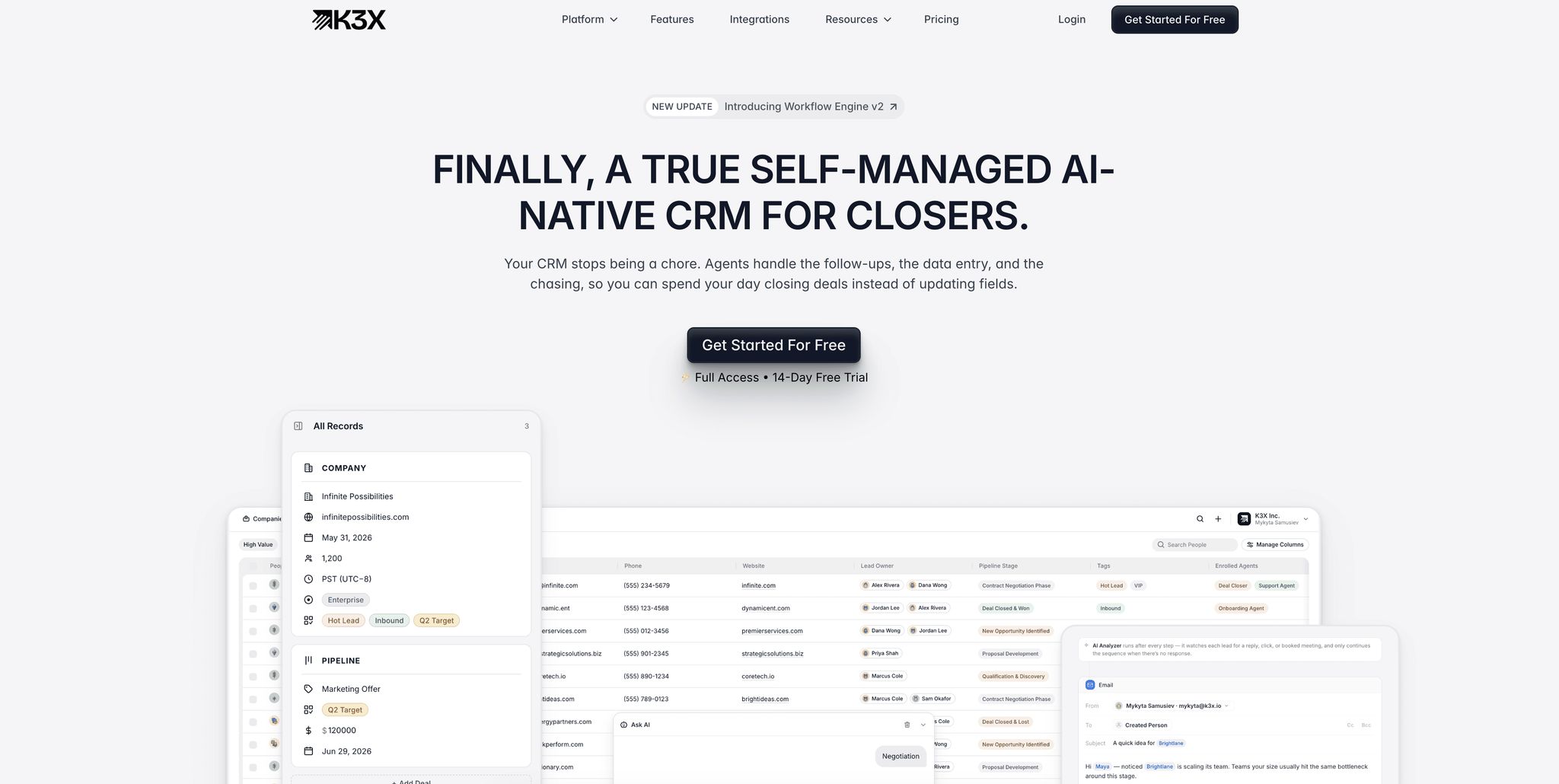
K3X operates based on user intent. Instead of creating detailed workflows, setting triggers, or mapping sequences, users simply describe their goal in plain language. For example, you could say, "Book demo calls with every lead who hasn't responded in five days", and K3X’s AI agents handle the rest. The system automates follow-ups, updates pipeline stages, logs data, and routes deals. It even adjusts dynamically when leads respond unpredictably or skip steps.
As CEO Mykyta Samusiev explains:
"We're building a CRM that works the way people expect it to, not through menus, workflows, or complexity, but through intention. You tell it the outcome. The system figures out the work." [1]
This approach delivers measurable results. K3X users report saving an average of 8 hours per week on tasks like follow-ups and data entry. Across its customer base, the platform has automated over 312,000 hours and cut operational costs by $12.4 million [1].
While K3X automates tasks from start to finish, Pipedrive depends on sales reps to drive progress manually.
Pipedrive: Visual Pipeline and Deal Management
Pipedrive is built around an activity-based selling model. Its drag-and-drop Kanban board gives sales teams a clear, visual representation of every deal in the pipeline. Setup is straightforward - small teams can configure stages, fields, and basic automations in less than a day.
In July 2025, Pipedrive introduced Pulse AI, which provides lead scoring and next-action recommendations to help sales reps prioritize tasks. However, Pulse AI only suggests actions; reps must manually move deals, log activities, and schedule follow-ups. The platform also includes "deal rotting" alerts to highlight stalled opportunities, but addressing these alerts remains the rep's responsibility [3].
This system works well for teams that prioritize hands-on relationship management and value visual accountability. However, as deal volumes grow or workflows become more complex, the manual workload can increase significantly. These differences highlight the distinct priorities of K3X and Pipedrive in modern sales processes.
How K3X and Pipedrive Compare to Legacy CRMs
Both K3X and Pipedrive offer faster deployment compared to legacy CRMs. Platforms like Salesforce and HubSpot often require months of implementation and ongoing administrative support. For example, HubSpot's Professional tier costs approximately $800–$900/month for 10 users, includes a $1,500 onboarding fee, and demands 8–15 hours of admin work per week for a 20-person team to maintain [4]. In comparison, Pipedrive reduces admin time to about 1–3 hours per week [4], while K3X aims to eliminate it entirely through automation.
The table below highlights key differences between the platforms:
Feature | K3X | Pipedrive | Salesforce / HubSpot |
|---|---|---|---|
Core Logic | Outcome-based (prompts) | Activity-based (visual boards) | Process-based (relational data) |
Setup | Natural language prompts | Manual stage/rule definition | Complex admin configuration |
Entry | Fully autonomous | Manual logging and syncing | Manual/high admin overhead |
Implementation Time | Under 1 hour | Under 1 day | 2–3 months |
Starting Price | $20/seat/month | $14/seat/month | $165+/seat/month |
Primary User | Revenue teams, closers | SMB sales reps | Enterprise/RevOps teams |
K3X shifts administrative tasks to its automated system, unlike legacy CRMs where, as Abhishek Singla, Founder of ZielLab, noted, "the RevOps labor cost is 5–6x larger than the software cost difference" [4]. These operational differences illustrate how each platform caters to distinct sales team needs, making them suitable for different business scenarios.
Features and Automation
K3X and Pipedrive differ significantly in how they handle tasks after a lead enters the system. The key distinction lies in how much work is automated versus how much remains manual.
Sales Workflow Automation
K3X employs an outcome-driven approach. Users specify desired outcomes, such as "Follow up with every lead who opened my email but didn't reply", and the AI handles the execution. It adapts dynamically, even when leads respond unexpectedly or skip steps, eliminating the need for configuring if/then rules or building flowcharts. This philosophy sets K3X apart from traditional systems.
Pipedrive, on the other hand, follows a rule-based, linear model. Users define specific triggers and actions in a fixed sequence, requiring sales reps to manually advance deals. While Pipedrive introduced Pulse AI in July 2025, which offers lead scoring and next-step coaching, it doesn’t automate execution - reps must act on its recommendations.
The difference in automation has a tangible impact. K3X users report saving an average of 8 hours per week per employee on follow-ups and data entry alone [1]. Broader industry trends also show that companies using AI-enabled sales platforms in 2026 achieved 30% higher win rates and 25% faster deal cycles compared to those without [2].
This automation extends beyond follow-ups, addressing data management as well.
Data Capture and Enrichment
Manual data entry is a significant time sink, with sales teams spending over 20 hours per week on it when advanced automation is lacking [1]. K3X eliminates this entirely by automating calls, emails, and contact updates, freeing up time for more strategic tasks.
Pipedrive requires a more hands-on approach. Sales reps must update deal fields and log activities manually, aligning with its "good hygiene" philosophy. Data enrichment is only available through the Ultimate tier ($79/seat/month) or the LeadBooster add-on ($32.50/month) [6]. Pulse AI automates some activity logging on Advanced and higher plans, but manual updates to deal stages remain a core part of Pipedrive's workflow.
A real-world example of K3X’s impact comes from Ruby Capital Group, a 125-person funding company. After implementing K3X’s AI agents in December 2025, the company reduced time spent on follow-ups by 70% within two days. CEO Michael Chkechkov shared:
"Our sales team was spending half their day on admin work. Now they're talking to customers and closing deals. The automation handles everything from lead qualification to contract routing." [1]
Beyond data management, effective communication tools are crucial for sales efficiency.
Communication and Collaboration Tools
K3X offers a comprehensive communication suite in its base $20/seat/month plan [1]. This includes built-in email, calling, SMS, and a one-click Power Dialer with unlimited call recordings - no add-ons required.
Pipedrive’s base plans are more limited. While email sync and tracking are included, the Pipedrive Dialer is a paid add-on costing $14–$22/month per user. SMS requires third-party integrations, and email sequences are only available on the Advanced tier or higher [5]. Additionally, the Campaigns add-on for email marketing costs $13.33/month [6]. For a 10-person team requiring calling and email sequences, these add-ons can increase Pipedrive’s monthly cost by 30–50% beyond the base subscription price [6].
Feature | K3X | Pipedrive |
|---|---|---|
Automation Logic | Outcome-based (prompt-to-action) | Rule-based (if/then sequences) |
Data Entry | Fully automated via AI | Primarily manual; AI assists on higher tiers |
Enrichment | Autonomous AI agents | LeadBooster add-on or Ultimate tier |
Calling/Dialer | Native Power Dialer included | Paid add-on ($14–$22/mo) |
SMS | Built-in natively | Requires third-party integration |
Email Sequences | Included in base plan | Advanced tier or add-on required |
AI Role | Executes autonomously | Suggests next steps (coaching) |
For teams seeking a complete communication solution without piecing together multiple tools, K3X provides an all-in-one setup. Pipedrive, while straightforward and visually intuitive, requires additional tools and costs for more advanced capabilities beyond basic pipeline management.
Pricing and Total Cost of Ownership
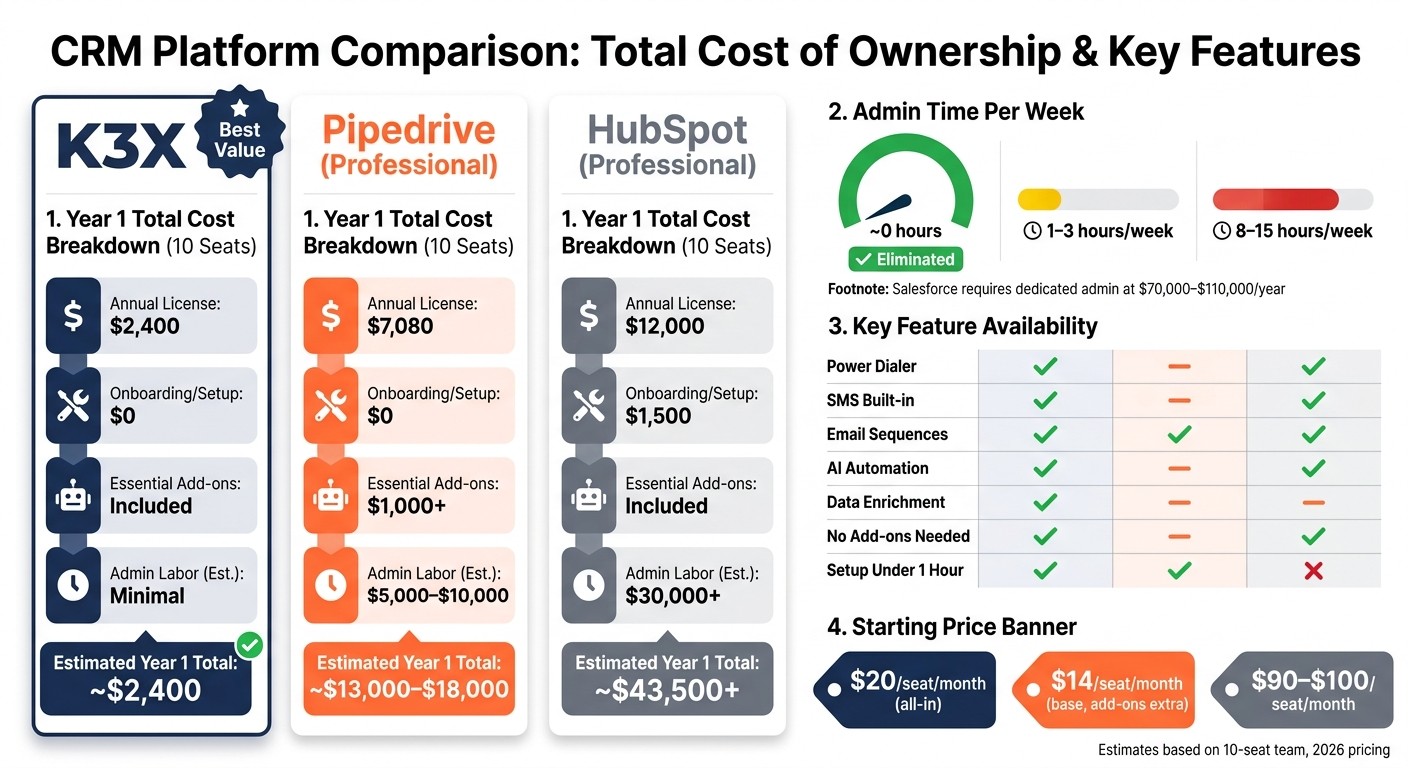
K3X vs Pipedrive vs Legacy CRMs: Total Cost & Feature Comparison 2026
Pricing varies widely across CRM platforms, not just in subscription costs but also when factoring in additional features, setup, and administrative expenses. These differences highlight K3X's simplified, automated pricing model compared to Pipedrive's tiered structure with multiple add-ons.
Pricing Plans and Models
K3X offers a straightforward Adaptive Pay As You Go plan at $20/seat/month. This flat rate includes essential tools like a Power Dialer, unlimited call recordings, built-in SMS, unlimited automations, and 1,000 AI credits monthly. Costs adjust based on usage, and there are no long-term contracts [1].
Pipedrive, on the other hand, uses a tiered pricing system. Its Lite tier starts at $14/seat/month, but features like email sync and workflow automation only become available at the Growth tier for $39/seat/month and the Professional tier for $59/seat/month. AI capabilities require an additional $20/seat/month [7].
Add-ons significantly increase Pipedrive's costs, with tools like LeadBooster priced at $32.50/month and Campaigns at $13.33/month [6]. In contrast, K3X includes these features in its base plan.
Cost Component | K3X | Pipedrive (Professional) | HubSpot (Professional) |
|---|---|---|---|
Annual License (10 seats) | $2,400 | $7,080 | $12,000 |
Onboarding/Setup | $0 | $0 | $1,500 |
Essential Add-ons | Included | $1,000+ (LeadBooster, Campaigns) | Included |
Admin Labor (Est.) | Minimal | $5,000–$10,000 | $30,000+ |
Estimated Year 1 Total | ~$2,400 | ~$13,000–$18,000 | ~$43,500+ |
Subscription fees are just part of the picture - administrative overhead can be a major expense.
Admin Overhead and Hidden Costs
Administrative work adds up quickly with many CRMs. For example, a 20-person team using Pipedrive typically spends 1–3 hours per week on admin tasks. Platforms like HubSpot demand even more time, with 8–15 hours per week, while Salesforce often requires a dedicated certified administrator, costing $70,000–$110,000 per year [4].
K3X minimizes these costs with its prompt-driven functionality. Sales managers can adjust workflows directly without needing IT support or complex automation setups, reducing admin time and eliminating the need for lengthy migrations [1]. Mykyta Samusiev, Co-Founder & CEO of K3X, explains:
"K3X is the first CRM that runs on prompts. You tell it the outcome. The system figures out the work." [1]
While Pipedrive's Lite tier may seem affordable for smaller teams, businesses requiring robust outbound capabilities, AI tools, and built-in automation will likely find K3X's $20/seat plan more cost-effective in the long run.
Use Cases and How to Choose
Select K3X if you need a system that takes action automatically, or Pipedrive if you prefer a tool that records and visually organizes sales activities.
When to Choose K3X
K3X works best for teams focused on revenue growth but bogged down by administrative tasks. If your sales reps spend more time logging calls or chasing follow-ups than closing deals, K3X eliminates that inefficiency with its action-driven model. All you need to do is set a goal - like "re-engage cold leads from Q1" - and the AI takes care of outreach, data updates, and pipeline adjustments without manual input [1].
This platform is also ideal for teams aiming to scale revenue without hiring additional staff. Its AI credits grow with your workload, making it possible for a mid-sized SaaS company, for example, to automate lead qualification, follow-ups, and pipeline management across hundreds of deals simultaneously. K3X is built to focus on outcomes, not just tasks, and it acts on what needs to happen next [1].
When to Choose Pipedrive
Pipedrive is a great choice for smaller sales teams (1–15 reps) that prefer a hands-on, visual way of managing deals [3]. Its Kanban-style pipeline is intuitive, helping reps get up to speed quickly. Features like deal "rotting" alerts allow managers to identify and address stalled opportunities. However, as team sizes grow beyond 40–50 users, its reporting and automation capabilities may feel restrictive [4].
When to Consider Other CRMs
If neither K3X nor Pipedrive fully meets your needs, there are other CRM platforms worth exploring. For example:
HubSpot's Sales Hub Professional: At $90–$100 per seat per month, this platform combines email marketing, landing pages, and service ticketing, making it a good option for teams needing both marketing and sales tools in one place [8].
Salesforce: The go-to choice for enterprises with 100+ employees, offering custom objects, territory management, and robust RevOps support [9].
Close: Priced at $49 per seat per month, it’s designed for high-velocity outbound teams with features like a built-in power dialer and SMS [5].
Zohoormonday.com: Both are budget-friendly options offering a broad range of features without requiring a high financial commitment.
Team Profile | Recommended Platform |
|---|---|
High lead volume, outcome-focused automation | K3X |
Small B2B team, visual pipeline management | Pipedrive |
Unified marketing + sales stack | HubSpot |
Enterprise with dedicated RevOps | Salesforce |
High-velocity outbound with native dialer | Close |
Ultimately, the best CRM is the one your team will use consistently [10]. K3X prioritizes automation to reduce manual management, while Pipedrive emphasizes a visual, hands-on approach. Each serves a distinct operational style, so the choice depends on your team's priorities.
FAQs
How hard is it to switch from a pipeline CRM to an AI-native CRM?
Switching from a pipeline-focused CRM like Pipedrive to an AI-driven CRM such as K3X requires more adjustment in workflows than technical setup. K3X offers a quick setup process, allowing users to integrate their existing tools and start operating in less than an hour. The real challenge lies in transitioning from manual tasks to automation powered by AI. A well-structured 30-day plan is key, focusing on simplifying workflows and training teams to use AI prompts efficiently.
What tasks can K3X automate end-to-end without manual steps?
K3X simplifies and streamlines sales operations by prioritizing prompts and outcomes over fixed rules. Its main functions cover a wide range of essential tasks:
Lead management: Handles stage transitions, assigns owners intelligently, and distributes leads efficiently.
Data entry: Automates tasks like logging emails, recording calls, and keeping contact records up to date.
Sales execution: Provides instant responses, automates sequencing, and sets follow-up reminders to keep deals moving forward.
Workflow adjustments: Adapts processes in real time based on changing goals, eliminating the need for manual updates.
What’s the real total cost after add-ons and admin time?
The overall cost of a CRM goes beyond just the base subscription price. You also need to account for AI features, onboarding expenses, and administrative labor. K3X offers straightforward pricing at $20 per seat per month with no long-term commitments. On the other hand, HubSpot's onboarding fees begin at $1,500, with administrative labor potentially costing up to $36,000 annually for a team of 20. Pipedrive requires less administrative effort but charges $19–$22 per seat per month for essential add-ons.