Sales Automation
•
What Is an Agentic CRM? AI Agents That Run Your Pipeline
Agentic CRMs run pipeline work end-to-end with AI agents that plan, act, observe, and adapt — not just recommend next steps.

An agentic CRM is a CRM with AI agents that do pipeline work on their own, not just suggest it. It can set a goal, plan steps, use tools like email, SMS, calling, and calendar booking, check outcomes, and change the next step without waiting for a person each time.
My short take: the line is execution. If the system can send messages, log activity, move deals, and keep follow-up going by itself, it is agentic; if it only drafts or recommends, it is assistive.
CRM Applications Reimagined with AI and Agentic Capabilities
What does “agentic” mean in a CRM?
It means the CRM is built to act toward an outcome. I’d reduce it to one loop: goal → plan → act → observe → adjust.
That is different from a chatbot or copilot. A chatbot answers one prompt and stops. A copilot may draft an email and wait. An agentic CRM can take a goal like “follow up with every inbound lead within 5 minutes until they book or decline” and run that process across tools with limited human input.
The core parts are simple:
Goal: the user gives an outcome
Plan: the system picks the next steps
Tool use: it sends email, texts, books meetings, logs calls, and updates records
Feedback loop: it checks replies, opens, clicks, stage changes, and call results, then changes course
That loop is the point. The CRM is no longer just a database with reminders.
How does an agentic CRM work day to day?
It reads pipeline data, decides what to do next, takes the action, then checks what happened. I’d think of it as a system that works from live signals instead of fixed branches alone.
In practice, the agent pulls from contact records, email threads, call transcripts, calendar events, and deal stage data. Then it chooses a next action: send an email, try SMS, place a call, book time, or move the deal.
After that, it watches the result. If a lead opens but does not reply, it may wait, switch channels, or change timing based on prior response patterns. The workflow does not end after one touch.
That matters because sales reps spend only 28% of their week selling, with the rest going to admin and data entry, according to Salesforce research cited in the article. Gartner also reports 25 hours per week on work that could be delegated, automated, or simplified.
What does this look like in the pipeline?
It usually looks like faster first response, steady follow-up, and cleaner records. I’d expect the first wins to show up in inbound lead handling and no-reply follow-up.
A common flow is:
A form fill creates a new contact
The CRM sends an email within minutes
It watches for open, click, or reply
If there is no reply, it tries SMS or another touch
If there is interest, it books a meeting
It updates the deal and logs each touch
It stops when the lead books, declines, or hits a set limit
The speed point matters. The article cites data showing that when response time moves from under five minutes to 30 minutes, the odds of qualifying a lead fall by 100x. For a small sales team, that gap is often the difference between working the lead and losing it.
How is it different from workflow automation?
Workflow automation follows preset rules; agentic CRM works toward a goal. That is the cleanest way I can put it.
In a workflow-based CRM, someone must map the branches in advance: if this happens, do that. That works when the process is stable. But when behavior changes, the workflow has to be edited by hand.
In an agentic CRM, the user sets the target and guardrails, and the system chooses the path from live data. It still uses rules and limits, but the next step does not have to be hard-coded in the same way.
A plain example:
Workflow-based CRM: “If no reply after 2 days, send Email B”
Agentic CRM: “Try to book inbound leads within 7 days, stop if they decline, and use the channel most likely to get a reply”
The first follows a map. The second works toward an outcome.
Which tools fit this model today?
As of July 6, 2026, the market is mixed. Some products act on their own; many still focus on suggestions, drafting, or rule-based automation with AI added on top.
Here is the short version:
K3X: prompt-driven CRM for small teams; built around agent execution across email, SMS, and calls
Salesforce Agentforce: enterprise-grade agent system with broad scope, but setup is heavy and cost is higher
HubSpot Breeze: task agents inside HubSpot; more agent-assisted than fully self-running in many sales cases
Zoho CRM with Zia: no-code agent builder; still needs setup work
Pipedrive AI Sales Assistant: mostly recommends actions
monday.com CRM: AI added to workflow logic; still leans on user-built automation
Attio: strong design and API focus, but less mature on agent execution
The article notes that Salesforce said in March 2026 it would invest another $900 million in Agentforce. It also cites Adobe seeing meetings with more than 10 customers that its sales team would not have reached otherwise within three weeks of a limited launch of Microsoft’s Sales Development Agent.
Why does this matter more for small teams?
Small teams usually do not lose deals because they lack a CRM field. They lose deals because follow-up slips, inboxes get missed, and admin work eats selling time.
That is why agentic CRM gets attention. If a team has 1 to 9 people, there may be no SDR pool, no full-time CRM admin, and no one watching inbound leads all day. An agent that answers in seconds, books meetings, and keeps records current can close that gap.
The article points to three numbers that frame the issue:
65% of sales time lost to admin tasks - HubSpot State of Sales 2026
25 hours/week spent on work that could be delegated, automated, or simplified - Gartner
100x lower qualification odds when response time slips from five minutes to 30 minutes - primary research cited in the article
The business case is simple: less manual follow-up, less record cleanup, and more rep time for actual selling.
How should I separate “agentic,” “prompt-driven,” and “autonomous”?
They are related, but not the same. I’d keep the distinction tight:
Prompt-driven CRM = how I interact with the system
I type goals in plain English instead of clicking through menus.Autonomous CRM = what the system can do by itself
It runs parts of the pipeline without constant human triggers.Agentic CRM = how the system is built
It uses agents that plan, use tools, and complete multi-step work.
A product can be prompt-driven without being agentic. It can accept a natural-language request and still only return a suggestion. The test is not the chat box. The test is whether the CRM can act.
What should a buyer check before calling a CRM “agentic”?
I’d ask whether the system can take action end to end with guardrails. If it cannot, I would treat it as AI-assisted automation, not agentic CRM.
My checklist would be:
Can it send email or SMS on its own?
Can it log activity and update records without manual cleanup?
Can it book meetings and move stages?
Can it watch results and change the next step?
Can I set limits and guardrails on timing, channels, and stop conditions?
Does it work from a goal, or do I still need to build each branch myself?
If the answer is “it drafts” or “it recommends,” that is useful, but it is not the same category.
Bottom line
An agentic CRM is a CRM where AI agents run multi-step pipeline work across channels and keep going based on outcomes. The key difference is not that it uses AI; it is that it executes.
My one-line takeaway: if the CRM can send, move, log, and follow up on its own, it is agentic; if it waits for me to approve each step, it is not.
TL;DR
An agentic CRM uses AI agents to handle multi-step pipeline work from start to finish. It can set a goal, make a plan, take actions through tools like email, SMS, and calls, check what happened, and adjust when conditions shift instead of stopping for human sign-off at each step.
An agentic CRM embeds AI agents that plan multi-step actions, use tools like email, SMS, and calls, observe results, and adapt as conditions change - managing pipeline work end-to-end rather than waiting for human approval at each step.
The core loop is goal → plan → act → observe → adapt. K3X is one factual example: an AI-native, prompt-driven CRM for teams of 1–9 people.
The mechanics are below.
What Is an Agentic CRM?
An agentic CRM is a customer relationship management system with autonomous AI agents that carry out pipeline work from start to finish. It can plan multi-step actions, use tools like email, SMS, calls, and calendars, and change its next move based on what happens.
The main difference is execution. A standard CRM may suggest what to do next, but an agentic CRM does the work itself, including follow-up, qualification, record updates, and keeping email, SMS, and calls in sync.
Those four traits explain how agentic CRMs handle a pipeline in day-to-day use: they work toward a goal, decide what to do next, use the right tools, and adjust based on results.
What Makes Software 'Agentic'?
Software is agentic when it can do four things: work toward an outcome, plan actions, use tools, and respond to feedback.
Goal - It is given an outcome, not just a prompt.
Planning - It chooses the next sequence of actions.
Tool use - It sends email, logs calls, moves stages, and books meetings.
Feedback loop - It checks results and adjusts the next action.
A chatbot reacts to one input and stops. A copilot drafts a response and waits for a person to send it.
An agentic CRM works differently. It can receive a goal such as "follow up every inbound lead within 5 minutes until they book or decline" and then run the full sequence without more instruction. That setup is what makes the workflow in the next section possible.
How Does an Agentic CRM Work?
An agentic CRM takes a plain-language sales goal and runs it through a repeatable loop: read, decide, act, and adjust. It looks at live CRM data, chooses the next step, carries it out in connected tools, and changes course based on what happens next.
In practice, the agent reads the current pipeline state from CRM records, email threads, call transcripts, and calendar events. It then weighs the goal against each contact’s deal stage and behavior. From there, it can send an email, place a call, book a meeting, or move a deal to a new stage.
After acting, it checks the outcome. If a prospect opens an email but doesn’t reply, the agent might switch to SMS or change send time based on past response data. This is the goal → plan → act → observe → adapt loop applied to live pipeline activity.
Sales reps spend only 28% of their week on selling, while the rest goes to admin work and data entry [2][1]. Agentic CRMs cut that load by handling execution on their own.
These agents work on routine tasks such as first-touch outreach, follow-ups, and record updates. They pass late-stage negotiation and other major deal calls back to human reps.
What Does This Look Like in a Real Pipeline?
In a live pipeline, the main gain is speed. When lead response time slips from under five minutes to 30 minutes, qualification odds fall by 100x [2]. An agentic CRM removes the need for someone to watch the inbox by hand.
Here’s how that usually works:
Detects a new contact record from a form submission
Sends an email within minutes
Watches for an open, reply, or click, then follows up by SMS if there’s no reply after a set window
Books a meeting if the lead replies with interest, using open calendar slots
Updates the deal stage, logs each touchpoint to the contact record, and stops the sequence if the lead declines or goes quiet past a set limit
In K3X, a user can say, "Follow up every inbound lead within 5 minutes until they book or decline", and the agent carries out that instruction across email, SMS, and calls without setting up sequences or triggers.
With Microsoft’s Sales Development Agent, Adobe saw a similar pattern. Within three weeks of a limited-scale launch, the agent drove meetings with more than 10 customers the sales team would not have reached otherwise [1].
That differs from fixed workflow automation. The next section compares this loop with standard CRM automation.
How Is an Agentic CRM Different from Standard CRM Automation?
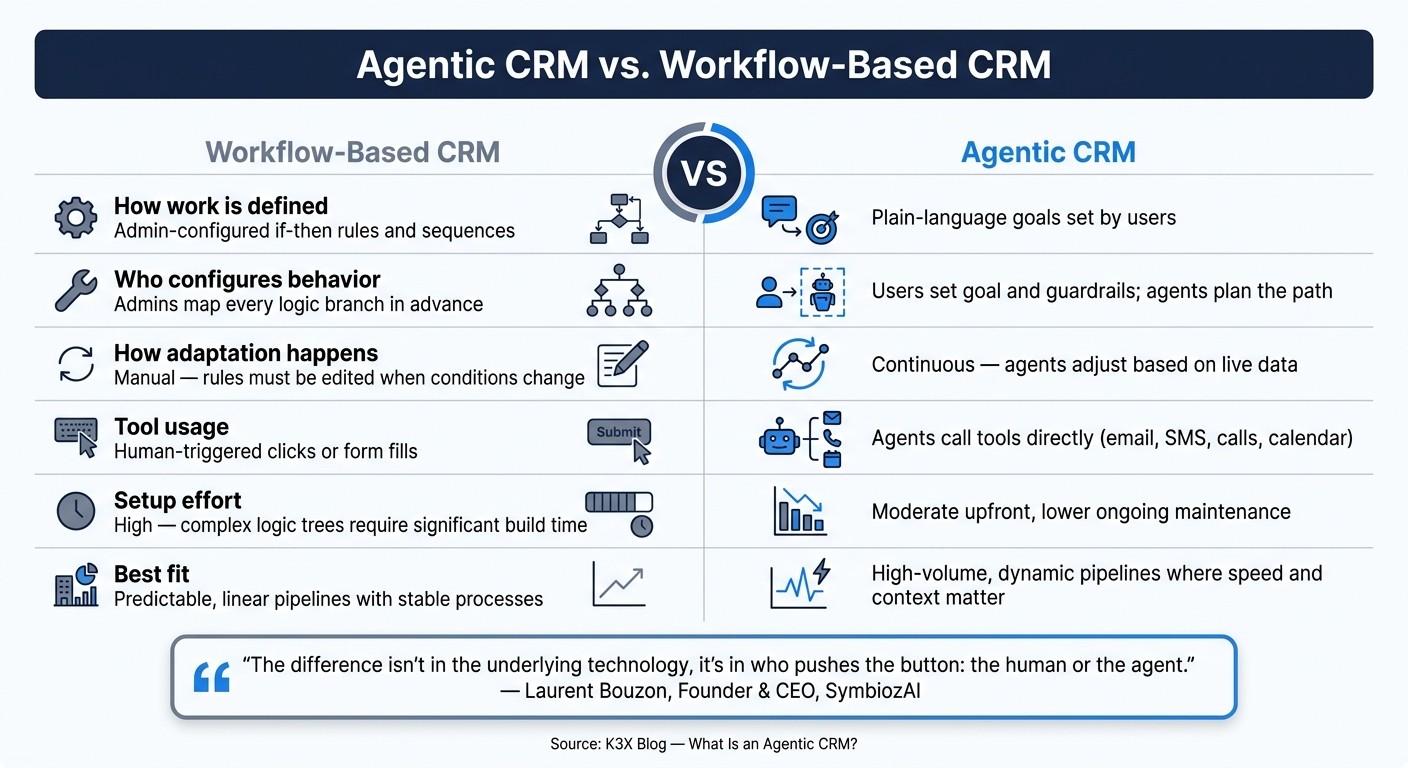
Agentic CRM vs. Workflow-Based CRM: Key Differences
Standard CRM automation runs on preset rules. Agentic CRM runs toward a goal. In a rule-based setup, an admin has to map each branch ahead of time. In an agentic setup, a user gives the outcome, and the agent decides what to do next from live data.
Standard CRM automation follows fixed sequences and if-then logic. That works when the process is stable and easy to predict. But when conditions shift, someone has to go back and edit the workflow.
Agentic CRM works differently. It follows the same goal → plan → act → observe → adapt loop described above, but it swaps a fixed rule tree for live decision-making. In plain terms, a copilot might draft an email, while an agentic CRM can send it, log the outcome, and pick the next step on its own.
Agentic CRM vs. Workflow-Based CRM: Comparison Table
Most of the CRM platforms commonly grouped into this market still use the workflow-based model. That includes Salesforce, HubSpot, Pipedrive, Zoho, monday.com, Close, and Attio. The table below shows the core split in how these systems work.
Dimension | Workflow-Based CRM | Agentic CRM (e.g., K3X) |
|---|---|---|
How work is defined | Admin-configured "if-then" rules and sequences | Plain-language goals |
Who configures behavior | Admins map every logic branch in advance | Users set the goal and guardrails; agents plan the path |
How adaptation happens | Manual - rules must be edited when conditions change | Continuous - agents adjust based on live data |
Tool usage | Human-triggered clicks or form fills | Agents call tools directly (email, SMS, calls, calendar) |
Setup effort | High - complex logic trees require significant build time | Moderate upfront, with lower ongoing maintenance |
Best fit | Predictable, linear pipelines with stable processes | High-volume, dynamic pipelines where speed and context matter |
This is an architectural difference, not just a missing feature here or there. Workflow-based CRMs were built first to store and organize records, then later layered on automation. Agentic CRMs are built to take action on that data and adjust based on results.
The next section shows which real products fit each model.
Real Examples of Agentic CRM and Related Tools
As of July 2026, the key difference is simple: some tools recommend actions, while others take actions on their own. An AI assistant may draft an email or suggest a next step; an agent can send the message, update the record, and change its next move based on what happens.
K3X is an AI-native, prompt-driven CRM built for teams of 1–9 people. Users describe the result they want in plain English - for example, “follow up every inbound lead within 5 minutes until they book or decline” - and K3X’s agents carry that out across email, SMS, and calls, with no workflow builder or sequence setup required. Pricing starts at $20 per seat/month and includes 1,000 AI credits, unlimited integrations, and a one-click power dialer. The limits are clear: K3X is still a young product, its native integration catalog is smaller than older vendors, AI credit use needs tracking, and it is not built for teams that need 100+ seats or deep admin controls.
Salesforce Agentforce is the large-enterprise option in this set. Its Atlas Reasoning Engine coordinates agents across sales, service, and marketing, and Salesforce said in March 2026 that it would invest an added $900 million in Agentforce development [3]. The trade-off is setup load. Agentforce often needs certified implementers and a large IT budget, which makes it a weak fit for small teams. Advanced agent features usually start at more than $50 per user/month [6].
HubSpot Breeze offers task-specific agents for prospecting and content inside the HubSpot ecosystem, and it includes a public Model Context Protocol (MCP) server for external AI access [5][2]. That makes it a better fit for marketing-led teams already using HubSpot. Zoho CRM’s Zia takes a different path with a no-code Agent Studio, where teams can build custom agents using natural language, with paid plans starting at about $14 per user/month [5][2]. Even so, the agent logic still needs manual setup at the start.
Pipedrive and monday.com remain more assistive than autonomous. Pipedrive’s AI Sales Assistant focuses on pipeline momentum and deal health, but it mainly recommends actions instead of carrying them out on its own [2]. monday.com CRM adds AI to its existing workflow engine, which means the system still leans on user-built logic. Attio is design-forward and API-first, but its agent execution layer is still less mature than the top enterprise tools [4].
K3X vs. Salesforce, HubSpot, Pipedrive, Zoho, monday.com, and Attio: Comparison Table
Platform | Automation Style | Setup Complexity | Target Team Size | Starting Price |
|---|---|---|---|---|
K3X | Prompt-driven / autonomous | Low - no workflow builder | 1–9 people | $20/seat/month |
Salesforce Agentforce | Autonomous orchestration | High - requires certified implementers | Large enterprise | $50+/user/month [6] |
HubSpot Breeze | Agent-assisted | Medium | SMB to enterprise | Free CRM tier; paid tiers vary [5] |
Zoho CRM (Zia) | No-code agent studio | Medium | SMB to mid-market | Approximately $14/user/month [7] |
Pipedrive | Workflow-based / assistive | Low to medium | SMB to mid-market | Approximately $14.90/user/month [7] |
monday.com CRM | Workflow-based / assistive | Low to medium | SMB to mid-market | Varies by plan |
Attio | Copilot / API-first | Low to medium | SMB to mid-market | Varies by plan |
“The difference isn't in the underlying technology, it's in who pushes the button: the human or the agent.”
Laurent Bouzon, Founder & CEO, SymbiozAI [3]
Why Does an Agentic CRM Matter for Small Teams?
An agentic CRM matters for small teams because it handles follow-up, record updates, and handoffs on its own. That lets a lean team move faster and keep deals active without building or babysitting a maze of workflows.
In a workflow-based CRM, people still push the work forward. In an agentic CRM, the system does that work for them. The difference shows up when the CRM needs to act instead of just store notes.
For small teams, the main limit is simple: capacity. No one has time to watch every form fill, email reply, and buying signal all day. When response time slips from five minutes to 30 minutes, the odds of qualifying a lead drop by 100x [2]. An agentic CRM can reply in seconds, which helps small teams stay in the game when speed decides the outcome.
The business case is straightforward: less admin work, faster lead response, and more time spent selling.
Metric | Finding | Source |
|---|---|---|
Admin time | 65% of sales time is lost to administrative tasks | HubSpot State of Sales 2026 [3] |
Non-selling hours | 25 hours/week spent on activities that could be delegated, automated, or simplified | Gartner [1] |
Lead response impact | Odds of qualifying a lead fall 100x when response time increases from five minutes to 30 minutes | Primary research [2] |
How Is an Agentic CRM Related to Prompt-Driven and Autonomous CRM?
These terms are connected, but they are not the same thing. Agentic CRM refers to the system design, prompt-driven CRM refers to how a user interacts with it, and autonomous CRM refers to what the system can do on its own.
That difference matters in practice. Some vendors call a product "AI CRM" or "autonomous" when it can only take a natural-language input and return a suggestion. A CRM may accept prompts without planning steps, using tools, or finishing work by itself.
For the category-level view, see the autonomous CRM page. This page focuses on the agent architecture - the goal → plan → act → observe → adapt loop - that makes both prompt-driven interaction and autonomous operation possible.
Here is the clean split.
Term | What It Means | What the User Sees |
|---|---|---|
Prompt-Driven | User interface and interaction model | Natural-language requests instead of forms and menus |
Autonomous | Operating model | The system runs the pipeline without constant human triggers while maintaining enterprise-grade security |
Agentic | AI agent architecture | Agents plan, call tools, and execute tasks end to end |
Related Terms
What Is a Prompt-Driven CRM? - Explains how users state goals in plain language and how that differs from form-based CRM navigation.
CRM Follow-Up Automation with AI - A practical look at how AI agents manage follow-up work without manual triggers.
HubSpot Alternatives for Growing Sales Teams - Compares workflow-based CRMs with newer AI-native options.
Key Takeaways
The main difference is execution. An agentic CRM uses AI agents to carry out multi-step pipeline work across email, SMS, calls, and calendars, then adjust based on results - not just suggest the next step.
That’s what separates agentic systems from workflow-based ones in day-to-day use. A standard CRM depends on someone to build rules, maintain sequences, and keep the process moving. An agentic CRM gets a goal and handles the work itself.
For small U.S. sales teams, this matters because capacity is often the bottleneck. Sales reps spend an average of 25 hours per week on tasks that could be automated, which leaves only 9 hours for selling [1]. Agentic systems aim to give that time back by taking over admin work like data entry, lead qualification, and follow-up.
That feedback loop is what makes the software agentic. A copilot suggests. An agent acts.
The simple test is this: if the CRM can send, move, or log actions on its own, it is agentic. If it only recommends actions or waits for approval, it is assistive.