Sales Automation
•
K3X vs Close CRM: Best CRM for Outbound Sales Teams
K3X for AI automation and low cost; Close for high-volume calling and SDR workflows.

K3X and Close CRM both serve outbound sales teams, but their strengths differ. Close is best for teams prioritizing high call volumes with its built-in Power Dialer and structured workflows. K3X, priced at $20/seat/month, focuses on reducing manual tasks through AI-driven automation, saving teams up to 8 hours per week per rep. Choose Close for high-volume SDR workflows and K3X for automation-first efficiency.
How to Automate Outbound Sales: 4 Workflows Built Live
How to Evaluate a CRM for Outbound Sales
Not all CRMs are built to support outbound sales effectively. The right CRM should simplify processes, enhance productivity, and help teams focus on selling instead of administrative tasks.
Key Metrics That Matter for Outbound Teams
When evaluating a CRM for outbound sales, focus on metrics that directly impact results. Activity volume - such as the number of calls, emails, and SMS sent daily - is a key starting point. However, this metric is only meaningful if paired with insights like connect rates, pipeline velocity (how quickly deals progress from first contact to close), and reply rates across various communication channels.
Another critical factor is how much manual work the CRM eliminates and how quickly teams can begin selling. For instance, K3X can have teams live in under an hour [1], Close offers a setup timeline of less than a week [3], while Salesforce typically requires four to twelve weeks for implementation [10].
Efficient data management also plays a big role. CRMs like K3X automate data entry by capturing call details and syncing emails without requiring manual updates [1]. Similarly, Close automatically logs all calls, emails, and SMS activity [8], saving time and reducing errors.
Evaluation Factor | Why It Matters for Outbound |
|---|---|
Activity volume support | Can the CRM handle 50+ calls/day without extra tools? |
Automation depth | How much manual work is eliminated? |
Setup speed | Can the team start selling within days? |
Pipeline velocity tracking | Does the CRM identify stalled deals automatically? |
Total cost of ownership | Are dialers, SMS, and sequences included, or are they extra? |
For outbound teams, integrated CRMs that combine dialers, SMS, and sequencing into one platform can significantly reduce costs. A 25-rep team, for example, could save about $13,800 annually by opting for an all-in-one solution instead of piecing together tools around a legacy system [3].
These metrics highlight the differences between older systems and newer, AI-driven platforms.
Legacy CRMs vs. AI-Native CRMs
Understanding the architecture of legacy versus AI-native CRMs is essential. Platforms like Salesforce and HubSpot were originally designed as systems of record, focusing on data storage and organization rather than active sales execution. These systems often require dedicated admins, complex customizations, and third-party tools like Aircall or Gong to manage outbound workflows [6]. While this approach works for large enterprises with IT support, it can slow down smaller, leaner sales teams.
AI-native CRMs like K3X and Close are built with a workflow-first mindset, prioritizing seamless sales processes and minimizing context switching. The main distinction lies in automation. Legacy CRMs rely on rigid, step-by-step workflows - for example, sending a follow-up email three days after no response. These workflows can fail when unexpected events occur, such as a lead replying out of sequence.
K3X, on the other hand, uses a goal-oriented model. As Mykyta Samusiev, Co-Founder & CEO of K3X, explains:
"Most systems are linear. They follow fixed steps - and if something unexpected happens, the flow breaks... K3X works on goals. Instead of defining steps... you define the objective." [1]
For example, a rep can instruct K3X to "schedule demo calls with all leads who haven’t responded in 10 days", and the AI handles follow-ups, sequencing, and pipeline updates automatically.
Close offers a middle ground between legacy CRMs and fully AI-native platforms. While it’s optimized for outbound sales with features like a native power dialer and activity-focused design, its automation still relies on structured sequences rather than the adaptable, goal-based approach seen in K3X.
Selecting the right CRM ultimately comes down to which platform best aligns with your team's need for efficiency and scalability in outbound sales.
K3X for Outbound Sales Teams
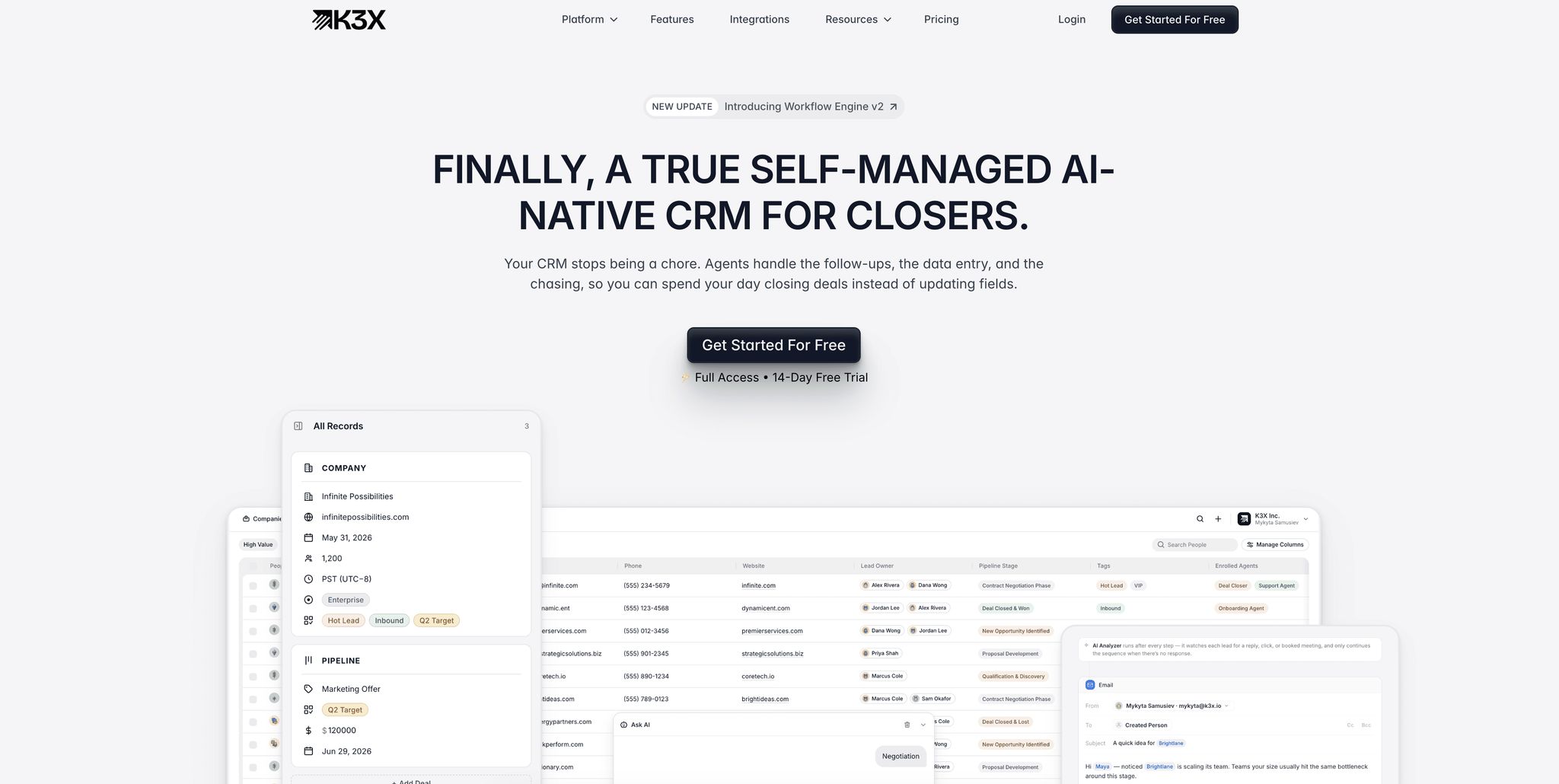
K3X is an AI-powered CRM designed to eliminate repetitive tasks for outbound sales teams. Instead of navigating complicated menus or setting up sequences, users can simply state their goals in plain language, and the AI takes care of the rest. This approach increases both activity levels and pipeline speed, addressing the inefficiencies of traditional CRMs.
Key Features and Capabilities
K3X relies on a prompt-to-action model that simplifies workflows. Sales reps can type commands like "follow up with leads who haven’t responded in 10 days", and the AI will handle the outreach, update records, log activities, and manage the pipeline. This eliminates time-consuming administrative tasks, allowing sales teams to focus on closing deals instead of data entry tasks [1].
The platform also includes essential outbound tools like a one-click native power dialer, built-in SMS, and unlimited call recordings - all included in the base price. Unlike tools such as Salesforce, which often require third-party integrations for similar functionality, K3X provides these features without additional costs [1].
Ruby Capital Group, a 125-person funding company, implemented K3X in December 2025. Within just two days, they reduced time spent on follow-ups by 70% and tripled ticket resolution speed. CEO Michael Chkechkov noted:
"Our sales team was spending half their day on admin work. Now they're talking to customers and closing deals. The automation handles everything from lead qualification to contract routing." [1]
These features, combined with its simple pricing model, make K3X a scalable option for outbound sales teams.
Pricing and Scalability
K3X offers one flat plan at $20 per seat per month, billed monthly with no long-term contracts [1]. This plan includes:
1,000 AI credits
Unlimited contacts and leads
Built-in email, calling, and SMS tools
Native power dialer
Unlimited call recordings
Unlimited workflow automations
The pricing is usage-based, meaning costs remain at the $20 base rate during slower months, but scale up during busier periods based on AI credit usage. This ensures teams only pay for what they need [1].
Feature | K3X ($20/seat/month) |
|---|---|
Power Dialer | Included |
Unlimited Contacts | Included |
Built-in SMS | Included |
Workflow Automations | Unlimited |
AI Credits | 1,000/month |
Contract Term | Month-to-month |
Setup Time | Under 1 hour |
For comparison, Close CRM includes its Power Dialer in its Growth plan, priced at $109 per user per month. Salesforce, meanwhile, requires third-party dialer tools, with seat costs ranging from $25 to $300 per month [1][2].
Strengths and Limitations
K3X allows teams to get up and running in under an hour and has already automated over 312,000 hours of manual work for more than 50 teams. This makes it a strong choice for teams without dedicated CRM administrators.
However, its feature set is still growing. K3X lacks the advanced reporting, extensive enterprise integrations, and detailed territory management offered by established platforms like Salesforce and Close CRM. It prioritizes speed and automation over the extensive configuration options found in older CRMs.
For teams that value simplicity and automation over complex system customization, K3X is a strong fit. However, businesses needing advanced compliance tools or deep customization should weigh these limitations carefully.
Close CRM for Outbound Sales Teams
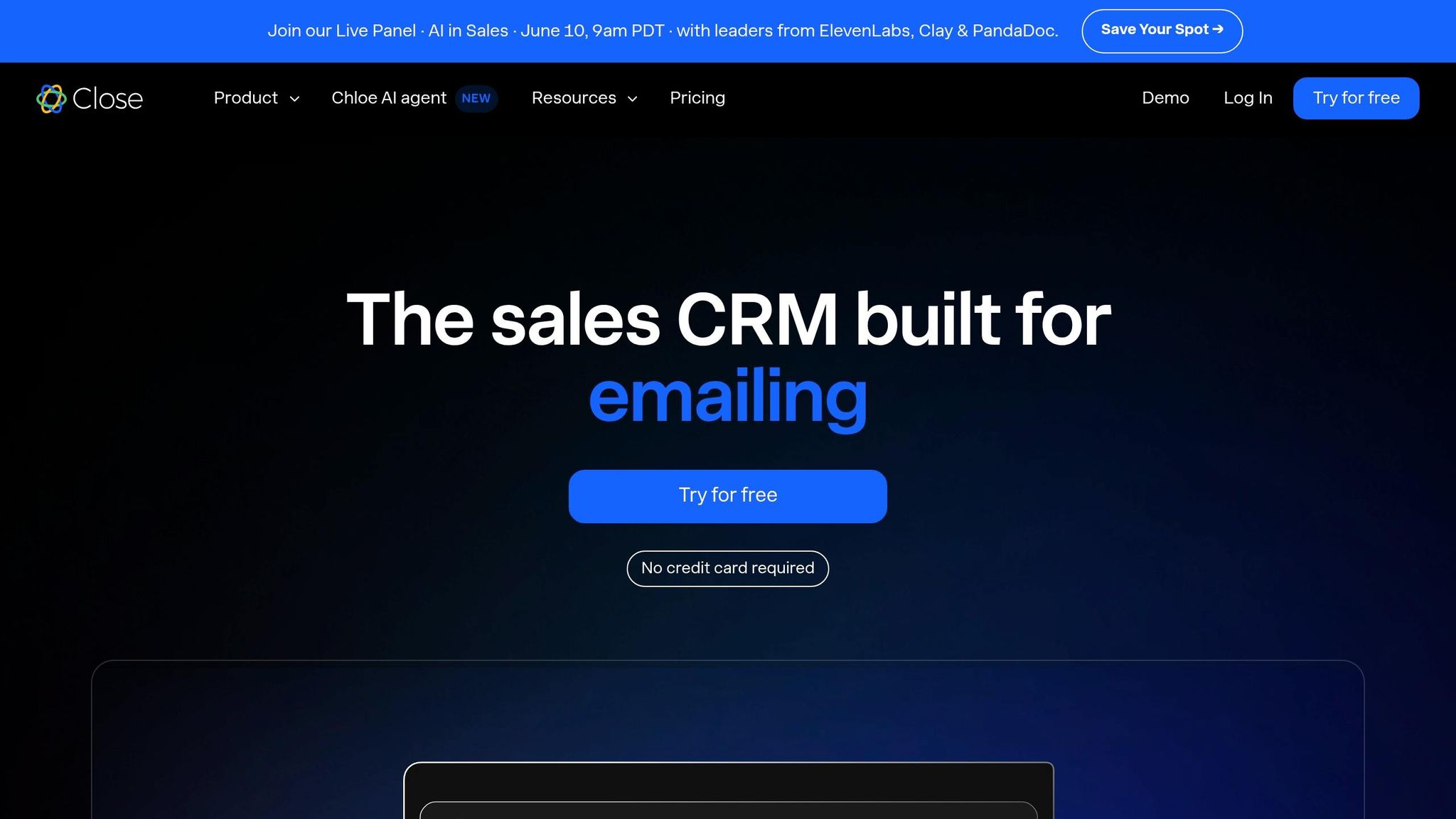
Close CRM stands out as a tool tailored for outbound sales teams, combining calling, SMS, and email sequences into one platform. This makes it particularly effective for teams focused on high call volumes and multichannel outreach. Below, we explore how its features support outbound sales efficiency.
Key Features and Capabilities
Close is designed for speed and communication efficiency, offering tools like one-click calling, voicemail drops, automatic call logging, and native SMS - all without needing external integrations such as Twilio or Aircall. According to user feedback, 81% of users appreciate the built-in dialer for simplifying workflows and avoiding third-party tools [13].
One of Close's standout tools is Smart Views, which are dynamic lead lists that update in real time based on activity filters. For instance, teams can instantly see leads who missed a call in the last 48 hours or opened an email but didn’t respond:
"Close was the first one I found that shows you everything that you need and nothing that you don't." [4]
Additionally, Close includes an AI agent called Chloe, which automates tasks like call transcription, meeting summaries, follow-up emails, and lead enrichment. By handling post-call documentation, Chloe can save sales reps about 30 minutes per day [5].
With these features, Close offers a streamlined experience supported by flexible pricing options suited to teams of various sizes.
Pricing and Plans
Close uses a tiered pricing model, with the Power Dialer becoming available at the Growth tier and above.
Plan | Annual Price | Key Outbound Features |
|---|---|---|
Solo | $9/user/mo | Chloe AI, basic calling, 10,000 leads (1 user only) |
Essentials | $35/user/mo | Multiple pipelines, click-to-call; no Power Dialer |
Growth | $99/user/mo | Power Dialer, automated workflows, bulk email, SMS |
Scale | $139/user/mo | Predictive Dialer, call coaching, role-based permissions |
For teams opting for monthly billing, prices increase to $19, $49, $109, and $149 per user, respectively [11].
The Growth plan, starting at $99/user/month with annual billing, is the entry point for the Power Dialer. Despite this, Close remains cost-efficient compared to piecing together multiple tools. For example, a 25-person team switching from HubSpot Professional to Close can save over $13,000 annually, making it a competitive choice for outbound teams in the $99–$139/user range [3].
Strengths and Limitations
Close is ideal for teams with high call volumes, offering tools that consolidate calls, emails, and texts into a single activity timeline. This setup reduces the need for switching between tools and keeps sales reps focused on outreach:
"Close is built for inside sales teams that live in a dialer and care about call volume above all." [12]
However, its linear sequence model - email, wait, call, then SMS - may not adapt well to unpredictable prospect behavior. Additionally, onboarding can take some time, with most teams becoming fully operational within one to two weeks [10].
Close also lacks certain features like native marketing automation, lead scoring, and landing pages, which means teams may need to invest in additional marketing tools, increasing complexity and costs. Its reporting capabilities are another area where it falls short, offering less granularity compared to competitors like HubSpot or Salesforce [3].
K3X vs Close CRM: Head-to-Head Comparison

K3X vs Close CRM: Feature & Pricing Comparison for Outbound Sales Teams
Both platforms provide built-in calling, email, and SMS tools, but their priorities differ. Close emphasizes speed and linear workflows, while K3X centers on goal-oriented, adaptive automation. This distinction influences their performance across key areas.
Outbound Communication Tools
Close and K3X both support calling, email, and SMS as core outbound tools. Close's built-in dialer stands out, enabling teams to achieve 2–3 times more call volume compared to external dialers [7]. The Power Dialer becomes available with the Growth plan, while the Predictive Dialer is part of the Scale plan.
However, the platforms approach follow-ups differently. Close uses fixed, linear sequences that can pause if a lead responds unexpectedly. In contrast, K3X dynamically adjusts follow-ups based on lead behavior in real time, offering a more fluid experience.
Automation and AI Assistance
Automation strategies reveal a key difference between the two platforms. Close employs rule-based automation, such as triggering an SMS after a missed call or assigning tasks when an email is opened. Its AI features, like Chloe for call transcription and the AI Email Assistant, enhance traditional workflows.
K3X takes a different approach. Co-founder Mykyta Samusiev explains:
"Traditional CRMs react to scripts. They either move forward or stop. K3X works on goals. Instead of defining steps... you define the objective." [1]
For instance, a user could set a goal like "Book demo calls with every lead who hasn't responded in five days", and K3X's AI agents would handle the outreach, logging, and pipeline updates automatically. This method reportedly saves employees an average of eight hours per week by eliminating manual tasks [1]. By comparison, Close's Call Assistant saves about 30 minutes per day per rep through transcription and summaries [5].
Pipeline Management and Data Hygiene
K3X automates pipeline updates, aligning with its outcome-focused design. Close, on the other hand, uses a lead-centric model that often requires manual data entry. While Close consolidates accounts, contacts, and opportunities into a single record - ideal for straightforward outbound teams - this setup can create challenges as deals grow more complex. Pipeline updates in Close depend on manual logging or rule-based triggers, which can lead to incomplete data if improperly configured.
K3X eliminates this issue by automating pipeline updates and data entry. For example, Ruby Capital Group, a 125-employee company, adopted K3X in December 2025 and reduced time spent on manual follow-ups by 70% within two days. CEO Michael Chkechkov noted that K3X managed tasks from lead qualification to contract routing seamlessly [1].
Reporting and Insights
Close and K3X reflect their core philosophies in reporting capabilities. Close focuses on activity metrics like call durations, email open rates, and rep leaderboards, which are helpful for monitoring daily outreach. However, its reporting depth has been criticized, with some users describing it as insufficient for advanced needs [7].
K3X, by contrast, offers real-time dashboards that automatically update as its AI processes interactions. This automation results in more complete data, reducing inaccuracies caused by missed manual entries [1]. K3X's dashboards provide a broader view of performance, capturing every interaction in one place.
Pricing and Scalability
When comparing pricing, K3X offers more features at a lower cost. Close’s advanced outbound tools, like the Power Dialer and bulk email functionality, are only available starting at $99 per user per month with the Growth plan. In contrast, K3X includes these features in its base plan at $20 per seat.
Feature | K3X (Adaptive) | Close (Growth) | Close (Scale) |
|---|---|---|---|
Monthly Cost (Annual) | $20/seat | $99/seat | $139/seat |
Power Dialer | Included | Included | Included |
Predictive Dialer | Included | Not included | Included |
Automated Workflows | Unlimited | Included | Included |
Call Recordings | Unlimited | Included | Included |
Close offers predictable pricing, which appeals to teams with 20–30 representatives. However, its limitations in reporting and lack of enterprise features make it less ideal for larger teams of 50–100 reps [3][7]. K3X's pay-as-you-go model adapts to seasonal demand, offering greater flexibility with AI credit-based pricing [1].
Which CRM Should Your Team Choose?
The right CRM depends on your team's structure and sales priorities. Based on a detailed comparison of features and pricing, both K3X and Close cater to outbound sales but are tailored to distinct workflows and team needs.
Best for Small or Founder-Led Teams
K3X is ideal for small, founder-led teams. Its AI-driven, prompt-based design simplifies setup and reduces ongoing admin work, making it a great choice for teams without a dedicated CRM manager. There’s no need to configure flowcharts, integrate third-party tools like Zapier, or maintain sequences. Instead, you just describe your desired outcome - for example, "Follow up with every lead who hasn't replied in five days" - and the AI takes care of execution.
At $20 per seat per month, K3X is also more budget-friendly than Close's $49 per user monthly Startup plan. For a five-person team, this pricing difference saves about $1,740 annually [1].
Best for High-Volume Calling Teams
Close is better suited for SDR teams focused on high daily call volumes. Its built-in Power Dialer, voicemail drop, and VoIP features are tailored for reps making 50+ calls per day [3]. As Steli Efti, CEO and Co-founder of Close, emphasizes:
"Close will never become a platform. We don't want to be HubSpot or Salesforce. We want to be the best inside-sales CRM in the world." [7]
This focus is evident in its design. Close's activity-first interface keeps reps dialing without unnecessary screen-switching, while its structured sequences give managers clear insights into team performance. With over 2,000 G2 reviews averaging 4.7/5, Close has proven itself as a reliable tool for cold-calling teams [9].
What to Consider as Your Team Grows
Scalability is a key difference between the two platforms. Close works best for teams with 5 to 30 reps [3], but it may fall short for larger teams due to limitations in reporting and EU data residency [7]. On the other hand, K3X's AI and usage-based pricing adapt easily to changes in team size or seasonal demand, making it a flexible option for growing teams [1].
The choice ultimately depends on how your team operates. If you need a CRM that minimizes operational overhead with AI-driven management, K3X is the way to go. If your focus is on maximizing daily call volume and tracking rep activity, Close offers the structured tools you need.
Decision Factor | Choose K3X | Choose Close |
|---|---|---|
Team Size | Solo to 100+ seats | 5–30 reps |
Primary Motion | Outcome-based outreach & follow-up | High-volume cold calling |
Setup Speed | Under one hour | Under one week |
Starting Price | $20 per seat per month | $49 per user per month |
Admin Overhead | Minimal – AI self-manages | Low – structured but manual sequences |
Calling Tools | One-click Power Dialer included | Power and Predictive Dialers |
FAQs
Which CRM fits my team’s outbound motion best?
The best CRM for your team depends on factors like team size, sales approach, and technical requirements. Close works well for outbound-focused teams, offering a power dialer, SMS, and email all in one platform. For teams prioritizing inbound growth, HubSpot stands out with its marketing automation features. Pipedrive is a great choice for smaller teams looking for a straightforward solution, while Salesforce is built to handle the complexities of large enterprises. If your focus is on AI-driven productivity, K3X reduces manual effort and emphasizes results and progress.
How does AI credit usage affect monthly cost?
AI credit systems replace fixed subscription fees with variable costs tied to usage. For instance, Salesforce employs a consumption-based model using credit pools, which can result in either overages or leftover credits. Close CRM charges a base fee, adding $50 per month for AI Call Assistants and $0.02 per minute for transcription services. Similarly, K3X offers 1,000 monthly credits in its plan, allowing costs to adjust during less active periods.
What features will I miss if I need advanced reporting?
For enterprise-level reporting, many outbound sales CRMs, such as Close, fall short when compared to robust platforms like Salesforce or HubSpot. Close excels in outbound-focused metrics, offering detailed insights into areas like call performance and sequence effectiveness. However, it doesn't support advanced features like multi-organization territory analysis or comprehensive enterprise forecasting. On the other hand, K3X streamlines reporting with AI-driven, real-time insights, eliminating the need for the complex manual dashboards often required by legacy platforms like Pipedrive, which also faces challenges in supporting larger teams effectively.