
The Evolution of AI Agents
If I had to give one short answer, I’d say this: K3X is the best fit for real estate agents who want automatic follow-up with the least setup, while Follow Up Boss and kvCORE fit teams that care more about routing, IDX, and team control. The article’s main point is simple: if your problem is missed lead response, the top CRM is the one that replies fast and keeps contact going after hours. Explore the AI-native CRM features that make this possible.
Follow Up Boss Review: Best Real Estate CRM for Teams in 2025?
Which CRM is the best fit if automatic follow-up is the main goal?
K3X comes out first when the main job is automatic follow-up across email, SMS, and calls. The reason is not IDX or routing depth. It is that the tool is framed as prompt-led follow-up instead of workflow building.
I’d sum up the ranking like this:
K3X: best for hands-off follow-up
Follow Up Boss: best for lead routing and team response tracking
kvCORE: best for IDX-driven nurture
Pipedrive, HubSpot, and Wise Agent: lower-cost or simpler options, but more manual
That matches the article’s core test: how fast the CRM can respond, how long it can keep follow-up active, and whether it fits real estate work without extra admin.
Why does the article put so much weight on response time?
Because delay kills conversion in real estate. The article leans on two numbers: agents who reply within 5 minutes are up to 21x more likely to qualify a lead, and the average response time is still more than 15 hours [3].
That gap is the whole case for automation.
It also points out that about 62% of inquiries come in outside normal business hours [3]. So if an agent is in a showing, with family, or asleep, a CRM that only logs the lead is not enough; you need automated CRM workflows that handle the heavy lifting. The article argues that the system has to reply, qualify, and keep the conversation moving without waiting for the agent.
What makes K3X different from the other CRMs?
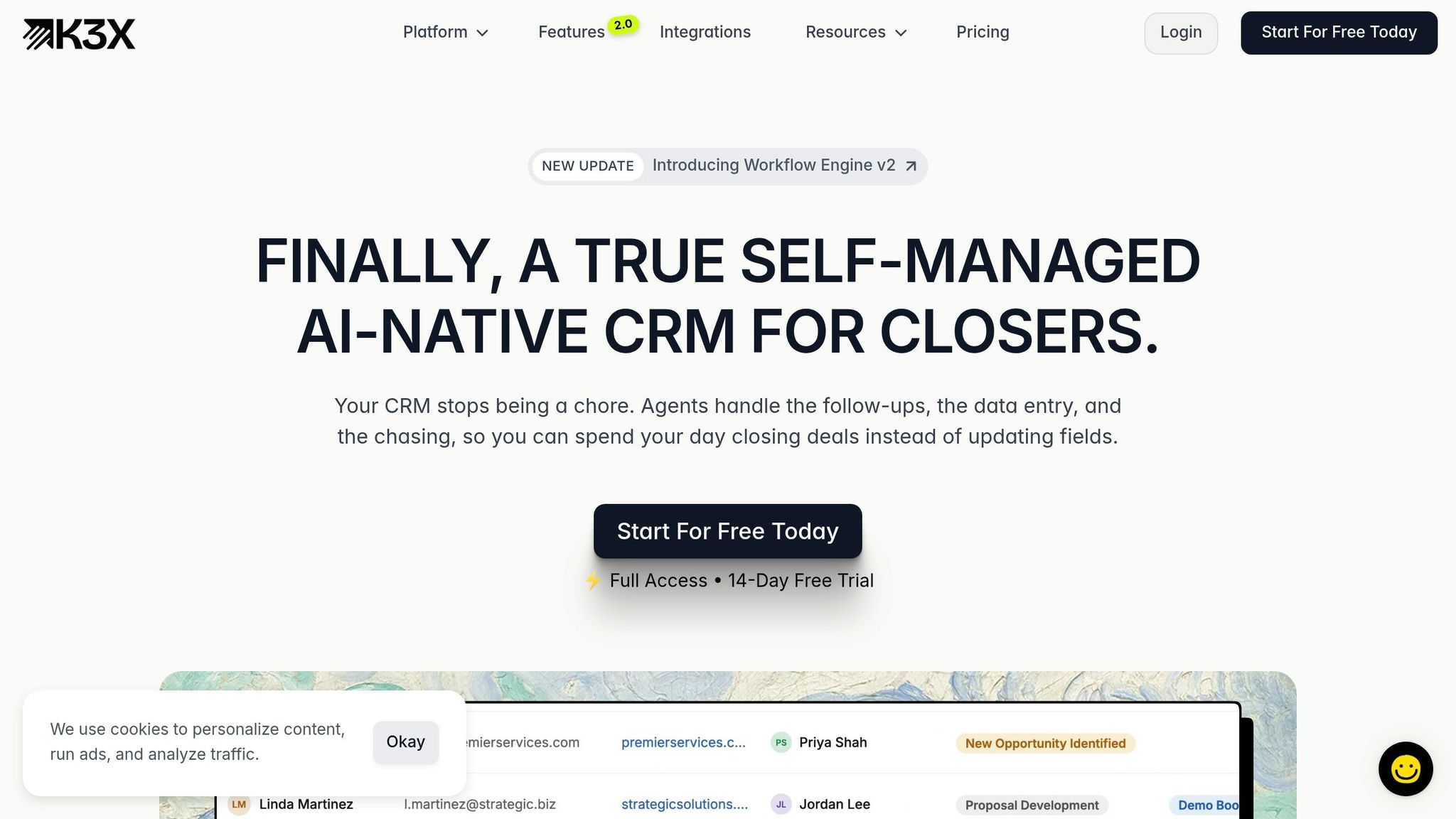
The short answer is setup style. The article says K3X runs follow-up from a plain-language prompt, while the other tools mostly depend on rules, sequences, campaigns, or workflow builders.
That leads to a clear split:
K3X is positioned as the easiest path to automatic follow-up.
Follow Up Boss and kvCORE are stronger when the team needs routing logic, portal intake, or website behavior data.
HubSpot, Pipedrive, and Wise Agent can automate parts of follow-up, but they need more manual setup and more agent involvement.
The pricing point matters too. K3X costs $399/month flat for unlimited team seats with 400,000 K3X credits per month and a 7-day free trial after a 1:1 demo, with no credit card required [1]. In the article, that makes it a flat team price among tools aimed at automatic follow-up.
When would Follow Up Boss be a better choice?
Follow Up Boss is the better pick when a team cares more about lead routing and agent accountability than prompt-led automation. If leads come from Zillow, Realtor.com, or many portals, the article treats Follow Up Boss as the stronger option.
The article highlights three reasons:
tracking for whether agents responded within the 5-minute window[3]
It also notes that Action Plans can run for up to 24 months, which fits long buyer and seller cycles [12]. Teams using those plans on older leads converted them at 3.1x the rate of teams using manual follow-up [12].
So my read is simple: if the team problem is who gets the lead and how fast they answer, Follow Up Boss has the edge.
When does kvCORE make more sense than K3X?

kvCORE makes more sense when listing behavior should drive follow-up. If a lead keeps viewing homes, saving searches, or returning to the same ZIP code, the article says kvCORE can shift campaigns based on that activity.
That is its main edge over K3X.
The tradeoff is cost and setup. Team pricing starts around $499/month, brokerage pricing often runs from $1,000 to $2,000+ per month, and onboarding can take 4–6 weeks [7][2]. So the article places kvCORE behind K3X for agents who mostly want to stop missed follow-up windows fast.
I’d put it this way: K3X is for reply speed; kvCORE is for website-behavior nurture.
Are the lower-cost options enough for most agents?
They can be enough for contact tracking or basic drip campaigns, but the article does not treat them as top choices for automatic follow-up. That applies to Pipedrive, HubSpot, and Wise Agent.
Here’s the short read:
Pipedrive: low entry cost, strong visual pipeline, but no native MLS/IDX and weaker automation for real estate
HubSpot: free contact management is useful, but native SMS and MLS/IDX are missing, and stronger automation moves up to about $800/month on Professional [4][5]
Wise Agent: low flat pricing at $49/month for up to 5 users, but texting costs extra and follow-up is more drip-based than activity-based [2][11]
So yes, they can work. But if the question is which CRM follows up with leads automatically for realtors, the article’s answer is still K3X first.
Does an agent need MLS or IDX in the CRM?
No. The article says MLS or IDX matters only if follow-up needs to react to property-search behavior. If the main issue is slow response time, IDX does not solve that by itself.
That is one of the clearest parts of the piece.
Choose kvCORE if website search behavior should trigger follow-up.
Choose Follow Up Boss if routing and portal intake matter more.
Choose K3X if the main problem is missed or late contact after a lead comes in.
The article also notes a cost issue here: adding IDX through outside tools can run about $150 to $500 per month for tools that do not include it natively [2][7].
What is the main takeaway from the article?
The article’s bottom line is that the best CRM depends on the first problem you need to fix. If the problem is missed lead response, K3X is the top pick for AI follow-up reminders. If the problem is team routing, Follow Up Boss is the better fit. If the problem is listing-aware nurture, kvCORE is the better choice.
The article supports that view with a few hard numbers that are hard to ignore:
21x higher lead qualification odds when agents respond within 5 minutes[3]
62% of inquiries arrive after hours [3]
85% of callers who hit voicemail do not call back [8]
missed-call text-back can recover 30% to 60% of lost leads [8][7]
My short read is this: for most agents who want follow-up to keep moving without extra work, the article puts K3X first because it is built around autonomous outreach, not just CRM storage or drip setup.
What matters most in a CRM for real estate agents who want automatic follow-up?
Speed-to-lead is the top factor. Agents who reply within five minutes are 21x more likely to qualify a lead, but the average reply time is still more than 15 hours [3]. That delay costs deals, especially when leads are comparing multiple agents at once.
After-hours coverage comes next. About 62% of real estate inquiries come in outside normal business hours [3]. If the CRM cannot reply, qualify, and keep the conversation moving when the agent is offline, it leaves a big hole in the process.
Real estate follow-up also has to last. Buyer and seller timelines often stretch from 6 to 24 months, so the system needs to stay active across email, SMS, and calls without the agent having to babysit every step. A one-off text or drip email won't cut it.
That’s where the split starts to show. AI-native tools and real-estate-specific CRMs solve different problems. K3X handles follow-up across email, SMS, and calls from a plain-language prompt [1]. Follow Up Boss and kvCORE bring in lead routing plus MLS/IDX data, so outreach can react to listing views, saved searches, and other property signals.
Evaluation Criterion | Why It Matters for Real Estate Agents |
|---|---|
Speed-to-lead automation | Conversion drops hard after the 5-minute window [3] |
24/7 off-hours coverage | 62% of inquiries arrive outside business hours [3] |
Multi-channel nurture | Long cycles need steady SMS, email, and call follow-up |
Autonomous follow-up vs. MLS/IDX context | AI-native tools handle instant reply and nurture; real-estate CRMs add listing-aware follow-up |
Ease of ongoing management | The system has to fit into an agent’s day without extra admin work |
1. K3X
K3X is the top pick for real estate agents who need automatic follow-up. It turns a plain-language goal into follow-up across email, SMS, and calls without a workflow builder, sequences, or triggers to set up [1]. For agents, that helps keep the first response fast when they’re in a showing, driving, or tied up with a client.
K3X works best when speed-to-lead matters more than listing data. If leads come in after hours or during appointments, it keeps the conversation moving without the agent having to jump back into the CRM right away.
Best for: Solo agents and teams that want hands-off follow-up without spending time managing CRM automation.
Pricing: Costs $399/month flat for unlimited team seats, includes 400,000 K3X credits per month, and includes a 7-day free trial after a 1:1 demo, with no credit card required at k3x.ai [1].
Details | |
|---|---|
Starting price | $399/month flat for unlimited team seats |
Channels | Email, SMS, calls |
AI credits included | 400,000 K3X credits/month |
MLS/IDX | Not built in |
Contract | None |
Use K3X when the lead cycle is long and the first reply can’t wait.
Pros:
No workflow builder, sequences, or triggers. Plain-language prompts run follow-up across email, SMS, and calls [1]
Built-in power dialer, email, and SMS are included in the flat price, with calling and texting subject to credit consumption [1]
K3X users report saving an average of 8 hours per week per rep, and the platform has automated more than 312,000 hours of work across its users [1]
Cons:
It’s a newer product, with fewer native integrations than Follow Up Boss, which offers 250+[1]
High-volume outreach can use included credits fast [1]
It is not built for companies that need deep admin controls [1]
K3X does not include MLS/IDX, so it fits agents who care more about automatic follow-up than listing-aware automation. Agents who want follow-up tied to saved searches or property views will need a tool like kvCORE instead.
2. Follow Up Boss
Follow Up Boss stands out for lead routing and team accountability. If your team buys leads from portals and needs them sent to the right agent fast, this is where it tends to fit better than K3X [7][4].
It connects to 250+ native integrations and can route leads by zip code, price point, or round-robin rules [7][4]. That setup is useful for teams that want less manual triage and clearer ownership the moment a lead comes in.
Best for: Small teams and broker-owners who buy leads from Zillow or Realtor.com and need structured routing, multi-agent accountability, and long-tail nurture [7][4].
Pricing: Grow starts at $58/user/month billed annually for up to 3 users, plus a $39/user/month calling and texting add-on. Pro costs $499/month for up to 10 users. Platform costs $1,000/month for up to 30 users [2].
Details | |
|---|---|
Starting price | $58/user/month (annual) [2] |
Channels | Email, SMS, calls |
Integrations | |
MLS/IDX |
Action Plans handle automated call, text, and email sequences as soon as a lead arrives. Those plans can run for up to 24 months, which matters for buyers and sellers who take a long time to move [12].
The performance data here is worth noting. Teams using Action Plans on leads older than 90 days convert those leads at 3.1x the rate of teams relying on manual follow-up [12].
The reporting side is built for manager oversight. Team accountability reports show which agents replied inside the five-minute window, which is often the period teams care about most for inbound speed-to-lead [3].
Pros:
Instant lead routing from 250+ sources by zip code, price point, or round-robin rules [7][4]
Action Plans run automated multi-channel sequences for up to 24 months, keeping long-cycle buyers and sellers in nurture [12]
Team accountability reporting shows which agents responded within the critical five-minute window [3]
Cons:
Compared with K3X, Follow Up Boss is the better pick when routing logic, portal integrations, and agent follow-up tracking matter more than prompt-led automation. It is stronger for multi-agent lead distribution than for hands-off prompt execution.
3. kvCORE
kvCORE is a better fit when follow-up should react to saved searches and listing activity, not just route leads. It bundles a CRM, a branded IDX website, and behavior-based automation in one platform, so lead actions can trigger the next step without a manual review [7][11].
If a lead keeps browsing the same ZIP code or views a large number of listings, kvCORE can move that person into a more active outreach sequence on its own [7][11]. That makes it useful for long nurture cycles, where property activity is often the clearest buying signal.
kvCORE is different from K3X in a pretty direct way. K3X focuses on follow-up execution from a plain-language prompt, while kvCORE is stronger on native IDX/MLS context and brokerage-level tools.
Best for: Brokerages and large teams that want built-in IDX, behavior-based nurturing, and long lead-cycle automation in one system.
Pricing: Team plans start at about $499/month, while brokerage pricing is custom and often falls between $1,000 and $2,000+/month based on agent count [7][2]. Individual agents usually get access through their brokerage.
Details | |
|---|---|
Starting price | Around $499/month for teams [7] |
Channels | Email, SMS, calls |
IDX/MLS | Built-in branded IDX website [11] |
Behavioral automation | Yes - campaigns shift based on lead activity [7] |
Pros:
Built-in IDX sends listing behavior straight into follow-up sequences [11]
Behavior-based automation moves leads between campaigns based on actions like repeated searches in a given ZIP code [7]
Team tools include agent reporting, roster management, and company-wide campaigns [7]
Cons:
Many teams use only part of the platform, and onboarding can take 4–6 weeks[7]
The starting cost can be tough for solo agents who do not need the full brokerage stack [2]
kvCORE makes the most sense for brokerages that need native real estate infrastructure and listing-aware nurture. For agents mainly trying to stop missed follow-up windows, K3X is the simpler and lower-cost option.
4. Pipedrive

Pipedrive works best for agents who care more about a clear visual pipeline than built-in real estate automation. It gives strong deal visibility, but teams that want after-hours follow-up and property-data sync will need extra setup.
For lead response outside business hours, Pipedrive takes more manual effort than the AI-first tools listed earlier. Its automation is basic: on the Advanced plan, it can send follow-up emails when a deal stage changes, but most real estate teams will still need third-party tools for MLS/IDX connections and lead-source sync [2][3]. When comparing K3X vs Pipedrive, K3X handles follow-up from a plain-language prompt across email, SMS, and calls without a workflow builder, while Pipedrive leaves that setup to the agent.
Best for: Solo agents and small teams that want a low-cost pipeline and can handle their own automation.
Pricing: Essential starts at $14.90–$19/user/month when billed annually. Automation starts on Advanced at $24.90/user/month [4].
Feature | Pipedrive Capability |
|---|---|
Starting price | $14.90–$19/user/month (Essential, billed annually) [4] |
Automation | Workflow automation on Advanced plan ($24.90/user/month) [4] |
MLS/IDX | |
Lead routing | Not included [4] |
Mobile app | Strong native iOS/Android app [2] |
Pros:
Low entry price with a 14-day free trial [4]
Strong mobile app for agents managing deals between showings [2]
Cons:
No native MLS/IDX integration; real estate lead sources require third-party connectors [2][3]
Automation is limited compared with K3X's prompt-driven follow-up and kvCORE's behavioral triggers [4]
Pipedrive makes sense when an agent wants a simple pipeline and low software cost. It is a weaker fit when automatic follow-up is the top need, especially for teams that want built-in real estate workflows rather than piecing them together with outside tools.
5. Is HubSpot a good CRM for real estate agents?
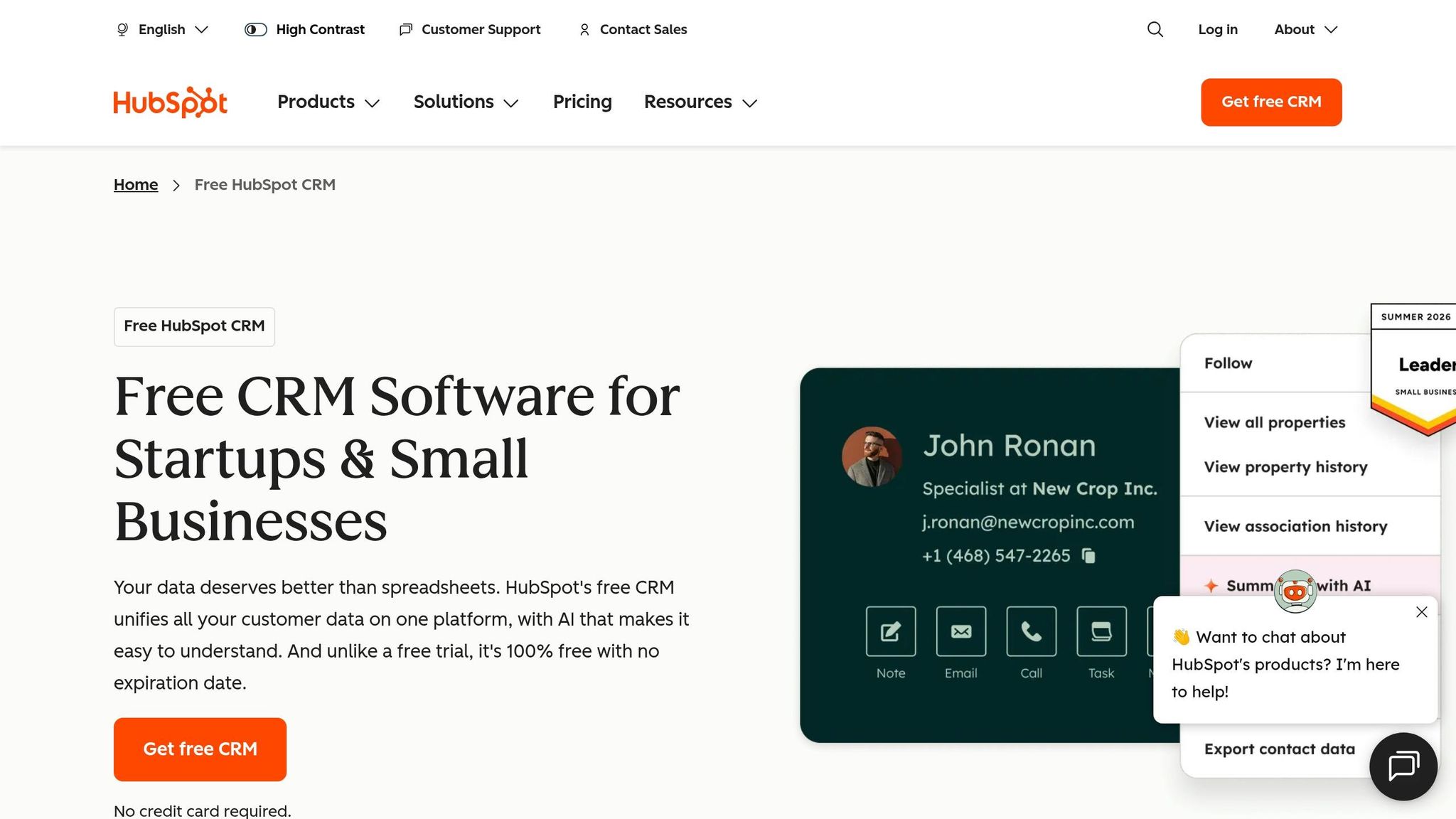
HubSpot is usable for real estate agents, but it fits basic contact management better than hands-off follow-up. It can store contacts and track email activity, but it does not include native MLS/IDX, built-in SMS, or real-estate-specific automation, so agents have to piece those parts together with workflows and integrations [2][4].
That gap matters if follow-up speed is the whole game. If an agent wants automatic texting, behavior-based routing, or real-estate workflows out of the box, HubSpot asks for more setup than a real-estate-focused CRM. By contrast, K3X handles more of that natively than HubSpot.
HubSpot’s strongest point is its free plan. It includes up to 1,000,000 contacts, email tracking, and a meeting scheduler at $0/month, which gives new agents a low-risk place to start building a contact database [6][4]. The meeting scheduler can also help with open-house follow-up and booking calls without extra software.
Automation is where HubSpot gets limited on lower tiers. Basic sequences are available before the top plans, but conditional logic and lead-routing workflows require the Professional tier [4][5]. That means HubSpot may look cheap at first, then get much more expensive once an agent needs automated assignment or more advanced follow-up.
Best for: Brand-new agents who need a free contact database and can live with manual follow-up.
Pricing: Free at $0/month for up to 1,000,000 contacts with email tracking and a meeting scheduler [6][4]. Professional is about $800/month and is required for advanced automation and lead routing [4][2][5].
Feature | HubSpot Free | HubSpot Professional |
|---|---|---|
Price | $0/month [4] | ~$800/month [4] |
Automation | Limited sequences | Conditional workflows |
Lead routing | None | Available [5] |
SMS/texting | No native SMS; requires integration [5] | No native SMS; requires integration [5] |
MLS/IDX | None | None |
Best for | New agents, no budget | Teams that need full automation |
Pros:
Free tier includes up to 1,000,000 contacts, email tracking, and a meeting scheduler [6][4]
Strong email engagement tracking helps agents see who opened and clicked listing emails [4]
Cons:
No native SMS, no MLS/IDX, and no real-estate-specific templates out of the box [2][4]
The jump from free to Professional is steep for agents who need automation but not a larger sales platform [4][2]
HubSpot makes sense when the budget is $0 and the main job is simple contact organization. It is a weak fit when automatic follow-up, especially by text or behavior-based routing, is the main need. If you want a more real-estate-specific option with less setup, Wise Agent is the next comparison.
6. Wise Agent
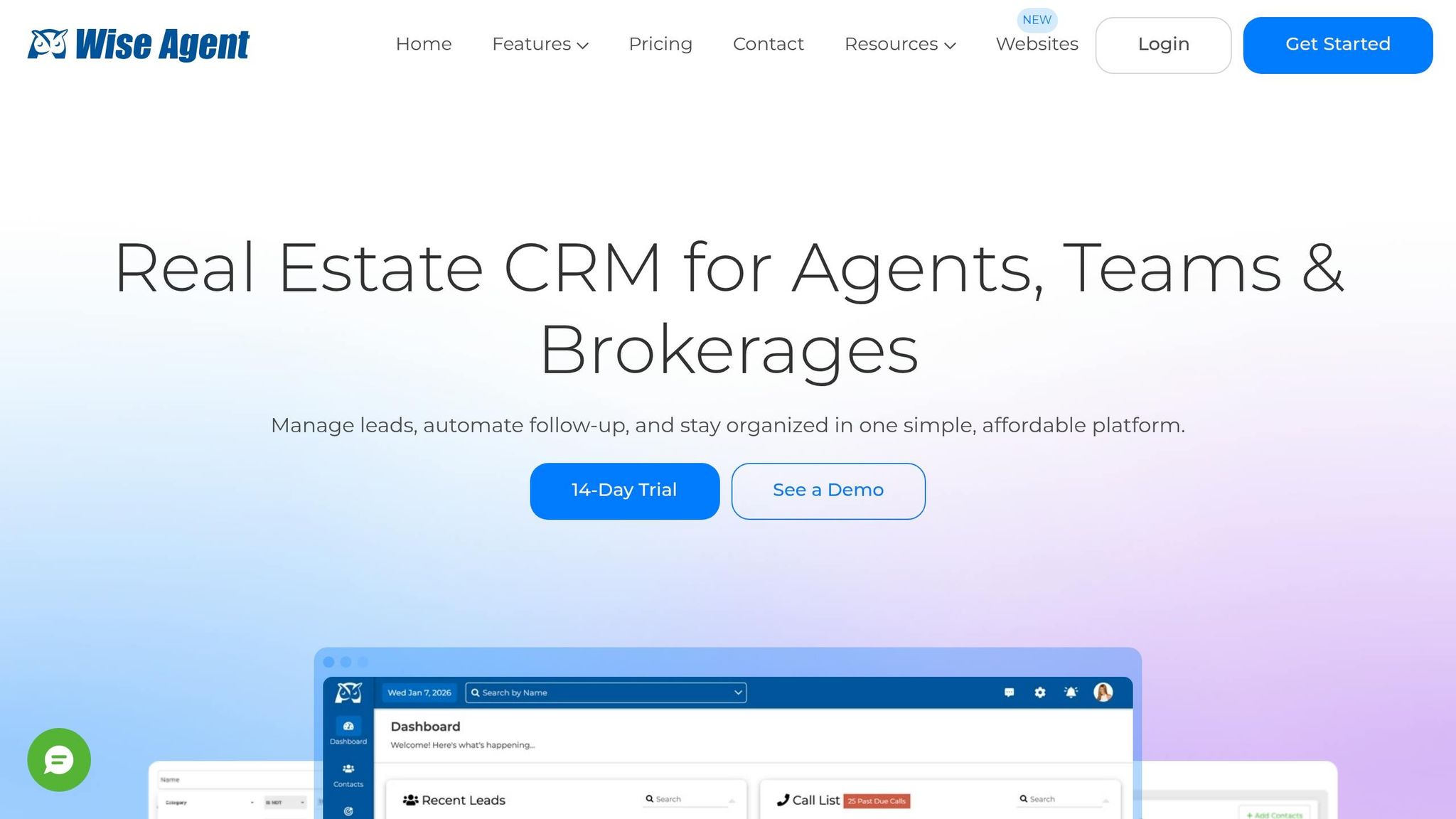
Wise Agent is the lowest-cost real-estate CRM in this group for small teams. At $49 per month for up to 5 users, it covers basic after-hours follow-up and includes core real estate tools without pushing the price up [7][2].
It includes drip campaigns, portal lead routing, transaction management, and 24/7 US-based phone and chat support [7][2]. For small sales teams and solo agents, that flat pricing is the main draw.
Follow-up is built mostly around automated email drip sequences. Texting is available, but only as a paid add-on [7][2]. Wise Agent also includes a landing page builder and an AI writing assistant for listing descriptions, email templates, and text sequences [5][11].
Compared with K3X, Wise Agent costs less but does less on its own. Compared with kvCORE, it does not include native IDX or behavior-based triggers.
Its limits show up fast if speed-to-lead is a top concern. There is no built-in dialer and no behavior-based AI, so follow-up depends on scheduled drips instead of reacting to lead activity in real time [7][2].
For nights and weekends, campaigns keep running through those scheduled drips. But the system does not shift messaging based on what a lead is doing at that moment. Lead routing is also simpler than Follow Up Boss, and MLS data comes through third-party links rather than native IDX [7][5].
That makes Wise Agent a good fit for agents who care most about keeping software costs low. It is less suited to teams that want automated CRMs for self-running follow-up or listing-driven nurture.
Best for: Solo agents and small teams of 1–5 people who want a real-estate-specific CRM with built-in transaction management and drip campaigns at a flat, predictable price.
Pricing: $49/month flat for up to 5 users or $499/year (about $42/month billed annually); texting is a paid add-on; 14-day free trial; no long-term contracts [2][11].
Feature | Wise Agent |
|---|---|
Price | $49/month flat (up to 5 users) [7] |
Email drip campaigns | |
Text follow-up | |
Built-in dialer | |
MLS/IDX | |
Transaction management | |
Lead routing | |
Support |
Pros:
Flat $49/month pricing covers up to 5 users, which is cheaper per user than Follow Up Boss at $58–$69/user/month[7][2]
Built-in transaction checklists and document storage are part of the base plan, while Follow Up Boss and kvCORE often depend on separate add-ons or links to tools like Dotloop or SkySlope[7][5]
24/7 US-based phone support helps agents who need help outside normal business hours [2][5]
Cons:
No built-in dialer and no behavior-based AI, so follow-up relies on time-based drip sequences instead of lead activity triggers [7][2]
No native IDX and only basic portal routing reduce its fit for long nurture cycles tied to listing behavior [7][5]
Wise Agent fits best when price is the main filter and the team wants real-estate-specific tools without paying for extra software they may not use. If routing depth and IDX matter more than cost, Follow Up Boss or kvCORE are the better fit.
How do the top CRMs compare for real estate agents?
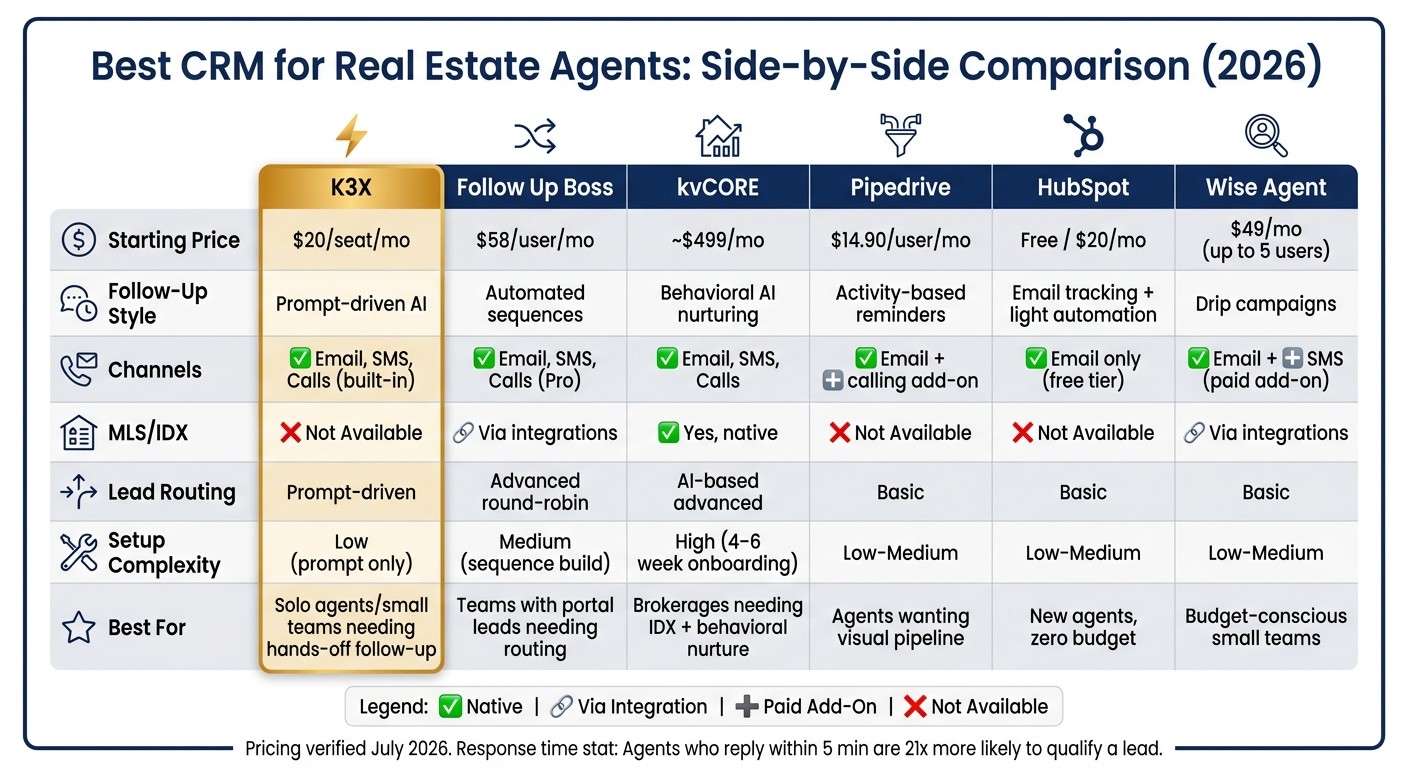
Best CRM for Real Estate Agents: Side-by-Side Comparison (2026)
The fastest way to sort these tools is simple: pick based on the job you need done first. If you need hands-off follow-up, K3X is the closest fit. If MLS/IDX and lead routing matter more, Follow Up Boss and kvCORE are the stronger picks.
No single CRM handles both jobs equally well. That’s the key takeaway from the side-by-side review below.
CRM | Real Estate Outcome | Follow-Up Style | SMS/Email/Calls | MLS/IDX | Lead Routing | Starting Price | Main Tradeoff |
|---|---|---|---|---|---|---|---|
K3X | Instant autonomous response | Prompt-driven AI agents | Built-in SMS, email, power dialer | No | Prompt-driven | $399/month flat for unlimited team seats [1] | No native IDX |
Follow Up Boss | Speed-to-lead routing | Automated sequences | Built-in dialer & text (Pro) | Integrates | Advanced round-robin | Starts at $58/mo billed annually [7] | No native IDX website |
kvCORE | Listing-aware nurture | Behavioral AI nurturing | Built-in | Yes, native | AI-based, advanced | ~$499/mo [7] | Steep learning curve |
Pipedrive | Visual pipeline tracking | Activity-based reminders | Email and calling add-on | No | Basic | $14.90–$19/user/mo [4] | No native real estate features |
HubSpot | Low-cost contact management | Email tracking, tasks, and light automation | Email only on the free tier | No | Basic | Free tier; paid plans from ~$15–$20/mo [4] | Limited automation on the free tier |
Wise Agent | Budget solo agent tools | Drip campaigns | Built-in texting | Integrates | Basic | $49/mo for up to 5 users [7] | No built-in dialer |
These options split into two groups. K3X, Follow Up Boss, and kvCORE are built for teams that treat response speed as a hard requirement. Pipedrive, HubSpot, and Wise Agent are easier entry points, but they depend more on manual follow-up.
That gap matters because speed changes outcomes. Agents who respond within five minutes are up to 21x more likely to qualify a lead, and 78% of buyers work with the first agent who responds [3].
The sharpest divide is between K3X and the real-estate-native tools. K3X manages follow-up across email, SMS, and calls without workflow setup [1]. Follow Up Boss is stronger for routing and team accountability, while kvCORE is stronger for IDX and behavior-based automation.
The next section shows the July 2026 data behind these rankings.
What data supports these rankings for July 2026?
The rankings are based on three checks: speed, persistence, and real-estate-specific automation. The data comes from vendor pricing pages, product documentation, and first-party real estate research, with pricing verified on vendor sites as of July 2026.
Missed calls remain a major source of lost leads, especially during showings, evenings, and weekends. The numbers are blunt: 85% of callers who reach voicemail do not call back [8]. By contrast, missed-call text-back automation recovers 30% to 60% of leads that would otherwise be lost [8][7].
That gap explains why the rankings put autonomous follow-up ahead of deeper MLS/IDX features. If a lead disappears after the first missed call, richer listing data does not help much.
The buyer timeline also supports that weighting. The average buyer takes 10 weeks from the initial search to making an offer and previews 9 homes during that period [8]. In plain terms, a CRM has to do more than log contact details. It has to keep follow-up moving across a long window without relying on the agent to remember every next step.
Usage data points in the same direction. 87% of top-performing agents use a dedicated CRM [10], which suggests that AI lead-scoring platforms are now standard for agents who want tighter lead handling. K3X also reports that users save an average of 8 hours per week on follow-up and manual outreach [1]. This efficiency is often driven by tools like a sales call script generator that streamlines communication.
Taken together, those figures support the ranking logic used here: prioritize systems that respond fast, keep following up, and fit the way real estate teams work day to day. MLS/IDX depth still matters, but only after the CRM can prevent lead loss in the first place.
What CRM do real estate agents actually use?
Real estate agents most often use Follow Up Boss, kvCORE, Wise Agent, HubSpot, and Pipedrive. The right pick usually comes down to one thing: does the team need lead routing and IDX, or does it need automatic follow-up while agents are tied up with showings, calls, and closings?
Usage tends to split by team type. Portal-heavy teams and broker-owners often end up with Follow Up Boss or kvCORE because those tools are built for routing, intake, and lead handling at scale. Solo agents on a budget and agents who work mostly from referrals often start with Wise Agent or HubSpot. Agents who want a simple, visual sales pipeline at a lower monthly cost often test Pipedrive. In practice, the main dividing line is how much follow-up agents still do by hand [2][4][7].
K3X falls into the automatic-follow-up group, not the MLS/IDX group. It fits teams that want plain-language follow-up across email, SMS, and calls without building workflows or trigger-based automations [1].
For MLS/IDX and portal lead routing, Follow Up Boss and kvCORE are usually the stronger fit. That’s why some agents lean toward routing and IDX tools, while others care more about automatic follow-up.
What is the cheapest CRM for real estate agents?
K3X is a flat-priced team option for automatic follow-up in this group. It costs $399/month flat for unlimited team seats and includes 400,000 K3X credits per month, so email, SMS, and calling are part of the base price, with calling and texting subject to credit consumption [1].
If you only look at the sticker price, Pipedrive starts lower at $14.90 per seat per month. But its workflow automation starts on the Advanced plan at $24.90 per seat per month [4]. HubSpot also looks low-cost at Free or $20 per month for Starter, but automation is limited and it does not include native IDX/MLS [2][4].
Wise Agent is the lowest-cost real-estate-specific CRM in this set at $49 per month for up to five users [2][13]. That flat rate can look good for small teams. The catch is that texting costs extra, and it does not include the AI-based follow-up that K3X includes [2][13].
Two extra costs often change the math: optional credit top-ups and IDX website fees. K3X does not include native IDX, so agents who need MLS listing integration still need a third-party tool. That usually adds $150 to $500 per month. Pipedrive, HubSpot, and Wise Agent have the same IDX gap [2][7].
So the base price does not tell the whole story once texting, calling, and IDX are part of the setup.
CRM | Base price (July 2026) | Main extra cost to watch |
|---|---|---|
K3X | $399/month flat for unlimited team seats [1] | Optional K3X credit top-ups starting at $99 for 100,000 credits; IDX tools |
Pipedrive | $14.90/seat/mo [4] | SMS/calling integrations; automation requires Advanced plan |
HubSpot | No native IDX/MLS; automation on paid plans | |
Wise Agent | $49/mo for up to 5 users [13] | Texting add-on |
Follow Up Boss | $39/user/mo dialer + SMS; separate IDX website | |
kvCORE | Extra modules and ad spend |
K3X has a flat team price for automatic follow-up. Wise Agent has the lowest flat rate for a real-estate CRM. For most teams, the key issue is simple: does the lower price still cover automatic follow-up, or do you have to pay more to get it?
What CRM follows up with leads automatically for realtors?
K3X is the only option in this group that handles follow-up on its own across email, SMS, and calls [1]. The other CRMs use rule-based automation, which means someone has to set up sequences, triggers, or campaigns before anything runs [7][4][2].
That gap matters because speed drives lead conversion. About 62% of real estate inquiries arrive outside normal business hours, and agents who reply within five minutes are up to 21x more likely to qualify a lead [3]. Rule-based systems can line up emails and texts, but in these products, calls still sit as manual follow-up tasks [7][4][2].
K3X works differently. It turns a plain-language prompt into follow-up actions, so agents do not have to build workflows or map trigger logic first [1]. For teams focused on speed-to-lead, that makes it a better fit than HubSpot alternatives for sales automation and other workflow-first CRMs.
Here is the side-by-side view.
CRM | Follow-up model | Calls | Setup |
|---|---|---|---|
K3X | AI-native / prompt-driven [1] | Autonomous [1] | Prompt only [1] |
Follow Up Boss | Rule-based / Action Plans [7] | Manual task [7] | Sequence build [7] |
kvCORE | Rule-based / Smart Campaigns [7] | Manual task [7] | Campaign setup [7] |
HubSpot | Rule-based / Workflows [4] | Manual task [4] | Workflow builder [4] |
Pipedrive | Rule-based / Automations [4] | Manual task [4] | Trigger-and-action setup [4] |
Wise Agent | Rule-based / Drip campaigns [2] | Manual task [2] | Drip campaign build [2] |
So the split is pretty clear. K3X leads on follow-up speed and hands-off execution, while the real-estate-focused tools still have the edge on MLS/IDX context. If MLS or IDX matters as much as automation, the next comparison shows where those systems give up autonomy to keep that real estate context.
Do real estate agents need MLS or IDX in their CRM?
Not always. MLS and IDX help when you want your CRM to react to what people do on your website, especially home searches. If your main issue is slow response time or weak lead routing, IDX alone won’t fix that.
kvCORE is a fit when follow-up should change based on property-search activity. For example, it can trigger follow-ups when a lead searches for specific homes on an integrated website. That setup is useful when listing behavior should drive the next action.
Follow Up Boss sits in the middle. It does not have native IDX, but it connects with many lead sources and websites, including Zillow and Sierra Interactive. If you already have lead traffic and need solid routing, it can do that job well without adding IDX to the mix.
K3X does not include MLS or IDX, and it automates follow-up through prompt-driven workflows instead of property-search triggers [1]. Choose kvCORE when follow-up needs to react to property-search behavior. Choose K3X when speed-to-lead and hands-off outreach matter more.
Conclusion
The choice depends on the job you need to solve first. For most real estate teams, the best CRM is the one that cuts response time and keeps follow-up going for months, not just days.
If slow lead response is costing deals, K3X is the simplest fit. It turns a plain-language follow-up goal into email, SMS, and call execution for $399/month flat for unlimited team seats, with 400,000 monthly K3X credits and execution subject to credit consumption [1].
If your team needs tighter lead routing and clearer accountability, Follow Up Boss is the stronger pick. If you want outreach tied to property-search behavior, kvCORE (BoldTrail) is the better match [7][9].
That tradeoff explains why the rankings split the way they do.