Sales Automation
•
K3X vs monday CRM: Outcome-Driven AI vs Work Management Boards
AI-driven CRM suits 1-9 person sales teams wanting automated follow-ups and built-in calling; board-based CRM fits cross-team workflows

If I had to give a one-line answer, I’d say this: K3X fits small sales teams that want the CRM to handle follow-ups and pipeline work, while monday CRM fits teams that want to build and manage that process themselves in boards. The choice comes down to team size, setup style, and whether you want AI to execute tasks or rules to route them.
I’d pick K3X for a 1–9 person sales team that wants built-in calling, SMS, and AI-led execution at $20 per seat/month. I’d pick monday CRM for teams that want a more mature system, 200+ integrations, and board-based control, even if setup and admin work are higher.
Which tool is the better fit?
K3X is the better fit for small execution-first sales teams. monday CRM is the better fit for teams that want sales tied to project, ops, or marketing work.
That is the cleanest split in the article. K3X is built around plain-English prompts that turn into sales actions. monday CRM is built around boards, fields, and recipe-based automations inside monday.com’s Work OS.
I’d frame it this way:
Choose K3X if I want the CRM to do more of the sales work.
Choose monday CRM if I want the CRM to organize work across teams.
How do price and buying model compare?
K3X has the simpler pricing model. monday CRM starts lower on paper, but seat minimums, annual billing, and automation caps can change the actual cost.
K3X starts at $20/user/month and includes 1,000 AI/Twilio credits per seat plus a built-in power dialer, based on the article’s cited pricing source. monday CRM starts at $12/seat/month on annual billing, but that entry plan comes with a 3-seat minimum and no automations or integrations on Basic.
A few numbers stand out:
K3X: $20 per user/month
monday CRM Basic: $12 per seat/month, annual billing, 3-seat minimum
monday CRM Standard: $17 per seat/month
monday CRM Pro: $28 per seat/month
The article also notes that monday may bill in seat buckets. In its example, a 6-person team may pay for 10 seats. That matters more than list price when I compare monthly spend.
For the sample teams in the article:
4 users: K3X = $80; monday Standard = $85; monday Pro = $140
6 users: K3X = $120; monday Standard = $170; monday Pro = $280
9 users: K3X = $180; monday Standard = $170; monday Pro = $280
Those monday figures use annual billing and do not include third-party calling tools, per the article.
Which one is easier to set up?
K3X is easier for non-technical sales teams to launch. monday CRM takes more manual setup and usually needs admin help.
The article’s claim is direct: K3X can go live in under 1 hour, while monday CRM often takes 1–2 weeks to reach a usable setup. That gap matters if I do not have a RevOps lead or systems admin.
The setup model is the main reason:
K3X: I describe the result I want in plain English.
monday CRM: I build boards, fields, stages, permissions, and automation recipes.
For a founder-led or rep-led team, K3X asks for less system design work up front. monday CRM gives more control, but I have to create and maintain that logic myself.
How do automation styles differ?
K3X uses AI agents to carry out sales work. monday CRM uses if-this-then-that recipes with action limits.
This is the biggest product difference in the piece. K3X is described as outcome-driven: I type something like “follow up every inbound lead within 5 minutes until they book or decline” and the system handles the steps.
monday CRM is more rule-based. I define triggers and actions manually, and usage is tied to monthly caps by plan. The article gives one clear example: a rule like “when status changes, notify owner and move to archive” counts as two actions.
The limits listed in the article are:
Standard:250 automation actions/month
Pro:25,000 actions/month
Ultimate:250,000 actions/month
The article also says automations pause when the account hits its monthly cap. For a sales team that depends on automated follow-up, that is not a small detail.
What about calling, SMS, and day-to-day sales work?
K3X includes calling and SMS in the base seat. monday CRM usually needs outside tools for that today.
For many sales teams, this is where the cost and workflow gap becomes more obvious. K3X includes:
Built-in power dialer
SMS
1,000 monthly credits per seat
500 AI credits
250 calling credits
250 SMS credits
monday CRM does not center its base CRM around built-in telephony the same way. The article says teams often rely on third-party calling and SMS tools, while monday’s AI Sales Agent is still in beta for U.S. users.
If I want one seat price to cover follow-up, calls, texts, and pipeline updates, K3X has the cleaner setup. If I already use a stack of outside tools and mainly want a shared workspace, monday CRM can still fit.
Which one has stronger integrations?
monday CRM has the larger native integration catalog. K3X keeps integrations more API- and webhook-focused.
The article gives monday CRM the edge here with 200+ native integrations through its marketplace. That makes it easier to connect sales work to onboarding, marketing, project delivery, and other teams inside one workspace.
K3X takes a narrower approach:
Webhooks
API access
Smaller native app catalog
I’d read that as a tradeoff between breadth and simplicity. If my stack is light and sales-focused, K3X may be enough. If I need many ready-made app connections, monday CRM is the safer pick.
Which product looks more mature?
monday CRM is the more established product, with more support paths and admin controls. K3X is newer and more focused on small-team sales use.
The article cites monday as founded in 2012 and serving 225,000+ organizations. It also points to:
24/7 support
CRM Academy
Webinars
Community forum
Partner network
Higher-tier controls like HIPAA, SAML SSO, audit logs, and multi-level permissions
K3X is positioned differently. The article says it focuses on small teams, light setup, email support on Starter, and dedicated onboarding on Custom. That can work well for a small group that wants to get live fast, but it is less suited to large multi-admin rollouts.
Who should choose K3X?
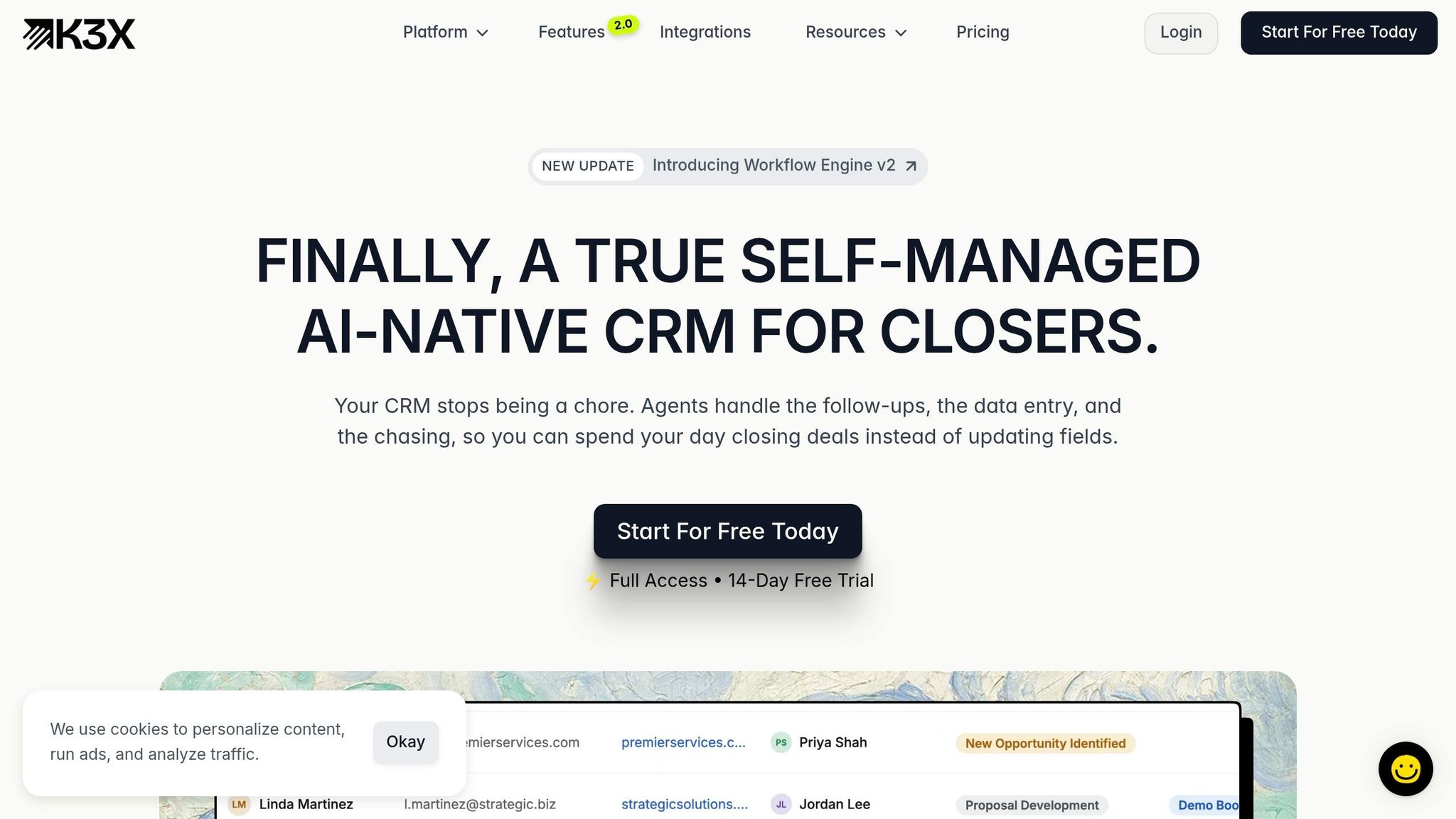
I’d choose K3X if I run a small sales team and want less manual CRM work each day.
Based on the article, K3X fits best when these points match my situation:
My team has 1–9 people
I want AI to handle follow-up logic
I need built-in calls and SMS
I do not want to build boards and recipes first
I care more about execution than cross-team work management
The article also points out the tradeoffs: smaller native integration catalog, credit usage to monitor, and less depth for 100+ seat governance-heavy deployments.
Who should choose monday CRM?
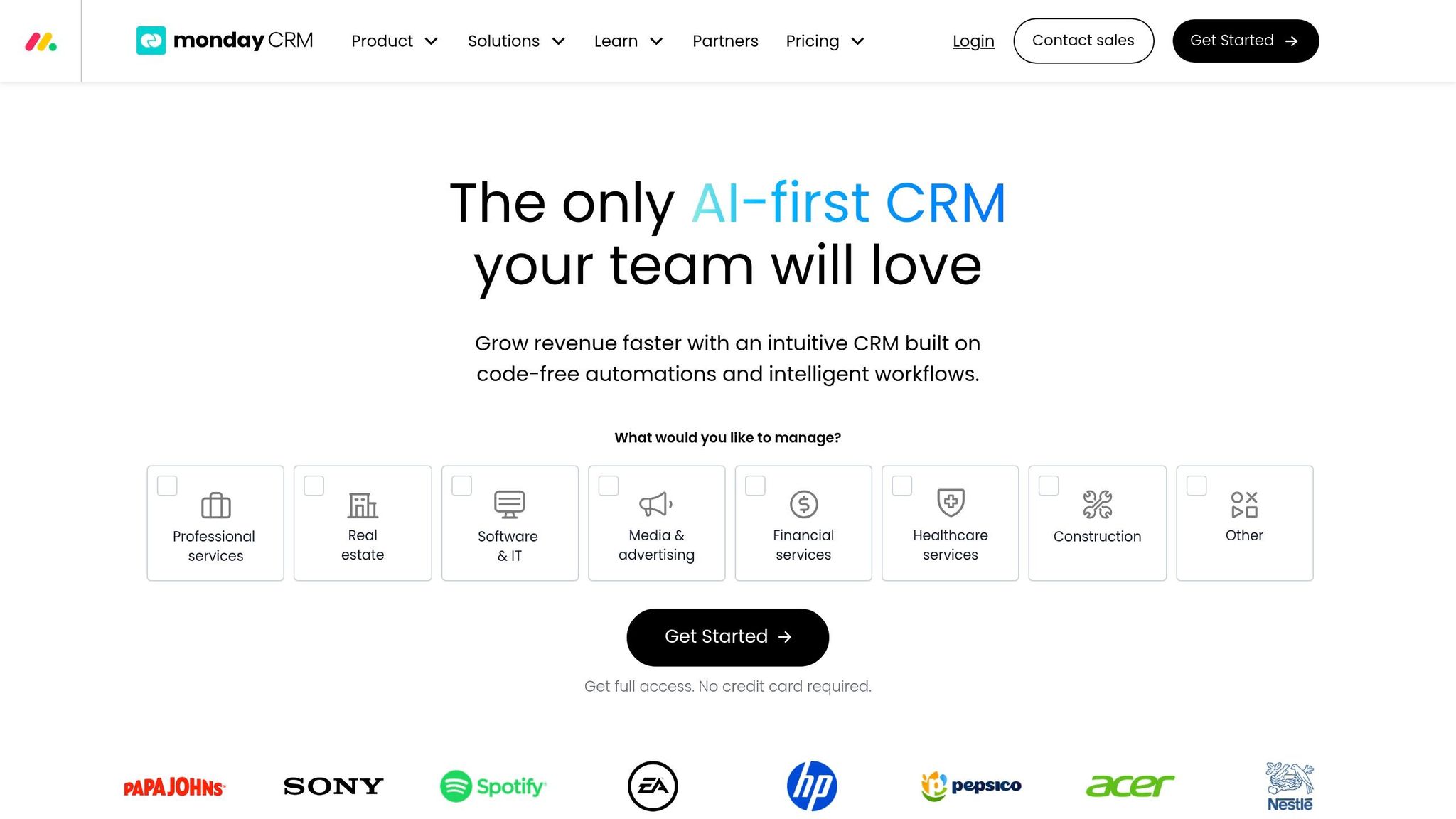
I’d choose monday CRM if I want control, cross-team workflows, and a more established admin and support setup.
It makes more sense when these needs matter most:
I want a board-based CRM
Sales must connect closely with delivery, onboarding, or marketing
I need 200+ integrations
I want more admin and compliance controls
I am fine building and maintaining automations myself
The article highlights the main catches too: 3-seat minimum, annual billing on entry pricing, automation caps on lower tiers, and likely extra spend for telephony.
What if I want to move from monday CRM to K3X?
The data can move, but the workflow logic has to be rebuilt.
The article says monday CRM data can be exported by CSV and imported into K3X. That covers contacts, companies, deals, and custom fields. What does not transfer as-is are:
Board layouts
Custom setup structure
Automation recipes
So the move is not a one-click migration. I would export the data, import it into K3X, then rewrite each monday automation as a plain-language outcome inside K3X.
My bottom line
K3X is the better pick for small sales teams that want AI-driven execution. monday CRM is the better pick for teams that want a board-based CRM inside a larger work management system.
If I care most about low setup time, built-in calling/SMS, and AI-led follow-up, I would lean toward **K
TL;DR: K3X or monday CRM - which one should you pick?
Pick K3X if you have a 1–9 person sales team and want AI agents to run follow-ups, calls, SMS, and pipeline updates for you. Pick monday CRM if you want a more established, board-based CRM that ties sales to other teams with rule-based automations.
K3X starts at $20 per seat/month and includes 1,000 AI credits plus a built-in power dialer. The table below compares pricing, setup, automation, integrations, and support.
K3X vs monday CRM: side-by-side comparison

K3X vs monday CRM: Side-by-Side Comparison 2025
K3X is built to do sales tasks from prompts. monday CRM is built to organize sales tasks through boards, columns, and automation recipes. For buyers comparing day-to-day use, the main gaps show up in setup, automation, integrations, and total cost.
K3X | monday CRM | |
|---|---|---|
Starting price | $20 per seat/month [3] | $12 per seat/month, billed annually; 3-seat minimum [10] |
Free trial/tier | 14-day free trial; no free tier [3] | 14-day free trial; no free tier for the CRM product [10] |
Setup model | Prompt-driven - describe the outcome and the AI builds the logic | Manual - configure boards, columns, statuses, and recipes |
Who configures it | Non-technical sales reps | Admins or operations teams |
AI/automation model | Outcome-driven AI agents that execute follow-ups, SMS, calls, and pipeline updates | Rule-based if-then automation recipes; AI assists with drafting and summarizing |
Calling/SMS | Built-in power dialer and SMS; 1,000 AI credits included per seat [3] | Usually depends on third-party calling/SMS tools; AI Sales Agent is in beta for U.S. users [5] |
Integrations | Webhooks and API-first, with a smaller native catalog [3] | 200+ native app integrations via marketplace [7] |
Best for | Small sales teams of 1–9 people that want AI to handle execution | Cross-functional teams that want a visual pipeline tied to broader work management |
The price gap looks smaller once you account for how each product is bought and used. monday CRM starts at $12 per seat per month, but it requires at least 3 seats and annual billing on that entry plan [10]. K3X starts at $20 per seat per month with no free tier, and each seat includes 1,000 AI credits, which affects how far the base plan goes before added usage comes into play [3].
How does K3X pricing compare to monday CRM?
K3X is simpler on price. It charges $20 per user per month with AI, calling, and SMS credits included, while monday CRM uses tiered annual pricing, a 3-seat minimum, and plan-based limits on features and automations [3][10].
K3X also offers a 14-day free trial at k3x.ai/pricing and does not require a long-term contract [3]. For teams that want a straight per-user cost, that makes budgeting easier.
How K3X pricing works
Each K3X seat costs $20 per month and includes 1,000 AI/Twilio credits each month [3]. That bundle includes 500 AI credits, 250 calling credits, and 250 SMS credits, plus the built-in power dialer [3].
The math is simple: number of users × $20. In practice, the main moving part is credit usage. If a team uses more calls, texts, or AI actions, that usage becomes the cost variable. monday CRM works differently because cost can climb through seat buckets and automation caps.
monday CRM pricing tiers and trade-offs
monday CRM uses annual-billing plans with different limits for automations and contacts [4][10].
Plan | Price (annual) | Automation limit | Contact limit |
|---|---|---|---|
Basic | $12/seat/month | No automations or integrations | 1,000 |
Standard | $17/seat/month | 250 actions/month | 10,000 |
Pro | $28/seat/month | 25,000 actions/month | 100,000 |
Ultimate | Custom | 250,000 actions/month | Unlimited |
There are two main trade-offs here. First, monday CRM sells seats in fixed buckets, so a 6-person team may be billed for 10 seats [10]. Second, automation limits apply at the account level. On the Standard plan, that means 250 automation actions per month across the account, and if the team goes over that limit, automations pause until the next billing cycle [10].
That can change the real monthly cost fast. Unused seats still cost money, and many teams also need third-party calling software on top of monday CRM [10][11]. So the biggest cost drivers are seat waste and automation volume.
Common monthly costs at current pricing look like this:
Team size | K3X total | monday Standard | monday Pro |
|---|---|---|---|
4 users | $80 | $85 (5-seat bucket) | $140 (5-seat bucket) |
6 users | $120 | $170 (10-seat bucket) | $280 (10-seat bucket) |
9 users | $180 | $170 (10-seat bucket) | $280 (10-seat bucket) |
These monday CRM prices use annual billing and do not include third-party calling subscriptions [10][11].
Where K3X and monday CRM sit on price
K3X sits near the middle of the CRM market on list price, but its base seat includes more day-to-day sales execution tools. At $20 per user per month, it lands between Zoho CRM Standard at about $14 per user/month and Pipedrive Growth at about $24 per user/month [8][10].
At the higher end, HubSpot Sales Hub Pro is roughly $100 per user/month and Salesforce Sales Cloud Pro is around $165 per user/month [8][10]. Close often costs more as well, since calling is bundled. For small sales teams, K3X keeps AI and calling in the base seat instead of pushing those needs into add-ons or outside tools.
How Fast Can Non-Technical Teams Set Up K3X vs monday CRM?
K3X is faster for non-technical teams. Most small teams can go live in under 1 hour without technical help, while monday CRM often takes 1–2 weeks to reach a usable setup and usually works better with an admin or RevOps owner in the mix [1][9].
That setup gap matters right away. It changes who can launch the system, how much time the team spends building workflows, and how much manual upkeep follows later.
How K3X's Prompt-Driven Setup Works
K3X starts with a plain-language instruction instead of a menu of rules. A rep or founder can type, "follow up every inbound lead within 5 minutes until they book or decline", and K3X's AI agents map the steps, timing, and follow-up logic automatically - no triggers, sequences, or conditions to configure [2][1].
That shifts setup to the person closest to the sales motion. In many small companies, that’s the founder or a frontline seller, not a systems admin.
monday CRM can still work well, but teams usually need to build the pipeline structure first. So the work starts with system design, not with the sales outcome the team wants.
How monday CRM's Board, Field, and Recipe Configuration Works
monday CRM starts with templates, but teams still need to define stages, fields, permissions, and automation recipes [5]. From day one, the team owns that configuration and has to update it as the process changes.
Feature | K3X | monday CRM |
|---|---|---|
Setup time | Under 1 hour [1] | 1–2 weeks [9] |
Primary owner | Founders / frontline sellers | Admin / RevOps lead |
Setup method | Natural language prompts | Manual board & recipe config |
Logic type | Outcome-driven AI agents | Rule-based if-then recipes |
Maintenance | Agents adapt automatically | Requires manual rule updates |
For small teams without an ops owner, K3X is the faster path. After launch, that early setup difference also affects how much manual work each system still needs.
How Do K3X and monday CRM Handle Automation Differently?
K3X uses plain-language instructions to carry out sales tasks, while monday CRM uses rule-based recipes that trigger set actions. In practice, K3X is built to do the work for small teams, and monday CRM is built to automate parts of a process that someone has already mapped out.
That difference shows up fast in day-to-day use. K3X focuses on execution across follow-ups, calls, SMS, and pipeline updates. monday CRM focuses on triggers and actions, with monthly limits that can stop automations when an account hits its cap. Automation also only goes so far if the CRM does not connect well with the rest of the stack.
K3X: AI Executes Sales Work Directly
K3X lets a rep type a goal in plain language and then carries out the sales work tied to that goal. For example, a rep can write, "follow up every inbound lead within 5 minutes until they book or decline", and the AI agents manage the follow-up sequence.
As replies come in, the system changes the next step based on what the lead does. That means the rep is not building a workflow step by step first. K3X is an AI-native CRM aimed at teams with 1–9 seats, though larger teams may run into limits with its governance setup and credit model. [3]
monday CRM: Rule-Based Automation Recipes
monday CRM uses recipe-based automation. A trigger happens, then one action follows, so teams have to build rules manually to cover each part of a workflow.
A rule such as "when status changes, notify owner and move to archive" uses two actions in one rule. On the Standard plan, an account gets 250 actions per month. On Pro, that limit goes up to 25,000 actions per month. [4][10]
monday's AI layer, Sidekick, can help with summaries, draft emails, and next-step suggestions. But it does not run the pipeline from start to finish on its own.
When an account reaches its monthly cap, those automations stop until the next billing cycle. [10] For revenue teams, that makes usage limits part of the buying decision, not just a pricing footnote.
What Does That Mean for Day-to-Day Sales Operations?
For daily sales work, the gap is pretty simple: K3X is set up to turn goals into actions, while monday CRM is set up to turn process rules into automations. One removes more admin work upfront; the other still depends on someone building and maintaining the logic.
That puts K3X closer to an execution layer for small teams. Salesforce, HubSpot, and Pipedrive still depend on admin-built workflows, and monday CRM fits that same general model. K3X removes more of that setup for smaller groups, while monday CRM turns pipeline work into rules.
How Do K3X and monday CRM Compare on Integrations?
Integrations shape how much work your CRM can handle on its own versus how much it has to hand off to other tools. monday CRM has the broader native integration footprint today, while K3X keeps things simpler with webhooks and API access. If your team needs one system to connect sales, marketing, and ops, monday CRM is the broader fit. If you mostly need core sales tools and a few custom triggers, K3X is easier to keep under control. For sales teams, that often decides whether the CRM can trigger work directly or just move data from one app to another.[13][3][1]
K3X Integration Approach
K3X leans on webhooks and API connections instead of a large native app marketplace. It offers webhook support and API access for custom connections, which gives teams room to build the flows they need.[1][3]
The trade-off is pretty clear: fewer native apps out of the box. If your team uses tools beyond the core sales stack, someone may need to wire those connections through webhooks or the API. That can be fine for a lean RevOps setup, but it adds work when the stack gets larger.
monday CRM Ecosystem Strengths
monday CRM stands out for native coverage. Its marketplace includes 200+ integrations, which gives teams more ready-made ways to connect sales workflows with ops, onboarding, and project work.[13]
That wider app catalog matters when different teams rely on the same customer data. Instead of building each connection from scratch, teams can often start with marketplace recipes and then adjust from there.[5]
Feature | K3X | monday CRM |
|---|---|---|
Native app count | Smaller sales-stack catalog | 200+ native integrations [13] |
Integration model | Marketplace recipes [5] | |
Setup complexity | Lower for standard use; higher for custom work | Lower for common apps; higher for custom work |
Best for | AI-driven sales execution | Cross-functional teams |
If integrations mostly exist to support selling, K3X is simpler to run. If the CRM also needs to connect sales with operations, onboarding, or project work, monday CRM is the better fit. The gap shows up most when support needs and product depth depend on how much custom work your stack requires.
How Mature Are K3X and monday CRM, and What Support Can Buyers Expect?
monday CRM is the more mature product. It was founded in 2012 and serves more than 225,000 organizations, while K3X is a newer AI-native CRM built for small teams.[6][3] In practice, that gap shows up in support coverage, template volume, and admin controls.
Where monday CRM Has the Edge
monday CRM has the broader support setup. Buyers get 24/7 support, a CRM Academy, webinars, a community forum, and a partner network. Enterprise customers can also get Customer Success Managers.[4]
That matters for teams that need more than basic troubleshooting. If you expect formal onboarding, self-serve training, and outside implementation help, monday CRM gives you more paths to get there.
Its Ultimate tier also includes HIPAA compliance, SAML SSO, audit logs, and multi-level permissions.[4][10] For regulated teams or groups with several admins, those controls can make a big difference.
Where K3X Has the Edge
K3X is built for speed and lower admin work. Instead of a large support ecosystem, it focuses on a lighter setup model that small teams can get running fast.
K3X says setup takes under an hour, with email support on Starter and dedicated onboarding on the Custom plan.[1][3] That approach fits teams that want to get live fast without spending much time on system design or process management.
The trade-off is scale and governance depth. K3X is younger and less suited to deployments with 100+ seats or teams that need heavier controls across many users.[3]
Feature | K3X | monday CRM |
|---|---|---|
Founded / scale | Younger, AI-native, small-team focus | Founded in 2012; 225,000+ organizations [6] |
Support | Email on Starter; dedicated onboarding/support on Custom [3] | 24/7 support, CRM Academy, webinars, community, partner network [4] |
Templates / setup | 200+ templates [6] | |
Governance | SSO and custom roles on Custom plan [3] | HIPAA, SAML SSO, audit logs, multi-level permissions [4][10] |
Best for | Teams that want AI to do the work | Teams that want a more mature, board-based CRM |
Who should choose K3X, and who should choose monday CRM?
The short answer is simple: choose K3X if you want the CRM to do sales work for you, and choose monday CRM if you want to run the process yourself inside a visual workspace. After pricing, setup, automation, and integrations, that’s the main split.
K3X leans toward execution. monday CRM leans toward operator control. For sales and revenue teams, that difference tends to matter more than feature checklists.
Choose K3X if...
K3X fits teams of 1–9 people that want to describe an outcome in plain language and let AI handle follow-up across email, SMS, and calls.[1][2][3] If your team wants fewer manual steps and less board-building, that’s the appeal.
The trade-off is that K3X is a younger product. It has a smaller native app catalog, needs credit tracking, and is not built for 100+ seat rollouts or deep governance needs.[1][3] In practice, that makes K3X the execution-first pick.
Choose monday CRM if...
monday CRM fits teams that want a board-based CRM with hands-on control and rule-based automation. It works well when sales needs to stay linked to project delivery, onboarding, or marketing work.[5][11]
It also has 200+ native integrations and stronger enterprise controls, including HIPAA compliance on higher tiers.[4][5][13] The main catch is the 3-seat minimum on paid plans.[5][12] That makes monday CRM the control-first pick.
The table below pulls the earlier trade-offs into one buying view.
Signal | Choose K3X | Choose monday CRM |
|---|---|---|
Team size | ||
Setup style | Plain-language prompts | Manual boards and templates |
Automation model | AI executes follow-ups and pipeline updates | Rule-based if-then recipes |
Calling/SMS | Built-in calling and SMS [3] | Third-party telephony and SMS integrations [11] |
Best fit | Sales execution | Sales plus delivery |
Ecosystem | Smaller native integration catalog | |
Maturity | Younger, AI-native platform | More mature Work OS ecosystem |
How do you move from monday CRM to K3X?
You move from monday CRM to K3X by exporting your CRM data, importing it into K3X, and then rebuilding your workflows inside K3X. monday CRM data can move over by CSV, but its board layout, custom field setup, and automation recipes do not carry over as-is to K3X’s prompt-based system.[2][3]
That’s why this is less of a straight import and more of a rebuild.
Data portability and rebuild expectations
Start with the data, then rebuild the logic. The migration has two parts: export your monday CRM boards as CSV files so you keep contact, company, deal, and custom field data, then import those files into K3X.[1][2][3]
After that, rebuild each workflow in K3X based on the result you want. Instead of copying over monday’s if-then automation recipes, describe the outcome in plain language, such as “follow up with every new inbound lead within 5 minutes until they book or decline,” and K3X handles the execution.[1][2][3] In practice, each monday recipe should be rewritten as a K3X outcome, not copied over step by step.
Use the approval step while you test the rebuilt process. K3X can let you review AI-drafted emails and actions before anything is sent, which gives you a check while you confirm the new setup matches the process you had in monday CRM.[2]
Once the workflow behaves the way your old one did, the rest of the move is mainly ongoing data cleanup and maintenance.
Conclusion: K3X or monday CRM - which fits your sales process?
Pick K3X if your sales team has 1 to 9 people and you want AI prompts to handle follow-ups, pipeline updates, and lead chasing. Pick monday CRM if you want a more established, board-based CRM that can support sales and other team workflows in one place.
The split is pretty simple. K3X leans toward small teams that want to move fast and cut manual CRM work. monday CRM makes more sense if your team already works in boards, needs more shared process across departments, or wants a CRM that sits inside a broader work management setup.