Sales Automation
•
K3X vs Attio: AI-Native CRM vs Flexible Data-Model CRM
AI-first platforms prioritize instant automation and minimal setup; graph-based CRMs offer flexible schemas but need longer implementation.

K3X and Attio cater to different CRM needs in 2026. K3X is built for sales teams seeking fast, AI-driven automation to reduce administrative tasks, while Attio focuses on customizable workflows for technically inclined teams with complex data structures. Both offer distinct advantages depending on your team's priorities, setup time, and budget.
K3X simplifies CRM with AI handling tasks like follow-ups and pipeline updates, starting at $20 per user per month with minimal setup time. Attio, starting at $34 per user per month, provides flexibility for teams needing custom data models but requires more upfront configuration. For quick deployment and automation, K3X is ideal. For tailored workflows, Attio excels.

K3X vs Attio vs Legacy CRMs: Full Platform Comparison 2026
Overview of K3X and Attio
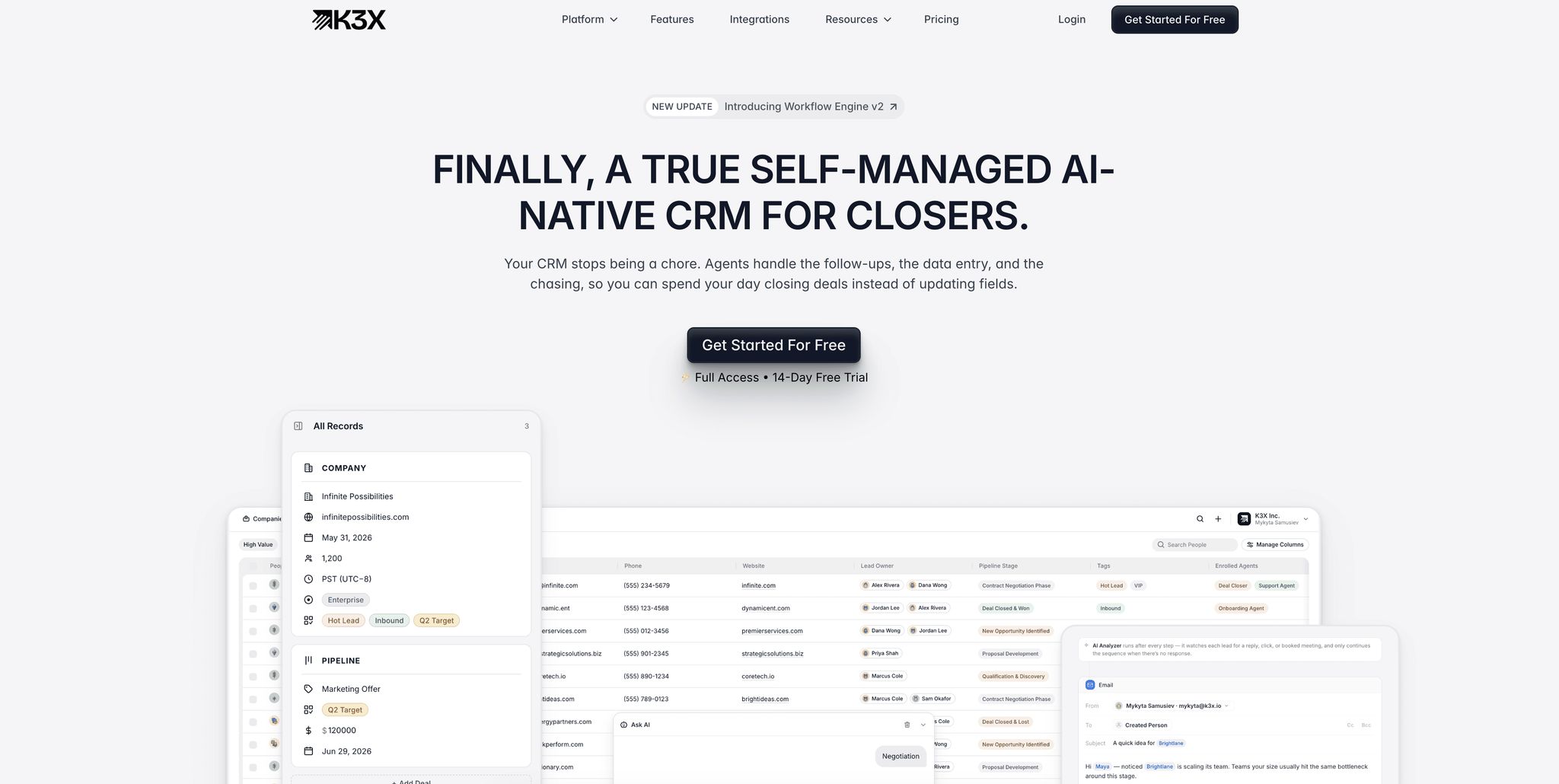
K3X focuses on simplifying sales through AI-driven automation, while Attio emphasizes customization with a flexible data model. Below, we explore how each platform operates and how they stack up against legacy CRM systems.
K3X: AI-Powered, Outcome-Oriented CRM
K3X takes a goal-driven approach to CRM. Users simply state their objectives in plain language - like "Follow up with leads who haven't responded in five days" - and the AI handles tasks such as follow-ups, updating pipeline stages, data entry, and outreach without manual effort [1].
The platform is designed to be self-sufficient, eliminating the need for IT support, dedicated admins, or lengthy onboarding processes. According to K3X, users can go from signup to full functionality in less than an hour [1]. The pricing is straightforward at $20 per seat/month, which includes 1,000 AI credits, unlimited integrations, a built-in power dialer, and unlimited workflow automations - all without requiring long-term contracts.
In December 2025, Ruby Capital Group implemented K3X within two days. The result? A 70% reduction in follow-up time and a threefold increase in ticket resolution speed [1]. This streamlined approach addresses common inefficiencies in traditional CRMs.
"We're building a CRM that works the way people expect it to... through intention. You tell it the outcome. The system figures out the work." [1] - Mykyta Samusiev, Co-Founder & CEO of K3X
Attio: Customizable Data-Model CRM
Attio offers a different take by allowing teams to build custom data structures tailored to their specific needs. Each record is treated as an object, and users can define relationships between objects. For instance, teams can link investors to portfolio companies, contracts to multiple approving parties, or product usage data to deal stages [2].
This graph-based data model overcomes the rigidity of legacy CRMs, making it ideal for complex workflows. For example, a Series A fintech company used Attio in early 2026 to create a regulated contract workflow requiring approval from a Buyer, a Legal officer, and a Compliance officer. They built a fully reportable deal review pipeline in just one afternoon, solving issues that had previously caused data leaks in HubSpot's standard object model [2].
Attio integrates AI features - Research, Classify, and Summarize - directly into its workflows. These features are central to its functionality, as highlighted by Doug Camplejohn, CEO of Coffee:
"An Attio implementation is AI-native when the AI is load-bearing. Pull the AI out and the workflow stops working." [5]
Pricing begins at $34/seat/month for the Plus plan, with the Pro plan costing $69–$74/seat/month. Enterprise pricing is customized. Attio's $52 million Series B funding in August 2025 reflects strong investor confidence in its graph-based approach [8].
How Legacy CRMs Compare
Legacy CRMs like Salesforce, HubSpot, Pipedrive, Zoho, monday.com, and Close rely on fixed record structures and often require extensive manual configuration to align with a team's workflow.
Salesforce holds 20.7% of the global CRM market as of 2026 [3], offering robust customization and governance at a high cost. HubSpot is better suited for marketing-driven inbound teams but lacks the structural flexibility of Attio and requires weeks of setup [2]. Close caters to outbound-heavy teams with high call and SMS volumes, while Pipedrive and Zoho are geared toward SMBs needing straightforward pipeline management with minimal complexity.
Platform | Core Logic | Best For | Setup Time | Starting Price |
|---|---|---|---|---|
K3X | Outcome-based (AI prompts) | High-volume sales teams | Under 1 hour | $20/seat/month |
Attio | Object-based (flexible schema) | Technical GTM teams | Days–weeks | $34/seat/month |
Salesforce | Record-based (fixed objects) | Large enterprises | Months | ~$290/user/month |
HubSpot | Platform-first (all-in-one) | Marketing-led teams | Weeks | ~$90/seat/month |
Close | Sequence-based (outbound) | High-volume callers | Days | $49–$149/seat/month |
Pipedrive/Zoho | Pipeline-based (visual) | SMB sales teams | Days | $14–$20/seat/month |
The comparison highlights a key tension: balancing automation with flexibility. This trade-off is a major factor in why 70% of CRM projects fail to meet their goals [6].
Sales Automation and Workflow Design
This section explores how automation design sets K3X and Attio apart from traditional CRMs. It highlights K3X's goal-oriented AI model, Attio's rule-based precision, and the script-heavy complexity of legacy platforms, focusing on how these approaches impact operational efficiency.
K3X's AI-Driven Automation
K3X simplifies automation by using a prompt-based system instead of traditional workflow builders. For example, a command like "Book demo calls with every unresponsive lead" triggers automated messaging, updates the pipeline, and logs activity seamlessly [1].
This approach significantly reduces non-selling tasks, which consume 71% of sales teams' time, by automating data entry and updates [6]. Across more than 50 teams, K3X has saved over 312,000 hours of manual work, giving employees an average of 8 extra hours per week [1].
A notable example is Ruby Capital Group, which implemented K3X in December 2025. The 125-person firm deployed the system in just two days, cutting follow-up time by 70% and tripling ticket resolution speed [1].
"Most systems are linear. They follow fixed steps - and if something unexpected happens, the flow breaks... K3X works on goals. Instead of defining steps like 'Send this email, then wait,' you define the objective." - K3X FAQ [1]
K3X also avoids reliance on third-party tools like Zapier or Make, ensuring a straightforward setup and minimal maintenance [1].
Attio's Rule-Based Automation
Attio's automation is built on a graph data model, allowing users to visually define triggers and actions. For example, changing a deal stage to Negotiation could automatically create a task for legal review. This gives teams precise control over workflows [4].
However, this level of control requires upfront planning. Teams must define objects, attributes, and relationships before automation can deliver value [4][9]. On average, setting up Attio takes 14 to 16 days [8]. For advanced use cases, teams often depend on external tools like n8n or Clay to handle time-based delays or re-enrollment logic [2].
Attio's AI features - Research, Classify, and Summarize - focus on enriching and organizing data rather than executing tasks like outreach or follow-ups [2]. As Abhishek Singla, Founding GTM Engineer at Ziellab, explains:
"Attio is a better CRM. HubSpot is a better platform." [2]
This underscores Attio's strength in managing structured data, though it lacks the hands-off sales execution capabilities seen in other systems.
How Legacy CRMs Handle Automation
Legacy platforms like Salesforce, HubSpot, Pipedrive, Zoho, monday.com, and Close rely on script-based, linear automation. These systems execute tasks in order, but workflows often break when unexpected events occur [1]. For example, Salesforce's "Flows" offer detailed control but are known to be fragile, requiring dedicated administrators to maintain them. This contributes to the $285,000–$330,000 annual cost for a 50-user Enterprise deployment [3].
HubSpot's workflow engine supports advanced features like re-enrollment and lead scoring decay. However, configuring it to a functional state typically takes a 10-person team about four weeks [2]. Close and Pipedrive are quicker to set up but are limited to fixed pipeline stages and sequence-based outreach, offering little flexibility.
Feature | K3X | Attio | Salesforce / HubSpot |
|---|---|---|---|
Automation Logic | Outcome-based (AI prompts) | Rule-based (triggers/actions) | Script-based (linear steps) |
Setup Time | Under 1 hour | 14–16 days | 1–6 months |
External Tools Needed | No | Often (n8n, Clay) | Often (Zapier, custom dev) |
Maintenance | Self-managed AI | Manual rule updates | Dedicated admins required |
Starting Price | $20/seat/month | $29/seat/month | ~$90–$290/seat/month |
Legacy CRMs often involve complex, time-consuming setups and high maintenance costs. Attio requires significant initial configuration, while K3X's AI-driven automation provides a faster, more streamlined alternative. The 70% failure rate of CRM projects [6] often stems from underestimating the ongoing cost of maintaining rule-heavy systems, a challenge that K3X's prompt-driven design aims to solve.
Data Organization and Reporting
How you organize and report data can significantly affect the balance between selling time and administrative tasks. K3X and Attio take very different approaches - K3X automates the data layer entirely, while Attio provides tools to create a custom data structure. Here’s a closer look at how K3X uses AI to simplify sales data management.
K3X's AI-Managed Sales Data
K3X eliminates manual data entry by automatically logging activities, updating pipeline stages, and suggesting next steps through natural language prompts [1]. For example, when a rep completes a call or sends an email, K3X handles the follow-up admin tasks, giving reps more time to focus on selling.
On the reporting front, K3X offers live dashboards and performance insights that activate within minutes of connecting your tools. Its "Performance Insights" feature pinpoints where deals are stalling and advises reps on where to concentrate their efforts. As Mykyta Samusiev, Co-Founder & CEO of K3X, explains:
"Most CRMs record activity. K3X understands outcomes. It listens, knows what changed, and makes the next moves." [1]
K3X boasts 92% efficiency in generating reports and 99.8% compliance accuracy, all without requiring any business intelligence (BI) configuration [1].
Attio's Custom Data Structures and Views
Attio, on the other hand, allows users to design custom objects like "Workspaces", "Investors", or "Partners", and establish many-to-many relationships between them [7][8]. This makes it a strong option for companies with unconventional business models, such as those in product-led growth or two-sided marketplaces.
A standout feature is Attio's AI Attributes, which act as dynamic fields that can summarize email threads, classify leads by ICP tier, or extract details from unstructured conversations [7]. As Sejla Hajric from CRM.org describes:
"Attio's AI Attributes act like living fields that summarize emails, classify records, or extract details from messy conversations." [7]
Additionally, Attio supports the Model Context Protocol (MCP), enabling external AI tools such as Claude to directly access and update CRM records [11]. This capability extends its data organization potential beyond the platform itself. It also supports queries on datasets with millions of records in under 50 milliseconds [14]. However, creating a useful schema can take anywhere from a few hours to several weeks, depending on the complexity [11][12].
These differences in approach set the stage for how each platform handles reporting.
Reporting Across Platforms
The key difference in reporting lies in immediacy versus customization. K3X offers live reporting right out of the box, requiring no setup. Attio, by contrast, provides flexible, customizable views - any list can be displayed as a Kanban board or table - but requires a pre-designed schema to make those views functional [7].
One limitation of Attio is its lack of native reporting at the individual sales rep level, often requiring workarounds or external tools to fill the gap [14]. In comparison, legacy platforms like Salesforce and HubSpot offer advanced BI-layer reporting but often require months of implementation and dedicated administrative resources.
The table below summarizes these differences:
Feature | K3X | Attio | Salesforce / HubSpot |
|---|---|---|---|
Reporting Basis | Outcome-based prompts [1] | Flexible object lists [7] | Standardized dashboards [13] |
Analytics Depth | Live performance & deal slowdown alerts [1] | Pipeline visibility & segment trends [7] | Advanced, customizable BI dashboards [13] |
Setup Speed | Under 1 hour [1] | Days to weeks [7] | 3–6 months [3] |
Actionable AI | Intent-based next steps [1] | AI-summarized records & attributes [7] | Predictive lead scoring [3] |
Rep-Level Reporting | Built-in [1] | Requires workarounds [14] | Built-in (complex setup) [3] |
Starting Price | $20/seat/month [1] | $29/seat/month [7] | ~$90–$290/seat/month [3] |
Ultimately, the choice depends on your team’s priorities. If you value instant, no-setup reporting, K3X is ideal. For those with complex data models who need a highly customizable architecture, Attio’s flexibility can justify the initial setup time.
Setup, Maintenance, and Total Cost
This section builds on previous comparisons by focusing on setup efficiency and total ownership costs. It highlights how setup time and ongoing expenses vary across CRMs, particularly for U.S. SMBs.
K3X's Setup and Cost Structure
K3X prioritizes simplicity and speed. Most teams can get started in under an hour by connecting existing tools and setting goals using plain-language prompts, eliminating the need for complex migrations, IT support, or additional integrations [1]. Mykyta Samusiev, Co-Founder & CEO of K3X, explains:
"K3X is the first CRM that runs on prompts... You tell it the outcome. The system figures out the work." [1]
Once operational, K3X's AI handles data logging, follow-ups, and pipeline updates without requiring dedicated administrators [1]. Pricing is straightforward at $20 per seat per month, including 1,000 AI credits. Costs scale with usage but revert to the base rate during slower periods, with no contracts or hidden fees.
Attio's Customization and Upkeep
Attio offers flexibility but requires upfront effort to unlock its potential. Teams need to design a custom data model before using the system effectively. Typical implementations take 12–16 days with partner assistance, and more complex setups can take weeks. These configurations involve creating custom objects, multi-directional relationships, and AI attributes [8].
Delin Sirkov, Senior RevOps Specialist, highlights the challenge:
"Attio requires you to design your data model before it delivers value... Teams that want to open a CRM and start logging activities immediately will experience friction in the first two weeks while they configure objects, attributes, and views." [9]
Although ongoing maintenance is lighter than with legacy CRMs, teams must keep custom data structures aligned with evolving sales processes. Attio also lacks certain built-in features, like a dialer, leading to additional integration costs as businesses scale. Pricing starts at $29 per user/month for the Plus plan, increasing to $59–$74 for the Pro plan and approximately $119 for the Enterprise tier [8].
Cost and Complexity of Legacy CRMs
Legacy CRMs require more infrastructure and administrative support compared to K3X and Attio. For example, Salesforce implementations typically take 3 to 6 months and require 1 to 3 dedicated administrators [3]. A 50-user Salesforce Enterprise deployment can cost between $285,000 and $330,000 annually, including licenses, admin salaries, and support expenses [3]. This is roughly 8 to 10 times the cost of a comparable Attio Pro setup, which is about $35,400 per year.
HubSpot offers a lower entry-level cost at $20 per seat/month for its Starter plan, but expenses rise quickly. Professional tiers cost $100 per seat/month, and onboarding fees range from $1,500 to $10,000 per hub [8]. Pipedrive provides lower starting prices but requires manual workflow configuration, adding hidden time costs.
Summary of Costs and Setup Times
The table below compares the platforms:
Platform | Starting Price | Setup Time | Admin Requirement | Data Entry |
|---|---|---|---|---|
K3X | $20/seat/month [1] | Under 1 hour [1] | None (self-managed) [1] | Fully autonomous [1] |
Attio | $29/user/month [8] | 12–16 days [8] | Minimal (self-serve) [9] | Manual + AI enrichment [9] |
HubSpot | $20/seat/month [10] | Weeks | Moderate | Mostly manual |
Salesforce | $175/user/month [3] | 3–6 months [3] | 1–3 dedicated admins [3] | Manual-heavy [6] |
Pipedrive | $24/seat/month [10] | Days to weeks [10] | Low to moderate | Manual |
One major concern is that 70% of CRM projects fail due to poor user adoption, often caused by the burden of manual data entry [6]. K3X addresses this by automating data entry entirely, while Attio reduces the workload with passive data capture and AI enrichment. However, Attio still requires users to create or sync records from external tools.
For U.S. SMBs seeking fast deployment and minimal overhead, K3X's $20/seat pricing and rapid setup make it the most accessible option. Attio is better suited for technically inclined teams with unique business models willing to invest in upfront configuration. Legacy platforms like Salesforce and HubSpot are generally more appropriate for enterprises that need advanced compliance, reporting, and integration capabilities.
Use Cases: Picking the Right CRM
Selecting the right CRM - whether it's K3X, Attio, or a legacy system - depends on factors like your team's technical expertise, the complexity of your data model, and how quickly you need to see results. The following scenarios provide practical guidance on when each CRM might be the best fit, building on the platform comparisons discussed earlier.
When to Choose K3X
K3X is perfect for revenue-driven teams aiming to reduce administrative tasks immediately. If your sales reps are bogged down with updating records or chasing leads instead of closing deals, K3X can help. Its prompt-driven model lets you focus on outcomes, like "book demo calls with inbound leads", while the AI manages follow-ups, pipeline updates, and data logging automatically - no manual effort required [1]. Ruby Capital Group's experience highlights the platform's effectiveness, showing quick deployment and performance improvements [1]. At just $20 per user per month and no long-term contracts, it's an affordable option with a quick return on investment.
When to Choose Attio
Attio shines when your business doesn't operate within the typical contact-company-deal framework. Teams handling investor relations, multi-party contract approvals, or product-led growth (PLG) pipelines will benefit from Attio's graph-based data model, which offers a level of flexibility that legacy CRMs can't match right out of the box [2]. This makes it especially useful for workflows requiring detailed and customizable relationships between data points [2][4].
Attio is designed to support go-to-market (GTM) strategies where scalability and customization are priorities [4]. However, it's best suited for organizations with a GTM engineer or RevOps lead who can manage the schema and API integrations. Without such technical expertise, the initial setup may slow down adoption.
When Legacy CRMs Make More Sense
Legacy CRMs like Salesforce or HubSpot are better suited for organizations with specific compliance requirements, such as HIPAA, FedRAMP, or SOX. They also work well for companies needing an all-in-one platform that integrates marketing automation, sales, and customer service [3]. Salesforce, in particular, is ideal for enterprises with over 200 users, complex territory management needs, or multi-cloud data unification, though it comes at a steep price. For example, a 50-user Salesforce deployment can cost between $285,000 and $330,000 annually [3]. For smaller U.S. businesses, these features may be overkill, especially when faster and more affordable alternatives are available.
The table below provides a quick reference for these scenarios:
Scenario | Best Fit |
|---|---|
Fast setup, no admin, AI-driven follow-ups | K3X |
Custom data model, non-standard relationships | Attio |
HIPAA/FedRAMP compliance required | Salesforce |
Unified marketing + sales + service suite | HubSpot |
Budget-conscious team, simple pipeline | Pipedrive |
FAQs
How do I choose between K3X and Attio for my team?
Pick K3X if you're looking for quick automation of follow-ups, stage transitions, and data entry with minimal effort - it can be up and running in under an hour. For those who need a modern interface, a flexible graph-style data model, and quicker schema adjustments, Attio is a better fit, with onboarding typically taking 1–3 days. If your team lacks a dedicated RevOps expert, K3X’s goal-driven prompts simplify admin tasks more efficiently compared to Attio when relying on external tools.
What data should I migrate before switching CRMs?
Before transitioning to a new CRM, take time to review your data - studies show that 30% to 40% of legacy records are often outdated. Start by securely exporting all relevant records, including contacts, companies, deals, activities, and custom fields. Prioritize migrating essential data, such as active contacts, open deals, and recent notes. Use unique identifiers, like email addresses or domain names, to eliminate duplicates. Avoid cluttering the new system by leaving behind stale records and unused fields. Rely on the new CRM's built-in tools to refresh firmographic and contact details as needed.
How do AI credits affect K3X’s monthly cost?
K3X employs a usage-based pricing model centered on AI credits. For a base price of $20 per seat, each seat comes with 1,000 AI credits per month. If usage increases during busy months, costs adjust accordingly, while slower periods see automatic reductions. Unlike competitors such as Salesforce and HubSpot, K3X provides access to AI features without requiring costly tier upgrades or imposing unpredictable per-conversation fees.