Sales Automation
•
Best AI-Native CRM Software in 2026
AI-native CRMs cut admin work with goal-driven automation; K3X leads for sales teams, Salesforce for enterprises, HubSpot for SMBs.

The best AI-native CRM in 2026 depends on your team's size, budget, and needs. For sales teams prioritizing automation and simplicity, K3X stands out with its $20/seat/month pricing, quick deployment, and AI-driven workflows. Larger enterprises may prefer Salesforce for its customization, while SMBs often choose HubSpot for its integrated sales and marketing tools. Platforms like Pipedrive and Zoho offer cost-effective options, while Close and Attio cater to specific use cases like inside sales and complex data models. Each tool has trade-offs in pricing, features, and ease of use.
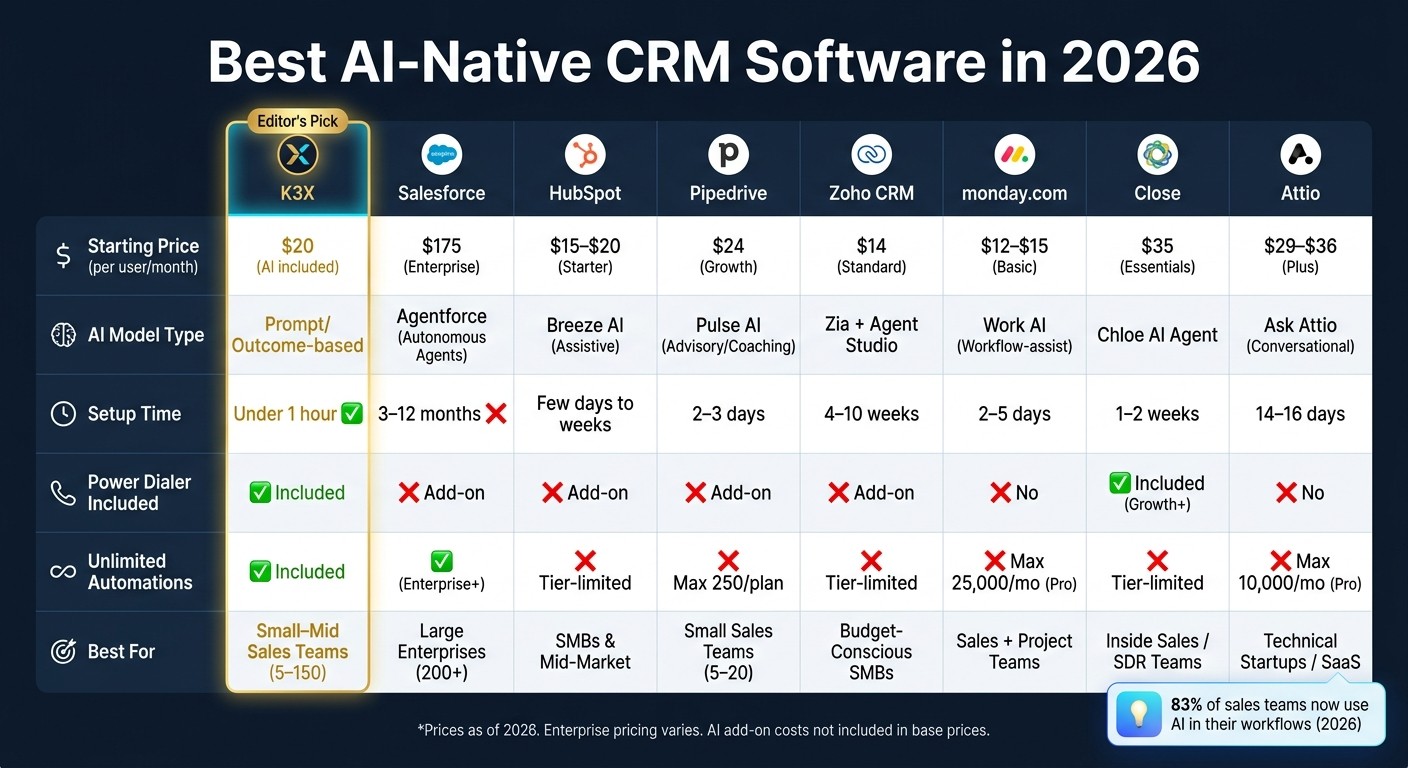
Best AI-Native CRM Software Compared: Pricing, AI & Features (2026)
Top 10 CRM Systems In 2026 | Best Customer Relationship Management Software | Leading CRM Systems
1. K3X
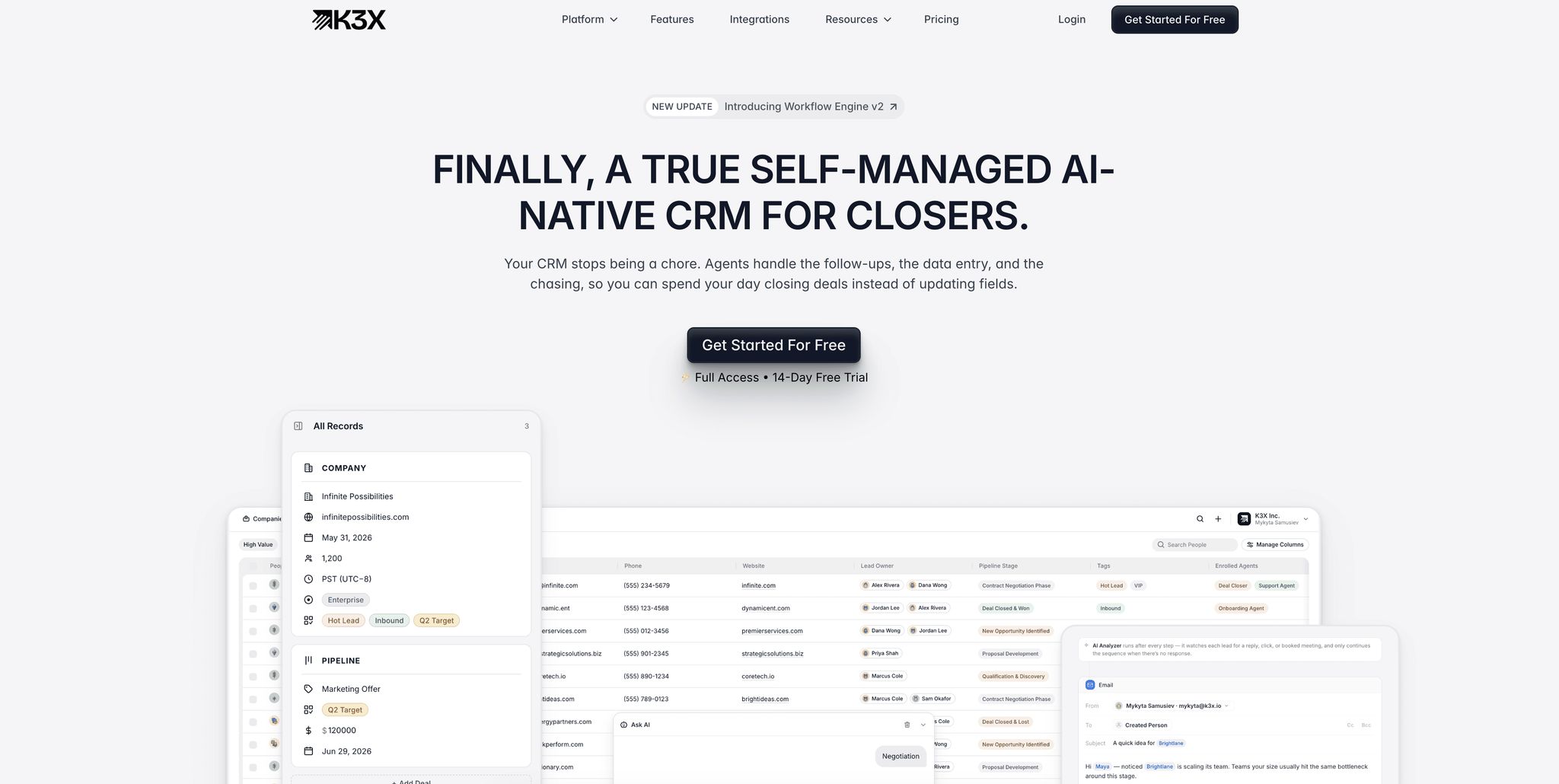
K3X stands out as an AI-native platform designed entirely around user-defined outcomes. Unlike traditional CRMs that integrate AI into existing frameworks, K3X was built from scratch to let users focus on goals while the AI manages execution. This eliminates the need for flowcharts, trigger setups, or dedicated administrators.
AI Model
K3X takes a unique approach to AI by prioritizing natural language interaction. Instead of navigating complex configurations, users can issue straightforward prompts like, "Book demo calls with every lead who hasn't responded in five days." The platform then handles all necessary steps - scheduling, outreach, and pipeline updates - automatically [3]. It also reduces manual data entry by logging emails, recording calls, and updating contact records in real time. This is crucial, as traditional CRM data can become 47% incomplete or outdated within six months [7][8].
This focus on outcomes makes K3X highly adaptable, transitioning seamlessly into advanced automation capabilities.
Automation Capabilities
K3X's automation prioritizes outcomes over rigid workflows. Unlike the fixed logic of tools like Pipedrive or Zoho, K3X adjusts in real time based on lead activity [3]. This adaptability ensures follow-ups and pipeline stages remain relevant.
The platform integrates automation directly, avoiding reliance on third-party tools like Zapier or Make. With built-in features such as email, calling, SMS, and a one-click power dialer, K3X keeps data centralized and minimizes integration challenges. On average, users save 8 hours per employee each week, with the system automating over 312,000 hours of work and cutting operational costs by $12.4 million [3].
An example of this efficiency comes from Ruby Capital Group, a 125-employee funding company. After implementing K3X in December 2025, they reduced follow-up time by 70% and tripled ticket resolution speed within two days. CEO Michael Chkechkov shared:
"Our sales team was spending half their day on admin work. Now they're talking to customers and closing deals. The automation handles everything from lead qualification to contract routing." [3]
This level of automation boosts productivity while reducing operational expenses.
Pricing Structure
K3X offers a flexible Adaptive Pay-As-You-Go model at $20 per seat per month, with no long-term contracts. The base plan includes 1,000 AI credits monthly, unlimited contacts, leads, workflow automations, integrations, and a built-in power dialer with unlimited call recordings [3]. During high-activity periods, pricing adjusts automatically and reverts to the base rate when usage decreases.
By comparison, other platforms have more rigid pricing. Close's Growth tier costs $99 per seat per month, Attio's AI-native tier is $119 per user per month, and monday.com CRM starts at $12–$17 per seat but requires a three-seat minimum and charges extra for AI features.
Feature | K3X | Close (Growth) | Attio (Advanced) | monday.com CRM |
|---|---|---|---|---|
Base Price | $20/seat/mo | $99/seat/mo | $119/seat/mo | $12–$17/seat/mo (3-seat min) |
AI Model | Prompt/Outcome-based | AI Sales Agent (Chloe) | AI-native | AI Blocks/Add-ons |
Power Dialer | Included | Included | No | No (requires integration) |
Setup Time | Under 1 hour | Under 1 hour | Varies | 2–5 days |
Unlimited Automations | Included | Limited by tier | Limited by tier | Add-on dependent |
Ideal Use Cases
K3X is ideal for sales teams managing large lead volumes that require automated follow-ups without needing a dedicated CRM administrator. It’s especially beneficial for small- to mid-sized teams looking for enterprise-level automation - such as power dialing, AI-driven workflows, and real-time pipeline management - without the complexity or cost of traditional CRMs. Teams scaling quickly or frustrated by the lengthy setup of tools like Salesforce or HubSpot will appreciate K3X’s fast deployment (under one hour) and user-friendly, prompt-based interface [3].
2. Salesforce

Salesforce is a go-to CRM solution for large enterprises, known for its complex, data-driven AI capabilities. As of 2026, Salesforce holds an impressive 20.7% share of the global CRM market [19]. Its latest AI initiative, Agentforce, represents a shift toward autonomous AI agents that handle tasks independently, powered by the Atlas Reasoning Engine. According to Vantage Point:
"Agentforce represents Salesforce's pivot from assistive AI (Einstein copilots) to autonomous AI agents that can plan, reason, and take action without human intervention." [12]
AI Model
Agentforce has made a substantial impact, generating $540 million in ARR by early 2026 and serving 18,500 customers, with over 3 billion workflows processed monthly [13][14]. It leverages Data Cloud, which consolidates data from Sales, Service, Marketing, and Commerce into unified customer profiles, enabling real-time AI decision-making. Additionally, the Einstein Trust Layer ensures customer data remains secure and avoids being stored by external LLM providers, a critical feature for industries like healthcare and finance [4].
Unlike K3X's straightforward, outcome-focused interface, Salesforce's Agentforce requires more technical setup, relying on tools like Apex code and Flow automation. This distinction highlights a tradeoff between ease of use and the granular control Salesforce offers [3].
Automation Capabilities
Salesforce excels in enterprise-scale automation. Its platform enables multi-step workflows across departments, predictive lead scoring with Einstein AI, and territory-level forecasting hierarchies - key features for large, multi-department organizations. For instance, companies using Einstein Predictive Lead Scoring report conversion rate improvements of 20–35% [4].
However, this enterprise-level power comes with challenges. Implementations often take 3–12 months and require a certified Salesforce administrator [12][18]. A 2026 study found that 77% of B2B Agentforce deployments fail within the first six months, largely due to poor data quality [17]. On the other hand, success stories exist: a global manufacturer with over 50,000 employees achieved a 97% case deflection rate just 76 days after launch in May 2026, though this required a custom Bring-Your-Own-Model layer to meet Azure compliance standards [19].
These capabilities, while powerful, contribute to the higher costs and technical expertise needed to effectively use Salesforce.
Pricing Structure
Salesforce’s pricing reflects its enterprise-grade functionality. Following a 6% price hike in 2025, the Enterprise Edition costs around $175 per user/month, while the Unlimited Edition is priced at $350 per user/month [12][18]. Adding Agentforce functionality costs an extra $125 per user/month or $2 per AI conversation, and full AI capabilities via Data Cloud range from $50–$100+ per user/month [15].
Component | Cost |
|---|---|
Enterprise Edition | ~$175/user/mo |
Unlimited Edition | ~$350/user/mo |
Agentforce Add-on | +$125/user/mo or $2/conversation |
Einstein AI Add-on | $50–$220/user/mo |
Data Cloud | $50–$100+/user/mo |
For a 50-user team over three years, the total cost of ownership falls between $550,000 and $850,000, not including the salary for a dedicated administrator, which typically ranges from $100,000 to $160,000 annually [16]. By contrast, K3X offers a starting price of $20 per seat per month, with AI included in the base package [3].
Ideal Use Cases
Salesforce is best suited for large enterprises that can handle its configuration-heavy requirements. Its strengths lie in its AppExchange ecosystem - boasting over 4,000 apps - and its ability to support deep customization through tools like custom objects and Apex code [12][18]. However, for mid-sized teams or organizations without robust IT resources, Salesforce’s higher costs and complexity make AI-native alternatives like K3X a more practical choice.
3. HubSpot
HubSpot offers a CRM solution tailored to small and mid-sized businesses (SMBs) that want integrated AI without the complexity of enterprise-grade systems like Salesforce. While its AI features are layered onto a traditional CRM framework, it remains a strong contender for teams seeking streamlined functionality.
AI Model
HubSpot's AI framework, Breeze, includes a conversational assistant, automated agents for prospecting and support, and data enrichment for over 200 million company profiles [2]. The Prospecting Agent autonomously researches leads and drafts personalized outreach, while the Customer Agent resolves support tickets using context from the knowledge base. HubSpot also introduced the Model Context Protocol (MCP) server, which facilitates integration with external AI tools [20].
However, unlike K3X, HubSpot relies heavily on manual data entry, with AI analyzing data only after it has been input. Laurent Bouzon, Founder & CEO of SymbiozAI, sums it up well:
"HubSpot remains a system of record. Data accumulates there. AI analyzes it after the fact... Manual data entry stays the default mode." [1]
Automation Capabilities
HubSpot's automation tools are designed to meet the needs of SMBs effectively. Its Conversation Intelligence tool transcribes sales calls, flags mentions of competitors, and alerts managers to potential deal risks [2]. Predictive lead scoring prioritizes high-intent prospects based on engagement signals, eliminating the need for manual updates. HubSpot's internal data shows that 76% of sales professionals using Breeze AI report spending more time selling, and 73% report improved win rates [17][24].
However, HubSpot requires users to define workflow steps manually, unlike K3X, which can infer goals automatically. Additionally, HubSpot's setup process can take weeks, compared to K3X's rapid deployment time of under an hour [3].
Pricing Structure
HubSpot's pricing starts at an accessible level but can increase significantly as teams grow. The Starter plan costs $15–$20 per seat/month, while the Professional plan jumps to $100 per seat/month and includes a one-time onboarding fee of $1,500 [18][25]. The Enterprise plan is priced at $150 per seat/month, with a $3,500 onboarding fee [9][26].
Plan | Price (per seat/mo) | Key AI Features |
|---|---|---|
Free | $0 | Basic Breeze Copilot, 1M contacts |
Starter | ~$15–$20 | AI email writer, basic chatbots |
Professional | ~$100 | Predictive lead scoring, Prospecting Agent, Conversation Intelligence |
Enterprise | ~$150 | Breeze Agents, AI forecasting, custom AI objects |
For a 10-user team managing 15,000 contacts, HubSpot Professional costs approximately $12,680–$15,680 in Year 1, compared to Salesforce Enterprise's $49,800–$134,800 for the same scale [26]. However, HubSpot's costs can rise sharply when marketing contact thresholds are exceeded, making it crucial to account for Year 2 expenses before committing [18]. In contrast, K3X offers a flat rate of $20 per seat/month, including AI in the base package, making it a more predictable option for teams wary of scaling costs [3].
Ideal Use Cases
HubSpot is ideal for SMB and mid-market teams (approximately 10–500 employees) that need a unified platform for marketing, sales, and customer service without requiring extensive IT support. Its user-friendly interface, rated 8.6/10 on G2 [21], and all-in-one design eliminate many of the data synchronization challenges found in multi-tool setups. However, for teams focused solely on AI-driven sales execution rather than full-funnel marketing, solutions like K3X may offer faster implementation and lower costs.
4. Pipedrive

Pipedrive is a CRM designed primarily for sales teams, featuring a visually intuitive Kanban pipeline that makes it easy for smaller teams to adopt. Its AI tools focus on providing recommendations rather than automating tasks entirely. For example, Pulse AI evaluates deals to estimate win probabilities, identify risks, and propose next steps. Additionally, the AI Email Suite, powered by OpenAI, helps draft outreach emails and condense email threads, offering sentiment analysis and highlighting key actions [30]. As noted in the Surferstack Guide:
"Pipedrive's Pulse AI is less ambitious than HubSpot's Breeze or Salesforce's Agentforce. It does not autonomously write emails or qualify leads. Instead, it acts as a sales coach."
This coaching-oriented approach aligns with its straightforward automation tools, which are explained below.
Automation Capabilities
Pipedrive uses a simple rule-based automation system with "if/then" triggers, making it accessible but less advanced compared to platforms like K3X. The number of automations available depends on the plan: 50 on the Growth plan, 150 on Premium, and 250 on Ultimate [27]. Unlike K3X, where users can define sales goals and let AI handle the execution, Pipedrive requires sales reps to manually progress deals through the pipeline [3][27]. Despite this, teams can automate critical tasks such as lead assignment, follow-up emails, deal stage updates, and drip campaigns without needing coding skills. The LeadBooster chatbot also supports lead engagement around the clock, transferring qualified leads to live agents when necessary [30].
Implementation is relatively quick, typically taking 2–3 days and not requiring a dedicated administrator. This is faster than Salesforce's setup process but slower than K3X, which can be deployed in under an hour [18][28].
Pricing Structure
In November 2025, Pipedrive updated its pricing plans, replacing the Essential/Advanced/Professional tiers with Lite, Growth, Premium, and Ultimate [18].
Plan | Price (per user/mo, annual) | Key AI & Automation Features |
|---|---|---|
Lite | $14 | Visual pipeline; no automation or email sync |
Growth | $24 | 50 automations, email sync, AI deal scoring, forecasting |
Premium | $49 | 150 automations, Pulse AI, LeadBooster, e-signatures |
Ultimate | $69–$79 | 250 automations, sandbox, SSO, audit logs |
For most sales teams, the Growth plan at $24 per user per month is the minimum viable option, as the Lite plan lacks essential features like automation and email syncing [18][32]. A 10-person team using Pipedrive Premium would spend around $13,000–$15,000 in the first year, compared to $38,000–$48,000 for Salesforce Pro Suite. Pipedrive also avoids the onboarding fees charged by HubSpot ($1,500–$3,500) and does not use per-contact pricing, which can drive up costs. However, compared to K3X's flat $20 per user per month, which includes AI, Pipedrive's Premium plan is more expensive for similar features. That said, its ecosystem of over 500 native integrations with tools like Zapier, Zoom, and Gmail can add value for teams already using those applications [30][31].
Ideal Use Cases
Pipedrive is a good fit for small sales teams (5–20 members) with straightforward sales processes, such as prospecting, qualification, proposal, and closing. Its advisory AI approach is ideal for teams that prioritize ease of use and a clear visual pipeline over fully automated AI workflows. With a G2 ease-of-use score of 8.9/10, it’s recognized for its user-friendly design and is used by more than 100,000 companies across 179 countries [29][30]. While Pipedrive works well for teams looking for guidance-oriented AI, those seeking significant automation might lean toward platforms like K3X or Salesforce Agentforce.
5. Zoho
Zoho CRM is a well-established platform packed with features, complemented by its AI system, Zia. While it isn't built as an AI-first tool like K3X, it offers a solid combination of automation capabilities and affordability.
AI Model
In 2026, Zoho introduced Zia Agent Studio, a no-code tool that allows users to define AI behavior using plain language prompts [4]. This studio integrates with over 700 pre-built actions across the Zoho ecosystem, streamlining tasks such as record updates, task creation, and document analysis [4]. Zia also supports predictive lead scoring, detects sales anomalies, and provides "Next Best Action" recommendations based on historical success patterns [4].
Unlike K3X, which uses an outcome-focused design where users can set goals like "Book 10 demo calls this week", Zoho embeds its AI agents within a traditional CRM interface. This means users must navigate a feature-rich environment to fully utilize its capabilities [3][4].
Automation Capabilities
Zoho offers extensive automation options, especially given its price. The Blueprint process builder, included in the Professional plan ($23/user/month), ensures adherence to defined sales stages, preventing deals from bypassing critical steps [25][36]. At the Enterprise level, Zia adds real-time anomaly detection, which flags sudden drops in deal velocity or win rates, helping teams address issues before they escalate [36][37].
However, its complex interface can hinder adoption, with user engagement rates ranging from 40–60%, compared to over 80% for HubSpot [38]. Stephen Sexton, Director of Partnerships at NowADays Media, shared his thoughts:
"The user interface feels difficult, unintuitive, and cluttered. With a few weeks or months of practice and usage, I'm sure I could make it work powerfully, but it just felt…. meh." [33]
For teams seeking customization, Zoho's Canvas Design Studio allows no-code redesigns of the CRM interface, though it requires effort to configure effectively [23][36].
Pricing Structure
Zoho's pricing is a standout feature. The Enterprise plan, priced at $40/user/month, includes the full Zia AI suite without additional fees - a stark contrast to Salesforce, where similar AI tools require both the Enterprise base plan (~$175/user/month) and Einstein add-ons ($50–$125/user/month) [4][36].
Plan | Price (per user/mo, annual) | Key AI & Automation Features |
|---|---|---|
Standard | $14 | Scoring rules, basic automation, 10 pipelines |
Professional | $23 | Blueprint process management, webhooks, inventory |
Enterprise | $40 | Full Zia AI, Zia Agent Studio, CommandCenter, sandboxes |
Ultimate | $52 | Advanced analytics, QuickML (custom ML models), 25 Canvas views |
Zia AI features are only available with the Enterprise plan or higher [34][35].
Zoho also offers Zoho One for $37/user/month (all-employee pricing), bundling over 50 apps, including Zoho Books, Desk, and Projects. This makes it a cost-effective choice for teams seeking a unified business platform, not just a CRM [25].
Ideal Use Cases
Zoho is best suited for small and mid-sized businesses (SMBs) and mid-market teams looking for high-level AI features - like predictive scoring and anomaly detection - at a fraction of Salesforce or HubSpot's costs [4][35]. It’s especially advantageous for organizations already using other Zoho products, as Zoho One's ecosystem integration can amplify its value [35][37].
However, Zoho requires a greater time investment for setup and learning, with implementation timelines ranging from 4–10 weeks. This makes it less appealing for teams seeking quick deployment, like what K3X offers. Still, for those willing to navigate its learning curve, Zoho delivers excellent functionality at a competitive price. With over 250,000 businesses using the platform and an 8.4% share of the global CRM market [35][36], Zoho is a reliable, cost-effective choice for teams ready to invest time in its configuration.
6. monday.com
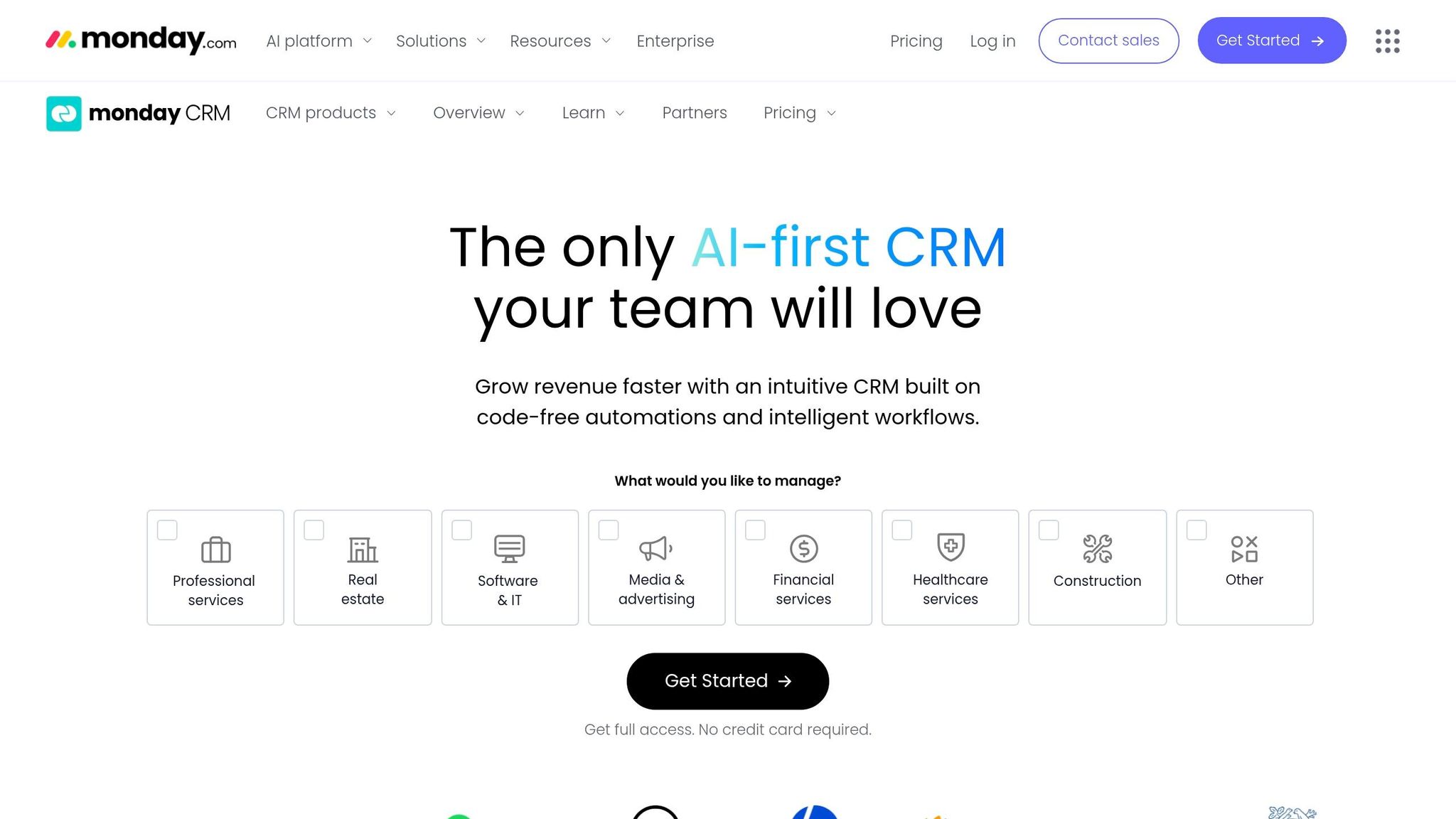
monday.com combines CRM and Work OS functionality, offering a visually intuitive platform that is easy for teams to adopt. It works particularly well for teams that manage both sales and project delivery, though its focus on general workflows may limit its depth in sales-specific features. Below is a closer look at its AI tools, automation capabilities, pricing, and the types of teams that benefit most from this platform.
AI Model
monday.com's AI suite, branded as Work AI, includes several tools designed to streamline sales workflows:
AI Sidekick: Provides context-aware insights and prioritizes deals.
Notetaker: Transcribes meetings, identifies speakers, and extracts actionable items.
Email Composer: Crafts personalized emails using deal history and CRM data.
Fernanda Falcon, an Account Manager at Inteli-k, shared her experience with the Email Composer:
"The AI email generator helps me communicate better. The AI emails have a higher response rate since they are clearer and more objective in terms of the purpose of the message." [40]
Additionally, monday.com offers an AI SDR Agent, a virtual sales representative that autonomously sources leads, qualifies prospects, and schedules meetings around the clock [43]. The platform's Model Context Protocol (MCP) server also allows external AI tools, such as ChatGPT or Claude, to directly interact with CRM boards to update records or trigger automations [11].
While these features enhance efficiency, they lack the goal-oriented automation found in platforms like K3X. For example, K3X allows users to set specific sales outcomes, such as "Book 10 demos this week", and automates the steps to achieve those goals [3]. monday.com's tools are more focused on assisting within predefined workflows rather than independently driving results.
Automation Capabilities
monday.com uses a no-code "If This Then That" automation engine, making it accessible for non-technical teams. Its drag-and-drop interface allows users to set up automations like lead routing, task assignments, and status updates without needing IT support. Kyle Dorman, Operations Manager at Ray White, highlighted its impact:
"Reports show a 70% increase in efficiency in regards to the admin tasks that were removed and automated, which is a huge win for us." [43]
However, the Standard plan limits automations to 250 actions per month, which may not be sufficient for active sales teams. To unlock up to 25,000 actions per month, users need the Pro plan, priced at $28 per user per month [39] [41].
Pricing Structure
monday.com’s pricing is competitive at higher tiers but has limitations for smaller teams. All plans require a minimum of three seats, which can make it less appealing for solo users or very small teams compared to more flexible options like Pipedrive [39] [41]. Seats are sold in fixed increments (e.g., 3, 5, 10), which may result in paying for unused licenses.
Plan | Price (per seat/mo, annual) | Key AI & Automation Features |
|---|---|---|
Basic | $12–$15 | Contact/deal tracking, unlimited boards; no automations |
Standard | $17–$20 | 250 automations/mo, AI Sidekick, AI Email Composer |
Pro | $28 | 25,000 automations/mo, AI email sequences, sales forecasting |
Enterprise | Custom | Advanced analytics, enterprise security, unlimited automations |
All plans require a minimum of 3 seats. Pricing details are based on available documentation.
The Pro plan at $28 per seat per month offers features like forecasting and advanced automations, making it a cost-effective alternative to HubSpot Professional ($90–$100 per seat per month) and Zoho's Enterprise plan ($40 per user per month). However, its AI tools are narrower in scope compared to those competitors.
Ideal Use Cases
monday.com is best suited for mid-sized B2B teams (5–200 users) where sales reps are involved in both closing deals and managing client projects. Its seamless transition from "deal closed" to "project started" within the same workspace is a standout feature, saving teams time and effort. Some users have reported an 80% increase in opportunity capture [40] and saved over 3,500 hours through automated reporting and data entry [40].
That said, teams requiring advanced sales-specific tools - such as detailed reporting, territory management, or enterprise-level CPQ - may find monday.com lacking. As CRM analyst David Paul noted:
"The moment you need email sequences, call logging, sales forecasting, or even a free plan, you've outgrown what Monday's CRM was built to do." [42]
For those needs, platforms tailored for deep sales execution or outcome-driven automation may be more suitable.
7. Close
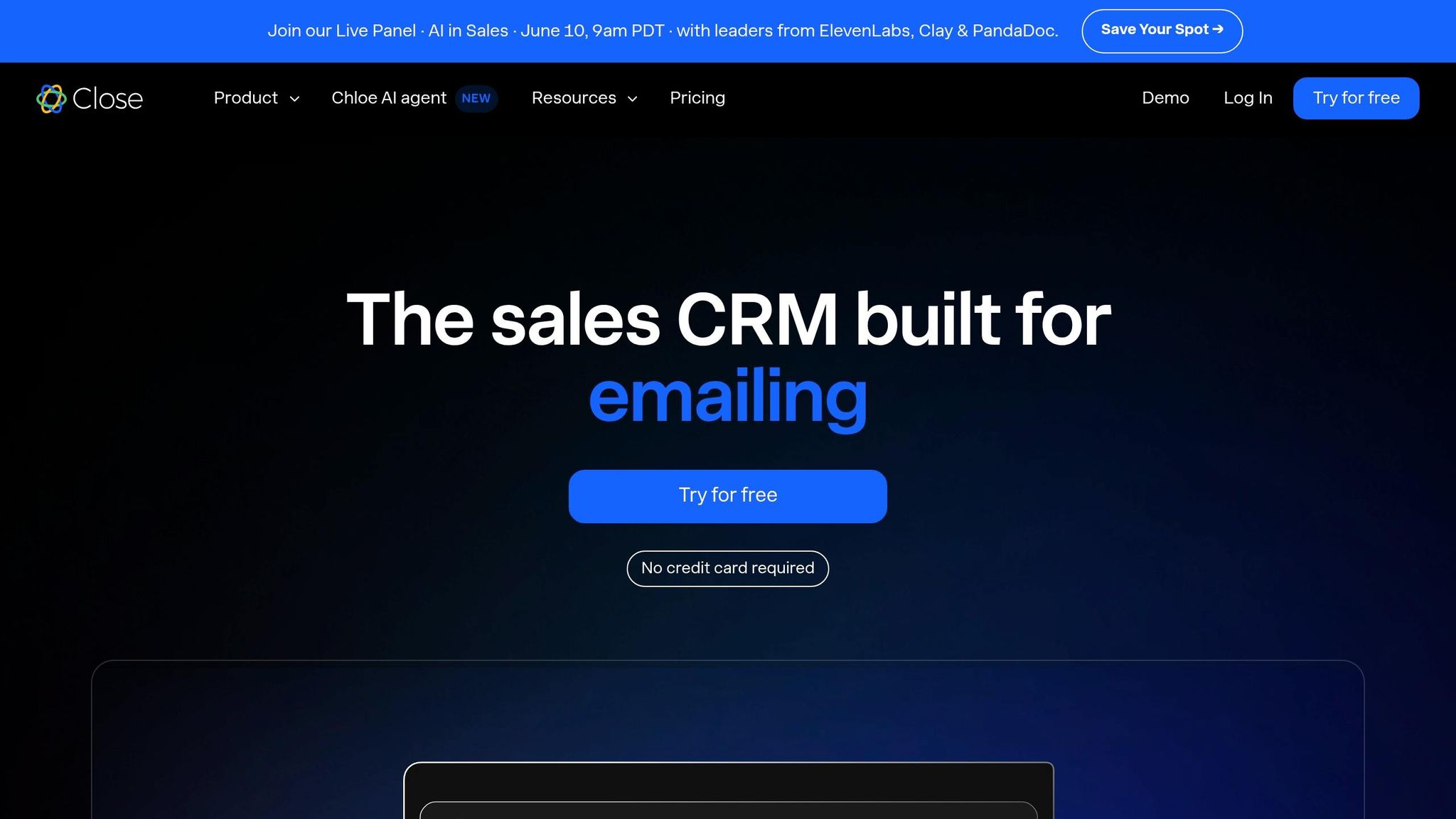
Close is designed for fast-paced inside sales teams, offering a unified workspace that integrates a power dialer, SMS, email sequences, and an AI sales agent to streamline prospect engagement. Its focus on seamless communication tools makes it a strong contender for sales teams aiming to boost productivity.
AI Model
Close's AI agent, Chloe, handles tasks like calling, qualifying leads, booking meetings, enriching contact records using LinkedIn and web data, and updating the CRM automatically [45]. Additional AI features include an AI notetaker, call summaries with actionable insights, and follow-up email drafts generated from call transcripts [44]. Close also features a native MCP (Model Context Protocol) server, enabling direct data integration with tools like ChatGPT, Claude, and n8n without requiring middleware [44].
Unlike the prompt-to-outcome model used by K3X [3], Close emphasizes execution, prioritizing activity volume through dialers and sequences while leaving strategic decisions to sales reps and managers.
Automation Capabilities
Close combines tools like the Power Dialer, Predictive Dialer (available in the Scale plan), SMS, and multichannel sequences into one platform. This setup reduces the risk of data inconsistencies that can occur when using multiple tools [44]. The Smart Views feature helps sales reps by surfacing hot leads and missed calls, creating an actionable to-do list. Teams using Close report completing 2–3 times more activities compared to those using platforms like HubSpot or Pipedrive [22]. Voice AI upgrades are planned for release in Spring 2026 and will be available on higher-tier plans [44].
These automation features enhance Close's appeal by providing efficiency and value at competitive pricing.
Pricing Structure
Close offers a straightforward pricing model with no onboarding fees. AI credits and the Chloe agent are included in all plans, unlike competitors like HubSpot, which charge extra for similar features [9] [10] [18].
Plan | Price (per user/month, annual) | Key Features |
|---|---|---|
Solo | $9 | 1 user, CRM, Chloe AI notetaker, 500 AI credits |
Essentials | $35 | Up to 3 users, built-in calling/SMS, 1,000 AI credits |
Growth | $99 | Power Dialer, automated workflows, 1,500 AI credits |
Scale | $139 | Predictive Dialer, call coaching (whisper/barge), 2,000 AI credits |
Additional costs include a $50/month base fee for the AI Call Assistant plus $0.02 per minute, with outbound calls costing roughly $0.02 per minute [46] [10].
For teams with 5–30 reps, Close can lower the total cost of ownership by 40–60% compared to using a combination of HubSpot, Aircall, and Gong [44]. Some teams have reported savings exceeding $100,000 after switching from Salesforce [45]. Implementation typically takes 1–2 weeks, significantly faster than the 4–12 weeks required by Salesforce or HubSpot Professional [44].
Ideal Use Cases
Close is particularly effective for inside sales teams focused on outbound efforts, such as SDRs and BDRs making 50+ calls daily, and is best suited for teams of 5 to 50 reps. Its built-in telephony integration eliminates the need for separate phone tools, saving an estimated $30–$50 per seat [9] [47]. The platform's efficient design reduces unnecessary clicks and context-switching, further improving productivity. With over 2 billion calls, emails, and meetings processed, Close has proven its reliability and scalability [10]. While Salesforce may be a better fit for enterprises with over 100 reps requiring complex custom-object schemas, Close shines in scenarios where high call volume drives sales success.
8. Attio
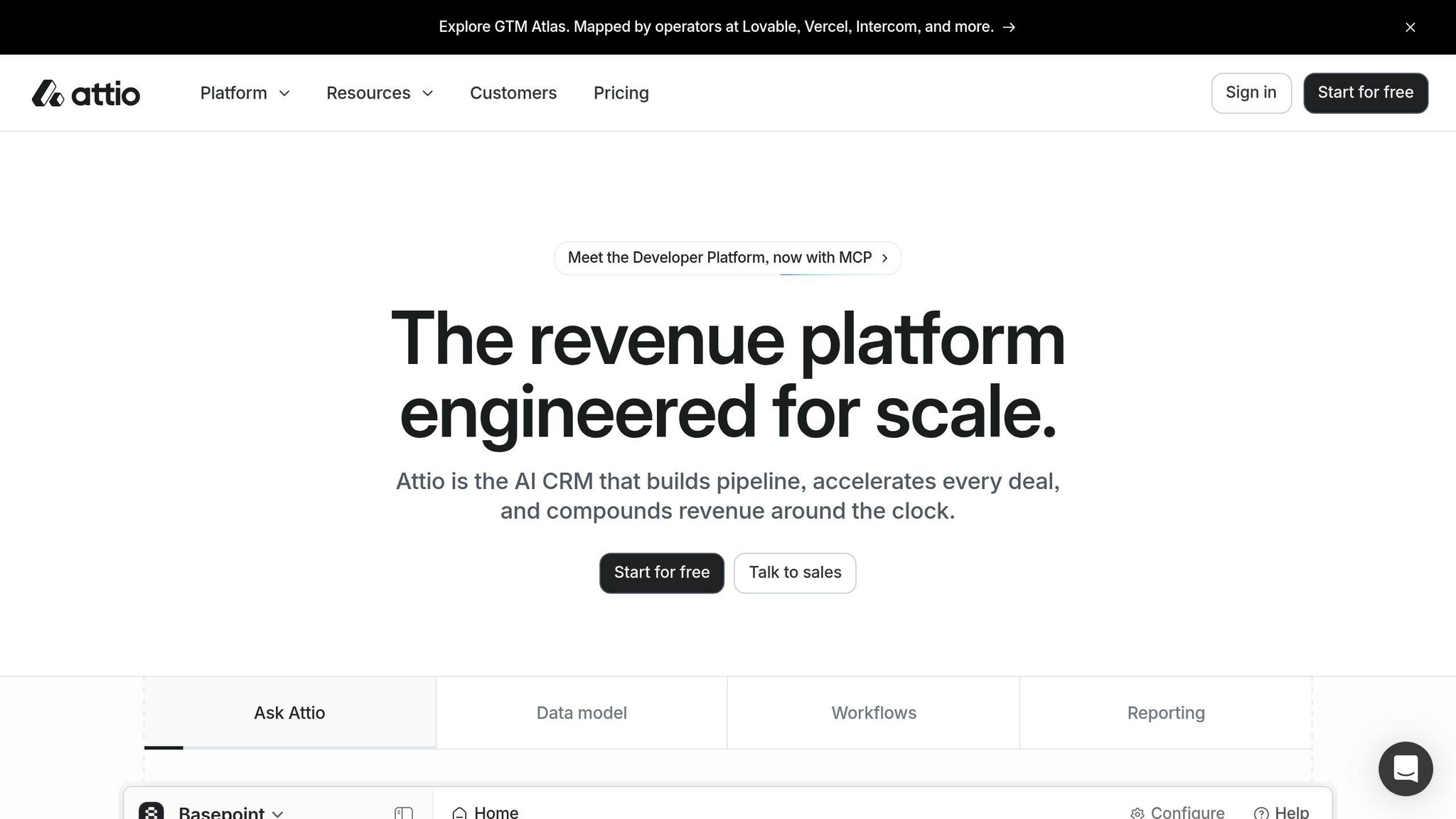
Attio is a CRM designed with an AI-first approach, utilizing a graph data model instead of traditional relational databases. This makes it particularly well-suited for product-led companies, technical startups, and teams with unique sales processes. Unlike platforms like Salesforce or HubSpot, which often require workarounds for complex relationship structures, Attio handles these natively.
AI Model
Attio's AI capabilities are powered by technologies like Claude Sonnet 4.6 and Gemini 3.1 Pro, integrated into its conversational AI tool, Ask Attio. Users can interact with their CRM data using plain-language prompts to query information, update records, or trigger workflows. Its AI Attributes feature can summarize call transcripts, classify records, and extract insights from unstructured data, such as email conversations. Additionally, the built-in AI Research Agent enriches records through web research without the need for third-party tools.
In October 2025, Attio introduced a developer platform with a hosted MCP server, enabling direct interaction with its AI agents. This differs from Close’s focus on telephony or K3X’s end-to-end prompt-driven model, as Attio requires users to design their own workflows. To complement these AI features, it also offers a visual workflow builder for creating trigger-based processes.
Automation Capabilities
Attio provides a visual workflow builder for automating CRM actions like record updates, stage transitions, and field modifications. For more complex workflows across multiple systems, external tools like n8n or Clay are often required. The Plus plan includes 1,500 monthly automation runs, while the Pro plan increases this limit to 10,000 runs. Teams should monitor usage to stay within their plan limits. According to Abhishek Singla, Founding GTM Engineer at Peec AI, Attio performs well as a CRM, though platforms like HubSpot offer broader functionality. [48]
Pricing Structure
Attio offers flexible pricing plans to cater to different needs, though it raised its prices in early 2026, removing its previous $19/seat tier. The current plans include:
Plan | Price (per user/month) | Key Features |
|---|---|---|
Free | $0 | Up to 3 users, 3 objects, 50,000 records |
Plus | ~$29–$36 | Unlimited records, 1,500 automation runs, 5 objects |
Pro | ~$69–$86 | Custom objects, 10,000 automation runs, email sequences |
Enterprise | ~$119 | Unlimited objects, SAML/SSO, advanced reporting |
For a team of 10 users, Attio Pro costs approximately $4,080 annually, significantly less than the $24,000 per year required for a comparable HubSpot Sales + Marketing Pro setup. Over three years, Attio’s total cost of ownership is estimated at $1,200 per user, compared to $8,150 per user for Salesforce.
Ideal Use Cases
Attio is particularly effective for venture-backed startups, SaaS companies with a product-led growth model, and technical B2B teams managing non-standard data models. For example, in late 2025, a Series A fintech company transitioned from Salesforce to Attio to manage contracts involving three distinct approving parties (buyer, legal, compliance), each modeled as separate objects with role attributes. This allowed the company to create a fully reportable deal review pipeline in just one afternoon - something that previously caused reporting issues in HubSpot.
While Attio’s implementation typically takes 14 to 16 days, much faster than HubSpot’s 6 to 8 weeks, it may not be ideal for teams needing native marketing automation tools like email builders or compliance standards such as HIPAA or FedRAMP. Additionally, teams without a dedicated GTM engineer or RevOps lead might find its API-driven automation setup challenging. Nicolas Sharp, CEO and co-founder of Attio, highlighted the transformative potential of AI in CRM:
"CRM is entering its most exciting era. AI is reinventing the interface, killing manual work, and finally capturing customer context in full." [49]
Attio is designed for teams handling complex sales processes and non-traditional data models, offering a streamlined alternative to platforms like K3X for these specific needs.
Pros and Cons of Each Platform
The table below provides a clear comparison of the strengths and weaknesses of each platform to help you make an informed decision.
Platform | Pros | Cons |
|---|---|---|
K3X | Eliminates manual data entry with a prompt-to-action model, saving users an average of 8 hours weekly [3]. Flat $20/seat pricing includes 1,000 AI credits; quick setup. | Limited track record compared to established vendors; primarily designed for sales-focused teams rather than comprehensive marketing needs. |
Salesforce | Highly customizable with a 20.7% global CRM market share [5]. Agentforce automates complex multi-step workflows. | High total cost of ownership: a 50-user Enterprise deployment can cost up to $330,000/year [5][2]; requires dedicated administrators; 6–12 week implementation. |
HubSpot | Combines sales and marketing tools; Breeze AI resolves over 50% of support tickets autonomously [5]; operational in a few days. | Onboarding fees are mandatory [9][25]; costs rise steeply as you scale; free tier supports only 2 users. |
Pipedrive | Simple visual pipeline with an affordable $24/seat entry price; AI Sales Assistant offers stall detection and coaching. | No native marketing automation; AI features require an add-on [9][6]; limited functionality for teams beyond sales. |
Zoho CRM | Strong pricing advantage - 60–75% lower than Salesforce for similar features [9][25]; includes Zia AI for predictive scoring. | Zia AI is only available in the Enterprise tier ($40/user) [25]; interface can feel cluttered, leading to a steeper learning curve. |
monday.com | Flexible no-code workflow builder suitable for non-standard processes; user-friendly for non-technical teams. | Not designed as a dedicated CRM; advanced sales features require workarounds and additional costs for multiple boards and automations. |
Close | Built-in calling, SMS, and email sequences with AI tools; ideal for inside sales teams. | Higher mid-tier price at $109/user [9]. |
Attio | Object-first data model supports complex relationships; implementation in 14–16 days; much lower TCO than Salesforce ($1,200 vs. $8,150 per user over 3 years). | No native marketing automation. |
This comparison highlights the balance each platform strikes between simplicity, innovation, and complexity. Platforms like K3X, Attio, and Close focus on rapid deployment and reducing manual work. For instance, K3X's AI-driven, prompt-to-action model simplifies workflows, while Attio caters to technical teams with unique data needs, and Close excels in inside sales with its integrated communication tools.
On the other hand, Salesforce and HubSpot offer extensive features but require significant time, resources, and technical expertise. As Mark Bishop, Editor at SaaS True Cost, noted:
"Salesforce remains the platform of choice above 100 seats because of customization depth, but real cost is 2–3x the list seat price after implementation." [9]
For smaller teams, Zoho CRM and Pipedrive provide cost-effective options, though unlocking their advanced AI capabilities often necessitates add-ons or upgrades. Meanwhile, monday.com stands out for its flexibility but lacks the depth of a purpose-built CRM.
This evolving landscape underscores a shift toward streamlined, AI-first platforms like K3X, which challenge traditional, more complex systems.
Conclusion
By 2026, the CRM landscape has divided into two distinct categories: traditional platforms retrofitted with AI and AI-native tools designed to minimize manual work from the start. Currently, 83% of sales teams incorporate AI into their workflows [12], and systems that integrate AI as a core feature are showing the most measurable impact.
AI-native CRMs, such as K3X, consistently outperform legacy systems in terms of speed, ease of use, and real-time automation.
Different platforms cater to varying team needs. Large enterprises (200+ users) with complex operations and the resources for dedicated administrators often find Salesforce to be the best fit. For SMBs needing a quick, unified marketing and sales solution, HubSpot stands out. As Sarah Chen, Automation Expert, explains, it "wins for SMBs and mid-market teams that want powerful AI without a 6-month implementation project" [2]. Pipedrive appeals to sales teams seeking visual simplicity without marketing extras, while Zoho offers the most features per dollar for budget-conscious organizations. Attio is ideal for technical teams managing intricate data relationships, and Close is tailored for inside sales teams focused on calls and sequences.
K3X is particularly well-suited for sales teams of 5–150 members aiming to eliminate manual tasks with a prompt-driven CRM. For example, in December 2025, Ruby Capital Group, a 125-person funding company, implemented K3X in just two days. The results included shorter follow-up times and a threefold improvement in ticket resolution [3]. At $20 per seat per month, K3X not only enables rapid deployment but also significantly reduces manual workload, making it a strong choice for teams burdened by repetitive tasks.
If your team spends hours each week on manual data entry, the issue lies in the structure of your CRM. As Mykyta Samusiev, Co-Founder & CEO of K3X, puts it:
"Unlike legacy CRMs that merely log activity, K3X drives outcomes. It listens, knows what changed, and makes the next moves." [3]
FAQs
What makes a CRM truly AI-native?
A CRM built from the ground up with AI at its core operates fundamentally differently from older systems. Instead of depending on manual data entry, these platforms automatically gather, organize, and respond to data as it happens.
Some standout features include:
Automated data management: Automatically tracks interactions and keeps records up to date without user intervention.
Goal-driven logic: Adjusts dynamically based on real-time data to meet specific objectives.
Continuous insights: Provides proactive recommendations to guide decisions.
How do AI credits impact total costs as we scale?
AI credits link costs to actual activity instead of just the number of user seats. This means expenses increase as usage grows, such as more conversations or actions - commonly referred to as an "agent tax." For example, Salesforce charges approximately $2 per conversation or uses a system like Flex Credits, which costs $500 for 100,000 credits. On the other hand, K3X provides 1,000 AI credits per month as part of its base offering and adjusts pricing based on usage, with costs dropping to $20 per month during periods of low activity.
Which CRM fits my team size and sales motion?
The best CRM for your team depends on its size, complexity, and available resources:
Startups (1–20 employees):K3X simplifies processes with AI-driven automation and minimal administrative tasks. Attio suits product-led growth (PLG) teams thanks to its flexible data model, while Pipedrive is ideal for small teams needing a visual pipeline tool.
Small and Medium Businesses (10–500 employees):HubSpot stands out with its all-in-one platform and quick AI integration.
Enterprises (200+ employees):Salesforce offers extensive customization options but requires substantial setup and dedicated administrative support.