Sales Automation
•
Outcome-Based Sales Metrics: Q&A
Focus on outcomes—not activity—to raise win rates, improve forecasting, and boost sales efficiency with AI CRM.

Outcome-based sales metrics focus on tracking results - like revenue, win rates, or quota achievement - rather than sheer activity, such as calls made or emails sent. This shift helps sales teams prioritize quality over quantity, leading to better performance and more meaningful engagement with buyers.
Key insights:
Activity vs. Outcome Metrics: Activity metrics track effort (e.g., calls, emails), while outcome metrics measure results (e.g., revenue, win rates).
Why It Matters: Activity alone doesn’t guarantee success. For example, 72% of buyers now ignore generic outreach, and focusing on volume has increased spam complaints by 43%.
Proven Results: Companies like DOMO improved win rates by 30% in 2025 by adopting outcome-focused KPIs. Teams using both leading and lagging indicators saw a 15% productivity boost.
Efficiency Gains: Tools like K3X automate outcome-based processes, saving time, improving accuracy, and reducing operational costs.
Outcome-Based Selling: Why Most Sales Transformations Stall
Outcome-Based vs. Activity-Based Metrics: What's the Difference?
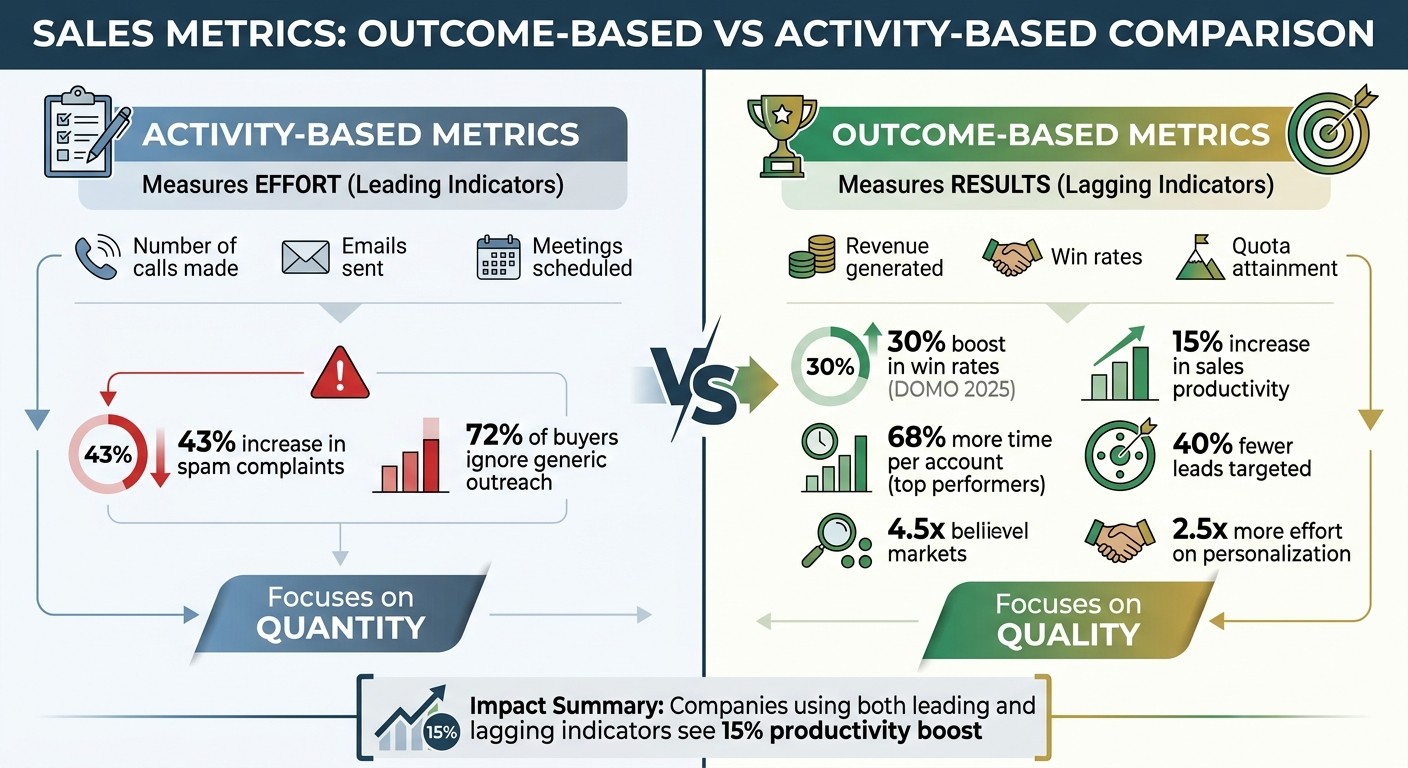
Outcome-Based vs Activity-Based Sales Metrics Comparison
Results vs. Tasks
Activity-based metrics focus on tracking inputs - like the number of calls made, emails sent, or meetings scheduled [4][5]. These metrics act as leading indicators, offering real-time insights into the effort being put in.
On the other hand, outcome-based metrics measure the end results - think revenue generated, win rates, or quota attainment [4][5]. These are lagging indicators, used to assess whether all those activities actually led to success. Since outcomes are influenced by factors like market conditions and buyer behavior, they’re better suited for strategic evaluation rather than day-to-day coaching [4].
Here’s the thing: a salesperson might make 100 calls and send 500 emails, but if none of those efforts lead to conversions, the numbers lose their meaning [1].
This fundamental difference shapes how each type of metric influences behavior on a sales team.
How Each Approach Affects Sales Team Behavior
The metrics you prioritize can significantly impact how your team operates. Activity-based tracking often encourages a focus on quantity over quality. For instance, tying compensation to the number of calls or emails can lead to unintended consequences - like a 43% increase in spam complaints as reps prioritize hitting quotas over meaningful engagement [1]. And buyers are catching on: 72% now ignore generic outreach entirely [1].
Outcome-based metrics take a different approach. When DOMO shifted to outcome-focused KPIs in 2025, they experienced a 30% boost in win rates [1]. This change encouraged reps to prioritize what truly resonates with buyers rather than just meeting activity goals.
Top-performing reps, for example, now spend 68% more time per account, moving away from high-volume outreach. Instead, they focus on fewer accounts - targeting 40% fewer leads but investing 2.5 times more effort into personalized engagement. This strategy has led to faster deal cycles and higher conversion rates [1].
By emphasizing outcomes over sheer activity, sales teams can refine their approach, leading to both improved behavior and better results.
Efficiency and Growth Benefits
Focusing on outcomes doesn’t just improve behavior - it drives efficiency and growth. Outcome-based metrics help teams concentrate on high-quality leads instead of wasting time on low-value prospects [1]. The results speak for themselves: companies that balance both leading and lagging indicators report a 15% increase in sales productivity [4].
The gains become even more apparent over time. For example, Ruby Capital Group, a 125-person funding company, adopted outcome-based automation in December 2025 under CEO Michael Chkechkov. Within just two days, they reduced follow-up time by 70% and tripled their ticket resolution speed by automating lead qualification and contract routing [7]. Similarly, GreenTech Solutions slashed administrative time from 14.2 hours to 2.1 hours per week per rep between January and June 2024. This change improved their close rate from 16.8% to 21.3%, adding $740,000 in annual value [6].
"Most CRMs record activity. K3X understands outcomes. It listens, knows what changed, and makes the next moves." - Mykyta Samusiev, Co-Founder & CEO, K3X [7]
Switching to an outcome-focused approach doesn’t mean ignoring effort - it’s about ensuring that effort leads to meaningful results. Modern tools like K3X are designed with this mindset, prioritizing results over processes. By measuring what truly matters, teams can move away from vanity metrics and focus on closing more deals.
Benefits of Outcome-Based Sales Metrics
Measuring the impact of sales efforts through outcome-based metrics offers clear advantages, helping teams focus on what truly drives results.
Higher Revenue and Win Rates
Shifting from tracking sheer activity to measuring outcomes can significantly boost financial performance. In fact, prioritizing outcome metrics has been linked to a 15–25% increase in revenue [6]. This approach encourages sales reps to concentrate on factors that genuinely affect revenue rather than superficial metrics.
The numbers tell the story. Companies that focus on outcomes like win rates and deal velocity report 18% higher win rates and 35% faster deal cycles [1]. High-performing B2B organizations achieve 2.5 times higher gross margin per dollar invested in sales compared to their lower-performing peers - thanks to their focus on metrics that matter [8]. Businesses leveraging AI-driven tools to align goals with outcomes see even better results: 38% higher win rates and 36% better customer retention [7].
Here’s a real-world example: In August 2025, a financial services firm with 200 employees invested $795,000 in an AI-powered CRM designed for outcome tracking. Within months, they realized $1.6 million in benefits, including $560,000 from revenue growth and $380,000 from reduced churn, achieving a 101.3% ROI [6]. Similarly, PTC generated $18 million in new pipeline over just four months by combining intent signals with automated, outcome-driven execution [7].
"The winning ROI narrative is not 'we saved 200 hours,' but 'we turned 200 hours into 40 more qualified meetings and 10 more opportunities.'" – EverWorker [6]
Stronger Team Accountability
Outcome-based metrics foster a sense of ownership within sales teams. Instead of focusing on activity dashboards, team members take responsibility for advancing the pipeline and closing deals. This approach eliminates meaningless "vanity metrics" that may look good on paper but fail to drive actual results.
By emphasizing outcomes like stakeholder engagement and message relevance, top-performing sales reps exhibit better behaviors. For example, they spend 68% more time per account than average performers [1].
Additionally, real-time visibility into deals enables more effective coaching. This is critical because only 1 in 3 managers can accurately identify their company’s top three priorities, and 58% of business leaders admit to making decisions based on outdated or incomplete data [7]. Outcome-based dashboards bring clarity, helping teams align on meaningful goals and stay accountable for results that count.
More Accurate Forecasting and Planning
While activity metrics track movement, outcome metrics reveal momentum - and that distinction is key for accurate forecasting. Metrics like pipeline coverage ratio, win rate by stage, and sales cycle length serve as predictive indicators of whether a team will meet its revenue targets [1][9]. Yet, only 7% of organizations achieve 90% or higher forecast accuracy, often because they rely on static dashboards that fail to reflect real-time buyer behavior [7].
Outcome-based data highlights potential issues early. For instance, when deals exceed 1.5 times the average sales cycle or remain inactive for 30 days, leaders can step in before the end-of-quarter results are affected [9]. Companies that balance leading indicators (e.g., lead response time) with lagging indicators (e.g., quota attainment) experience a 15% boost in sales productivity [4].
These advantages pave the way for tools like AI-native CRMs, such as K3X, to sustain long-term sales success.
How K3X Enables Outcome-Based Sales Metrics
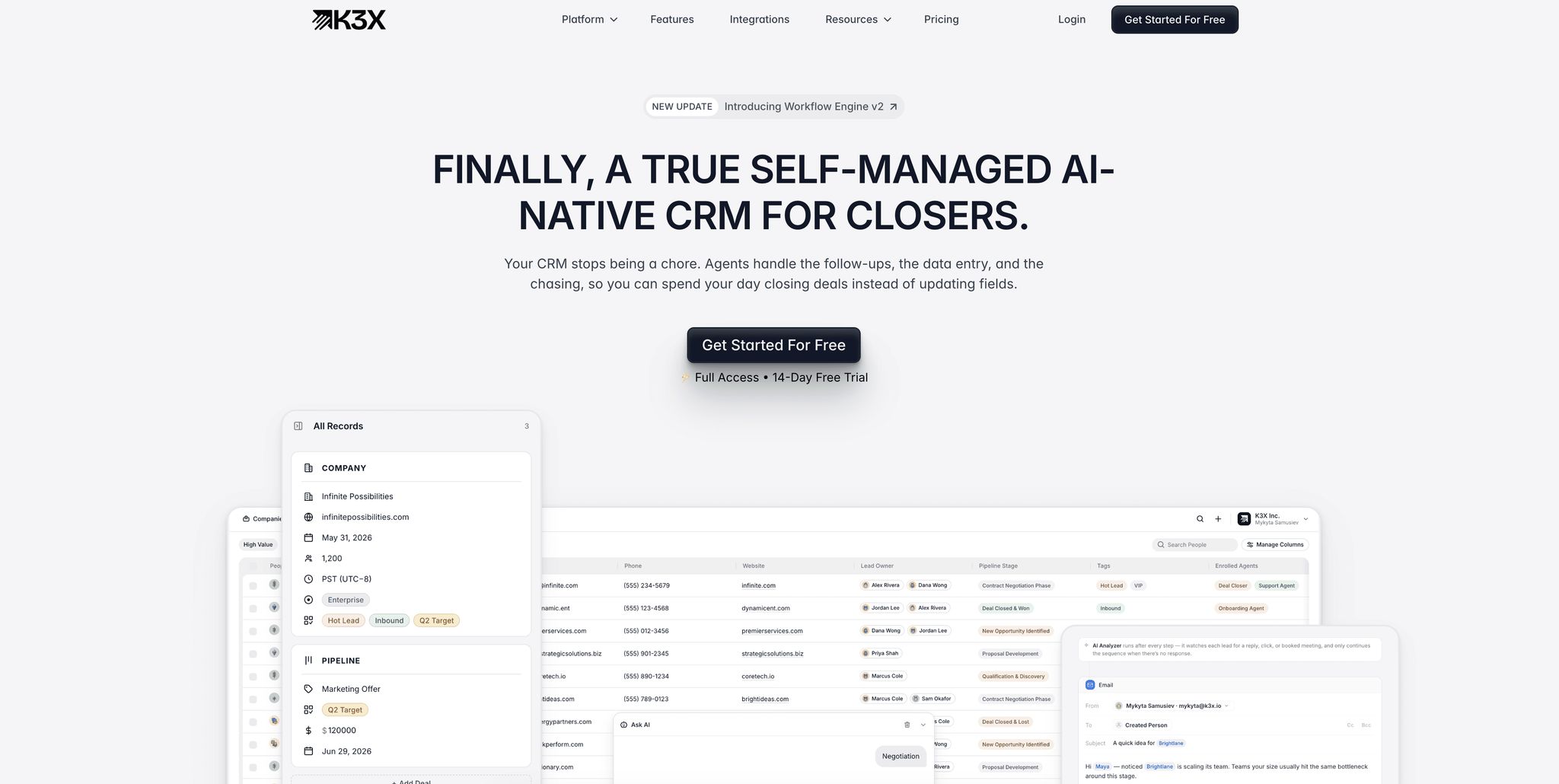
Most traditional CRMs, like Salesforce and HubSpot, were designed to track activities rather than outcomes. They rely heavily on manual data entry, intricate workflows, and lengthy automation setups. In contrast, K3X offers an AI-native CRM that prioritizes outcomes, eliminating the need for manual configurations and rigid processes. This shift reflects a broader movement toward results-focused sales strategies.
Prompt-Driven Control vs. Manual Workflows
With K3X, users simply define their goals in plain language. For example, you could instruct it to: "Schedule demo calls with every lead who hasn’t responded." The system then takes care of the necessary steps - sending follow-ups, updating pipelines, and managing tasks - entirely on its own. This eliminates the need for third-party tools like Zapier or Make. K3X also adapts dynamically when leads respond unexpectedly or out of sequence, ensuring the process stays aligned with the desired outcome. Traditional CRMs, by contrast, often struggle to handle such deviations effectively.
In December 2025, Ruby Capital Group, a 125-employee funding company led by CEO Michael Chkechkov, adopted K3X. Their team set up the entire automation process in just two days, cutting follow-up times by 70% and tripling ticket resolution speeds.
"We're building a CRM that works the way people expect it to, not through menus, workflows, or complexity, but through intention. You tell it the outcome. The system figures out the work."
– Mykyta Samusiev, Co-Founder & CEO, K3X
This prompt-driven system also powers K3X’s ability to continuously refine its processes.
Continuous Adaptation and Optimization
K3X doesn’t just execute tasks - it improves them over time. The platform tracks engagement signals like email opens and link clicks, adjusting its tactics automatically. For instance, if email responses slow down, K3X might initiate a phone call instead. Once a lead replies or schedules a meeting, it halts redundant follow-ups immediately.
The system also captures data without requiring manual input. If a prospect requests a contract during a call, K3X identifies the intent, updates the pipeline, and logs the interaction - all on its own. This capability has boosted forecast accuracy by 22% and shortened sales cycles by 17%. Across its user base, K3X has saved over 312,000 hours of work and reduced operational costs by an estimated $12.4 million.
"K3X adapts to your habits, workflows, and patterns in real time."
– Sophie Bergman, Head of Client Solutions, K3X
K3X vs. Traditional CRMs
K3X’s focus on outcomes sets it apart from legacy systems. While traditional CRMs emphasize activity tracking, K3X accelerates sales execution by integrating outcome-based metrics. Here’s a side-by-side comparison:
Platform | Metric Focus | Automation Approach | Setup Time | Key Outcome Improvements |
|---|---|---|---|---|
K3X | Outcome-Based | Prompt-Driven | Under 1 hour | 70% faster follow-ups, improved close rates |
Salesforce | Activity-Based | Workflow-based | 12 weeks | Moderate improvements |
HubSpot | Activity-Based | Workflow-based | 4–8 weeks | Incremental improvements |
Unlike traditional CRMs, which often require weeks or months of setup and IT support, K3X is fully operational in under an hour. This simplicity allows sales teams to focus on selling, not admin tasks. While reps using conventional systems spend only 28% of their time selling, K3X users save an average of 8 hours per week per employee by automating tedious tasks.
"Our sales team was spending half their day on admin work. Now they're talking to customers and closing deals."
– Michael Chkechkov, CEO, Ruby Capital Group
Common Challenges When Implementing Outcome-Based Metrics
Switching to outcome-based metrics isn't always smooth sailing. Teams often face hurdles like resistance to change, unreliable data, and misaligned goals. Tackling these issues head-on - and using modern tools to address them - can make the process much easier.
Overcoming Resistance to Change
One major roadblock is resistance from sales teams. New metrics can feel like micromanagement, which lowers morale. In fact, only 23% of employees feel engaged at work, and disengaged workers cost U.S. businesses between $450-550 billion every year [4].
The problem gets worse when metrics focus on gaps without offering actionable solutions. This pushes sales reps to prioritize quantity over quality, which is counterproductive [4][2].
"Measurement alone doesn't change behavior. Having data about sales performance and actually improving sales performance are two completely different challenges."
– SalesScreen [4]
The key is to foster a coaching culture. Use metrics to guide weekly tactical reviews and monthly strategy sessions instead of relying solely on quarterly evaluations. Celebrate small wins, like faster response times, even before they translate into revenue. Companies that track both early (leading) and later (lagging) indicators have seen a 15% boost in sales productivity [4].
A phased approach can help manage the transition. For example, in the first month, drop metrics that only measure volume. In the second, introduce standards for research and sentiment tracking. By the third month, adjust compensation to reward metrics like pipeline velocity [1]. These steps have been shown to improve win rates significantly.
Addressing resistance early on creates a solid foundation for tackling the next big challenge: data accuracy.
Ensuring Data Accuracy
Accurate data is the backbone of any metric system. Yet manual data entry remains a major issue, causing up to 30% of CRM inaccuracies and cutting revenue by as much as 15% [6][7]. A staggering 85% of salespeople admit they've lost deals due to incomplete or incorrect CRM data [7]. On top of that, sales reps spend an average of 3.4 hours per week on manual data entry, which not only frustrates them but also reduces data reliability.
Platforms like K3X solve this by automating data capture. It logs emails, records calls, and updates contact details based on real-time interactions. For example, if a prospect requests a contract during a call, K3X detects this, updates the pipeline, and logs the interaction - no manual input required.
"The system catches errors we would have missed manually, and our team finally has time for strategic analysis instead of data entry."
– Marcus Thompson, CFO [10]
Before introducing any new system, it's crucial to standardize definitions across the company. Agree on terms like "qualified lead" or "closed opportunity." Additionally, gather 8–12 weeks of historical data on metrics such as sales cycle length and lead conversion rates. This baseline will help you measure the impact of your changes accurately [6].
Once your data is reliable, the next step is ensuring your metrics align with your business goals.
Connecting Metrics to Business Goals
Outcome-based metrics only work if they align with your company’s key objectives. Yet, only 1 in 3 managers can correctly identify their organization's top three priorities, and just 26% of employees understand how their work ties into broader goals [7]. This disconnect is estimated to cost U.S. businesses over $1 trillion annually [7].
Start by setting clear, measurable objectives rather than vague goals like "increase revenue." For instance, aim to "boost qualified demo bookings by 25% within 90 days." Keep the focus on 5–7 meaningful KPIs that directly impact revenue to avoid getting overwhelmed. Many companies are moving away from vanity metrics like call volume and adopting more insightful measures such as "Stakeholder Coverage Score" and "Message Relevance Score" [1].
Ruby Capital Group offers a great example. In December 2025, they implemented K3X’s AI-driven agents and fully set up automation within two days. By automating lead qualification and contract routing, they cut follow-up times by 70% and tripled ticket resolution speed [10].
Tools like "Goal Trees" can help teams see exactly how their efforts contribute to revenue growth [7]. This kind of transparency ensures that everyone understands their role in the company’s success. By automating data capture and aligning metrics with objectives, AI-powered CRMs like K3X make it easier to connect daily activities to overall revenue growth.
"AI turns vague intentions into precise, measurable objectives, giving leaders unprecedented clarity and control over performance while still preserving the human touch."
– Emily Helen Arnold, People Strategy Specialist, Teamflect [7]
Next Steps: Implementing Outcome-Based Metrics
Switching to outcome-based metrics doesn’t have to be complicated. The main goal is to move beyond tracking sheer activity - like the number of calls made or emails sent - and instead focus on metrics that truly impact revenue. Think about areas like stakeholder coverage, message relevance, and pipeline velocity.
Here’s a simple 90-day plan to make the shift:
Month 1: Stop using call and email volume metrics. Instead, test two outcome-focused KPIs, such as Stakeholder Coverage Score and Message Relevance [1].
Month 2: Introduce buyer sentiment tracking and train your team to conduct in-depth account research. Dedicate at least three hours to each strategic account [1].
Month 3: Update compensation plans to reward outcomes like pipeline velocity rather than just activity levels [1].
Using modern CRM tools will be essential to execute this plan efficiently.
Platforms like K3X can speed up the transition. Instead of creating complicated workflows, you can define outcomes with straightforward prompts, such as “prioritize leads who visited our pricing page twice this week” [11]. The platform automatically tracks interactions (calls, emails, texts) and updates deal stages in real time, eliminating the need for manual data entry [11].
To start, gather 8–12 weeks of historical data on metrics like sales cycle length and lead conversion rates to set a baseline [6]. Then, focus on 3–5 KPIs that are directly tied to revenue. Avoid tracking too many metrics to keep things manageable [3]. These steps will help you see the measurable benefits of outcome-based selling.
The ROI speaks for itself: Teams using AI-driven systems like K3X report a 60% increase in workload capacity per rep. Automated data capture boosts forecast accuracy by 22% and shortens sales cycles by 17% [11]. At just $20 per user per month, K3X simplifies the path to outcome-based selling without the complexity of traditional CRMs [11]. By prioritizing outcomes, you’ll unlock actionable insights that fuel revenue growth.