Sales Automation
•
Why AI Response Time Matters in Sales
Faster AI replies boost lead conversion, cut follow-up time, and capture after-hours inquiries for higher revenue.

AI response time is now a critical factor in sales success. Here’s why:
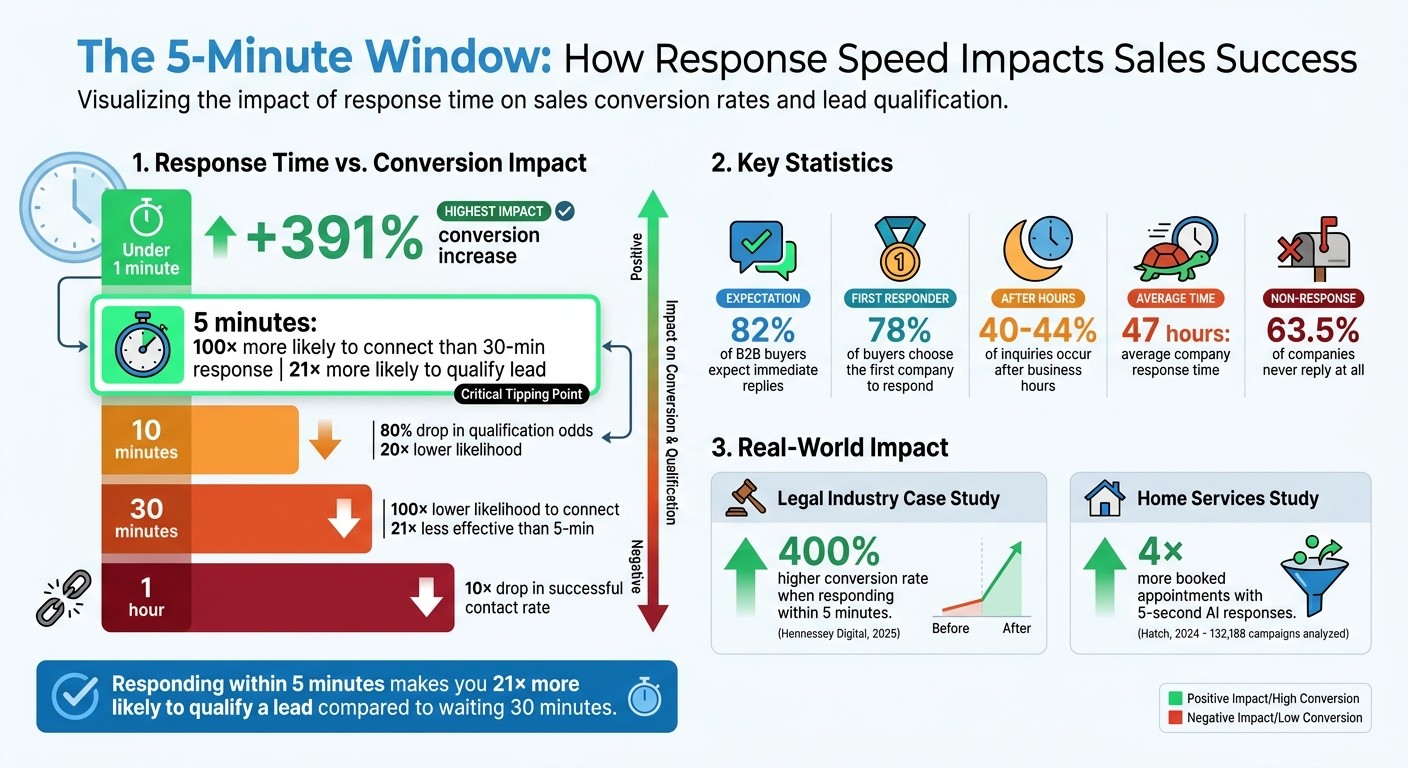
82% of B2B buyers expect immediate replies, but most companies take 47 hours to respond, and 63.5% never reply at all.
78% of buyers choose the first company to respond, making speed a direct driver of revenue.
Responding within 5 minutes makes you 21× more likely to qualify a lead compared to waiting 30 minutes.
AI tools like K3X eliminate delays by engaging leads instantly, even after business hours when 40%-44% of inquiries occur. Faster responses mean fewer lost opportunities, higher conversion rates, and more efficient sales teams.
The key takeaway? In sales, speed isn’t just helpful - it’s the difference between closing deals and losing them.
How AI Agents Cut Sales Lead Response Time: Insights from Deepu Prakash | Fingent StackWyse
How Slow Response Times Hurt Lead Conversion
How Response Time Impacts Sales Conversion Rates
When someone fills out a form or requests a demo, their interest is at its highest. But that interest doesn't last long. Modern consumers can shift focus roughly every 47 seconds, meaning even a small delay can cause them to rethink their problem - or worse, forget about it entirely.
The 5-Minute Window for Lead Engagement
The 5-minute window isn't just a guideline - it's a tipping point. Delays beyond this timeframe can dramatically lower your odds of converting a lead. For instance, waiting just 10 minutes slashes qualification odds by 80%, and a delay of one hour makes successful contact ten times less likely.
Quick responses are also psychologically important. If you respond within 2 minutes, there's a good chance the lead still has your website open. But wait 30 minutes, and they've likely moved on to something else.
In a 2025 study by Hennessey Digital, which analyzed 1,333 law firms, firms responding within 5 minutes saw a 400% higher conversion rate. Encouragingly, the legal industry's median response time improved dramatically - from 21 minutes in 2023 to 13 minutes by 2025.
Data on Response Times and Conversion Rates
The numbers make it clear: every second counts when it comes to lead conversion. Responding within 60 seconds can increase conversions by 391%, while responding within 5 minutes makes you 100 times more likely to connect compared to waiting 30 minutes. Delays not only hurt your chances but also open the door for competitors to swoop in.
Here’s a breakdown of how response times impact conversions:
Response Time | Conversion Likelihood | Impact on Qualification |
|---|---|---|
Under 1 minute | +391% compared to later responses | Baseline (highest) |
5 minutes | 8× lower if further delayed | 21× more likely than 30‑minute response |
10 minutes | 20× lower likelihood | 80% drop in qualification odds |
30 minutes | 100× lower likelihood | 21× less effective than 5‑minute response |
1 hour | 7× lower than under 1 minute | 10× drop in successful contact rate |
In 2024, Hatch, a home services technology provider, examined 132,188 speed-to-lead campaigns. Their findings? Using AI-powered customer service reps to respond in just 5 seconds resulted in four times more booked appointments - all without increasing lead spend. The financial benefits are clear: every minute of delay could mean lost revenue.
"The difference between a 5‑minute response and a 30‑minute response isn't 25 minutes - it's the difference between winning and losing the sale."
How to Achieve Faster AI Responses
Fast AI responses can streamline your sales process by eliminating unnecessary delays. Often, these delays occur because systems are designed around rigid workflows rather than focusing on achieving outcomes. For instance, if a lead submits a form at 9 p.m. on a Friday, they shouldn’t have to wait until Monday morning for a reply.
Removing Bottlenecks from AI Workflows
The root of many delays lies in structural inefficiencies. Did you know that sales reps spend about 70% of their time on administrative tasks, CRM updates, and research instead of actually selling [1]? This means when a high-priority lead comes in, your team might be too tied up with busywork to respond promptly.
About 40% of high-intent inquiries arrive after business hours, leading to an average 61-hour delay from Friday night to Monday morning [1][2]. This is where AI automation becomes a game-changer. Take Ruby Capital Group, for example. In December 2025, under CEO Michael Chkechkov, they implemented K3X's AI-driven agents. The results? A 70% reduction in follow-up times and a threefold increase in ticket resolution speed - achieved within just two days [8]. This demonstrates how K3X’s goal-oriented platform outshines traditional CRMs.
Traditional CRMs often worsen the issue with their inflexible "if-then" logic, which struggles when prospects behave unpredictably. A 2025 case study by Nyx Wolves revealed that just a 7-minute delay in responding to high-intent actions, like visiting a pricing page, cost one company $120,000 in lost deals per quarter. By switching to an AI system capable of real-time intent detection and instant outreach via SMS and email, they recovered that revenue within weeks [7]. This highlights the direct revenue impact of eliminating response delays.
"K3X works on goals. Instead of defining steps like 'Send this email, then wait,' you define the objective."
Mykyta Samusiev, CEO, K3X [8]
Using Automation to Speed Up Lead Engagement
Once bottlenecks are removed, automated systems can take over to ensure immediate outreach. Modern AI agents go beyond generic responses like "we’ll get back to you." They qualify leads, answer questions, and even schedule meetings in real time [5]. To maximize effectiveness, use multiple communication channels. For instance, SMS messages are typically read within 3 minutes and have a 98% open rate compared to just 20% for emails [5]. By combining SMS, phone, and email, you can connect with leads on their preferred platform almost instantly.
Companies like Salesforce have reduced response times from 20 minutes to just 20 seconds by leveraging unified data systems. Similarly, SUSE improved their lead response speed by 70% with automated lead routing [5]. These examples underscore the advantage of K3X’s prompt-driven systems over outdated, workflow-heavy tools.
Another key feature of modern AI systems is "stop on engagement" logic, which halts automation as soon as a lead responds [8]. This ensures the interaction remains human while maintaining speed. Companies using AI are 60% more likely to meet the 15-minute response standard compared to manual-only teams. Plus, 78% of buyers are more likely to purchase from the first company that responds [1].
K3X: Built for Instant AI Responses
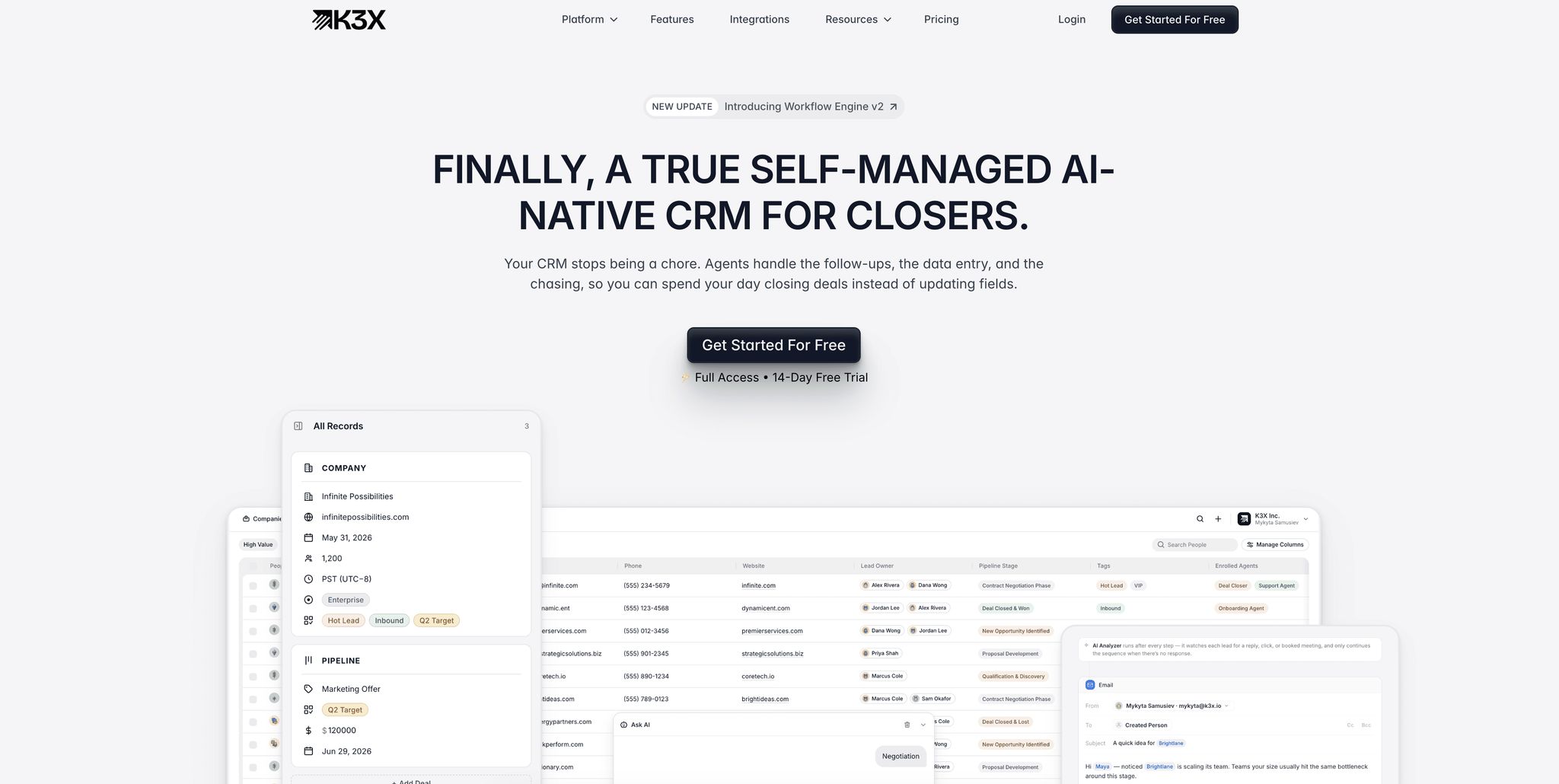
K3X changes the game in sales automation. Instead of setting up complicated workflows, you simply define what you want to achieve with a prompt. For instance, if you tell K3X to "schedule demos for all unresponsive leads", the system figures out the best actions on its own - no manual setup required.
Why Traditional CRMs Slow Down Response Times
Traditional CRMs rely on rigid sequences that often fail when leads act unpredictably. For example, if a lead responds after a day but your sequence is programmed to "send email, wait two days, then follow up", the system sticks to the script. This inflexibility wastes time and opportunities.
Sales reps spend over 20 hours a week on manual data entry and CRM updates. Worse, 85% of salespeople say outdated or inaccurate CRM data has cost them deals. And those errors? They can eat up as much as 15% of a company’s revenue. On top of all this, traditional systems demand constant maintenance - every tweak to your sales process means updating rules, scoring models, and sequences. Instead of speeding things up, these CRMs often become a roadblock to success [8].
How K3X Eliminates Response Delays
K3X tackles these issues head-on by adapting in real time. Forget rigid sequences - just set the outcome you want, and the AI takes over, adjusting its actions as leads engage. For instance, if a prospect opens an email but doesn’t click any links, K3X might shift to SMS or a phone call. It also automatically logs every interaction, eliminating manual data entry. This boosts forecast accuracy by 22% and shortens sales cycles by 17%.
The platform’s "stop on engagement" feature halts automated sequences the moment a lead replies or books a meeting. Operating around the clock across email, SMS, and WhatsApp, K3X ensures immediate follow-up whenever a lead interacts [8].
"Most systems are linear. They follow fixed steps - and if something unexpected happens, the flow breaks... K3X works on goals. Instead of defining steps like 'Send this email, then wait,' you define the objective."
Mykyta Samusiev, CEO, K3X [8]
Here’s a real-world example: In December 2025, Ruby Capital Group, a company with 125 employees, implemented K3X to handle their sales pipeline. Within two days, they cut the time spent on lead follow-ups by 70% and tripled their ticket resolution speed. This shift allowed their sales team to focus on engaging with customers and closing deals rather than drowning in administrative tasks [8].
K3X vs. Workflow-Heavy CRMs
The contrast between K3X and traditional CRMs is stark:
Feature | K3X | Traditional CRMs |
|---|---|---|
Response Speed | Instant (under 60 seconds) | Minutes to hours (manual/delayed) |
Setup Complexity | Minimal (under 1 hour) | High (weeks to months) |
Workflow Logic | Goal-based prompts that adapt in real time | Rigid sequences requiring constant updates |
Data Entry | Automated via API | Manual (avg. 3.4 hours per week per rep) |
Lead Evaluation | 2–3 seconds using AI | 10–30 minutes when done manually |
Adaptability | Dynamic adjustments based on lead behavior | Static and rigid |
Maintenance | Continuous real-time learning | Requires constant manual updates |
K3X evaluates leads in just 2–3 seconds, compared to the 10–30 minutes it takes manually. Businesses using AI-driven platforms like K3X report a 60% boost in sales rep capacity and a 30% increase in revenue per rep. On top of that, K3X saves employees an average of 8 hours a week, giving them more time for high-value tasks like negotiations and relationship building [8].
At just $20 per month per user, K3X offers these benefits at a fraction of the cost of traditional CRMs like Salesforce or HubSpot. Plus, its pricing adjusts based on workload, so you only pay more during peak times. This approach directly addresses the delays and inefficiencies that cost businesses valuable sales opportunities [8].
Measuring and Improving AI Response Performance
Speed is only meaningful when it's tracked. Without measuring key metrics, improving your AI system's response performance becomes nearly impossible. To maximize the potential of fast AI responses, it's essential to monitor performance and refine your approach over time.
Key Metrics for Tracking AI Response Speed
Start by focusing on Median Lead Response Time (LRT). This metric tracks the time between when a lead enters your system and when they receive their first meaningful outreach. The median is preferred over the average since it avoids being skewed by outliers [9]. Another important metric is threshold distribution, which measures the percentage of leads contacted within specific time frames. For example, reaching a lead within 5 minutes - the "Golden Window" - makes you 21 times more likely to qualify that lead compared to waiting 30 minutes [9][6][3].
You should also monitor the lead leakage rate, which represents the percentage of leads lost due to routing or process issues. Another critical measure is the qualification rate (QR), which calculates the proportion of leads successfully entering your sales process. Faster response times are strongly linked to higher qualification rates [3][4]. Finally, track pipeline velocity, which is determined using the formula: (Opportunities × Win Rate × Average Deal Size) ÷ Sales Cycle Length. Faster AI responses can significantly reduce the length of your sales cycle, boosting this metric [10].
Take GreenTech Solutions as an example. Between January and June 2024, they used these metrics to evaluate their AI CRM system. By cutting rep administrative time from 14.2 hours to just 2.1 hours per week, they sped up lead engagement. Their close rate jumped from 16.8% to 21.3%, resulting in $740,000 in annual value [10].
Tracking these metrics is the first step toward creating a system that improves continuously through timely feedback.
Using Feedback Loops to Improve AI Performance
Improvement starts with measurement. Set up real-time dashboards that integrate with your CRM to monitor key indicators like AI usage, prompt volume, and speed-to-lead [10]. Add automated alerts to notify your team when performance drops below certain thresholds - such as when a lead hasn't been followed up within 60 minutes [10].
"What gets measured gets managed. Organizations that measure AI performance improve it 3 times faster than those that don't." – Teneo [10]
Incorporate A/B testing to compare workflows. For instance, test AI-driven responses against traditional manual processes to see how they differ in conversion rates and time saved [10]. For AI-native CRMs like K3X, use performance data to refine prompts. If a prompt like "Book demo calls with every unresponsive lead" isn't working, adjust it to tackle specific bottlenecks and improve results [10].
Before rolling out AI, gather 8–12 weeks of historical data on metrics like sales cycle length and lead conversion rates. This data will provide a baseline to measure genuine improvements once AI is implemented [10].
Conclusion
Speed can make or break a deal in today's fast-paced sales environment. With 78% of customers choosing the first responder and 82% expecting replies within 10 minutes, response time is more than just a metric - it's a game-changer. Studies reveal that responding within five minutes makes you 100 times more likely to connect and 21 times more likely to qualify a lead compared to waiting 30 minutes [6].
Unfortunately, outdated CRM systems often slow teams down. Rigid workflows, manual lead routing, and excessive data entry create bottlenecks, leaving companies vulnerable to faster competitors.
"The race isn't to have the best product or the slickest pitch. It's to show up before anyone else does. Speed is the new competitive moat." – Nadeem Azam, Founder, Rep [5]
This is where K3X steps in, reimagining how sales teams operate. Instead of relying on rigid scripts, it allows you to set outcomes - like "schedule demos for all unresponsive leads" - while the AI handles the execution instantly [8]. Running around the clock, K3X captures the 40% to 44% of high-intent inquiries that come in after hours [1] and increases sales rep capacity by 60% [8]. Ruby Capital Group’s experience highlights this, with follow-up times slashed significantly in just days [8].
Fast AI responses don't just meet customer expectations - they redefine how sales teams operate, turning speed into revenue and enabling scalable growth.
FAQs
What should my target lead response time be?
Did you know that responding to leads within 5 minutes can make all the difference? Research reveals that leads contacted in this short window are up to 100 times more likely to convert. That’s a staggering number!
This isn’t just about being fast for the sake of it - it’s about showing potential customers that their inquiry matters. A quick response builds trust, keeps their attention, and dramatically increases the chances of turning a simple inquiry into a solid opportunity. In sales, speed isn’t just an advantage; it’s a necessity.
How can I respond fast after hours without hiring more reps?
If you're looking to maintain fast response times after hours without hiring more staff, AI-powered CRMs like K3X can be a game-changer. These tools handle tasks like automating follow-ups, routing leads, and setting priorities based on your specific goals. This ensures leads are engaged quickly - even when your team is off the clock.
Why does this matter? Responding to leads within minutes can dramatically improve your conversion rates. It keeps your sales pipeline active and responsive, all while cutting down on manual tasks and avoiding the need to grow your team.
Which metrics prove faster responses increase revenue?
Faster responses can dramatically increase revenue. For instance, responding to leads within just 5 minutes can result in a 21x higher likelihood of qualifying those leads and a 100x greater chance of making contact. These numbers clearly show how crucial prompt follow-ups are for improving lead conversion and driving sales.