Sales Automation
•
How AI Automates Sales Playbook Execution
How AI transforms static sales playbooks into real-time, automated guidance that saves reps time and increases win rates.

AI is transforming how sales teams operate by turning static playbooks into dynamic, real-time tools. Traditional playbooks often fail due to outdated content, manual updates, and rigid processes. AI solves these issues by providing:
Real-time guidance: AI analyzes live buyer signals (e.g., email sentiment, call transcripts) to suggest the next best action instantly.
Automation of tasks: It handles follow-ups, data entry, and updates without manual input, saving reps time.
Continuous updates: AI ensures playbooks stay relevant by identifying trends and drafting updates automatically.
Higher efficiency: Sales teams using AI report saving up to 8 hours weekly per rep and a 30% increase in revenue per rep.
AI-powered platforms like K3X simplify execution by focusing on goals (e.g., booking a demo) and determining the best steps to achieve them. They integrate seamlessly with tools like CRMs, email, and Slack, ensuring reps have the right guidance when and where they need it. Businesses adopting AI-driven playbooks experience faster deal cycles, improved win rates, and more accurate forecasts.
Key takeaway: AI-driven sales playbooks reduce inefficiencies, improve consistency, and help teams focus on closing deals instead of administrative tasks.
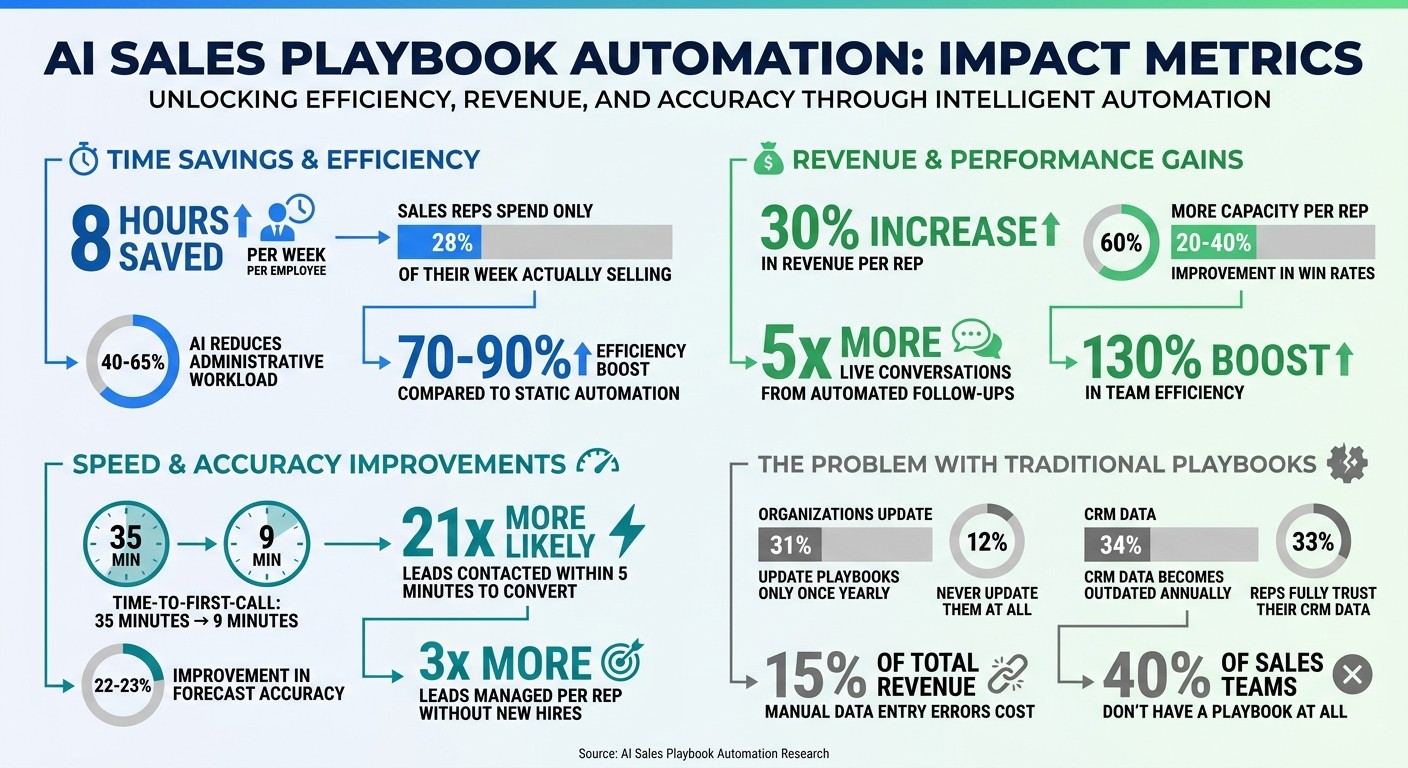
AI Sales Playbook Automation: Key Performance Metrics and ROI
Create A Sales Playbook That Powers Sales Reps And AI Agents
Why Sales Playbooks Fail in Execution
Sales playbooks often fall short when they rely on outdated content, manual processes, and strategies that aren't integrated into daily workflows. In fast-moving sales environments, these limitations can make even the best-designed playbooks ineffective.
Static Content Falls Behind Market Changes
Sales landscapes evolve at lightning speed. Competitor pricing shifts, new product features, and changes in customer preferences happen weekly - not quarterly. Yet, static PDFs and binders can't keep up with these rapid changes [2]. Add to this the complexity of modern B2B sales, which often involve 6–10 decision-makers navigating non-linear buying journeys with fluctuating budgets [7][12]. Static playbooks simply can't capture this level of complexity.
On top of that, the sheer volume of data overwhelms traditional playbooks. Sales reps face a flood of intent signals, engagement patterns, and competitor insights, leaving them unsure about what information to prioritize. Meanwhile, playbooks stored in intranet folders remain disconnected from where the work actually happens - like inside the CRM, during email drafting, or on live calls [2][7].
"The difference between a playbook and an NBA system is the difference between a map and GPS. A map shows you the roads. GPS tells you which turn to make right now, based on live traffic."
– Pingd [7]
Static content isn't just outdated - it’s also a hassle to update, further diminishing its usefulness.
Manual Updates Create Barriers to Adoption
Manually updating playbooks is a slow and inefficient process. A staggering 31% of organizations update their sales playbooks only once a year, while 12% never update them at all [13]. By the time new messaging or competitive insights are added, the information is often obsolete.
This inefficiency compounds the problem of trust. Only about one-third of sales reps fully trust the data in their CRM [8]. Even well-crafted playbooks are left untouched when reps perceive them as unreliable. Manual data entry mistakes alone cost businesses an estimated 15% of their total revenue [9], making it clear why adoption rates remain low.
Strategy and Execution Are Disconnected
Traditional playbooks often function as static reference materials rather than dynamic, operational tools. Sales reps don’t need a library of information - they need real-time guidance during live deals [1][13]. When playbooks are housed in slide decks or standalone portals, reps are forced to switch between tools and tabs, increasing their cognitive load and reducing adherence [12].
"A playbook designed as a library is destined to fail. Reps don't have time for research during a live deal. They need a decision system that surfaces the right action at the right time."
– Fluint [1]
This disconnect between strategy and execution creates what experts call the "Operator Layer" gap - the missing link between systems, workflows, and real behavior change [14]. Without this layer, even increased effort can fail to drive growth. While organizations with formalized sales playbooks are 33% more likely to be high performers, nearly 40% of sales teams don’t have one at all [13]. And even when playbooks exist, rigid if-then structures often collapse the moment a prospect asks an unexpected question or deviates from the script [3][8].
How AI Automates Sales Playbook Execution
AI-powered CRMs take the heavy lifting out of sales playbook management by continuously monitoring, adjusting, and delivering updated guidance in real time. Instead of locking reps into rigid scripts, these systems focus on outcomes - like securing a demo with an unresponsive lead - and figure out the steps needed to make that happen. By analyzing CRM activity, email threads, call recordings, and intent data, the AI stays on top of every deal’s status and determines the next best move.
Real-Time Data Analysis and Context
AI doesn’t just skim the surface; it dives deep into every interaction across your sales channels to build a detailed view of each opportunity. Using advanced language models, it processes unstructured data like call transcripts and email exchanges, evaluating qualification frameworks such as BANT and MEDDICC. For instance, if a prospect mentions a competitor during a call, the AI flags the objection instantly. Similarly, when someone says, "send the contract", the system updates the deal's stage automatically - no manual input required.
This level of contextual analysis helps prevent deals from stagnating in your CRM. AI identifies when conversations stall, decision-makers go silent, or budget approvals hit a snag. It then ranks potential actions by urgency and impact, suggesting the most effective next step - whether that’s involving legal, sending a mutual action plan, or scheduling a follow-up. These insights ensure that playbooks stay relevant without constant manual intervention.
Automatic Updates Without Manual Work
Sales playbooks have a shelf life, with CRM data becoming outdated at an average rate of 34% annually [11]. AI-driven systems tackle this problem by spotting outdated content and drafting updates based on what’s working in active deals. For example, if a new objection starts popping up in call recordings, the AI recognizes the trend, drafts a response, and updates the playbook - all without waiting for a manual review.
K3X takes this functionality a step further, letting users adjust goals and logic with simple prompts instead of rebuilding complex workflows. Want to ensure every unresponsive lead gets a follow-up? Just set the objective, and K3X adapts instantly across all active deals.
"Most CRMs record activity. K3X understands outcomes. It listens, knows what changed, and makes the next moves."
– Mykyta Samusiev, Co-Founder & CEO, K3X
By keeping playbooks current, the system ensures that every update is instantly actionable.
Instant Distribution Across Sales Channels
Once the AI updates your playbook, it doesn’t stop there - it makes sure the new guidance is instantly available across all your tools. Whether it’s email templates, dialer scripts, CRM dashboards, Slack notifications, or call notes, the updated content is ready to use. For example, if a competitor is mentioned, the AI immediately delivers the right objection-handling script and drafts a response via email or SMS.
This seamless integration ensures that sales reps have the right play at the right moment, whether they’re writing an email, preparing for a call, or updating a deal. By embedding guidance directly into the tools where selling happens, the system eliminates delays and outdated messaging. The result? A 70–90% boost in efficiency compared to static automation, saving each employee an average of 8 hours every week [11].
How to Implement AI-Driven Playbook Automation
Getting started with AI-driven playbook automation requires a step-by-step approach. Companies like Ruby Capital Group have seen impressive results - cutting follow-up time by 70% in just two days - by integrating their existing tools, testing workflows, and training the AI to align with their sales processes [3].
Connect With Your CRM and Sales Tools
For AI to automate playbooks effectively, it needs access to your sales data. Begin by standardizing key CRM elements like People, Accounts, and Opportunities. Ensure that critical fields - such as deal stage, contact role, and close date - are consistent across your database [18]. Use read/write APIs with OAuth scopes to grant the AI only the permissions it needs, keeping security tight while enabling data updates and action triggers in platforms like Salesforce or HubSpot [18][20].
K3X makes this process smoother by linking directly to tools your team already uses, like email, calendars, VoIP, and Slack. This minimizes disruptions by embedding AI into existing workflows [3][19]. For example, if a prospect mentions a competitor during a call, K3X flags the objection and drafts a response in the same thread - no need for reps to switch tabs or manually log details.
Once your CRM and tools are connected, ease into the transition with a phased rollout to encourage adoption.
Roll Out in Phases for Better Adoption
A phased implementation builds trust and ensures a smooth transition. The best rollouts typically follow three stages: Shadow Mode, Assist Mode, and Autonomous Mode [18].
Shadow Mode (Days 1-14): The AI observes and logs suggestions as CRM notes without taking any external actions. This allows your team to verify its accuracy.
Assist Mode (Days 15-45): Here, the AI drafts outreach and suggests updates, but all actions require human approval.
Autonomous Mode (Days 46-90): The AI begins executing routine tasks within predefined guardrails, while high-risk or high-value steps still require human review.
Rollout Phase | Duration | Focus | Control Level |
|---|---|---|---|
Shadow Mode | Days 1-14 | AI plans actions in the background. | No external writes or sends. |
Assist Mode | Days 15-45 | AI drafts and suggests, with human review. | Human approval required. |
Autonomous | Days 46-90 | AI executes routine tasks independently. | Human review for critical actions. |
Starting small - like automating lead qualification and follow-ups - helps avoid "pilot purgatory" and demonstrates clear ROI before expanding automation to other tasks [18].
"Our sales team was spending half their day on admin work. Now they're talking to customers and closing deals. The automation handles everything from lead qualification to contract routing."
– Michael Chkechkov, CEO, Ruby Capital Group [3]
Train AI Models on Your Sales Data
The AI's effectiveness depends on the quality of data it learns from. To ensure accurate execution, build a dataset that includes key sales insights like ICP definitions, value propositions, objection-handling scripts, and proof points [19]. Incorporate a variety of inputs - playbook content, CRM history, call transcripts, email threads, and customer FAQs - so the AI knows not just what to say, but when and why to say it [4].
Use prompt engineering to define the AI's role. For example, you could instruct it to act as a "Sales Operations Analyst" that evaluates conversations using criteria like BANT (Budget, Authority, Need, Timeline) or MEDDICC [15]. Document your current workflows, identify weak points, and design a target system where the AI handles the first 70% of tasks [19]. Set clear boundaries for automation, specifying what actions can be taken automatically versus those requiring human intervention, especially for sensitive tasks like pricing or legal reviews [4][19].
K3X takes a goal-focused approach, prioritizing outcomes over rigid processes. Instead of programming every step, you define objectives - like "Schedule demo calls with unresponsive leads" - and K3X determines the best path based on historical success [3]. This flexibility allows the AI to adapt in real time to changing behaviors and market conditions, eliminating the need for constant reprogramming. With well-trained models, your system is ready to scale and deliver measurable results.
How to Measure AI Automation Impact
Once your AI-driven playbook automation is up and running, it’s crucial to track the right metrics to see if it’s delivering results. Focus on early indicators like adoption and usage, as well as business outcomes such as revenue growth and improved win rates.
Time Saved and Efficiency Gains
One of the immediate benefits of AI automation is reclaiming lost time. On average, sales reps spend just 28% of their week selling, with the rest consumed by tasks like data entry, call logging, and drafting follow-ups [6]. AI automation can reduce this administrative workload by 40% to 65% [6], giving reps more time to focus on closing deals.
To calculate your own time savings, use this formula: multiply the number of reps by the average hours saved per week and their hourly cost (including benefits and overhead). For example, if 15 reps save 8 hours per week at $50/hour, that’s $6,000 weekly - or over $312,000 annually [3]. Key metrics to monitor include time-to-first-response (since leads contacted within 5 minutes are 21x more likely to convert [8]) and weekly admin hours to establish a baseline and track improvements.
"Our sales team was spending half their day on admin work. Now they're talking to customers and closing deals. The automation handles everything from lead qualification to contract routing, and our close rates have never been higher."
– Michael Chkechkov, CEO, Ruby Capital Group [3]
Additionally, AI can enhance the relevance of playbooks, which drives better adoption and efficiency.
Better Playbook Relevance and Usage
Adoption rates reveal whether your playbooks are being effectively used. Metrics like the playbook adoption rate (percentage of qualified opportunities where an AI-driven play was executed [21]) and talk-track usage rate (how often reps use recommended scripts during calls [21]) are key indicators. If these numbers are low, it might mean your playbooks are outdated or too complex.
AI can continuously refine playbooks by analyzing what works in real conversations. Keep an eye on data completeness - the accuracy and presence of key CRM fields like MEDDICC or BANT for each deal stage [4][5] - to ensure the AI has the right context. You can also use a Playbook Health Score to gauge overall effectiveness. This could include a weighted formula such as: 40% Adoption Rate + 30% Stage Conversion Lift + 20% Talk-track Usage + 10% Manager Coaching Completion [21].
To keep your playbooks streamlined, set criteria for retiring underperforming plays. For instance, if a play’s adoption falls below 10% for two consecutive quarters or its impact on win rates is negligible, it’s time to remove it [21].
Sales Performance Improvements
At the end of the day, success boils down to revenue growth. Track win rate by play to see how individual automated plays compare to your baseline [10][21]. Also, monitor stage velocity - the time deals spend in each stage versus historical averages [10][5]. Faster stage progression usually signals smoother execution and fewer stalled deals.
AI-driven automation can also boost forecast accuracy by 22% [8] by ensuring consistent data logging and timely stage updates. Keep tabs on forecast variance (the gap between predicted and actual revenue) and how often deals slip stages near quarter-end [5][10]. Another useful metric is multi-threading coverage - the number of stakeholders engaged per deal compared to your Ideal Customer Profile. Broader engagement often leads to faster and higher-value deal closures [10].
Companies using AI workflows report 60% more capacity per rep and 30% higher revenue per rep [8]. Automated follow-ups can also result in 5x more live conversations and a 130% boost in team efficiency [17][8]. To measure your own results, compare pre- and post-implementation metrics in areas like efficiency (hours saved), speed (time-to-first-call), effectiveness (win rate improvement), and capacity (leads managed per rep).
Metric Category | Key KPI | Target Impact |
|---|---|---|
Efficiency | Weekly hours saved | 8 hours per employee [3] |
Speed | Time-to-first-call | Reduction from 35 mins to 9 mins [17] |
Effectiveness | Win rate lift | 20%–40% improvement [8] |
Accuracy | Forecast accuracy | 22% improvement [8] |
Capacity | Leads per rep | 3x more leads managed without new hires [8] |
Conclusion
Main Benefits of AI-Driven Playbook Automation
AI-driven playbook automation is changing the game for sales teams, allowing reps to focus on what they do best: having meaningful conversations and closing deals. Companies using AI-native CRMs have reported impressive results, including a 30% increase in revenue per rep and a 60% boost in workload capacity [8].
One of the standout advantages is the ability to adapt in real time. Unlike traditional playbooks that stick to static scripts, AI systems analyze live inputs - like email sentiment and call notes - to recommend the next best action. This shift from static documentation to active, real-time execution ensures that playbooks stay relevant, even in fast-changing market environments [4].
AI also ensures that your sales methodology - whether it’s MEDDICC, SPIN, or another framework - is applied consistently. By automating key qualification questions, it reduces messaging drift and improves forecast accuracy by 23% [16]. These capabilities take sales operations to the next level, making processes more agile and data-driven, and helping teams close deals more effectively.
Why K3X Works Best for Playbook Automation
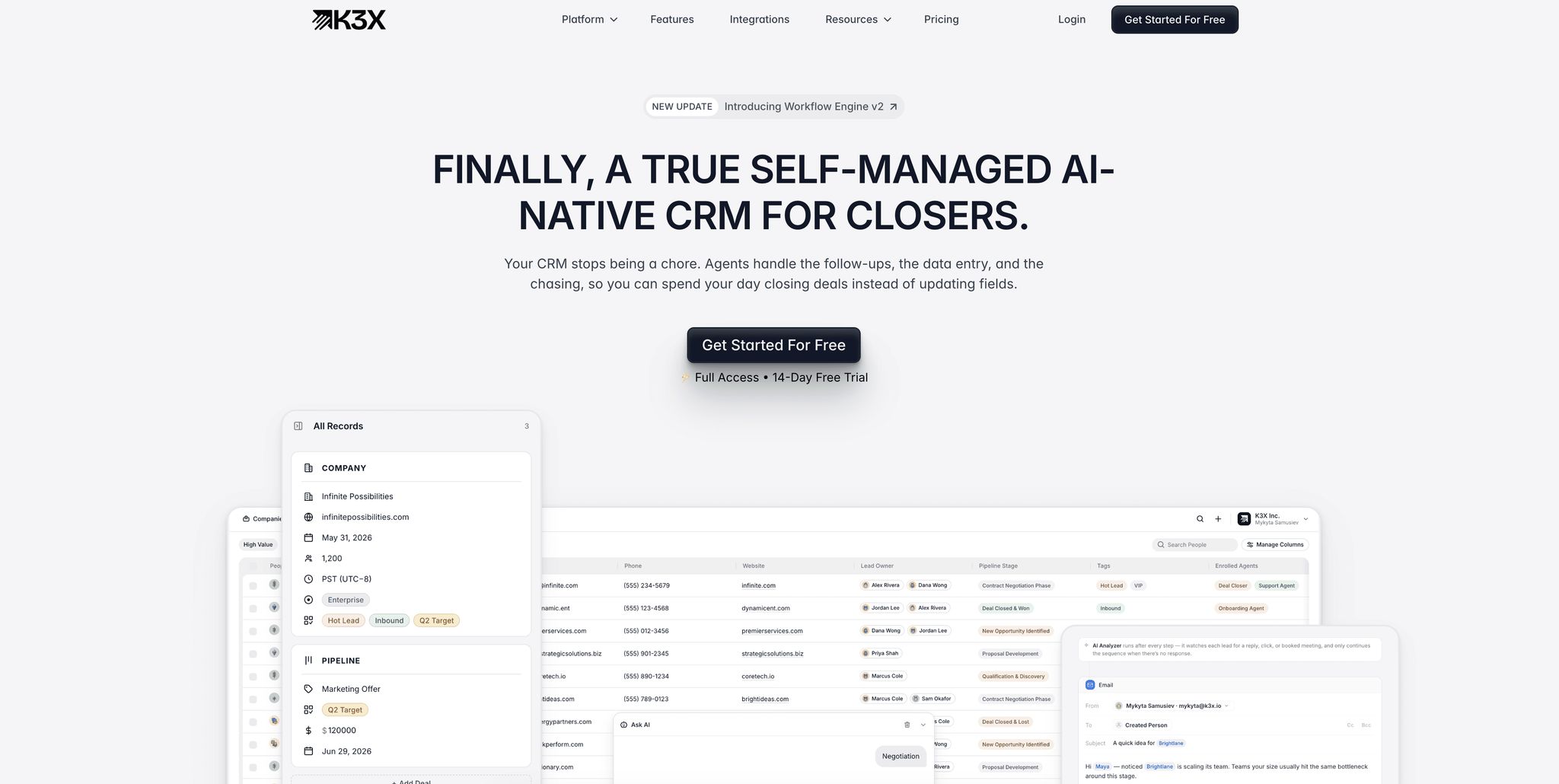
K3X builds on these benefits by providing a streamlined, intuitive platform that outperforms traditional automation tools. Unlike legacy systems that rely on rigid "if-then" workflows, K3X simplifies the process. All you need to do is define your goal - like "Re-engage leads who haven’t responded in 3 days" - and K3X handles the rest [3].
The platform also excels in automating tasks like lead qualification and contract routing, delivering real-world results. For example, Ruby Capital Group saw measurable improvements in follow-up speed and ticket resolution within just two days of implementing K3X [3]. On average, K3X saves employees 8 hours per week and has helped its user base cut operational costs by over $12.4 million [3]. By eliminating the inefficiencies of legacy CRMs, K3X delivers both time savings and cost reductions, making it a standout choice for modern sales teams.
FAQs
What data does an AI-driven CRM need to automate a sales playbook?
An AI-powered CRM thrives on real-time signals and contextual data. This includes CRM activity, email interactions, call recordings, intent data, product usage stats, and pipeline status. These inputs allow the AI to gauge deal progress, measure prospect engagement, and recommend the next best actions.
Structured conversation transcripts add another layer of insight. They help the AI identify objections, evaluate qualifications, and adjust strategies on the fly. With continuously refreshed data, the system stays accurate and ensures seamless automation of your sales playbook.
How do you keep AI playbook automation safe from sending the wrong message?
To prevent AI-driven sales playbook automation from sending out the wrong messages, certain safeguards are crucial. These include strong validation processes and human oversight. For instance, critical communications can be reviewed by a person before they're sent out, ensuring accuracy and appropriateness. Additionally, ongoing monitoring plays a key role in spotting and correcting errors as they arise.
Platforms like K3X stand out by prioritizing outcomes over rigid workflows. This flexibility allows them to adjust intelligently, minimizing the chances of miscommunication. The result is messaging that remains accurate, relevant, and aligned with the goals of the sales process.
What metrics prove the ROI of AI playbook automation?
To show a clear return on investment (ROI), focus on tracking metrics that highlight efficiency and revenue growth. Look at how much manual work is reduced (like data entry or follow-ups), how quickly responses are delivered, and the overall impact on revenue. Key metrics to monitor include lead prioritization accuracy, pipeline velocity, forecast accuracy, and shortened sales cycles.
AI tools, such as K3X, are designed to drive measurable results. They help boost win rates, expand the capacity of sales reps, and speed up engagement. For instance, responding to leads within five minutes - a feature powered by AI - can lead to a significant increase in conversions.