Sales Automation
•
K3X vs Freshsales: AI-Native CRM vs AI-Assisted CRM
Pick execution-first AI-native CRMs to automate follow-up, or AI-assisted CRMs for lower cost and stronger admin control.

If I had to reduce this comparison to one line, I’d say this: K3X is the better fit for small teams that want AI to run follow-up, while Freshsales is the better fit for teams that want a lower-cost CRM with AI support inside a more established system.
My read is simple. Pick K3X for execution. Pick Freshsales for structure, lower entry cost, and admin control.
What is the main difference?
The split is not about whether both tools have AI. It is about what the AI does.
With K3X, I can describe an outcome in plain English and let the system handle follow-up across email, SMS, and calls. With Freshsales, reps still run the process, while Freddy AI helps with scoring, drafting, and deal signals.
That means K3X leans toward AI-run outreach, while Freshsales leans toward rep-run outreach with AI help.
Which one costs less?
At the low end, Freshsales costs less. It has a free plan for up to 3 users, and paid plans start at $9/user/month billed annually [9].
K3X starts at $20/seat/month and includes 1,000 AI credits, calling, and SMS [3]. For teams that already know they need AI-driven follow-up, that flat starting point may be easier to justify than moving into Freshsales Pro plus add-ons.
A solo rep who only needs contact tracking will usually spend less with Freshsales. A small team that wants AI to carry out outreach may find K3X closer to the job they want done.
Which one is easier to set up?
I’d expect K3X to take less setup work for a 1–9 person team.
The reason is simple: K3X replaces workflow building with prompts. The article says teams can get started in under 1 hour [1]. Freshsales is easy enough for basic contact and deal tracking, but more setup is needed once you add workflows, multiple pipelines, sequences, and AI features.
For teams without a sales ops owner, that gap matters. Freshsales often works best when someone is in charge of fields, rules, and system upkeep.
How different are the AI models in practice?
This is the part I’d focus on most.
Freshsales uses assistive AI. Freddy AI scores leads, drafts emails, flags deal risk, and surfaces signals like out-of-office replies [6][8][9]. That can help reps move faster, but the system is still built around rep action or prebuilt rules.
K3X uses agentic AI. I set the goal, and the system plans and runs the follow-up steps across channels [1][2]. That is a very different operating model from a normal CRM plus AI helper.
So if the question is, “Will the CRM do follow-up for me?” the article’s answer points to K3X, not Freshsales.
What about integrations and ecosystem depth?
Here, Freshsales has the edge.
The article notes 280+ marketplace apps in one section [5] and 1,200+ apps in another [9], which signals a much larger app ecosystem than K3X. Freshsales also ties into the Freshworks suite, which may matter if a team already uses tools like Freshdesk.
K3X keeps more activity inside the product and uses webhooks and API-based connections [1][3]. That can work well for lean teams, but it is not the same as having a large plug-and-play app marketplace.
Which tool is better for larger teams?
Based on the article, Freshsales is the safer choice for larger or more structured teams.
Freshworks says Freshsales serves 65,000+ businesses worldwide [5]. The platform also has stronger admin controls, support coverage, and governance features such as audit logs, permissions, and territory management [6][9].
K3X is framed much more narrowly. It is aimed at teams of 1–9 people, and the article says it is not built for 100+ seat deployments.
So if I were advising a mid-market team with formal sales ops, I would lean Freshsales first. If I were advising a small founder-led sales team, I would take K3X more seriously.
Who should choose K3X?
I’d put K3X on the shortlist if the team is small and wants less CRM admin work.
That includes teams that:
want AI to send follow-up across email, SMS, and calls
do not want to spend time building sequences and workflow logic
need calling and SMS included in the base plan
care more about getting outreach done than shaping a deep CRM system
The article also says K3X claims to save reps 8 hours per week [1]. I’d treat that as a vendor claim, but it gives a clear picture of the use case K3X is aiming at.
Who should choose Freshsales?
I’d pick Freshsales if the team wants a lower-cost starting point, a more mature CRM, and more admin control.
That includes teams that:
want a free tier or low paid entry point
are fine with reps or admins running sequences and rules
need a larger app marketplace
already use other Freshworks products
want a CRM with more depth for permissions, oversight, and scale
Freshsales is also the simpler choice if AI is useful but not the center of the buying decision.
How hard is it to move from Freshsales to K3X?
The article’s view is that data migration is the easy part; automation rebuild is the hard part.
Contacts, leads, accounts, and deals can move by CSV. The article estimates 2–4 hours for a clean import [10]. The bigger lift is rebuilding workflows, sequences, and routing logic as prompts in K3X, which it estimates at 4–8 hours [10].
That means the move is less about data transfer and more about rewriting process logic.
My bottom line
If I want a CRM where AI acts, I’d look at K3X. If I want a CRM where AI assists inside a more proven setup, I’d look at Freshsales.
For most 1–3 person teams, Freshsales will be the lower-cost place to start. For 1–9 person teams that want AI to run follow-up without much system setup, K3X is the more direct fit based on the article.
The shortest verdict: Freshsales is the lower-cost, more established CRM. K3X is the more execution-focused option for small teams that want AI to carry out follow-up.
TL;DR: K3X or Freshsales - which should you pick?
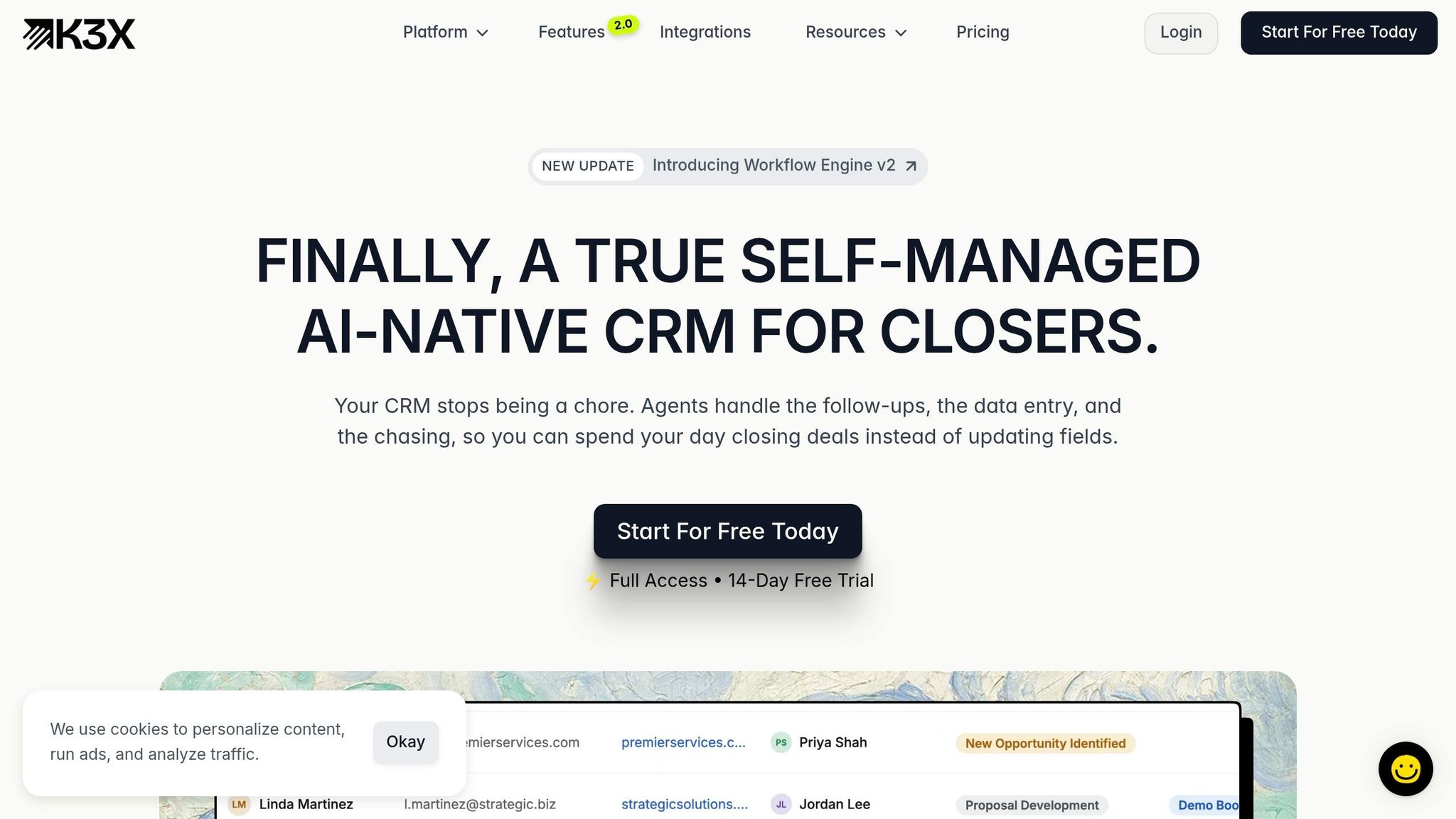
Pick K3X if you want AI to do the follow-up work across email, SMS, and calls from a plain-language prompt. Pick Freshsales if you want a more established CRM where Freddy AI helps reps score leads, forecast deals, and draft messages, while the rep still runs the process.
That’s the main split: execution vs. assistance. K3X is built for teams that want AI to carry out outreach steps. Freshsales fits teams that want AI support inside a CRM the sales team controls day to day. The table below breaks down price, setup, automation, integrations, and fit.
How do K3X and Freshsales compare side by side?
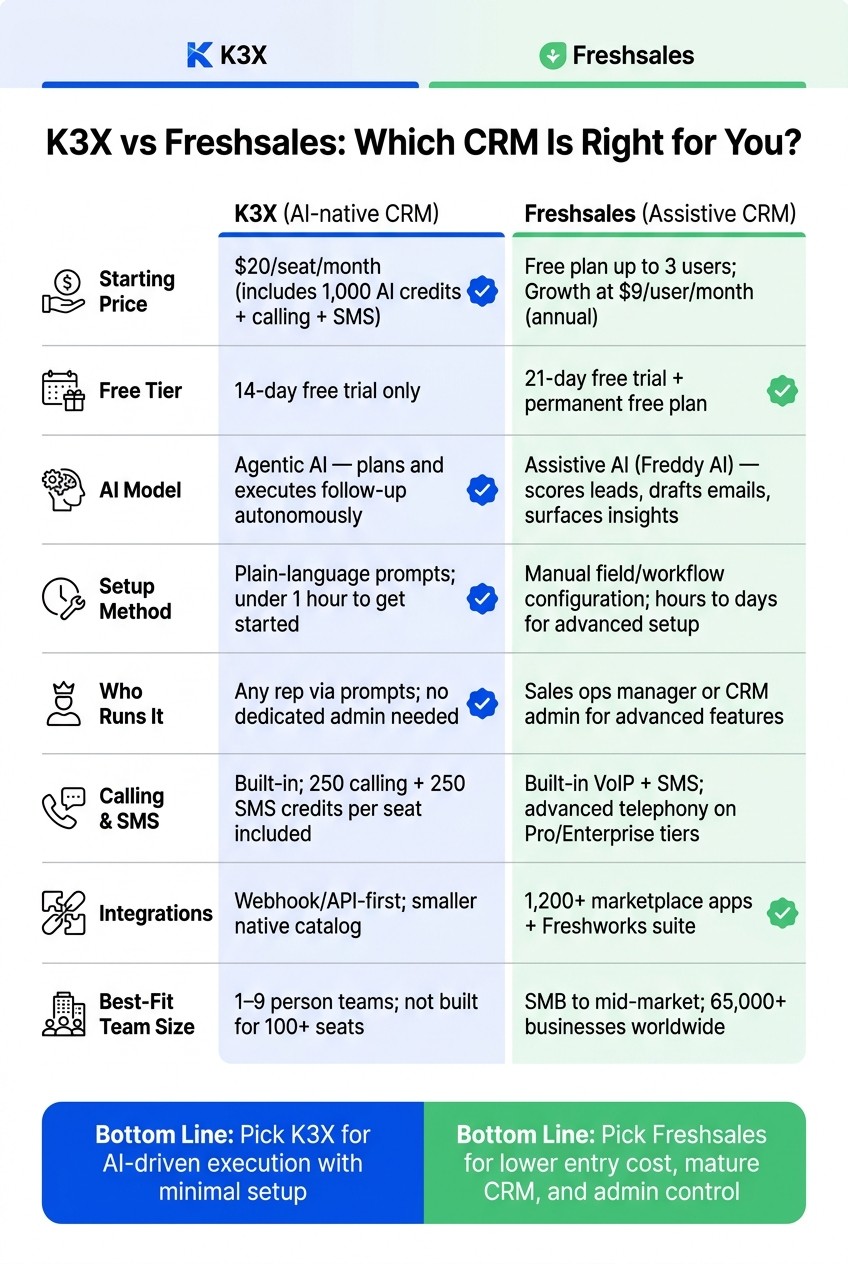
K3X vs Freshsales: AI-Native CRM Comparison 2024
Freshsales costs less at entry level, especially for very small teams. K3X is easier to operate day to day if your goal is to have AI carry out follow-up from a plain-language prompt.
For small teams, the main tradeoff is simple: Freshsales gives you a lower starting cost and a free tier, while K3X cuts down setup work by letting reps describe the outcome and letting AI do the rest [1][2][3][4][6][9].
Dimension | K3X | Freshsales |
|---|---|---|
Starting price | $20/seat/month, including 1,000 AI credits and built-in calling/SMS [3] | Free plan for up to 3 users; Growth starts at $9/user/month billed annually [9] |
Free trial / free tier | 14-day free trial at k3x.ai [3] | |
Setup model | Prompt-driven - describe the outcome, and AI handles the execution [1][2] | Manual configuration of fields, modules, and rules [4] |
Who configures it | Any rep, via plain-language prompts [1] | |
AI / automation model | Agentic - AI plans and executes follow-up across email, SMS, and calls [2] | Assistive - Freddy AI scores leads, surfaces insights, and drafts messages [6] |
Calling & SMS | Built in, with 1,000 credits included per seat [3] | Built-in VoIP and SMS; separate phone credits or BYOC on higher tiers [9][11] |
Integrations | Unlimited integrations via standard connectors and a webhook-first API [1][3] | 280+ marketplace apps plus the Freshworks suite [5] |
Best-fit team | Execution-focused teams of 1–9 reps that want AI to run outreach | SMBs to mid-market teams that want a structured, mature CRM |
The clearest pricing split shows up right away. K3X starts at $20 per seat per month and includes 1,000 AI credits plus calling and SMS [3]. Freshsales starts with a free plan for up to three users, and its Growth plan is $9 per user per month when billed annually [9].
Setup is the next big difference. K3X uses a prompt-driven model, so a rep can describe what they want done in plain language and the AI handles execution [1][2]. Freshsales takes the more standard CRM route: teams set up fields, modules, and rules manually, which usually means sales ops or a CRM admin owns the system [4][13].
The AI layer also works differently. In K3X, the AI is meant to plan and carry out follow-up across email, SMS, and calls [2]. In Freshsales, Freddy AI helps with lead scoring, message drafting, and surfaced insights, but it does not act as the main operator for outbound work [6].
On communication tools, both platforms cover calling and SMS, but the billing model differs. K3X includes those functions in the seat price with 1,000 credits per user [3]. Freshsales has built-in VoIP and SMS too, though teams may need separate phone credits or BYOC on upper plans [9][11].
Integration depth leans the other way. K3X offers unlimited integrations through standard connectors and a webhook-first API [1][3]. Freshsales lists 280+ marketplace apps and also connects tightly with the Freshworks product set [5].
In practical terms, K3X fits small teams that care more about execution speed than CRM administration. Freshsales fits SMB and mid-market groups that want a more structured CRM system, a free entry point, and a setup model that sales ops can control.
Which CRM costs less: K3X or Freshsales?
Freshsales is cheaper at the entry level. K3X can cost less once a small team needs built-in AI for follow-up, calling, and SMS. The key difference is simple: K3X includes those tools in its $20 per-seat price, while Freshsales puts AI features in higher tiers or separate add-ons [3][9][11].
How do the plan structures compare?
K3X keeps pricing simple with one paid plan. Freshsales uses four tiers, and the cost climbs as teams need more automation and AI.
K3X has one paid plan at $20 per seat/month, and that plan includes 1,000 AI credits, a power dialer, and SMS [3].
Freshsales has four tiers: Free, Growth, Pro, and Enterprise. Growth costs $9/user/month with annual billing or $11/user/month on monthly billing. Pro costs $39/user/month annually or $47/user/month monthly. Enterprise costs $59/user/month annually or $71/user/month monthly [9].
The Free plan is capped at 3 users and does not include custom fields or AI. Growth adds workflows and custom fields. Pro adds Freddy AI, sequences, and multiple pipelines [9][11]. On top of that, Freddy Copilot costs $29/user/month, and Freddy Insights costs $100/user/month [11].
What does total cost look like for small teams?
For basic use, Freshsales Free is the lowest-cost option. For teams that need AI execution, K3X is often the lower-cost paid option at small scale.
Team Size | K3X (Monthly) | Freshsales Free | Freshsales Pro (Annual Billing) |
|---|---|---|---|
Solo (1 user) | $20 | $0 | $39 |
3-person team | $60 | $0 | $117 |
8-person team | $160 | N/A (3-user cap) | $312 |
These numbers exclude add-ons and phone-credit usage [3][9][11].
For a solo user who just needs contact tracking, Freshsales Free is the cheaper choice. Once that same user needs AI or sequences, Freshsales moves up to Pro at $39/user/month, which is close to 2x K3X’s $20/user/month price [3][9].
That’s where the cost picture shifts. K3X is cheaper up front when AI execution is part of the job, but there’s a catch: teams need to watch credit use. High-volume outreach can burn through the included 1,000 AI credits fast [3]. Freshsales also costs more if billed month to month, since the lower published price depends on annual billing [9].
Which CRM is faster to set up, and who can run it day to day?
K3X is faster to set up for small teams. Reps describe the outcome they want, and the system handles follow-up. Freshsales is simple to start for basic contact and deal tracking, but setup gets more hands-on once you add automation, more than one pipeline, or AI lead scoring.
How does setup work in K3X?
K3X uses plain-language prompts instead of manual workflow building. A rep says what they want to happen, and K3X's AI agents run follow-up across email, SMS, and calls automatically [1][2]. For small teams, that means reps can use it day to day without a dedicated admin.
How much manual configuration does Freshsales require?
Freshsales is fast for basic CRM use, but advanced setup takes more work. Contact and deal tracking can be live in hours, but multiple pipelines, advanced workflows, and AI lead scoring sit in the Pro tier at $39/user/month [9]. So the starting point is simple, while scaling the system takes more planned configuration.
The clearest way to see the difference is to compare setup method, admin load, and who owns the system each day.
K3X | Freshsales | |
|---|---|---|
Setup method | Natural-language prompts | Manual configuration and workflow building |
Typical setup time | Under 1 hour [1] | Hours for basic setup; longer for advanced automation |
Needs a dedicated admin? | No dedicated admin for small teams | Not for basics; more deliberate setup for advanced features |
That setup gap leads to the next issue: whether the AI only helps reps or actually runs follow-up work.
How do K3X's agents and Freshsales' Freddy AI actually differ?
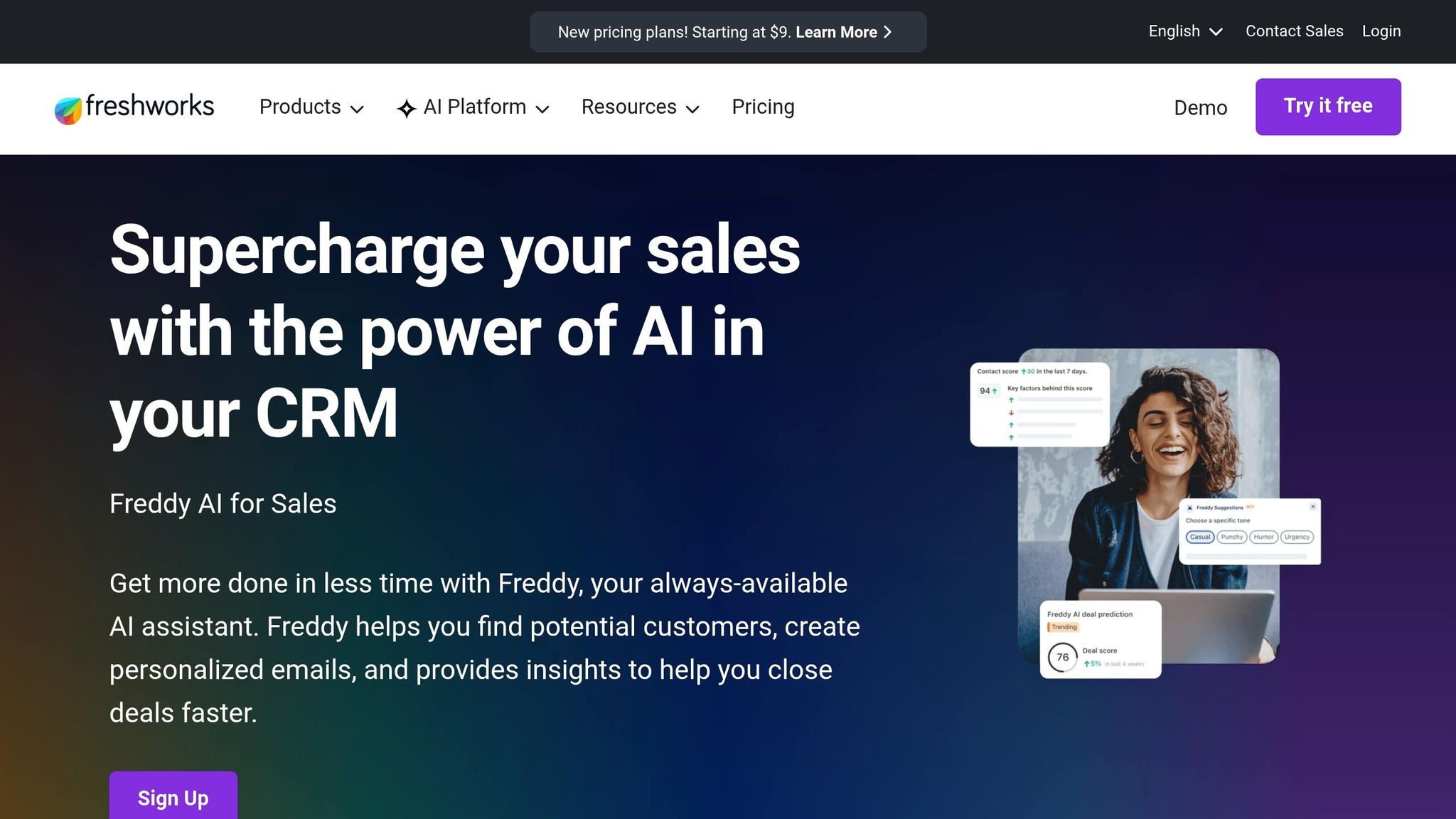
The main gap is simple: Freddy AI helps reps decide what to do next, while K3X agents do the follow-up work after you state the goal. In Freshsales, the rep still picks the next step or sets up rules in advance. In K3X, the user describes the outcome they want, and the agents run follow-up across email, SMS, and calls until that outcome is met [1][2][6][7].
That difference matters in day-to-day sales work. Freshsales uses AI inside a standard CRM setup. K3X uses AI more like an execution layer that handles outreach and updates on its own.
What does assistive AI look like in Freshsales?
In Freshsales, Freddy AI acts as a rep helper. It scores leads on a 1–99 scale, flags deals that may slip, spots out-of-office replies, and drafts emails, but the rep or a prebuilt workflow still has to carry out the next step [6][8][9].
So the AI is useful, but it does not run the process end to end. If a team wants follow-up to happen at the right time, through the right channel, they still need rep action or rule setup inside the CRM.
What does agentic AI look like in K3X?
In K3X, the user starts with a prompt instead of a workflow builder. A rep can type, "Follow up every inbound lead within 5 minutes until they book or decline", and K3X's agents manage the outreach, timing, and pipeline updates automatically, with a Human Review Layer available for approval before messages go out [1][2].
That changes the setup work. Instead of building sequences, triggers, and branching logic by hand, the rep states the goal and the system handles execution. For lean sales teams, that's a very different operating model.
Pricing also affects the comparison. K3X charges $20 per seat per month and includes 1,000 AI credits per seat, so teams with heavy automation volume need to watch credit use [1][3]. In other words, the low entry price helps, but usage still needs monitoring.
Where do HubSpot, Salesforce, Pipedrive, Zoho, Close, and Attio fit in this picture?
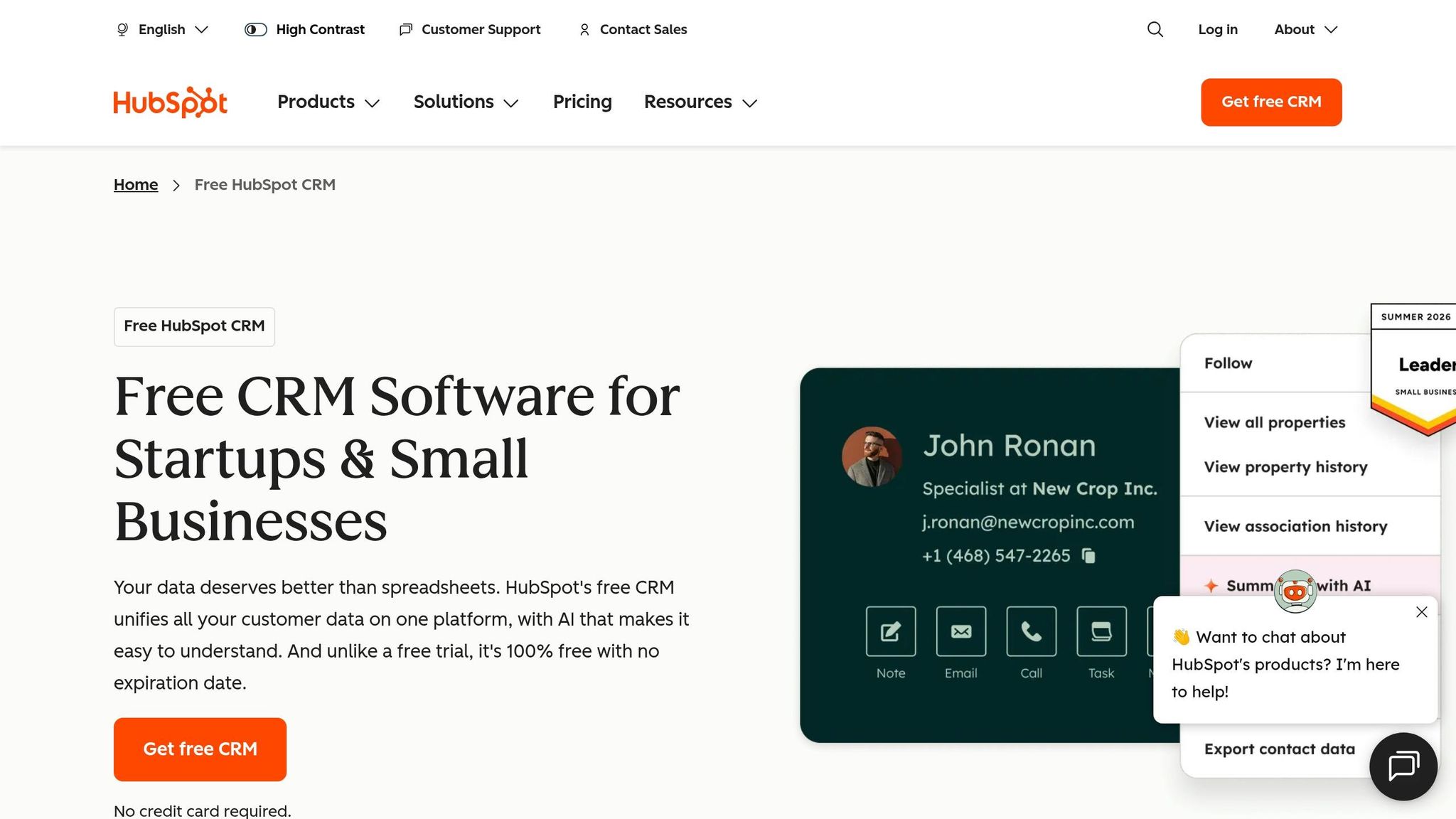
Most of these tools still center AI on rep assistance, not autonomous action. HubSpot, Pipedrive, Zoho, Close, and Attio mainly use AI for scoring, drafting, and summaries, while the actual sequences and rules still need manual setup.
Salesforce has gone further with Agentforce, but it is aimed at buyers that can handle enterprise pricing and heavier admin work [4][13][14]. K3X, by contrast, offers prompt-to-action execution for $20 per seat per month, which makes it easier to test for small teams that do not want a large admin burden.
AI model | Freshsales (Freddy AI) | K3X (AI Agents) | Salesforce (Agentforce) |
|---|---|---|---|
Role | Agentic, enterprise-grade [14] | ||
Execution trigger | Complex admin setup [14] | ||
Starting price | $9/user/month; Copilot add-on is roughly $100/user/month [7][9] | $330/user/month for the AI tier [13] | |
Best for | Teams comfortable managing sequences | Small teams wanting autonomous follow-up | Enterprises with dedicated admins |
Which platform has stronger integrations, calling, and ecosystem support?
Freshsales has the broader ecosystem, while K3X keeps more day-to-day execution inside the CRM. If your team wants plug-and-play app connections, Freshsales is the stronger pick. If you want email, SMS, and calling built in with less tool-switching, K3X is the tighter setup [1][3][9].
Freshsales lists 1,200+ marketplace apps [9] and ties in natively with the Freshworks suite. K3X leans the other way. It keeps more sales work inside the product and uses webhooks plus its API for custom connections [1][3].
What do K3X's built-in channels and integrations include?
K3X includes the core outbound channels in the base price. At $20 per seat per month, it comes with email, SMS, calling, and a one-click power dialer [3].
Each seat also includes 1,000 AI credits [3]. That matters for outbound-heavy teams, since higher usage can become a planning issue if reps rely on AI features every day.
For custom systems, K3X supports connections through webhooks and the API [1]. That gives ops teams room to connect internal tools, but it may take more work than installing a ready-made app from a marketplace.
Where does Freshsales have the edge?
Freshsales stands out when your team needs more ready-made connectors and a larger app ecosystem. It is the better fit for sales and revenue ops teams that already run several business tools and want them connected with less setup.
Freshsales also adds call recording, voicemail drop, and BYOC on higher tiers [6][9]. That setup fits teams that want a more standard telephony model. Some advanced automation and sales-sequence features sit behind the Pro plan, so feature access depends more on tier than it does with K3X.
The size of the Freshsales marketplace also points to a platform that has been built out more heavily over time. For teams comparing integration depth, that can matter just as much as the CRM feature list.
Feature | K3X | Freshsales |
|---|---|---|
Calling | Built-in power dialer; 250 calling credits per seat included [3] | Built-in VoIP; call recording and voicemail drop; BYOC on Pro and Enterprise [6][9] |
SMS / messaging | Built-in SMS; 250 SMS credits per seat included [3] | Built-in SMS, WhatsApp, and Messenger [6] |
Marketplace | Smaller native catalog; webhook/API-first extensibility [1][3] | |
Integrations | Unlimited integrations included; custom triggers via webhooks [1][3] | Broad plug-and-play connectors for common business tools [12] |
Best for | Small teams that want tighter built-in execution | Teams that want a more mature ecosystem and broader app support |
Which CRM is more mature and better suited to larger teams?
Freshsales is the safer pick for larger, more structured teams. It has a longer track record, broader admin controls, and support options that fit companies with more seats and stricter process needs.
Freshworks is an older public company, and it says Freshsales serves 65,000+ businesses worldwide [5]. For sales and revenue teams, that usually points to a product with more depth around admin setup, user access, and day-to-day oversight. Freshsales still leans on admin-led CRM management, while K3X cuts some of that work by handling follow-up on its own.
K3X is built for smaller teams, especially groups of 1–9 people, and it is not aimed at 100+ seat rollouts. Its governance layer is lighter, and it does not target enterprise-scale admin controls. If your team cares more about support, permissions, audit trails, and control than pure speed, Freshsales is the lower-risk option.
Dimension | K3X | Freshsales |
|---|---|---|
Team fit | Built for 1–9 people; not built for 100+ seat deployments | Mid-market and larger teams; 65,000+ businesses [5] |
Governance | Limited enterprise governance; not built for 100+ seat deployments | Sandbox, audit logs, field-level permissions, territory management [6][9] |
Support | Lean support model, not enterprise-grade SLAs | |
Maturity | Younger, AI-native product [1] | More mature, Freshworks-backed [5] |
Who should pick K3X, and who should pick Freshsales?
The choice comes down to team size, how much setup your team can handle, and whether you want AI to suggest next steps or carry them out. K3X suits small teams that want prompt-based execution with little setup. Freshsales suits teams that want a more mature CRM, assistive AI, and tighter admin control.
Pick K3X if your team wants execution over workflow building
K3X fits 1–9 person teams that want the CRM to handle follow-up work, not ask reps to build and maintain workflows. If your team is moving from Pipedrive or Attio and still losing time to manual automation upkeep, K3X removes much of that burden. You describe the outcome, and K3X’s agents handle email, SMS, and calls without triggers or sequences to set up.
Customer examples show K3X cutting admin work and automating follow-ups.[1] That points to a clear use case: small sales teams that care more about getting work done than managing the system itself.
Pricing is simple at $20 per seat per month, with no long-term contracts.[1][3] The trade-off is straightforward. K3X is newer, has a smaller native app catalog, and does not offer the same level of enterprise governance.
Pick Freshsales if your team wants a mature CRM with assistive AI
Freshsales fits teams that want a more mature CRM and are fine keeping more of the process in rep or admin hands. Its free tier supports up to 3 users, and teams already using Freshworks products such as Freshdesk or Freshchat can keep sales and service activity in one customer record.
Freshsales can cut admin time, but Freddy AI supports the process rather than running it end to end.[6] That’s the main distinction. Freshsales is the safer pick for teams that want an established CRM with admin controls, not just AI help.
If you are already on Freshsales, the next step is to sort out what can move cleanly into K3X and what will need to be rebuilt.
How hard is it to move from Freshsales to K3X?
The data move is straightforward. The harder part is rebuilding automation, because CSV imports bring over records, not workflow logic.
Contacts, leads, accounts, and deals can move from Freshsales to K3X through CSV exports and imports. What does not transfer is the logic behind workflows, sequences, and routing rules.
What data can you move over easily?
Standard CRM records from Freshsales export as CSV files and import into K3X. Basic fields like name, email, and phone usually come over cleanly, but teams still need to map lifecycle stages, deal stages, record owners, and custom fields.
A clean import usually takes 2–4 hours.[10]
What needs to be rebuilt rather than copied?
Freshsales workflows, sales sequences, and auto-assignment rules do not import directly. Those items need to be rebuilt in K3X based on the outcome each workflow is meant to produce, rather than copied step for step.
Rebuilding prompts and testing them usually adds 4–8 hours.[10] After that, teams should reconnect email and SMS, then test the full setup to make sure messages, routing, and handoffs work the way they should.
K3X's Human Review Layer lets reps approve agent-drafted messages before they send while you confirm the new setup is working as intended.[2]
For each Freshsales workflow, audit the outcome it is meant to drive, then turn that outcome into a K3X prompt. That keeps the migration focused on business logic instead of trying to mirror the old setup field by field.