Sales Automation
•
Checklist for GDPR-Compliant AI CRM Setup
Practical checklist to set up GDPR-compliant AI CRMs: governance, DPIAs, data mapping, vendor DPAs, access controls, and audits.

GDPR compliance is non-negotiable for AI-powered CRM systems. Mishandling personal data can lead to fines up to €20 million or 4% of global revenue, with even stricter penalties under the upcoming EU AI Act in August 2026. Here’s what you need to know to stay compliant:
Governance: Define roles like Data Protection Officer (DPO) and Human Reviewer. Conduct a Data Protection Impact Assessment (DPIA) for high-risk AI activities.
Data Handling: Map data flows, establish lawful bases for processing, and minimize data collection. Use role-based access control (RBAC) and ensure sensitive data is masked.
Vendor Agreements: Secure Data Processing Agreements (DPAs) with clear terms. For cross-border data transfers, use Standard Contractual Clauses (SCCs) or EU-hosted solutions.
Platform Configuration: Enable audit logs, human-in-the-loop reviews, and automatic data retention policies. Pin AI models to specific versions to prevent compliance risks.
User Rights: Implement processes to handle access, correction, deletion, and objection requests efficiently.
Security & Monitoring: Encrypt data, enforce two-factor authentication, and conduct regular audits. Monitor AI outputs for errors like hallucinations or bias.
With GDPR regulations already strict and new AI-specific rules on the horizon, setting up your AI CRM correctly now will save you from operational and reputational risks later.
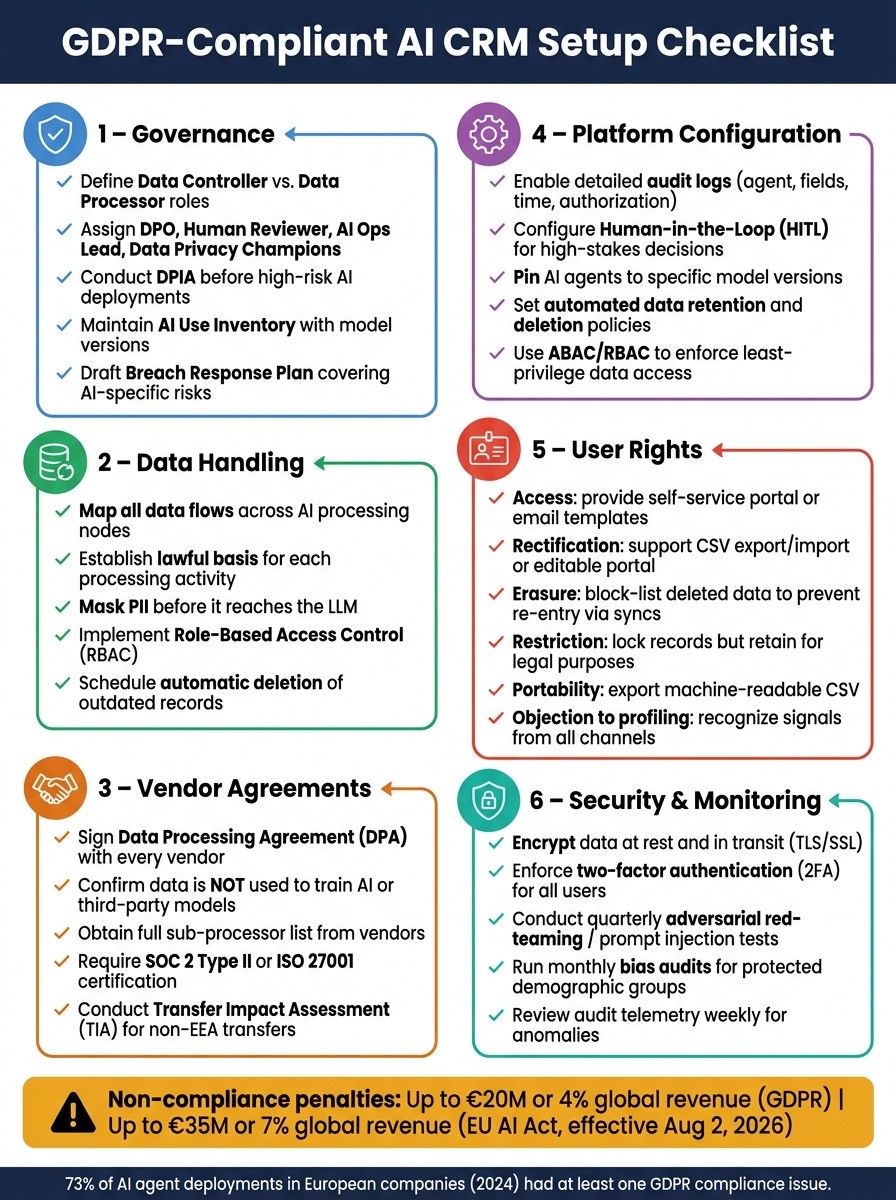
GDPR-Compliant AI CRM Setup: Complete Compliance Checklist
How to Avoid GDPR Fines: Automating Data Retention with AI
Governance and Documentation Checklist
Before diving into the configuration of your AI CRM, make sure you have a solid governance framework in place. This framework is the backbone of any compliance strategy. Once that's established, the next step is to clearly outline the roles and responsibilities necessary for overseeing your AI CRM.
Define Roles and Responsibilities
Start by determining who owns what. In an AI CRM environment, your business serves as the Data Controller - you decide the purpose and methods for processing personal data. Meanwhile, your AI vendor (like Salesforce, Microsoft, or platforms such as K3X) acts as the Data Processor, managing data according to your instructions.
To ensure effective governance, assign specific roles such as:
Role | Responsibilities |
|---|---|
Accountable Owner | Has the authority to disable AI features and handles incident responses. |
DPO (if required) | Oversees compliance and communicates with regulators, especially for systematic monitoring. |
Human Reviewer | Monitors automated decisions to ensure compliance with Article 22. |
AI Ops Lead | Regularly checks audit logs for unusual model behavior. |
Data Privacy Champions | Act as department-level contacts (Sales, Marketing, HR) to identify risks early. |
It's crucial to appoint an executive with both the budget and authority to act quickly when needed.
Data Protection Impact Assessment (DPIA)
Conducting a DPIA is non-negotiable before deploying AI for high-risk activities. These could include systematic customer profiling, automated lead scoring with legal implications, or recruitment screening. A recent study showed that 73% of AI agent deployments in European companies in 2024 had at least one GDPR compliance issue [4]. This highlights how essential a thorough assessment is.
Your DPIA should cover:
Data Access: Identify which data fields the AI interacts with, the tasks it performs, and where the data is stored.
AI-Specific Risks: Document potential threats like prompt injection or model poisoning, which are often missed by basic policy reviews.
"The question is no longer whether to use AI - it's whether your governance posture would survive a regulator audit, a board-level incident review, or your own incident postmortem six months from now." - CRM Curator
By documenting these risks and assessments, you'll lay the groundwork for strong internal policies.
Internal Policies and Procedures
Your internal documentation should address these critical areas:
Privacy Policy: Clearly state your use of AI in your public-facing privacy policy. Include details about the AI's logic and the potential impact on individuals.
Data Subject Rights: Have procedures in place to handle rights requests within the 30-day window [3].
Breach Response Plan: Create a plan that specifically accounts for AI-related issues like hallucinations or prompt injection attacks.
AI Use Inventory: Maintain a detailed record of all AI features in production. This inventory should specify what data each feature uses and the model behind it.
Data Mapping, Lawful Basis, and Minimization
To ensure your AI CRM complies with GDPR, it's essential to map out and justify every data processing step. This builds on a foundation of strong governance and keeps your operations within legal boundaries.
Data Inventory and Flow Mapping
The first step is identifying all personal data to protect it effectively. Consolidate this data into a single CRM as your central source of truth. By pulling together records from marketing, sales, and customer service, you eliminate unmanaged data silos - like scattered spreadsheets or disconnected tools - that make consistent GDPR compliance nearly impossible [1].
Next, create a technical inventory that maps data flows across all AI processing nodes. This should capture details such as the purpose of each feature, the individuals affected, the data fields accessed, and the handling model [2]. If your AI processes involve cross-border data flows, ensure these are mapped as well to confirm data remains within the appropriate regional infrastructure [2].
Audit logging is another critical piece. Record every step, from the user's initial input to the model’s response and any resulting changes made to records. This traceability is crucial, especially as the EU AI Act's high-risk AI obligations take effect on August 2, 2026, with penalties reaching up to 7% of global annual turnover for non-compliance [2].
This comprehensive mapping lays the groundwork for establishing clear and lawful processing bases.
Establish Lawful Bases for Processing
Before processing begins, determine a lawful basis for each activity [7]. Retroactively justifying processing activities is a common pitfall that often leads to regulatory issues.
AI CRMs introduce complexity because different activities may require different bases. For instance, AI-powered lead scoring for internal analytics might fall under legitimate interests, while behavioral tracking or detailed profiling often requires explicit consent [6]. If your AI system infers sensitive information - like health conditions or financial vulnerabilities - additional conditions under Article 9 may also apply, alongside the standard Article 6 basis [7].
"The requirement has always been the same: if you process personal data, you need a lawful basis, a transparent purpose, appropriate safeguards, and a means for data subjects to exercise their rights." - Narendra Sahoo, Founder and CEO, VISTA InfoSec [8]
To stay compliant, document the lawful basis for each processing purpose in your AI use inventory. Update your privacy notice to clearly outline AI processing activities and their specific purposes [7][8].
Once lawful bases are established, the next step is to minimize the data collected.
Data Minimization and Access Controls
Reducing the amount of data collected is one of the simplest ways to lower compliance risks.
"The GDPR mandates that systems, processes, and organizational measures, including CRMs, are built and managed with privacy in mind. This means minimizing data collection, securing personal information, and implementing privacy settings that default to the most protective option." - Celestine Bahr, Director Legal, Compliance & Data Privacy, Usercentrics [1]
On the technical side, mask personally identifiable information (PII) before it reaches the large language model (LLM) and audit prompt inputs to ensure masking is effective [2]. Tools like Salesforce’s Einstein Trust Layer come with platform-default masking, while HubSpot’s Breeze framework uses built-in field exclusion [2]. For AI-native CRMs like K3X, check your admin settings to control which fields the AI agent can access and configure field-level restrictions as needed.
Additionally, implement role-based access control (RBAC) to limit data access based on user roles. Schedule automatic deletion of outdated records on a regular timeline [1]. These two measures alone significantly reduce your exposure in case of a breach or a data subject access request.
Vendor Management and Platform Configuration
After establishing clear data processing records, the next step is to strengthen compliance by securing solid vendor agreements and fine-tuning platform settings.
Vendor Contracts and Risk Assessment
Start by formalizing vendor relationships with a signed Data Processing Agreement (DPA), which is a requirement under GDPR. The DPA should clearly outline key details such as the type of data processed, the purpose of processing, retention timelines, any sub-processors involved, and the security measures in place [9].
Make sure the agreement explicitly states that customer data will not be used to train AI models or any third-party systems. Without this clause, sharing data with the platform could lead to unauthorized disclosure under GDPR [2][9]. For generative AI features, go beyond marketing claims by contractually verifying any "zero data retention" assurances [2].
Transparency is equally critical. Vendors must provide a comprehensive list of all sub-processors, as you, the data controller, are responsible for ensuring compliance across the entire processing chain [9].
"A GDPR-compliant AI vendor is a business that handles its own operations lawfully. A GDPR-compliant AI deployment is a data processing operation your organization can defend to a supervisory authority." - Danielle Barbour, Kiteworks [5]
When assessing security, prioritize vendors with certifications like SOC 2 Type II or ISO 27001, as these provide independent validation of their security practices instead of relying solely on self-reported claims [2][9].
International Data Transfers
If your AI CRM vendor processes data outside the European Economic Area (EEA), such as through US-based APIs, you’ll need a valid transfer mechanism in place. One common solution is Standard Contractual Clauses (SCCs), which grant enforceable rights to data subjects [12][14]. Additionally, for US-based vendors, the EU–US Data Privacy Framework can serve as a legal basis, but always confirm its adequacy status [12][14].
Before relying on SCCs, conduct a Transfer Impact Assessment (TIA) to determine if the destination country provides protections equivalent to EU standards. This includes evaluating local surveillance laws and their potential impact on data privacy [14].
"The best way to [determine equivalent protection] is to carry out a Transfer Impact Assessment (TIA)." - European Data Protection Supervisor [14]
Whenever possible, configure your AI CRM to store and process data within the EEA. This reduces the need for complicated transfer mechanisms. Many organizations are now opting for EU-hosted APIs, such as Mistral or Aleph Alpha, to avoid the legal complexities tied to US data transfers [9][13].
AI CRM Platform Settings
Securing vendor contracts is only part of the equation. Your platform must also be configured to enforce compliance at a technical level.
Use role-based access control (RBAC) to ensure that users and AI agents can only access the fields they need [5][10]. Platforms like K3X allow administrators to specify exactly which fields the AI agent can read or modify, following the principle of least privilege.
Set up automated data retention policies, such as deleting logs or unresponsive leads after specific periods [4][11]. For example, K3X processes deletion requests within 30 days and uses SOC 2 compliant cloud infrastructure with TLS/SSL encryption for data in transit [10].
Include a human-in-the-loop (HITL) review for significant AI-driven decisions, such as lead disqualification or pricing changes, to comply with Article 22 on automated decision-making [4][11].
"Think of AI as your very fast intern that prepares everything - and you as the one who hits send." - SalesSo [11]
Security, Monitoring, and User Rights
Once vendor contracts are in place and platform settings are fine-tuned, the next step in ensuring GDPR compliance is to focus on security, logging, and respecting user rights. These elements build on earlier work like governance, data mapping, and vendor management, creating a more secure and transparent AI CRM system.
Implement Security Measures
Protecting data should always be a priority. Start by encrypting data both at rest and in transit, enforcing two-factor authentication (2FA) for all CRM users, and maintaining secure backups [1]. However, AI CRMs bring specific challenges that go beyond traditional security protocols, particularly when customer data interacts with large language models (LLMs).
To mitigate risks, ensure personally identifiable information (PII) is masked before being sent to an LLM. This means sensitive details like names, emails, and phone numbers should never appear in prompts. Test the masking process regularly to confirm its effectiveness [2]. Additionally, negotiate a "zero-retention" agreement with your vendor to ensure prompts are not reused for training purposes [2].
Another critical step is to pin your AI agents to specific model versions. Changes in model updates can unexpectedly alter how sensitive data is handled, introducing compliance risks through what’s called model selection drift [2].
"Inside a CRM... framing collapses into something more concrete because CRMs sit at the intersection of three things that make regulators nervous: personally identifiable customer data, decisions that affect customers, and external-facing automation." - CRM Curator [2]
Finally, conduct adversarial red-teaming exercises at least every quarter to identify vulnerabilities such as prompt injection before regulators or bad actors do [2].
Enable Logging and Monitoring
Secure configurations are just the beginning; proper logging and monitoring are essential for GDPR compliance. Standard session logs won’t cut it for an audit. Instead, you need detailed records that document every AI agent's actions: which agent ran, what data fields it accessed, why it accessed them, when it happened, and who authorized it [5].
Why is this important? GDPR's Article 30 mandates tamper-proof records of processing activities. For decisions covered under Article 22, logs must also include the decision logic and any human reviews [5]. Platforms like Salesforce and HubSpot are already addressing this. For instance:
Salesforce uses the Einstein Trust Layer to log prompts, masking events, and toxicity scores directly into its Data Cloud.
HubSpot employs "Audit Cards", which timestamp AI-driven property changes [2].
Regardless of the platform, your CRM must provide detailed logs, not just a basic login history. To stay proactive, review audit telemetry weekly for anomalies in prompt patterns or volumes, and use those insights to strengthen your system [2].
While logging ensures operational transparency, managing data subject rights is equally vital for maintaining user trust.
Handle Data Subject Rights Requests
Under GDPR, individuals have the right to access, correct, erase, restrict, and port their personal data. In an AI CRM, fulfilling these requests requires clear processes and well-configured tools.
Here’s how each right translates into actionable steps within a CRM:
Right | CRM Action | Note |
|---|---|---|
Access | Email templates or self-service portal | Ensure third-party data is redacted before sharing [19] |
Rectification | CSV export/import or editable portal | Avoid conflicts when re-importing corrected data [18] |
Erasure | Block-listing after deletion | Stops deleted data from re-entering via syncs or imports [18] |
Restriction | Record locking | Retain data but exclude it from processing workflows [18] |
Portability | Machine-readable export (CSV) | Ensure data can be transmitted directly to another controller [18][20] |
Explanation | Audit logs / transparency cards | Required for AI-driven decisions impacting individuals [2] |
One often-overlooked aspect is the right to object to profiling. Under Article 22, individuals can challenge decisions made solely through automated processing [20]. Your CRM must recognize objection signals from various channels, such as email replies, web forms, or LinkedIn messages. These objections should instantly update the individual’s status across the CRM and connected data providers [16].
To manage this efficiently, automate the intake process with a dedicated tracking system (e.g., New, In Progress, Completed). This is crucial for meeting GDPR’s strict response timelines at scale [18][19].
AI Behavior, Guardrails, and Ongoing Compliance
With security protocols, logging systems, and processes for data subject rights in place, the final layer of GDPR compliance zeroes in on controlling how your AI operates. This ensures it stays manageable as both technology and regulations continue to evolve.
Input and Output Controls
It's a mistake to assume that a vendor's Data Processing Agreement (DPA) automatically governs how an AI agent accesses and processes data - it doesn’t.
"A system prompt instructing a model to handle data carefully does not constitute privacy by design." - Danielle Barbour, Kiteworks [5]
The key is to enforce controls directly at the data level. Attribute-Based Access Control (ABAC) can limit AI agents to only the specific data fields necessary for a task. Additionally, masking personally identifiable information (PII) at the model boundary ensures sensitive data is redacted before any prompt leaves your CRM environment [2][5].
On the output side, it’s critical to screen AI-generated content for issues like toxicity or hallucinations before it reaches users or gets stored in your systems. Outputs that exceed predefined thresholds should be flagged for mandatory human review. For high-stakes decisions, human approval is non-negotiable. As Particula Tech emphasizes:
"The human reviewer must have authority and capability to actually review the decision, rubber-stamping AI outputs doesn't satisfy the requirement." [21]
GDPR’s Article 5 accuracy rules also apply to AI-generated inferences. If your model consistently delivers skewed predictions for certain demographic groups, you could be processing inaccurate personal data at scale [21].
These safeguards provide a solid foundation for the continuous oversight outlined in the following review processes.
Periodic Reviews and Monitoring
To ensure compliance remains strong, establish a regular review cycle that complements your initial setup. These reviews are essential for keeping AI behavior aligned with established controls.
Set up a structured review process with the following components:
Review Type | Frequency | Focus Area |
|---|---|---|
Telemetry Review | Weekly | Audit logs, prompt patterns, anomaly detection [2] |
Governance Review | Monthly | Updates to use-case inventories and assessments of new features [2] |
Red-Teaming | Quarterly | Adversarial testing and prompt injection defense [2] |
Bias Audits | Monthly | Testing for disproportionate effects on protected groups [17] |
Your Data Protection Impact Assessment (DPIA) should remain a living document. Revisit and update it whenever your AI model changes, new data flows are introduced, or a vendor modifies their underlying model [15]. To minimize risks from model drift, pin your production AI agents to specific model versions and route updates through a testing pipeline [2]. Assign a named accountable owner with the authority to halt AI features if they fail compliance checks.
Looking beyond daily operations, staying ahead of regulatory changes is crucial for long-term compliance.
Preparing for Upcoming Regulations
To future-proof your AI systems, start planning for new regulatory requirements, such as those introduced by the EU AI Act. These steps build on existing GDPR practices while preparing your AI-powered CRM for stricter standards.
The EU AI Act, which takes effect on August 2, 2026, adds another layer of obligations for high-risk AI systems [2]. Features like employment screening, creditworthiness assessments, or essential public services fall under this category. These systems must meet additional requirements, including conformity assessments, risk management frameworks, and documented human oversight processes. Non-compliance could result in penalties of up to €35 million or 7% of global annual revenue - higher than GDPR’s 4% cap [2][11].
To prepare, maintain thorough documentation for each AI feature. This should include its purpose, the data it accesses, the model version in use, and fallback mechanisms. Such documentation not only supports transparency requirements under the AI Act but also ensures compliance is integrated into your workflows.
Platforms like K3X, which rely on prompt-driven, goal-based instructions, can help enforce consistent guardrails across AI operations. By channeling every action through a defined, auditable process, these platforms provide the clarity needed when regulators request evidence of compliance.
Conclusion: Making GDPR Compliance Easier with AI-Driven CRMs
GDPR compliance for AI CRM systems isn't a one-and-done task - it requires ongoing attention to governance, Data Protection Impact Assessments (DPIAs), and robust data protection strategies. From identifying lawful bases for processing to managing data subject rights and ensuring retention policies, the process involves multiple layers of responsibility.
The good news? The right platform can take much of the manual work off your plate. Features like automated audit trails, consent verification, retention policy enforcement, and real-time anomaly detection make compliance far more manageable. A 2024 study revealed that 73% of AI agent deployments in European companies had GDPR vulnerabilities, often due to fragmented, manual compliance processes across systems [4]. This highlights the pressing need for AI-driven CRMs that integrate compliance directly into daily workflows.
"Security and privacy are not regulatory overhead, they are competitive advantage that builds trust." - Technova Partners [4]
Tools like K3X are designed with this in mind. By allowing teams to set compliance goals through conversational prompts, platforms like K3X eliminate the need for complex, manual configurations. They handle everything from updating pipelines to capturing data and coordinating actions, all while maintaining audit-ready processes. With the EU AI Act enforcement deadline of August 2, 2026, fast approaching, businesses need CRMs that adjust dynamically rather than relying on constant manual updates.
As AI continues to evolve, having compliance built directly into your CRM isn't just a convenience - it's a smarter way to manage risks and stay ahead.
FAQs
Do I need a DPIA for my AI CRM?
A Data Protection Impact Assessment (DPIA) is often advised when using AI-powered CRMs, particularly if they handle high-risk data processing as outlined under GDPR. Though not always required, performing a DPIA is a smart move - it helps pinpoint and mitigate privacy risks, ensuring both compliance with regulations and the safeguarding of user data.
How do I choose a lawful basis for AI profiling?
When deciding on a lawful basis for AI profiling under GDPR, there are a few key options to consider, including consent, contractual necessity, or legitimate interests. Each choice depends on the specific circumstances of your processing activities.
It’s essential to ensure that your processing aligns with GDPR principles. This means it should be necessary for its purpose and carried out with transparency. If your AI profiling involves automated decision-making that could have a significant impact on individuals, you’ll often need to provide clear and detailed information about the process - and, in many cases, obtain explicit consent.
Additionally, conducting a Data Protection Impact Assessment (DPIA) is a critical step. A DPIA helps you identify and evaluate potential risks associated with your profiling activities while demonstrating your commitment to GDPR compliance.
What logs are required for an AI CRM audit?
When conducting an AI CRM audit, keeping detailed records is crucial to meeting GDPR requirements. Here's what you need to document:
Data collection sources: Track where the data originates to ensure it was obtained lawfully.
Processing activities: Outline how the data is used, including any automated decision-making processes.
Consent records: Maintain evidence that users have given proper consent for their data to be processed.
Data access and modifications: Log who has access to the data and any changes made to it.
Data retention periods: Specify how long data is stored and justify the retention period.
Handling of DSARs (Data Subject Access Requests): Record how requests for data access, correction, or deletion are handled.
These records serve as proof of compliance and help demonstrate your organization's commitment to protecting user data under GDPR.