Sales Automation
•
Why Data Quality Matters in AI CRM
Poor CRM data causes costly AI mistakes and lost revenue—real-time validation and governance keep CRM-driven AI accurate and reliable.

Bad data in AI CRM systems leads to costly mistakes, lost revenue, and failed projects. Poor data quality affects everything from lead scoring to forecasting, and businesses lose an average of $12.9 million annually due to inaccuracies. AI systems magnify these issues, making bad decisions at scale when fed incorrect or incomplete data.
Key points:
71% of CRM records have errors, causing a 26%-42% loss in pipeline value.
60% of AI projects are expected to fail by 2026 due to poor data.
Bad data costs businesses 27% of revenue and wastes time for sales teams.
The solution? Real-time data validation and management. Tools like K3X ensure AI operates on accurate, current information by continuously verifying data quality. This prevents errors, improves decision-making, and enhances CRM performance.
Takeaway: Clean data is the foundation of effective AI CRM. Without it, businesses risk automating bad decisions and losing trust in their systems.
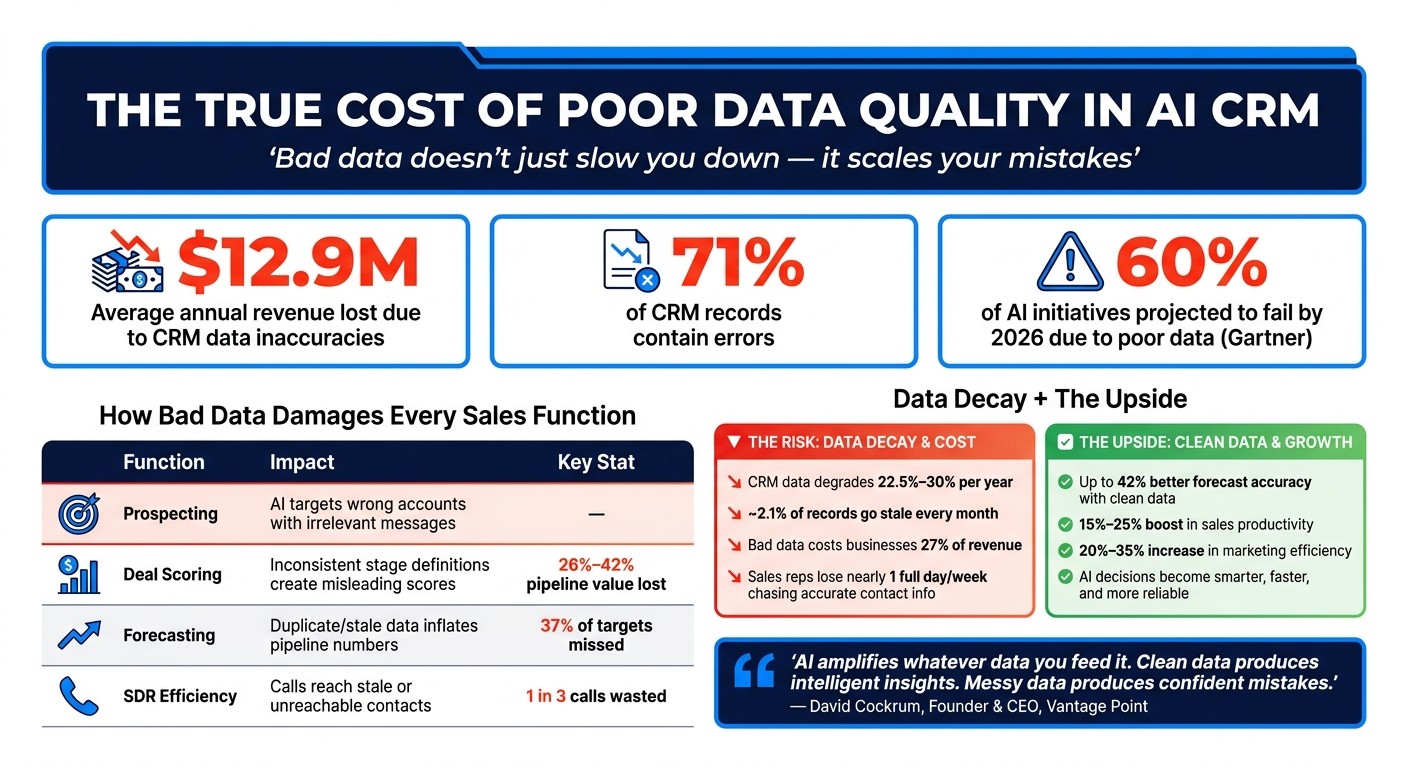
The True Cost of Poor Data Quality in AI CRM Systems
How Data Quality Shapes AI CRM Results
Why Accurate Data Makes AI CRM Work Better
In AI-powered CRMs, every bit of data plays a crucial role in guiding automated decisions. For instance, a properly tagged industry field can help prioritize leads, while an accurate deal stage sharpens revenue forecasts. Clean, well-maintained data doesn’t just improve reporting - it enhances every decision the AI makes.
This is especially evident in what researchers refer to as "detailed performance signals" - specific insights like how effectively a sales rep managed objections or how thoroughly they prepared for a call. These nuanced data points give AI models richer material to work with, far beyond basic administrative fields like "deal stage" or "close date" [3]. The more precise and complete this data is, the better the AI performs, leading to sharper predictions and smarter decisions.
On the flip side, poor-quality data can derail these benefits entirely.
What Poor Data Quality Costs Your Business
Bad data carries both financial and operational consequences. Businesses lose an estimated 27% of revenue due to inefficiencies caused by poor data, with sales reps spending nearly an entire day each week trying to track down accurate contact information [1][2].
Operationally, the damage is equally severe. For example, if an incorrect Ideal Customer Profile (ICP) tag is in your CRM, the AI prospecting tool might send polished but irrelevant messages to the wrong accounts [3].
Table: Impact of Poor Data on Core Sales Functions
Business Function | Impact of Poor Data Quality |
|---|---|
Prospecting | AI targets the wrong accounts with polished but irrelevant messages [3] |
Deal Scoring | Inconsistent stage definitions create misleading priority scores [3] |
Forecasting | Duplicate and stale opportunities inflate pipeline numbers, causing 37% of targets to be missed [2] |
SDR Efficiency | One in three calls reaches a stale or unreachable contact [4] |
There’s also a trust issue that compounds over time. When AI outputs become unreliable due to poor data, sales reps lose confidence in the system. This lack of trust discourages them from updating the CRM, which only worsens the data quality - a phenomenon researchers call the "CRM death spiral" [8].
"A lead scoring AI that learns industry is a key conversion factor won't help you much if 40% of your leads have blank or miscoded industry fields. The model is learning from a distorted picture." - Dorian Sabitov, G2 [8]
How K3X Uses Data Quality to Drive Better Outcomes
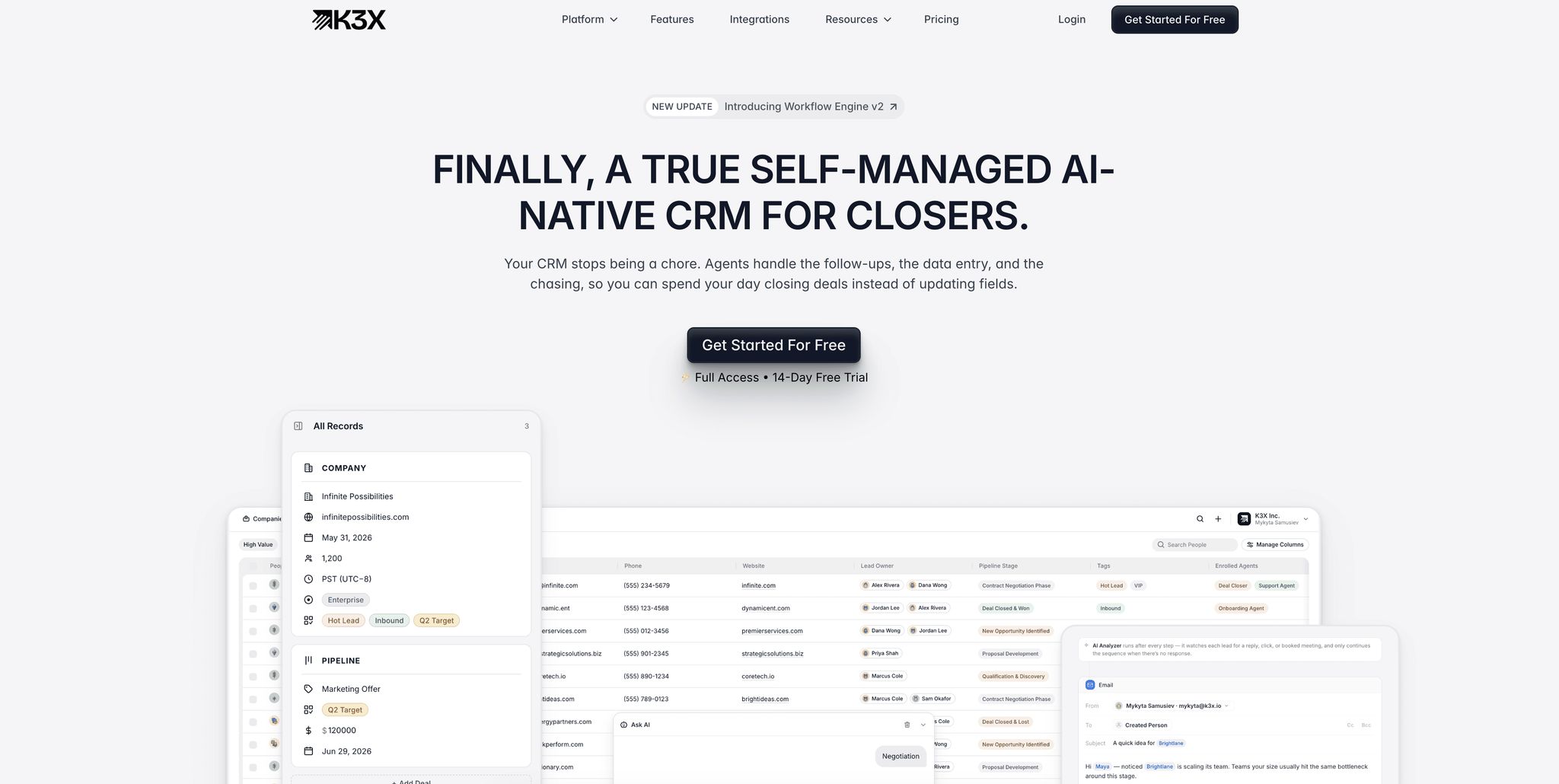
K3X addresses these challenges by turning data quality into a strength. Traditional CRMs rely on static administrative data like deal ownership, stages, and timestamps - an approach that worked when humans interpreted the data. But AI demands more than static snapshots; it needs real-time, contextual information to excel. K3X is built with this requirement in mind.
Instead of relying on dropdown menus that often default to "Other", K3X captures data continuously in real time. This ensures the AI works with up-to-date, context-rich information rather than outdated or incomplete entries. While older CRMs rely on rigid, step-by-step workflows based on manual inputs, K3X takes a conversational, prompt-driven approach. This allows its AI to act on reliable, meaningful signals instead of being bogged down by noise.
The Key Dimensions of Data Quality in AI CRM
What Each Data Quality Dimension Means
Data quality in your CRM boils down to several key dimensions, each playing a unique role. Breaking these down helps pinpoint where your data might need improvement.
Accuracy: This ensures your data mirrors reality - correct names, valid email addresses, and genuine company details are non-negotiable [10].
Completeness: All essential fields, like industry, revenue range, or contact roles, need to be filled. This gives AI the context it needs to make informed decisions [10].
Consistency: Uniform formatting is crucial - think of treating "USA" and "United States" as the same entity across the board [10].
Validity: Data must follow specific rules. For example, an email address should pass an actual SMTP check, not just look valid [4].
Timeliness: Data should reflect the current state of leads or accounts, not outdated information from months ago [3].
Each dimension represents a potential weak link. For instance, data can be accurate but incomplete, or complete but inconsistent. In AI-driven CRMs, even a small data gap can snowball into bigger issues, making it essential to understand how these dimensions impact your system's performance.
How Each Dimension Affects AI CRM Functions
The consequences of poor data quality become stark when tied to specific CRM functions. David Cockrum, Founder and CEO of Vantage Point, sums it up perfectly:
"AI amplifies whatever data you feed it. Clean data produces intelligent insights. Messy data produces confident mistakes." [10]
The difference between traditional CRM errors and those in AI-powered systems is scale. A human rep working with bad data might make occasional errors. But AI systems can multiply those errors at lightning speed, potentially affecting thousands of accounts. With 60% of AI initiatives projected to fail or be abandoned by 2026 due to poor data quality [6], the risks are real.
Here’s a closer look at how each data quality dimension impacts AI CRM functions:
Data Quality Dimension | Effect on AI CRM Functions | Risk of Poor Quality |
|---|---|---|
Accuracy | Enables relevant personalization [10] | AI sends "personalized" emails with wrong names or details, damaging trust [7] |
Completeness | Powers lead scoring models to rank opportunities effectively [9] | Missing data leads to undervalued high-potential leads [7] |
Consistency | Supports segmentation and pattern detection by grouping similar records [6] | Inconsistent formats (e.g., "CEO" vs. "Chief Executive") distort insights [6] |
Validity | Prevents issues like broken automations and email deliverability problems [12] | Failed automations and compliance risks waste resources [9] |
Timeliness | Ensures accurate forecasts by reflecting up-to-date pipeline data [4] | Outdated data results in unreliable revenue projections [7] |
One striking statistic: B2B contact data degrades at a rate of 22.5% to 30% per year [9]. That means roughly 2.1% of your CRM records go stale every month [5]. Keeping up with this decay is critical to maintaining CRM effectiveness.
How K3X Maintains Data Quality Across All Dimensions
K3X tackles these challenges head-on with a real-time approach to data quality. Unlike traditional CRMs that rely on quarterly data cleanups, K3X continuously updates and refines data. By capturing interaction data automatically, it eliminates the gaps that often arise from manual inputs. This ensures timeliness and completeness without adding extra work for your team.
Consistency and validity are handled at the system level. Instead of letting inconsistent manual entries cause chaos, K3X standardizes incoming data. This ensures your AI operates with a clear and unified view of your pipeline, keeping your CRM running smoothly and effectively.
Proven Practices to Improve Data Quality in AI CRM
Data Governance and Clear Ownership
Maintaining high-quality data starts with clear accountability. A striking 73% of enterprise data leaders cite data quality and completeness as their biggest challenge when working with AI [13]. Yet, many organizations still overlook data hygiene, treating it as an afterthought rather than a shared responsibility.
The key is assigning ownership across teams. Sales, marketing, operations, and IT all interact with CRM data in unique ways. Without clearly defined roles, inconsistencies can creep in. As Sathish Kumar Velayudam explains:
"Architecture, data quality, and governance determine whether CRM data can be trusted as an input to intelligent systems." [13]
One effective method is adopting a governance rhythm. This involves regular check-ins, such as weekly exception reviews (30–45 minutes) to catch duplicates or validation errors, monthly sampling of 20 high-value records to ensure field completeness, and quarterly stress-tests of merge policies [11]. These routines help prevent the gradual decline in data quality that can undermine AI performance. By establishing this framework, organizations lay the groundwork for system-based controls that safeguard data integrity.
Automated Monitoring and Data Quality Controls
Relying solely on manual cleanups isn't enough. Without built-in preventative measures, poor data quality will inevitably resurface. The solution lies in prevention controls - tools like validation gates and check-before-write logic that stop bad data before it enters the system [11].
A simple yet effective example is real-time email validation. By performing SMTP and MX record checks at web forms and import points, invalid addresses can be rejected in under 300 milliseconds, preventing them from being added to the database [4]. Additionally, AI-powered fuzzy matching can identify duplicates that traditional exact-match rules might miss. For instance, it can recognize "Acme Corp" and "Acme, Inc." as the same entity and automatically merge records when a 95% confidence threshold is met [4].
Monitoring the null rate on critical AI fields is another essential practice. This involves tracking the percentage of records missing key fields, such as industry or lead source, which are vital for scoring and routing decisions. If this rate rises, AI output can quickly deteriorate. Experts suggest pausing AI expansion if required-field completeness drops below 95% or if duplicate rates increase for two consecutive weeks [14].
"If your CRM hygiene is weak, the agent is not a force multiplier. It is an error multiplier." - ReliabilityLayer [11]
Automated systems like K3X enforce these controls continuously, preventing errors and reducing manual workloads. These measures work hand-in-hand with a unified data architecture to maintain consistency across all data sources.
Integrated Data Architecture for Consistent Records
A unified data architecture is the backbone of consistent CRM records. On average, sales teams use eight or more tools [1]. Without integration, the CRM often becomes a repository for conflicting data from marketing, billing, and support systems.
Standardizing data at the point of entry is critical. Transformation logic can normalize values like phone numbers and industry picklists before they are written to the CRM [15]. Additionally, weekly cross-system reconciliation - such as comparing CRM ownership with sales engagement data - helps catch "silent drift" that might not appear in internal dashboards [11].
Unlike older CRMs that require extensive custom integrations, K3X is designed with integration as a default feature. This ensures that data flows into the system in a consistent, validated format. As a result, AI can operate from a single, cohesive view of every account, rather than struggling with mismatched or incomplete records.
Data quality will make or break you lead gen strategy
Conclusion: The Business Case for Better Data in AI CRM
The relationship between data quality and AI CRM performance is hard to ignore, especially when you look at the numbers. Poor data quality can drain about 12% of annual revenue and cost over 25% of organizations more than $5 million each year [6][16]. Gartner forecasts that 60% of AI initiatives will fail by 2026, not because of flawed technology, but due to inadequate data foundations [4][5].
On the flip side, organizations that prioritize strong CRM data practices see measurable benefits: up to 42% better forecast accuracy, a 15% to 25% boost in sales productivity, and a 20% to 35% increase in marketing efficiency [1]. When AI is added to the mix, these benefits grow even further. Clean, reliable data doesn’t just improve reports - it powers every automated decision AI makes.
However, CRM data isn’t static; it degrades over time. Periodic cleanups can’t keep up with the accuracy demands of AI. Continuous, real-time data validation has become essential to ensure AI systems operate effectively.
K3X addresses this by capturing and verifying data at key interaction points in real time. By eliminating the need for manual inputs and scheduled updates, K3X ensures that AI systems rely on current, accurate information. This allows teams to focus on achieving results rather than dealing with the fallout of unreliable data.
FAQs
Which CRM fields matter most for AI accuracy?
For dependable AI-driven results, prioritize quality over sheer volume when it comes to CRM data. The most crucial fields include:
Identity data: Details like names and email addresses.
Firmographics: Information such as industry, company size, and revenue.
Operational markers: Key insights like lifecycle stages and lead sources.
Another vital element is a time-stamped interaction history, which helps track and understand user behavior effectively. Tools like K3X streamline this process by automating data capture. This ensures your records stay accurate and actionable - without the need for the tedious manual input often required by older systems.
How can we measure CRM data quality before using AI?
To ensure your CRM data is ready for AI, it's crucial to prioritize ongoing, KPI-focused audits over occasional cleanups. Keep an eye on important metrics like:
Duplicate rates: Strive to keep these below 1.0%.
Lifecycle transition failures: Monitor these to identify process bottlenecks.
Required field completeness: Aim for a completion rate of 95% or higher.
Unlike traditional CRMs, K3X takes a smarter approach. It reduces the need for manual data management by adapting to user behavior, slowing down data decay, and evolving into a system that practically optimizes itself. This makes AI integration smoother and more effective.
What should real-time data validation check in a CRM?
For an AI-driven CRM to function effectively, data validation needs to do more than just check for syntax errors. It must address deeper issues to prevent scaling problems. Here are the key areas to focus on:
Identity Resolution: Avoid fragmented records by deduplicating data through entity resolution. This ensures a unified view of each customer or entity.
Input Validation: Validate data as it’s entered by running checks like email verification and firmographic screening. This step catches errors early, keeping the database clean from the start.
Anti-Regression Controls: Implement validation gates to safeguard against schema drift. This prevents unexpected changes from breaking your system's structure or functionality.
Accuracy Audits: Regularly cross-check your data against reliable third-party sources. This ensures that the information remains accurate and relevant over time.
By addressing these areas, you can maintain a high-quality data foundation for your AI-driven CRM, ensuring smooth scalability and reliable performance.