Sales Automation
•
Never Miss a Follow-Up After a Demo: Automated Post-Meeting Plays
Outcome-based automation beats rule-based sequences for post-demo follow-up by adapting to replies and booking next meetings faster.

Deals usually stall after a demo for one reason: the follow-up does not happen fast enough or clearly enough. My takeaway is simple: the best post-demo play sends a recap the same day, asks for a specific next meeting time, and keeps going on a fixed cadence until the buyer books the next step or says no.
For small sales teams, rule-based CRM reminders can help, but they still need upkeep. Outcome-based tools such as K3X aim at one result - book the next step or close the loop - which makes them a better fit when reps are busy and buyers reply at uneven times.
I’d boil the article down to four points:
Speed matters most. Teams that follow up within 1 hour are 60x more likely to qualify a lead than teams that wait [5].
Generic recap emails underperform. Follow-up emails that mention at least two call-specific pain points see a 112% higher reply rate in the first 24 hours [7].
A fixed cadence beats memory. The article’s core sequence is recap in 15–30 minutes, then touches on Days 2, 5, and 9.
Most CRM automation is still rule-based.Salesforce, HubSpot, Pipedrive, Zoho, monday.com, Close, and Attio can run timed steps, but they do not shift course on their own when the deal state changes.
What I found most useful is the article’s focus on execution failure, not theory. Reps lose context fast, drafting from scratch takes time, and admin work gets pushed behind live selling. The article cites that reps forget about 60% of critical, non-recorded deal context within 20 minutes of a call ending [7], and that nearly 50% of reps stop after one follow-up attempt even though about 80% of B2B deals need at least five touches to close [1][9].
The article also draws a clear line between two automation models:
Rule-based automation: fixed triggers, sequences, and workflow branches
Outcome-based automation: the system keeps working toward a result, such as booking the next meeting
That distinction matters more after a demo than at earlier stages. If a buyer replies late, adds Finance, or ignores email but answers LinkedIn, a fixed sequence may keep firing the wrong step. An outcome-based agent is framed here as better suited to those state changes.
On tools, the article’s comparison is direct. It says Salesforce and HubSpot have more setup depth, Pipedrive, Close, and Attio are lighter to run, and K3X is simpler to launch for this use case because it runs from a prompt instead of a workflow builder. It also makes the trade-offs plain: K3X has a smaller integration catalog, usage depends on AI credits, and it is not aimed at teams that need 100+ seats or deep admin controls.
If I were applying this advice, I would start with one narrow rule set:
Send recap + materials within 30 minutes
Ask for one exact meeting slot plus two backups
Trigger follow-ups on Day 2, Day 5, and Day 9
Add other stakeholders by Day 3
Move the deal to nurture after five touches across more than one channel
The article’s best operational point is that I should measure only two things first: time from demo end to first email sent and booked-next-step rate week over week. That keeps the rollout tied to pipeline movement, not just task completion.
Bottom line: if I want fewer deals to fade after a demo, I need a post-meeting system that runs the recap, next-step ask, and follow-up chase without relying on rep memory. The article argues that this can be done with standard CRM workflows, but outcome-based automation is a better fit when buyer behavior does not follow a neat sequence.
Automate Your Post-Meeting Workflow with Make
What Should Happen After Every Demo?
After every demo, the next step should be set by process, not memory. The post-demo play is simple: send the recap within 15 to 30 minutes, lock in the next meeting, follow up on Days 2, 5, and 9 if the buyer goes quiet, involve other stakeholders, and log a clear next-step date in the CRM.
This works best with an AI-native CRM where each task is automated. If reps have to remember each step on their own, deals slip.
Step 1: Send the Recap and Materials the Same Day
Send the recap within 15 to 30 minutes of the call ending, ideally in the same work block. That timing matters because reps forget about 60% of critical, non-recorded deal context within 20 minutes of a call ending [7].
Keep the email under 90 words [4]. Use the buyer’s own language from the call, include three key takeaways, attach one useful resource such as the recording, and end with one clear ask: confirm the next meeting time.
Skip vague CTAs like “let me know what works.” A specific ask is easier to answer and gives the deal a clear path forward.
Step 2: Book the Next Meeting and Follow Up If They Go Quiet on Days 2, 5, and 9
The next meeting should be booked with a specific date and time. Emails with an exact CTA get a 30% to 40% booking rate, compared with 15% for generic asks [4].
Offer one proposed slot and two backups, such as Tuesday at 10:30 AM. That makes the reply simple: yes, no, or pick one of the alternates.
If the buyer goes quiet, use a set follow-up cadence:
Day | Channel | Action |
|---|---|---|
Day 2 | Value-add touch: relevant case study, industry benchmark, or 60-second product clip | |
Day 5 | Email or LinkedIn | Address unanswered questions from the demo; move to LinkedIn if email is ignored |
Day 9 | Phone | Direct dial or voicemail to confirm receipt of materials and offer a final re-engagement angle |
This cadence covers a common gap. About 80% of B2B deals require at least five follow-up touchpoints to close, yet nearly 50% of reps stop after one attempt [1][9].
Steps 3 to 5: Bring in Stakeholders, Keep Momentum, and Log the Next-Step Date
If the buyer does not book fast, involve other stakeholders before the deal cools off. The average B2B purchase now includes 6 to 8 decision-makers [8][5], so one contact rarely carries the deal alone.
Reach out to Finance, IT, or Operations as needed, and tailor each note to that role’s main concern. Finance may care about payback period, IT about setup and security, and Operations about workflow impact.
By Day 5, send a champion kit. Include a one-pager, an ROI calculator, and a short competitive comparison so the buyer has something concrete to share with the rest of the group.
The last step is CRM hygiene. Every demo should end with a logged outcome and a specific next-step date, not a loose label like “Demo Completed.”
Use outcome-based fields such as Technical Evaluation, Stakeholder Review, or No Fit. If there is no response after five touches across more than one channel, move the deal to nurture [7][5].
Here is the full play as a standalone checklist:
Step | Action | Timing |
|---|---|---|
1 | Send recap + materials: three key points, one relevant resource, specific next-step CTA | Within 15–30 mins |
2 | Follow up if quiet: value-add on Day 2, deeper follow-up on Day 5, phone on Day 9 | Days 2, 5, 9 |
3 | Map and engage full buying committee | By Day 3 |
4 | Send proof assets: ROI calculator, use-case clip, competitive one-pager | Day 5+ |
5 | Log outcome and next-step date in CRM; move to nurture if no response after 5 touches | After 5 touches |
When this play still breaks down, the issue is usually execution, not the plan itself.
Why Does Post-Demo Follow-Up Slip Even When the Team Knows Better?
Post-demo follow-up slips for a simple reason: reps run out of time and lose context before they can act. The breakdown usually happens in the same spots every time - the same-day recap, the next-step booking, and the follow-up chase.
Human Factors That Cause Missed Demo Follow-Ups
The biggest issue is often the calendar. Reps finish one demo and go straight into the next, with no gap to write notes, send a recap, or log a next-step date. Twenty minutes later, a lot of the sharp detail is gone. Reps forget about 60% of critical, non-recorded deal context within just 20 minutes of a call ending [7].
Writing the email from scratch adds more delay. If drafting takes 8 to 40 minutes, the same-day follow-up often misses its best window [1][3]. What should be a short task turns into one more thing sitting on the list.
Interruptions make that worse. The average employee is interrupted every 2 minutes by meetings, email, or chat notifications [2]. For sales reps, that usually means active requests win: a prospect sends a Slack message, a manager asks for forecast input, and the follow-up email gets pushed aside.
So missed follow-up is not random. It happens in a repeatable way when workload, context loss, and interruption stack up. The problem is less about knowing what to do and more about getting it done under pressure.
Pressure Factor | Impact on Follow-Up | Time Cost / Metric |
|---|---|---|
Back-to-back meetings | Causes context decay; specific prospect details are lost when reps jump straight into the next call | Only 23% follow up within 24 hours [6] |
Writing the follow-up from scratch | Blank-page drafting leads to procrastination or generic templates | 8–18 mins per email, or up to 40 mins from a blank page [1][3] |
Constant interruptions | Breaks the focus needed to turn notes into a personalized message | Interrupted every 2 mins on average [2] |
Logging and stage updates | Logging stages, stakeholder notes, and next steps gets pushed behind live selling | 15–20 mins per call [6] |
Automation handles the mechanical steps, while reps still review, edit, and send. That matters because the fix is not more reminders. The fix is a system that keeps the post-demo motion going until the next step is booked or the deal is declined.
That execution gap sets up the next section, which compares rule-based reminders with outcome-based automation.
Rule-Based vs. Outcome-Based Post-Meeting Automation: What Is the Difference?

Rule-Based vs. Outcome-Based Post-Demo Automation: CRM Tool Comparison
The difference is simple: rule-based automation follows preset steps, while outcome-based automation works toward a target result. In post-demo follow-up, that result is often clear: book the next meeting or get a direct no.
Rule-based automation uses fixed if-then logic. A trigger fires, a sequence starts, and the rep gets a task, reminder, or email. That works when the path is predictable, but it starts to break when buyers respond late, add new people, or stop replying for a while.
Outcome-based automation starts with the business goal instead of the trigger. For example, the system can aim to keep follow-up moving until the next step is booked or the buyer says no. In that model, an AI agent coordinates actions across systems and shifts course when the deal state changes.
That difference matters after a demo because response decay happens fast. If the system only sends reminders on a fixed schedule, it can miss the moment. If it works toward an outcome, it can react to what is happening instead of just pushing the next scheduled touch.
With rule-based tools such as Salesforce, HubSpot, Pipedrive, Zoho, monday.com, Close, and Attio, someone still has to build, maintain, and fix the workflow. A sequence can send timed messages, but it does not know how to adjust when a prospect replies or when the next meeting is already on the calendar.
Deals often die in the silence between touches. Outcome-based automation is built to close that gap: it watches the deal, drafts the next step, and changes direction when the state changes instead of running the same script to the end.
Comparison Table: K3X vs. Salesforce, HubSpot, Pipedrive, Zoho, monday.com, Close, and Attio
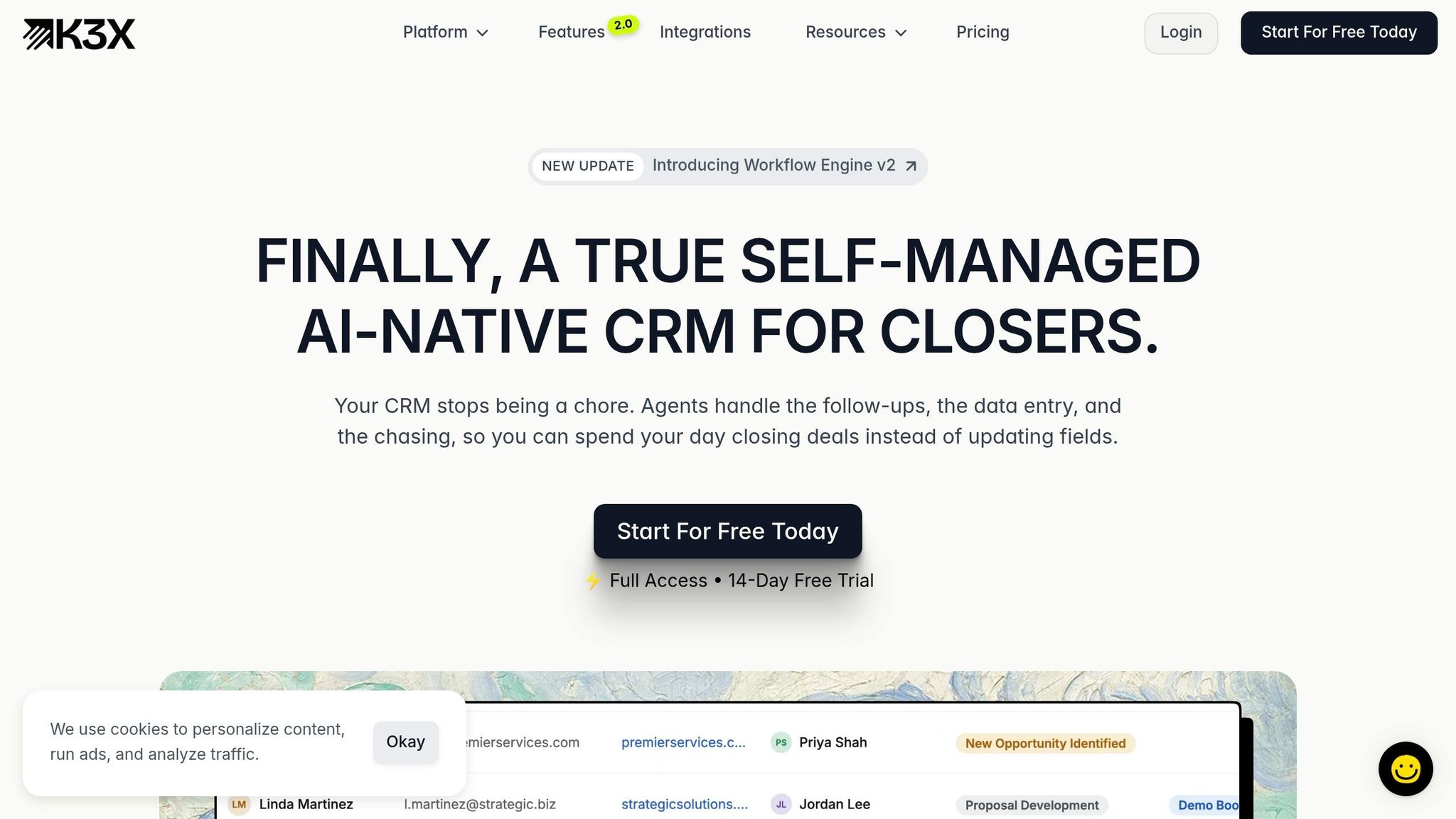
Here is the practical difference in a demo follow-up workflow.
Platform | Automation style | Setup and maintenance | Adapts to buyer replies? | Can run post-demo play without manual maintenance? |
|---|---|---|---|---|
K3X | Outcome-based; prompt-driven | Under 1 hour; no workflow builder or triggers to configure | Yes - AI agent adjusts when deal state changes | Yes - runs from one prompt until next step is booked or buyer declines |
Salesforce | Rule-based; workflow and sequence builder | Requires admin or RevOps to build and maintain | No - sequences continue on a fixed schedule | No - someone must update the workflow when the deal state changes |
HubSpot | Rule-based; sequence and workflow automation | Moderate setup; easier than Salesforce but still requires configuration | No - sequences do not pause on reply by default without manual rules | Partial - sequences can be paused on reply, but branching logic needs maintenance |
Pipedrive | Rule-based; workflow automations | Low-to-moderate setup; simpler than HubSpot | No - automations follow fixed triggers | No - deal-state changes require workflow updates |
Rule-based; workflow rules and blueprints | Moderate-to-high setup; blueprints require configuration | No - blueprints enforce fixed stage transitions | No - requires blueprint or workflow edits for each variation | |
monday.com | Rule-based; board automations | Low setup for simple automations; complex plays require more work | No - automations follow board-level triggers | No - post-demo plays need manual board and automation updates |
Close | Rule-based; sequences and workflow automation | Low-to-moderate setup; built for sales teams | No - sequences run on a fixed cadence | Partial - sequences pause on reply, but multi-stakeholder branching is manual |
Attio | Rule-based; workflow automations | Low setup; modern UI but limited automation depth | No - automations follow fixed triggers | No - outcome-based branching is not supported natively |
Honest note on K3X: It is a young product with a smaller native-integration catalog than Salesforce or HubSpot, AI credits need monitoring, and it is not built for teams needing 100+ seats or deep admin governance.
When Does Rule-Based Automation Work, and When Does Outcome-Based Automation Win?
Rule-based automation works best when the sales process is stable and someone on the team can keep workflows up to date. If most deals follow the same path, a sequence in a standard CRM can run dependably. It also fits teams that need tight control, approval steps, or compliance checks tied to explicit triggers.
Outcome-based automation works better when the process is messy. Buyers reply at odd hours, new stakeholders show up mid-cycle, and next steps slip without warning. In those cases, a prompt-driven agent that watches buyer state and changes its actions is a better fit for follow-up.
Human review still makes sense for sensitive tone or high-risk deals. That is where K3X fits in this category: it runs the play from one prompt instead of a sequence that someone has to keep tuning. That makes K3X useful when the follow-up motion is simple on paper, but the buyer behavior is not.
How Does K3X Automate a Post-Demo Follow-Up Play?
K3X takes a plain-language instruction and turns it into a live post-demo workflow. In this example, one prompt sets the follow-up motion, and K3X handles the recap, outreach timing, and pipeline updates based on buyer response.
Example Prompt: "After Every Demo, Send Recap and Chase Until Next Step Booked or Explicit No"
That prompt defines the play. K3X maps it to a full sequence: it drafts the recap email, attaches the right materials, sends it the same day, schedules follow-up touches on Days 2, 5, and 9 if there is no reply, identifies other stakeholders who have not replied for multi-thread outreach, and updates the pipeline stage when a next step is booked or the buyer declines.
K3X runs the play from one prompt and changes course when the buyer replies or a meeting gets booked. That cuts out manual sequence building and the usual rep-side task juggling.
From there, K3X turns the prompt into the recap, chase cadence, and pipeline update. Deals where the follow-up email referenced three or more specific moments from the demo had 4.1× higher close rates [6]. K3X drafts recaps from meeting context, so those references are built in at the start instead of being added by hand.
What the Agent Handles Automatically vs. What the Human Still Approves
K3X automates the draft and the timing, but the rep still controls what gets sent. That line matters because follow-up messages can go wrong when context is fuzzy.
The agent drafts, and the rep approves. K3X lets reps review AI-generated drafts before sending, so they can adjust tone, fix any misread context, and confirm the call to action. That matters in practice because AI can misread conditional language or sarcasm in a prospect's reply, and a rep can catch that before an awkward message lands in an already-warm inbox.
Action | Agent handles automatically | Human reviews or approves |
|---|---|---|
Recap email draft | ✓ | Final send approval |
Materials sharing | ✓ | - |
Follow-up timing (Days 2, 5, 9) | ✓ | - |
Channel selection (email, SMS, call) | ✓ | - |
Stakeholder outreach draft | ✓ | Tone edits, exceptions |
Pipeline stage update | ✓ | - |
Pricing or legal commitments | - | Human only |
Ambiguous replies | - | Human judgment |
The split is straightforward. The agent removes the blank-page problem and the scheduling work, while the rep keeps control over anything sensitive, unclear, or high-risk.
K3X Pricing, Setup Time, and Trade-offs
K3X costs $20 per seat/month and includes 1,000 AI credits, unlimited integrations, a built-in power dialer, no long-term contracts, and a 14-day free trial at k3x.ai/pricing. Setup for a post-demo play takes under an hour.
There are trade-offs. K3X is a young product with a smaller native integration catalog than Salesforce or HubSpot, AI credit usage needs active monitoring, and it is not built for organizations that need 100+ seats or deep admin governance.
For a small team, the value is simple. One prompt defines the follow-up play, and the agent handles the recap, chase cadence, and pipeline updates without workflow builders or sequence upkeep. The play runs without relying on rep memory.
Where Should a Small Team Start to Stop Missing Post-Demo Follow-Ups?
Start with a single post-demo play and keep it tight. Give one person clear ownership, use one review rule, and track one outcome that shows whether the follow-up led to a meeting.
Small teams usually lose steam when they add edge cases too early. The goal at first is simple: make the core follow-up happen every time, on time.
First Steps for the Fastest Time to Value
Document the 5-step play in one internal doc. Include recap timing, chase-day timing, channel order, and the CRM fields reps must fill in, such as Pain, Objection, and Next Step Date. Give follow-up ownership to the rep who ran the demo, since unassigned tasks are often ignored [7][9].
Use one approval rule: AI drafts, rep reviews, rep sends. That check helps catch tone issues before a message lands in a warm inbox, and it keeps the process moving without much drag [7][6].
Measure the rollout by speed and meeting-booking rate, not by raw activity. A sent email does not mean the play worked; a booked next step on the calendar does. Teams that use a clear call to action with an exact date and time can see a 30%–40% booking rate, versus about 15% for vague asks [4].
Track only two numbers at the start:
Time from demo end to first email sent, with a target of under 2 hours[5]
Week-over-week booked-next-step rate
Run this same play for 2–3 weeks before adding branches or extra logic. For broader follow-up automation, see the full CRM follow-up automation guide.
FAQs
How soon after a demo should you follow up?
Follow up within minutes to two hours after the demo ends. That gives you the best shot at reaching the prospect while the conversation is still fresh in their mind.
Response rates tend to fall as more time passes. If you wait until the next day, your note is more likely to get buried under new priorities and a busier inbox. If time zones get in the way, write the message right after the demo and schedule it for the next business morning.
What should a demo follow-up email include?
A demo follow-up email works best when it’s short, sent within two hours, and built to keep the deal moving. Don’t turn it into a recap dump or a long feature rundown.
Include the prospect’s specific pain points in their own words so the note feels tied to the conversation, not copied from a template. Then add one clear next step with a proposed time, plus a shareable asset that other stakeholders can review.
A simple structure looks like this:
Brief thank-you
Their pain points, phrased the way they said them
The next meeting or action, with a specific date and time
One asset to forward internally, like a deck, recording, or one-page summary
For example:
Hi [Name], thanks for the time today. You mentioned that reps are updating Salesforce by hand, managers don’t trust pipeline numbers, and it’s taking too long to spot stalled deals.
As a next step, are you available Thursday at 2:00 PM ET to review the rollout plan with your RevOps lead?
In the meantime, here’s the one-page overview you can share with the rest of the team: [link]
That kind of email is easy to scan, easy to forward, and gives the buyer a direct path to keep things moving.
How many times should you follow up after a demo?
At least five follow-ups is a solid benchmark. Research suggests 80% of sales need five or more follow-ups to close, yet most sales reps stop after one.
Instead of sending a single email, run a multi-channel cadence over 14 days while the demo is still fresh. Mix calls, social touches, and value-add emails so the prospect hears from you in a few different ways without feeling spammed.
Can follow-up be automated without sounding robotic?
Yes. Follow-ups can be automated without sounding robotic when the AI writes from the meeting transcript rather than from fixed templates.
The key is simple: use the prospect’s own words, business context, metrics, and pain points. That gives the message a human tone because it reflects what was actually said, not what a generic sequence assumes.
A good setup drafts personalized recaps from those details. It can mention the prospect’s stated goals, the blockers they named, and any numbers discussed in the call, all in plain language that matches the conversation.
For higher-risk messages, a human should still review before sending. That usually includes emails about pricing, contract terms, security claims, or legal commitments. This split keeps follow-ups helpful and specific without adding much manual work.