Sales Automation
•
AI Deal Scoring vs. Traditional Methods
Compare AI, rule-based, and hybrid deal scoring: accuracy, data needs, setup, costs, and when to use each for sales forecasting.
AI deal scoring is reshaping sales forecasting by leveraging data to predict deal outcomes with up to 90% accuracy, compared to the 40–60% error rates of manual methods. This approach analyzes behavioral signals like email response times and stakeholder engagement, offering dynamic updates and reducing subjective bias. Conversely, rule-based scoring relies on static criteria - like job titles or firmographics - and is easier to implement but less precise, with accuracy rates of 40–55%.
Key points:
AI Scoring: Uses historical data and behavioral signals; requires at least 200 closed deals for accuracy; updates scores automatically.
Rule-Based Scoring: Relies on fixed rules and manual updates; works for smaller pipelines but lacks flexibility.
Hybrid Scoring: Combines rule-based filters with AI insights for a balanced approach.
Quick Comparison:
Feature | AI Scoring | Rule-Based Scoring | Hybrid Scoring |
|---|---|---|---|
Accuracy | ~90% | 40–55% | Moderate |
Setup Complexity | High (needs data preparation) | Low | Moderate |
Data Requirement | 200+ closed deals | Minimal | Moderate |
Maintenance | Low (auto-learns from outcomes) | High (manual updates) | Moderate |
Best For | Large, complex pipelines | Small, simple pipelines | Teams transitioning to AI |
For small teams, rule-based scoring works well. Larger teams with complex sales cycles benefit from AI scoring. A hybrid approach bridges the gap, offering a gradual shift to advanced systems.
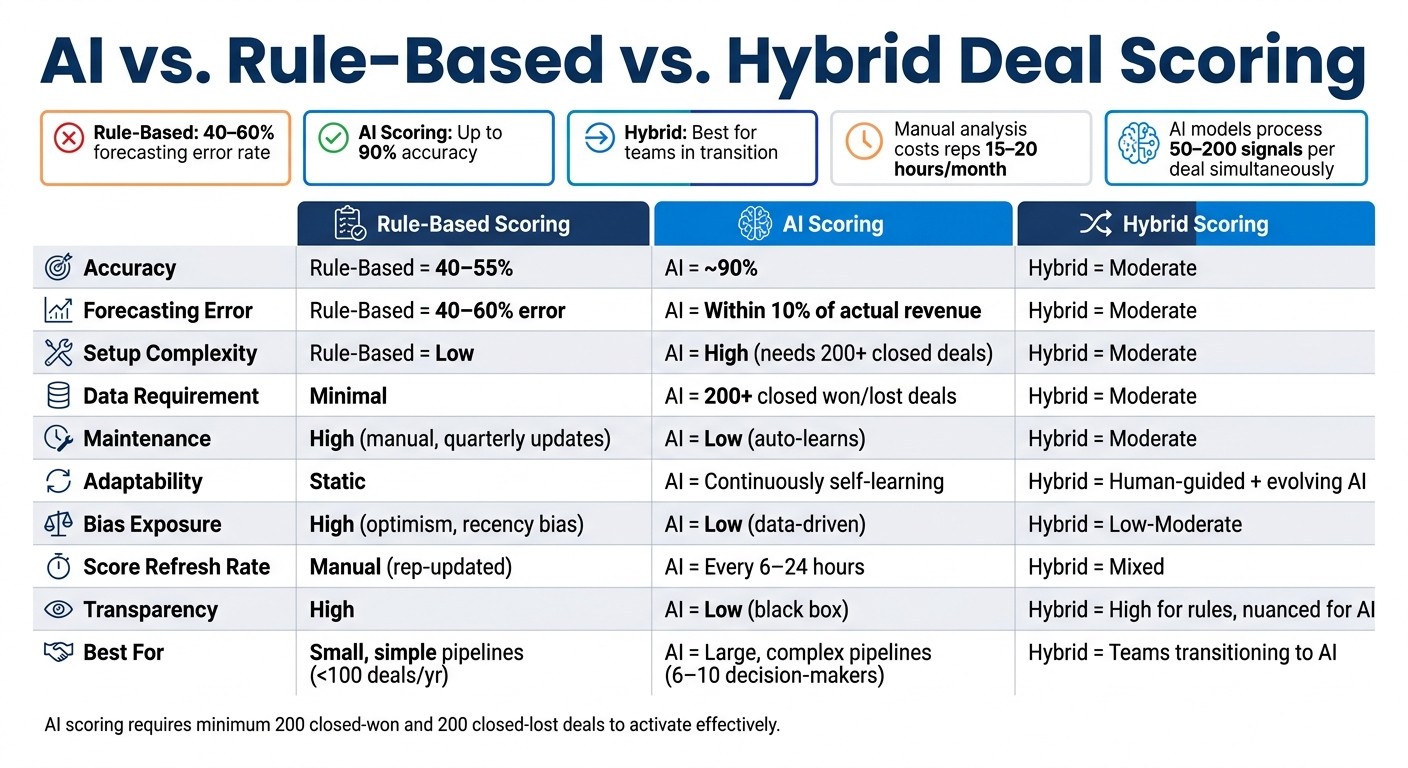
AI vs. Rule-Based vs. Hybrid Deal Scoring: Full Comparison
The SIMPLEST Way To Build An AI Lead Scoring Assistant (AI Automation)
How AI Deal Scoring Works
AI deal scoring leverages machine learning to dig into your historical CRM data - usually spanning about two years - to uncover the patterns that separate successful deals from unsuccessful ones. It evaluates factors like stakeholder engagement, how quickly emails are answered, attendance at meetings, and how smoothly deals move through the pipeline. The result? A dynamic score that gives a realistic picture of deal health, moving away from subjective judgments based on gut instinct. This data-driven approach forms the backbone of the strengths highlighted below.
What makes AI scoring stand out is its ability to learn and adapt continuously. Every time a deal is closed - whether won or lost - the outcome feeds back into the model, refining how it weighs different signals. If a specific behavior becomes less predictive over time, the model adjusts automatically.
"Measuring activity produces a misleading view of pipeline health, while true deal scoring measures progress toward a close." - Rob Stanger, Go-to-Market Expert [2]
Core Strengths of AI Scoring
One of the standout benefits of AI scoring is its emphasis on behavioral signals rather than static data. Instead of merely tracking how many calls were made, it assesses whether those calls actually moved the deal forward. Metrics like how quickly emails are answered, how deeply proposals are engaged with, and whether senior stakeholders are brought into the conversation provide a much clearer picture of a deal’s likelihood to close.
Scores are updated almost in real time. For example, HubSpot recalculates scores within six hours of a major change, while platforms like Gong and Clozo offer updates daily or even instantly [6]. This means if a key meeting is missed or email responses suddenly drop off, the score reflects this quickly, acting as an early warning system. Companies using AI-powered sales tools have reported win rate improvements of up to 30% [5].
What AI Scoring Requires to Work Well
To unlock the full potential of AI scoring, high-quality and sufficient data are essential. Most systems need at least 50–200 closed-won deals and 150–200 closed-lost deals from the past two years to generate accurate scores [6]. For example, Salesforce Einstein requires 200 won and 200 lost deals before its scoring engine can function effectively.
Both the volume and accuracy of data are critical. For instance, closed-won deals tend to have 92% CRM field coverage, while closed-lost deals often lag behind at just 49.6% [3]. Incomplete CRM data can lead to flawed training for the model, resulting in unreliable scores.
"The model is rarely the bottleneck. The CRM is." - Prospeo Team [3]
Before rolling out AI scoring, it’s crucial to clean up your CRM data. Take the example of cybersecurity company Snyk. In 2025, they collaborated with 50 Account Executives and used Prospeo to verify contact data, slashing their email bounce rate from 35–40% to under 5%. This effort not only helped them generate over 200 new opportunities per month but also ensured that their scoring models were powered by real engagement data rather than outdated or inaccurate leads [3][5].
How Rule-Based Deal Scoring Works
Rule-based scoring has been a go-to method for sales teams for years. It’s straightforward: your team creates fixed rules and assigns point values to specific actions or attributes. For instance, a VP-level contact might add +20 points, visiting a pricing page could add another +20, while 30 days of no communication might deduct 15 points. When a deal reaches a certain threshold - say, 75 points - it’s flagged as high priority. This clear and structured approach makes it easy to understand and implement.
The criteria for scoring usually fall into three main categories:
Demographics: Includes factors like job title and seniority.
Firmographics: Covers details such as company size, industry, location, and budget.
Behavioral Signals: Tracks actions like downloading whitepapers, attending webinars, or visiting specific website pages.
Many B2B sales teams also integrate structured frameworks like MEDDPICC. This framework maps elements like identifying the Economic Buyer, confirming the Decision Process, or quantifying Pain into weighted or binary CRM fields. According to research, 73% of SaaS companies selling deals above $100K ARR use some version of MEDDPICC [3].
"Manual lead scoring relies on predetermined rules created by marketing and sales teams. Administrators assign point values to specific actions or attributes based on experience and intuition." - Alex Thompson, Insights Author, Gain.io [7]
Core Strengths of Rule-Based Scoring
The biggest advantage of rule-based scoring is its transparency. Everyone on the team - whether a rep or a manager - can see why a deal received its score. There’s no mystery or guesswork involved. This shared understanding speeds up pipeline reviews and ensures consistency across the team.
It’s also a practical choice when your team doesn’t have a lot of historical data. For example, if you’ve closed fewer than 200 deals in the past two years, there might not be enough data to train an AI model effectively [3]. In such cases, a well-implemented rule-based system often outperforms poorly trained algorithms.
Where Rule-Based Scoring Falls Short
The main weakness of rule-based scoring is its rigidity. The rules are based on what your team thinks drives conversions, which may not align with actual data. As buyer behavior evolves, these assumptions can become outdated, reducing the system’s accuracy. In fact, traditional rule-based models typically achieve only 40–55% accuracy [8]. Additionally, deal probabilities submitted by reps are often incorrect 40–60% of the time [1].
Keeping the rules relevant requires regular updates, usually every quarter, which means coordinating between sales and marketing teams. On top of that, manual analysis can take up 15–20 hours per rep each month [7].
Another challenge is human bias. Sales reps often overvalue positive signals - like a great demo or an enthusiastic email - while overlooking red flags such as delays from procurement or a lack of follow-up. Without a way to counter this optimism bias, scoring discrepancies of 40% or more between team members are common [7]. These inconsistencies can hurt pipeline forecasts and overall decision-making.
Unlike AI-native CRM systems that adapt and improve over time, rule-based scoring remains static. This makes it essential to choose a scoring method that matches the complexity of your sales process.
AI vs. Rule-Based Scoring: A Direct Comparison
Rule-based scoring focuses on counting activities, while AI scoring evaluates the quality of engagement and how a deal progresses. This distinction highlights the key differences in efficiency, accuracy, and flexibility between the two systems.
"Measuring activity produces a misleading view of pipeline health, while true deal scoring measures progress toward a close." - Nathan Thompson, Fullcast [2]
Consider this: a deal might appear strong - plenty of touchpoints, involvement from senior contacts, a completed demo - but it could still stall. Why? Subtle signs like slower email responses or reduced stakeholder participation often go unnoticed by rule-based systems. AI, on the other hand, is built to detect these nuances, prioritizing outcomes over raw activity. This approach aligns seamlessly with modern CRMs like K3X, which focus on delivering actionable insights rather than relying on manual data inputs.
Another key difference lies in objectivity. Rule-based scoring is prone to subjective bias, influenced by factors like optimism or recency. AI scoring, however, relies on data-driven patterns derived from real outcomes. The result? AI models can forecast revenue with an accuracy margin of just 10% [1], compared to the 40–60% error rates commonly seen in manual estimates [1].
Comparison Table
Dimension | Rule-Based Scoring | AI-Driven Scoring |
|---|---|---|
Primary Inputs | CRM fields, firmographics, rep sentiment | Behavioral signals across emails, calls, meetings |
What It Measures | Activity (task quantity) | Progress (engagement quality) |
Accuracy | 40–60% forecasting error | Within 10% of actual revenue outcomes [1] |
Adaptability | Static; manual rule updates needed | Continuously adjusts based on outcomes [1] |
Scalability | Limited by human capacity | Processes thousands of signals simultaneously [1] |
Maintenance | High; frequent recalibration required | Low; learns automatically from closed deals |
Bias Exposure | High (e.g., optimism, recency bias) | Low; based on objective data patterns [1] |
Ease of Setup | Simple; no data threshold required | |
Score Refresh Rate | Manual; updated by reps | Automatic; refreshes every 6–24 hours [1] |
Platforms like K3X simplify AI-driven scoring by eliminating the need for complex rule setups, offering high accuracy and easy integration. Choosing between these systems depends on your pipeline's complexity and the volume of data you have available. Each approach has its strengths, but AI scoring is increasingly becoming the preferred choice for businesses aiming for precision and efficiency.
Choosing the Right Scoring Method for Your Business
Selecting the best scoring method depends on factors like your pipeline size, sales cycle complexity, and the quality of your CRM data. With efficiency, accuracy, and scalability in mind, here’s how different scoring approaches align with various sales environments.
AI Scoring for Large, Complex Pipelines
AI scoring thrives in environments with high deal volumes and intricate sales cycles involving multiple stakeholders. Considering that the average B2B purchase decision involves 6–10 decision-makers [4], manually tracking engagement across an entire buying committee becomes nearly impossible. AI steps in by analyzing 50–200 data points per deal - such as emails, calls, meeting schedules, and response times - across hundreds of opportunities at once [1].
This method works best when your CRM has a wealth of historical data. Ideally, you should activate AI scoring after logging at least 100–200 closed-won and closed-lost deals [3][9]. However, the accuracy of AI scoring hinges on clean and current data. Outdated or incomplete CRM records can lead to unreliable outcomes, so it’s essential to ensure your data is consistently up-to-date [5].
Rule-Based Scoring for Simple Setups
If your team closes fewer than 100 deals annually or operates with a short, uncomplicated sales cycle, rule-based scoring is a practical option. It’s straightforward, doesn’t demand extensive historical data, and is easy to adjust without technical expertise.
That said, rule-based scoring does come with some limitations. It typically requires quarterly updates to reflect changes in buyer behavior and market conditions [7]. Additionally, these models usually use only 10–15 variables [7], which means they might overlook subtle behavioral cues that could indicate whether a deal is stalling or progressing. For those seeking a more sophisticated solution without the hassle of setup, K3X offers an appealing alternative.
K3X: AI-Native Scoring Without the Setup Overhead
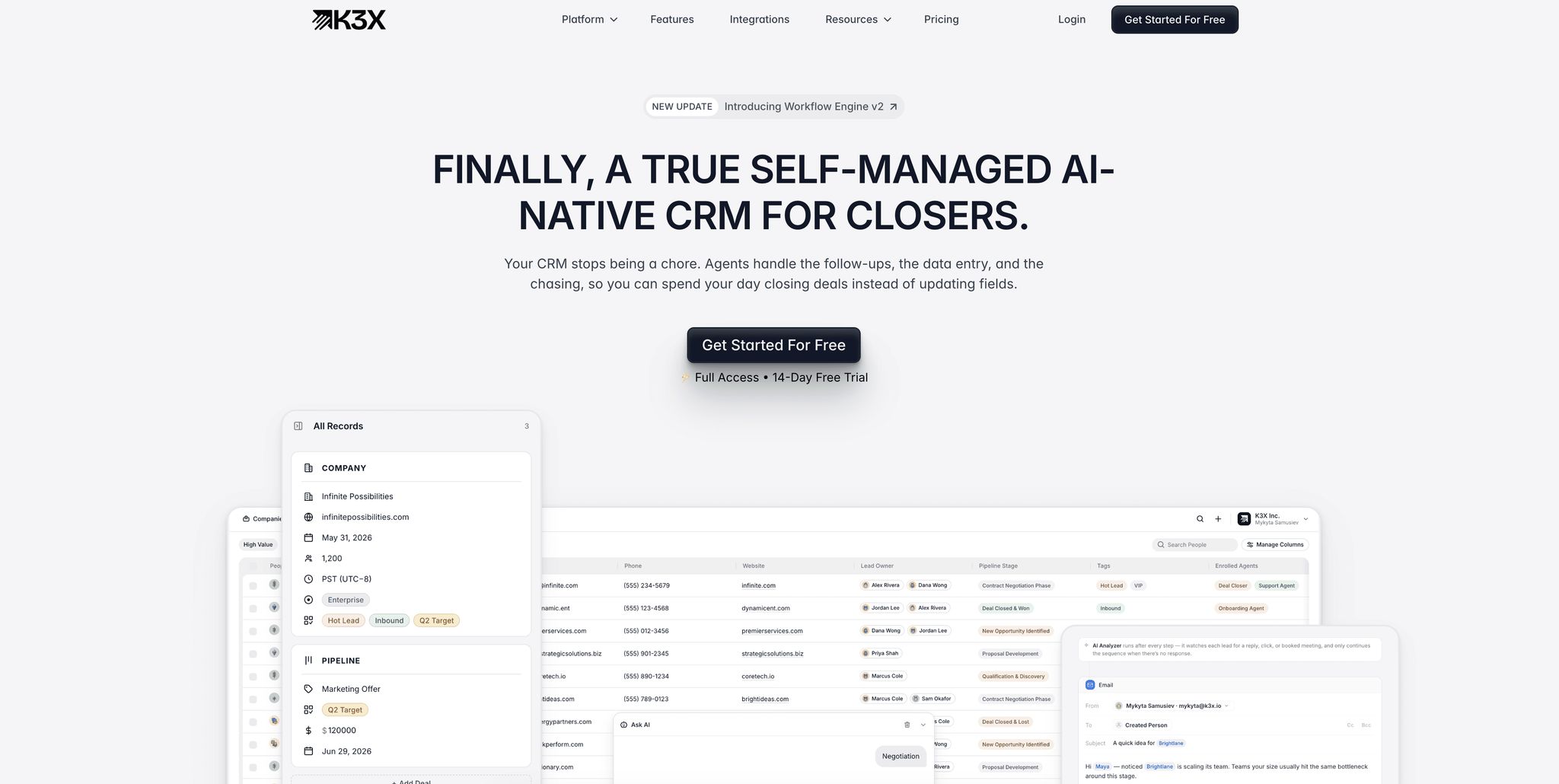
While traditional AI tools often involve lengthy implementation processes, K3X simplifies things with prompt-driven scoring that works out of the box. Platforms like Clari or Salesforce Einstein can take 8–16 weeks to deploy and frequently require dedicated professional services [5]. In fact, nearly 90% of predictive scoring projects stall during the feature engineering phase [9].
K3X skips the complications. You just define your goals using prompts, and it gets to work - updating pipelines, flagging at-risk deals, and adapting to new data in real time. Plus, it doesn’t require a dedicated RevOps specialist. At $20 per seat per month, it’s a cost-effective alternative to other tools, which can range from $100 to $250 per user per month [5].
The Hybrid Scoring Model
The hybrid scoring model blends the best of AI-driven and rule-based approaches, creating a practical solution for teams not ready to fully commit to AI scoring. This method keeps the straightforward nature of rule-based scoring while gradually incorporating AI's advanced capabilities. Essentially, rules eliminate leads that clearly don’t fit, and AI fine-tunes the ranking of the remaining prospects. This combination helps address the limitations of each approach, offering a more effective lead scoring strategy.
Why Hybrid Scoring Can Work Well
Here’s how it works: rule-based scoring applies strict filters to eliminate leads that don’t meet basic criteria, such as being in the wrong industry, having an unsuitable company size, or operating in an irrelevant location. Once those disqualifiers are applied, AI takes over to analyze behavioral signals like how quickly a lead engages with emails, visits to pricing pages, or responses to meeting invites.
"The smartest teams... run rule-based thresholds as the foundation - hard disqualifiers like wrong industry, wrong company size - and layer AI scoring on top for prioritization within the qualified pool." - Prospeo Team [9]
This layered approach helps build trust among sales teams, which is critical since 54% of AI projects stall because sales reps often distrust scores they don’t fully understand [6]. By combining clear, rule-based logic with AI's nuanced insights, the hybrid model addresses this issue directly.
During the first 6–12 months of implementation, hybrid scoring often outperforms purely AI-based systems. This is because the AI component needs time to learn and adapt to your data [9]. Running both systems side by side for 3–6 months allows teams to compare outcomes, test AI accuracy, and ensure it aligns with existing knowledge before fully transitioning. This gradual shift combines the reliability of rules with AI's adaptability, making it an effective way for sales teams to modernize their CRM strategies.
Hybrid Scoring Comparison Table
Here’s a quick breakdown of how the three approaches - rule-based, AI-powered, and hybrid scoring - stack up against each other:
Feature | Rule-Based Scoring | AI-Powered Scoring | Hybrid Scoring |
|---|---|---|---|
Primary Strength | Clear disqualification rules | Predictive accuracy and scalability | Balanced control with nuanced insights |
Weakness | Static; requires manual updates | Can feel like a "black box" | Needs more setup initially |
Data Requirement | Minimal | High (1,000+ leads, 100+ closed deals) | Moderate; rules fill data gaps |
Transparency | High | Low | High for rules; AI adds subtlety |
Adaptability | Manual updates only | Continuous self-learning | Human-guided with evolving AI |
Best Use Case | Small, simple pipelines | Complex, high-volume pipelines | Teams easing into AI scoring |
Another key advantage of the hybrid model is how AI can automatically adjust scores based on inactivity. Unlike traditional rule-based systems, which require manual updates to handle outdated leads, AI in a hybrid setup can lower scores for leads that go cold. This feature keeps pipelines clean and ensures that sales teams focus on the most promising opportunities. By combining clear-cut rules with AI's ability to adapt, hybrid scoring streamlines the process while fostering trust and efficiency.
Conclusion: Picking the Right Fit
The scoring method you choose should align with the complexity of your pipeline. Rule-based scoring is ideal for smaller, simpler pipelines. It’s straightforward, easy to manage, and doesn’t demand a lot of data to get started. On the other hand, AI scoring is better suited for high-volume, complex pipelines. It can process hundreds of signals in real time, delivering 85–92% accuracy, compared to the 40–55% accuracy of traditional methods [8].
Cost is another important factor to weigh. AI scoring typically costs between $15,000 and $45,000 annually, while traditional models, with their ongoing human maintenance needs, can range from $35,000 to $85,000 [8].
"The true cost of traditional qualification is not the leads you chase; it is the deals you could have closed while chasing them." - Zime AI [4]
This quote highlights how AI scoring can save both time and resources. For teams not yet ready to fully embrace AI, a hybrid model can serve as a stepping stone. However, for those looking to scale efficiently, AI-native solutions provide a better long-term option. Tools like K3X are designed for scalability without the heavy operational burden. Priced at $20/seat/month, K3X offers AI-driven deal scoring without the steep costs or lengthy setup times associated with platforms like Gong ($160–$250/user/month) or Clari ($100–$125/user/month plus implementation fees) [3][5].
Ultimately, whether you opt for rule-based, AI, or a hybrid approach, your choice should reflect your team’s data readiness and growth goals. If your pipeline is still developing, start simple. As your deal volume increases, transition to AI - or choose a platform like K3X that can grow with you right from the start.
FAQs
What data should I clean up before using AI deal scoring?
Before diving into AI deal scoring, it's crucial to ensure your data is in top shape. Start by cleaning up errors, fixing inconsistencies, eliminating duplicates, and filling in any missing values. This kind of data cleanup lays the groundwork for more reliable and effective AI-driven scoring results.
How do I know if I have enough closed deals for AI scoring to work?
AI deal scoring thrives when it has access to a solid dataset of closed deals - both wins and losses. While there's no magic number, having at least a few dozen well-documented deals with clean, consistent data gives the AI enough material to spot patterns and make dependable predictions. To keep improving its accuracy, it's essential to maintain high-quality data and regularly update it with new results.
How can I roll out a hybrid scoring model without disrupting the team?
To roll out a hybrid scoring model effectively, it's best to take things step by step with a focus on data and team readiness. Begin by cleaning up your CRM data - accuracy here is key. Use the CRM's current scoring features to set a baseline, making it easier for your team to adjust without overwhelming changes. Gradually introduce AI elements, emphasizing training and open communication to highlight how AI can improve existing processes. Keep an eye on performance metrics and tweak the model regularly to ensure it fits seamlessly into your team's workflows.