Sales Automation
•
How AI Improves Sales Forecast Accuracy
AI uses real-time buyer signals and machine learning to boost forecast accuracy, flag at-risk deals earlier, and reduce forecasting time.

Sales forecasting is broken. Most companies rely on outdated methods that are slow, subjective, and inaccurate. AI changes the game by using real-time data and buyer behavior to predict outcomes with up to 98% accuracy - far superior to the 51–67% accuracy of older approaches.
Key benefits of AI-powered forecasting:
Higher accuracy: 88–98% vs. 51–67% for manual methods.
Real-time updates: AI adjusts predictions instantly as new data comes in.
Time savings: Managers spend ~2 hours/week on forecasts instead of 6+ hours.
Risk detection: Warns about at-risk deals 3.2 weeks earlier.
AI tools like K3X use advanced models, such as machine learning and neural networks, to analyze hundreds of data points, from email activity to sentiment changes. This eliminates guesswork, reduces errors by up to 50%, and boosts sales outcomes.
If you're still relying on spreadsheets or CRM guesswork, you're leaving money on the table. AI doesn’t just improve accuracy; it transforms how sales teams operate.
The power of AI in sales forecasting
Traditional vs AI-Powered Forecasting
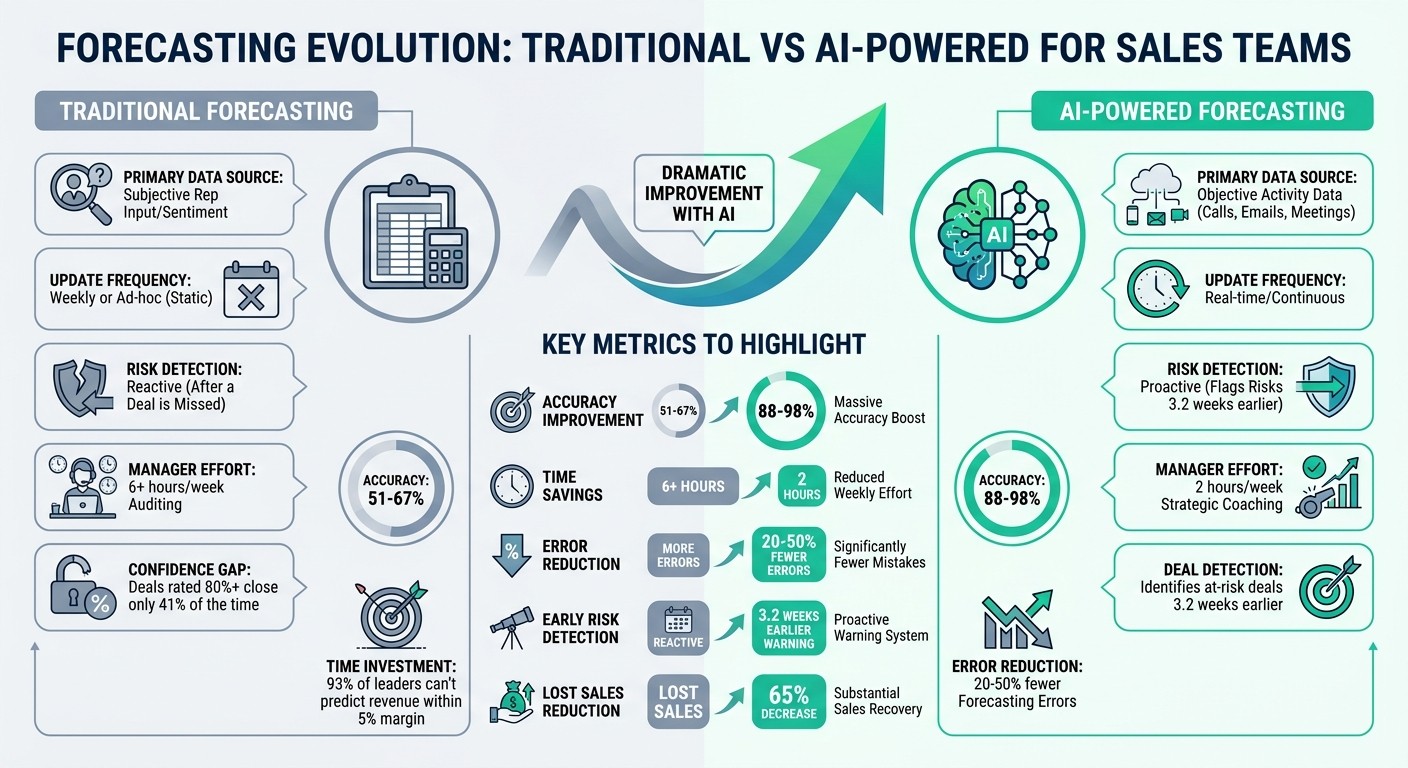
Traditional vs AI-Powered Sales Forecasting: Accuracy, Time, and Performance Comparison
Problems with Traditional Forecasting
Traditional forecasting methods often feel like frozen snapshots, such as those Monday morning forecasts that quickly lose relevance. By midweek, buyer behavior may have shifted entirely, but the forecast remains unchanged until the next scheduled update [5].
One of the biggest issues is subjectivity. Sales reps, under pressure to meet quotas, tend to overestimate the likelihood of deals closing. Managers then apply their own adjustments - often based on gut feelings rather than hard evidence. A telling statistic: deals rated at over 80% confidence actually close only 41% of the time. That’s a staggering 35–40 percentage point gap, often referred to as the "optimism tax" [5]. On the flip side, some reps intentionally "sandbag" their forecasts, underreporting deal potential to manage expectations. This results in forecasts that reflect internal politics more than actual deal progress.
The time investment is another pain point. Sales managers spend over six hours each week combing through CRM data and call recordings just to prepare for forecast meetings. Despite this effort, 93% of sales leaders admit they can’t predict revenue within a 5% margin even when only two weeks remain in the quarter [1]. AI-powered forecasting changes this narrative by swapping subjective guesswork for data-driven insights.
How AI Improves Sales Forecasting
AI tackles these challenges head-on by analyzing real-time buyer behavior instead of relying on subjective opinions. Forget asking reps how they "feel" about a deal - AI digs into measurable actions like email response times, stakeholder involvement, meeting participation, and even sentiment shifts. This shift from seller-focused metrics (like "Demo Completed") to buyer-centric signals removes much of the guesswork [3].
AI’s real-time processing turns forecasting into an ongoing process. Predictions update instantly when new signals emerge, such as a missed meeting, a slowdown in email responses, or a new stakeholder joining the conversation. This allows AI systems to identify at-risk deals up to three weeks earlier, giving sales teams the opportunity to act before revenue is jeopardized [1].
The accuracy improvements are dramatic. Traditional methods hover around 51–67% accuracy, while AI-powered systems achieve accuracy rates between 88% and 96%, cutting errors by 20–50% [3]. For instance, companies using machine learning report an 88% forecast accuracy compared to just 64% when relying on spreadsheets. AI also calculates dual probabilities - assessing not only the likelihood of winning a deal but also the chances of closing it within a specific timeframe - addressing revenue slippage that traditional models often miss [8].
The table below highlights the stark differences between traditional and AI-powered forecasting:
Feature | Traditional Forecasting | AI-Powered Forecasting |
|---|---|---|
Primary Data Source | Subjective rep input/sentiment | Objective activity data (calls, emails, meetings) |
Update Frequency | Weekly or ad-hoc (static) | Real-time/continuous |
Risk Detection | Reactive (after a deal is missed) | Proactive (flags risks 3 weeks earlier) |
Manager Effort | 6+ hours/week auditing | 2 hours/week strategic coaching |
Accuracy | 67% average | 88–96% |
AI Methods That Improve Forecast Accuracy
AI takes data-driven forecasting to the next level, offering tools that refine predictions and adapt to complex variables.
Machine Learning Models
Machine learning models like regression analysis and gradient boosting are key players in AI forecasting. These tools analyze historical win rates while factoring in deal stages, deal age, and more. For example, logistic regression can predict deal closures, while gradient boosting algorithms like XGBoost are particularly adept at managing the intricate pipelines of B2B sales, provided there’s at least a year’s worth of clean CRM data to work with [11].
Ensemble methods take things up a notch by combining multiple algorithms. Think of it as a panel of experts pooling their insights to assess factors like deal size, engagement levels, and past sales history. This approach improves accuracy, with benchmarks from 2025 showing Random Forest models achieving a Mean Absolute Percentage Error (MAPE) of 8.5%, compared to 15.2% for traditional smoothing methods [11]. Meanwhile, time-series analysis steps in to track trends, incorporating factors like seasonal revenue shifts - whether it’s the predictable Q4 surge or slower summer months [9].
Beyond these statistical approaches, advanced learning techniques push predictive accuracy even further.
Neural Networks and LSTMs
Neural networks, particularly Long Short-Term Memory (LSTM) models, excel at identifying intricate buyer behavior patterns. By processing a mix of data - like email timing and external influences such as holidays or economic shifts - LSTMs have achieved an impressive 91% accuracy rate [11]. Some hybrid models, like CNN-LSTM combinations, go even further. By integrating external variables, they’ve reduced MAPE to as low as 4.16% in retail sales forecasting [11].
Natural Language Processing (NLP) adds another layer by analyzing qualitative data that traditional methods often miss. For instance, NLP tools use sentiment analysis to evaluate buyer tone, track mentions of critical keywords like "budget" or "competitors", and even assess the dynamics of sales conversations, such as talk-to-listen ratios [9]. This transforms subjective sales call observations into measurable risk scores.
Real-Time Data Processing
AI’s ability to process data in real time ensures forecasts remain responsive to changing market conditions. Unlike static spreadsheets, AI systems continuously retrain themselves as fresh data comes in. They monitor variables like buyer engagement, sentiment shifts, and deal velocity to deliver up-to-the-minute probability scores [9]. For example, if a deal starts to stall or a buyer becomes unresponsive, the system flags the issue with a velocity decay alert, allowing managers to step in before it’s too late [9].
How K3X Delivers Better Forecast Accuracy
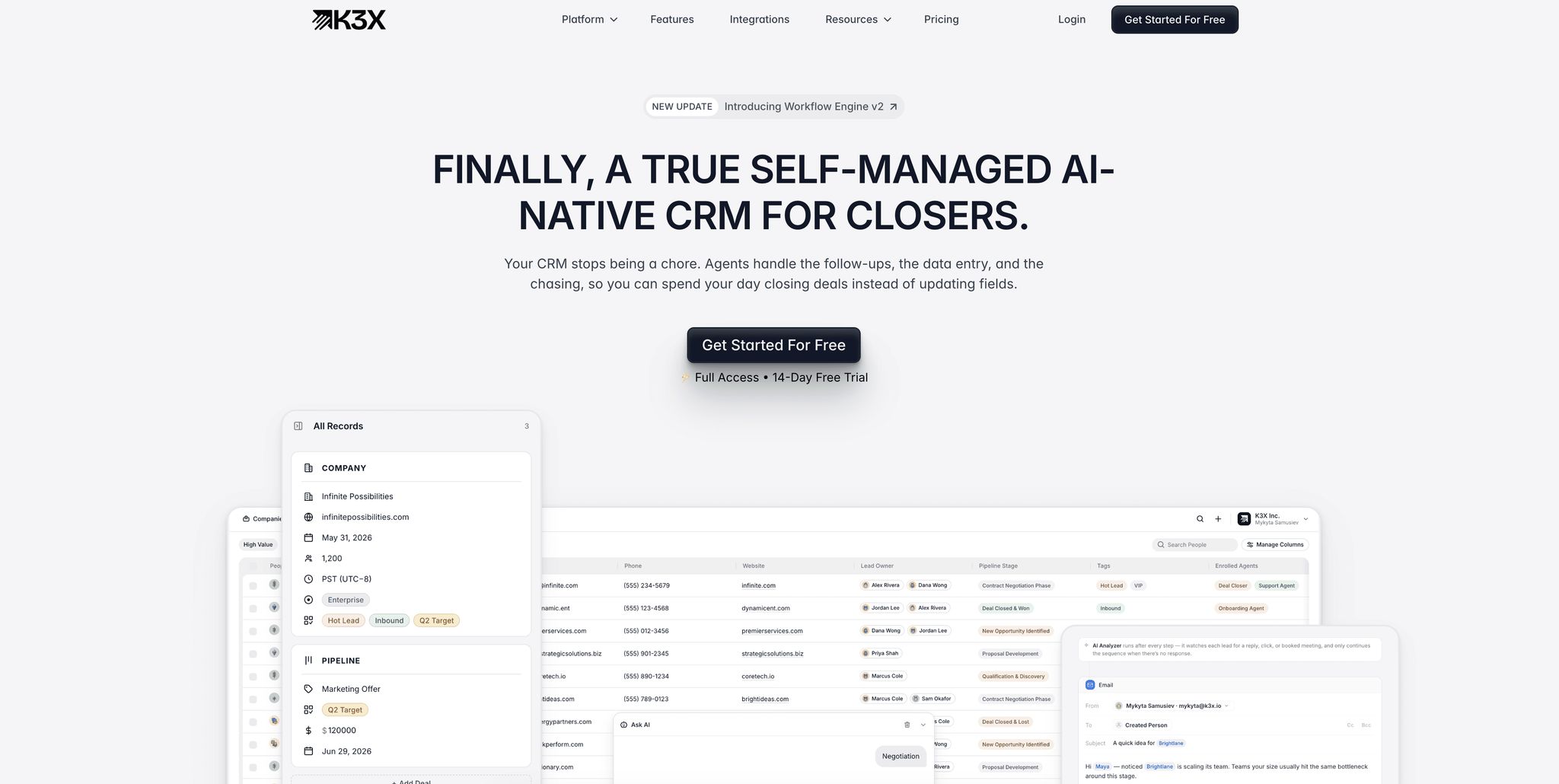
Traditional CRMs often slow teams down with manual updates and outdated data. K3X flips the script by focusing on outcomes rather than workflows. Instead of forcing sales teams to build sequences and configure triggers, K3X lets them set goals using simple prompts, and the platform takes care of the rest. This outcome-driven approach simplifies processes and makes forecasting much more precise.
Outcome-Based Prompts for Forecasting
K3X uses AI to revolutionize forecasting by removing the need for manual input while adapting to real-time data changes. The platform’s prompt-driven system captures data automatically, replacing the tedious task of CRM updates. Instead of relying on a salesperson’s gut feeling about a deal, K3X evaluates buyer actions - what the buyer has actually done - ensuring forecasts are based on facts, not assumptions [2][7]. This method avoids the common "garbage in, garbage out" issue that plagues traditional systems, where incomplete or biased data can lead to forecasts being off by 20–40% [5].
The platform digs deeper into conversational data, uncovering insights that static CRMs often miss. It tracks changes in sentiment, flags critical keyword mentions like "budget approved", and monitors buyer engagement patterns in real time [9][4]. For instance, if a rep asks, "Which deals should I focus on this week?" K3X doesn’t just generate a list - it provides scores based on factors like stakeholder involvement, response speed, and commitment signals. It even highlights deals at risk of slipping through the cracks, ensuring they don’t get incorrectly classified as a "commit" [9][3].
To counteract rep bias, K3X compares each deal against historical patterns. This ensures optimism is tempered with objective evidence, creating forecasts that are both realistic and data-driven [1][3][5]. With these insights, K3X’s adaptive learning capabilities take forecast accuracy to the next level.
Real-Time Adaptive Learning
K3X constantly learns and updates itself with every new piece of data [9][12]. After every email, call, or meeting, the platform recalculates deal health scores instantly. If a buyer raises concerns or hesitates on next steps, the forecast adjusts immediately - no need to wait for the next pipeline review [6]. This real-time processing allows K3X to spot at-risk deals early by identifying warning signs like slower email responses or the departure of a key stakeholder [1][5].
The impact is undeniable. While only 7% of sales teams achieve forecast accuracy above 90% [2][7], K3X’s AI-driven system can reach 94–98% accuracy within just 90 days of implementation [1]. Organizations using this technology have reduced forecasting errors by 20–50%, leading to a 65% drop in lost sales [3][12]. By removing emotional bias and continuously adapting to market dynamics, K3X turns forecasting into a reliable, data-driven process instead of a quarterly guessing game.
Steps to Implement AI Forecasting with K3X
To take full advantage of AI forecasting with K3X, follow these steps to ensure an effective implementation.
Organize and Prepare Your Data
AI models thrive on clean, well-organized historical data. For accurate predictions, you'll need 12 to 24 months of closed deals - both won and lost - and a minimum of 100 to 200 closed opportunities to ensure statistical reliability [5].
Bad data can be costly, with poor data hygiene eating up as much as 15% to 25% of a company’s annual revenue [13]. To avoid this, standardize your sales stage definitions - so terms like "Proposal" mean the same thing across your team - and ensure critical fields, such as deal amounts, close dates, and stakeholder roles, are filled in for at least 90% of closed deals [10]. Watch out for stale contact information too, as outdated buyer details can mislead the model.
"Stale CRM data is the silent killer of forecast accuracy. When reps chase contacts who changed jobs months ago, every model breaks" [13].
Integrating K3X with your email and calendar systems can help capture buyer engagement data automatically [7]. For example, Siemens revamped its forecasting for over 4,000 sellers across 190 countries in 2026 by first pushing forecast submission rates above 70%, creating a strong data foundation [13].
Once your data is clean, you can unlock the full potential of K3X's intuitive tools for real-time insights.
Use K3X's Prompt-Driven Interface
With your data ready, K3X’s prompt-driven system simplifies the process by removing the need for complex workflows or manual triggers. You can define goals conversationally, such as asking, "Show me deals at risk of slipping this quarter", or "Highlight opportunities with no stakeholder engagement in the past two weeks." K3X processes these requests and delivers actionable insights without requiring you to configure every detail.
The platform continuously updates deal health scores based on real-time interactions. This allows K3X to identify at-risk deals earlier than manual methods by analyzing leading indicators like slower email replies or the exit of a key stakeholder [1]. To refine your data inputs and build confidence, run K3X in "shadow mode" for 30 to 90 days before fully deploying it [5].
Monitor Insights and Scale Operations
Once K3X is set up, its real-time dashboards make it easy to monitor and scale your operations. Instead of relying on subjective judgment, these dashboards provide evidence-based insights to guide forecast reviews. Regular inspection rhythms - like setting Monday commitments and making adjustments later in the week - help keep your team aligned on pipeline health.
Combining AI-driven insights with human relationship knowledge yields the best results [7]. K3X explains why scores change, offering visibility into engagement trends, historical close rates, and stakeholder involvement. This transparency builds trust and encourages adoption across your team.
As your operations grow, K3X reduces administrative tasks by automatically capturing interactions and updating CRM fields. This allows teams to manage larger pipelines without increasing headcount [7]. For instance, in 2025, RUCKUS Networks saved $2 million annually by using real-time pipeline risk detection to address issues during the quarter, rather than after the fact [14]. Similarly, Omniplex Learning improved forecast accuracy to within 5% by ensuring reps and leaders worked off the same live data during reviews [13].
To maintain accuracy, track metrics like Weighted Mean Absolute Percentage Error (WMAPE), which weights errors by revenue, and monitor Bias% to identify systematic over- or under-forecasting [13]. Aim for a 3× coverage ratio for enterprise deals and a 4× ratio for mid-market opportunities to ensure sufficient backup when deals slip [1]. Lastly, remove deals with no activity for 30 days or more from the forecast, as these are 80% less likely to close [13].
Measured Results and Industry Outcomes
Comparison: Traditional vs AI Forecasting
When comparing traditional forecasting methods to AI-driven systems, the differences in outcomes are striking. Traditional methods, which often depend on subjective input from sales reps and manual CRM updates, typically achieve accuracy rates of 51% to 67% [3]. On the other hand, AI-native platforms like K3X deliver accuracy rates ranging from 94% to 98%. This is made possible by analyzing over 300 contextual signals in real time [1].
Method | Accuracy Range | Update Frequency | Data Sources Analyzed | Bias Reduction | Manager Prep Time |
|---|---|---|---|---|---|
Traditional | 51%–67% | Weekly/Monthly | Limited Historical Data | Low | 6+ hours/week |
AI (K3X) | 94%–98% | Real-Time | Real-Time Multivariable Data | High | ~2 hours/week |
AI forecasting doesn’t just enhance accuracy - it also improves deal management. For instance, AI systems can detect at-risk deals approximately 3.2 weeks earlier than traditional methods by identifying leading indicators [1]. This proactive capability reduces forecasting errors by 20% to 50% and cuts lost sales by up to 65% [3]. Companies using AI-powered forecasting also report shorter sales cycles - between 15% and 23% - and see their win rates increase by 8 to 12 percentage points [1].
Proven ROI with K3X
AI platforms like K3X offer more than just better forecasting accuracy - they also deliver measurable ROI by streamlining workflows and minimizing manual tasks. For example, K3X reduces the time spent on forecast preparation from over 6 hours to roughly 2 hours per week, allowing managers and sales reps to focus on strategic initiatives rather than tedious administrative work [1][6]. By automating these processes, K3X ensures operational efficiency and drives financial benefits.
"AI-powered systems set a higher benchmark for forecast reliability, with reports of up to 96% accuracy compared to about 51% for traditional methods." - Nathan Thompson [3]
AI also significantly boosts deal qualification. Well-qualified deals identified by AI are 6.3 times more likely to close than poorly qualified ones [3]. A concrete example of this transformation can be seen in Qualtrics’ 2025 shift to an AI-powered forecasting system. By integrating territories, quotas, and commissions into a unified platform, Qualtrics automated end-of-year updates and connected go-to-market planning directly to performance. This eliminated the need for manual spreadsheets, providing clearer revenue insights and a more streamlined approach to planning [3].
Conclusion
AI has redefined sales forecasting by turning predictions into a science rather than a guessing game. Unlike traditional methods, which often fall short in both speed and accuracy, AI-driven tools achieve near-perfect precision while slashing the time spent on forecast preparation - from over 6 hours to just 2 hours per week [1][3]. This marks a major shift in how sales teams operate.
The advantages go beyond just accuracy. AI flags at-risk deals 3.2 weeks earlier than manual approaches, reduces forecasting errors by 20% to 50%, and accelerates deal closures by 15% to 23% [1][3]. Additionally, deals identified as well-qualified by AI are 6.3 times more likely to close successfully than poorly qualified ones [3]. These outcomes directly impact revenue: companies with precise forecasts are 10% more likely to achieve year-over-year revenue growth [15][16].
K3X simplifies the complexities of traditional CRMs. Instead of juggling tedious workflows, users can define their goals through intuitive prompts. From there, K3X takes over - automatically updating pipelines, capturing data from calls and emails, coordinating team efforts, and adapting to changes in real time. This prompt-driven system eliminates technical headaches, allowing sales teams to concentrate on closing deals.
The move from static spreadsheets to autonomous forecasting tools transforms managers into strategic leaders rather than data crunchers [1][4]. As Nathan Thompson from Fullcast aptly puts it:
"The answer is not better guesses. It is removing guesswork entirely" [3].
With K3X’s usage-based pricing starting at just $20 per seat per month, accurate and efficient forecasting is now within reach for sales teams of all sizes.
FAQs
What data does AI need to forecast sales accurately?
AI thrives on high-quality, diverse data to deliver accurate sales forecasts. It pulls in key inputs like real-time data from sales conversations, buyer engagement activities, and historical sales records. On top of that, behavioral signals - such as email interactions and buyer actions - add another layer of precision.
By combining these elements - conversation insights, engagement patterns, and CRM data - AI builds forecasts that are not only grounded in evidence but also flexible enough to adjust to shifting customer behaviors and market conditions. This dynamic approach ensures predictions stay relevant and actionable.
How does AI spot deals likely to slip before the quarter ends?
AI can spot deals that might be at risk of falling through by analyzing real-time signals like buyer behavior, engagement trends, and even conversations during meetings. These insights help gauge deal momentum, understand buyer intent, and identify possible risks. With this information, teams can step in early to address issues and ensure deals stay on course.
How long does it take K3X to improve forecast accuracy after setup?
K3X starts enhancing forecast accuracy right away after it's set up. It adjusts in real time by analyzing user behavior and lead activity, turning the CRM into a dynamic, responsive tool. This means forecasts are more precise without the need for complicated setups or manual tweaks.