Sales Automation
•
ROI of Conversational Assistants in Sales Operations
Conversational AI transforms sales by boosting conversions, cutting admin costs, speeding cycles, and delivering rapid, measurable ROI.

AI conversational assistants are transforming sales by boosting revenue, cutting costs, and improving customer experiences. These tools automate repetitive tasks like data entry, lead qualification, and follow-ups, freeing sales teams to focus on closing deals. Here's what you need to know:
Revenue Impact: AI assistants respond to leads instantly (even outside business hours), increasing conversion rates by up to 40% and speeding up sales cycles by 32.6%.
Cost Savings: Automation reduces data entry and admin work by 60–80%, saving 7–9 hours per week per rep. AI also slashes the cost of customer interactions from $5-$12 to $0.15-$0.50.
Efficiency Gains: AI tools improve lead qualification rates by 28% and reduce SDR ramp time from four months to two.
Customer Experience: Faster response times (within 5 minutes) can boost conversions 100x, while AI ensures personalized and consistent interactions.
Platforms like K3X, priced at $20 per user/month, focus on outcomes rather than rigid workflows, making ROI tracking easier with real-time dashboards and automated data entry. Companies using AI sales tools report an average first-year ROI of 287% with a payback period of 3.5 months.
Bottom Line: Conversational assistants are a game-changer for sales teams, driving measurable results in revenue, efficiency, and customer satisfaction.
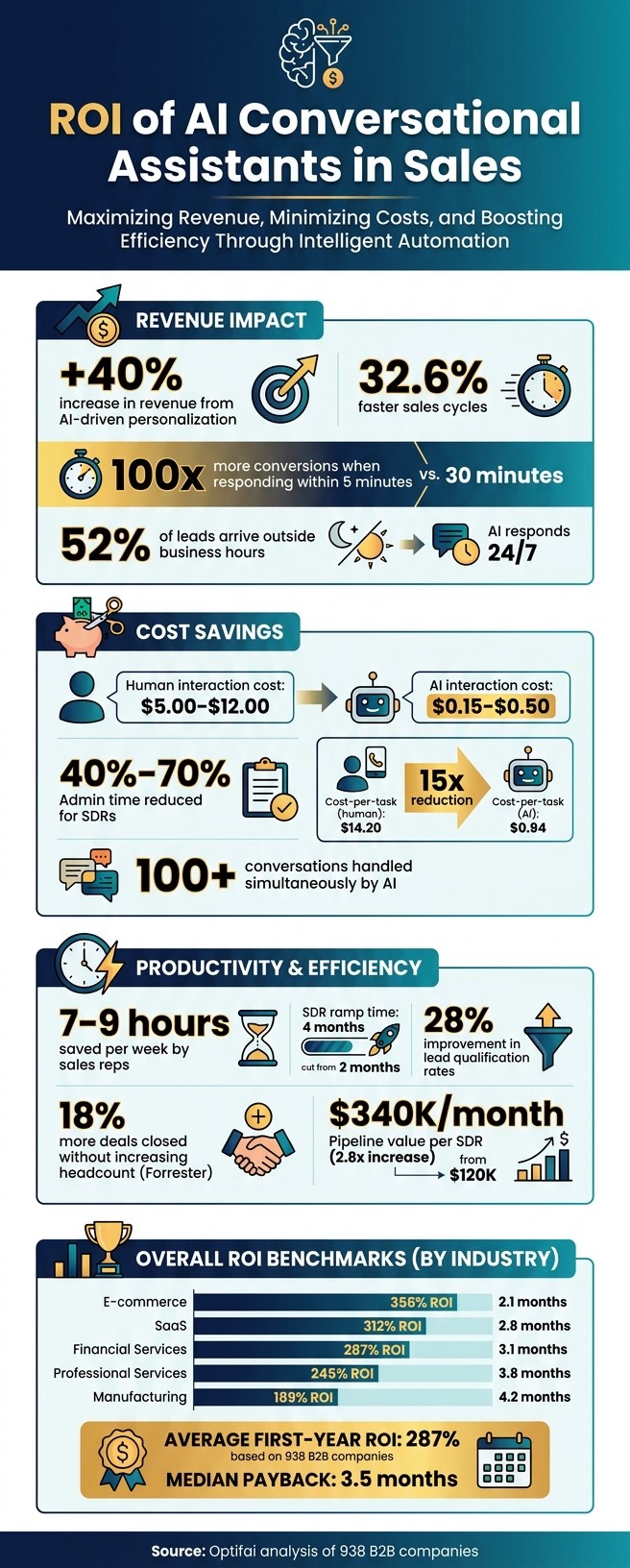
ROI of AI Conversational Assistants in Sales: Key Stats & Benchmarks
The Main ROI Drivers of Conversational Assistants in Sales
Revenue Growth and Higher Conversion Rates
Conversational assistants play a key role in boosting revenue by addressing one major issue: delays in lead response. When a prospect fills out a form or visits a pricing page, every minute of delay increases the likelihood they’ll lose interest or move on. AI assistants eliminate this problem by responding in under a second, 24/7. This is especially valuable considering that 52% of leads arrive outside standard business hours [7]. That kind of responsiveness can significantly shift revenue outcomes.
But speed isn’t the only factor. AI assistants also excel at personalization and proactive follow-ups. By integrating with CRM data, they tailor conversations to a prospect’s history and deal stage - something that 71% of consumers now expect [7]. On top of that, they can trigger follow-ups via SMS, email, or WhatsApp, ensuring leads remain engaged. Companies that leverage AI-driven personalization see a 40% increase in revenue from these efforts [7].
The data speaks for itself. A study of 938 B2B companies by Optifai found that AI sales assistants achieved an average first-year ROI of 287% and a median payback period of just 3.5 months [12]. Additionally, these tools sped up sales cycles by 32.6% [12].
These revenue improvements naturally complement the cost savings discussed below.
Cost Savings and Efficiency Gains
Conversational assistants deliver cost savings by automating tasks that don’t require human involvement. Sales reps currently spend 72% of their time on non-selling activities like data entry, scheduling, lead research, and follow-ups. AI takes over these repetitive tasks, freeing up reps to focus on actual selling.
This automation saves sales reps 7 to 9 hours per week [5]. For SDRs, administrative time can be reduced by 40% to 70% [13]. AI-native CRMs also cut data entry costs significantly, often within the first 90 days of use [5]. On the support side, the cost comparison is striking: human-handled resolutions cost $5.00–$12.00 each, while AI agents handle the same interactions for just $0.15–$0.50 [14]. Plus, a single AI assistant can manage 100+ conversations simultaneously, compared to one-at-a-time for human reps [6].
"The goal of AI voice isn't to replace the human element of a deal; it's to ensure the human element is only applied when it's truly needed - at the moment of final negotiation." - CEO, Conversational AI Infrastructure Firm [6]
Better Customer Experience and Retention
Beyond revenue and cost efficiency, conversational assistants enhance customer experience, which is crucial for long-term ROI. Traditional sales processes often fall short because 70% of marketing leads go ignored due to human capacity limits [9]. AI eliminates this issue by ensuring every lead gets an immediate and personalized response, no matter the time or team availability.
Speed is critical here. Responding to a prospect within 5 minutes instead of 30 minutes can boost conversion rates by 100x [14]. This quick response not only improves conversion rates but also builds the foundation for customer retention. AI assistants go further by using real-time data to identify churn risks early and initiate proactive check-ins, shifting retention strategies from reactive to preventive. Consistency is another major advantage: AI provides real-time coaching during calls, ensuring every customer interaction meets the same standard - whether they’re dealing with a seasoned rep or a new hire. This consistency reduces the variability that can erode trust over time [2].
Case Studies: ROI of Conversational Assistants in Action
Improving Lead Generation and Qualification
AI-powered tools are revolutionizing how B2B teams handle lead generation. For instance, teams using AI agents report a 2.8x increase in pipeline value per SDR per month, jumping from $120,000 to $340,000 [16]. These agents also filter out up to 85% of non-intent interactions, allowing sales reps to concentrate on high-intent prospects [6]. The result? A 40% uptick in meeting bookings within the first 24 hours when AI is used for inbound follow-ups, alongside a 28% improvement in lead qualification rates [3][5].
The efficiency gains are striking. By boosting pipeline value and slashing the cost of booked meetings from $1,920 to $83.33, AI-driven lead qualification transforms pipeline generation [17]. These advancements not only improve efficiency but also accelerate the progression of sales pipelines.
Speeding Up Sales Pipelines and Closing Deals
AI doesn’t just stop at lead qualification - it speeds up entire sales processes. Take the example of a mid-market SaaS firm that integrated AI for prospecting, deal management, and churn prediction. The company reduced its revenue team from six to five people while doubling its pipeline value (2.2x). Close rates increased by 28%, and monthly churn dropped from 6.2% to 2.8% [16]. These outcomes stemmed from AI’s ability to handle complex tasks like identifying at-risk deals, recommending next steps, and automating follow-ups, rather than relying on rigid, rule-based workflows.
Conversation intelligence (CI) software also delivers impressive returns, with users reporting a 4x to 12x ROI within the first year [2]. Additionally, 89% of CI buyers see positive ROI within 12 months [2]. AI-native CRMs further streamline the process, shortening sales cycles by an average of 12% by flagging potential deal blockers early [5].
"The ROI of conversation intelligence is not about recording calls. It is about changing what happens on calls - and that is where revenue lives." - Nilansh Gupta, Co-founder & CEO, Nimitai [2]
Increasing Sales Rep Productivity
AI tools drastically enhance sales team productivity. For example, Ruby Capital Group implemented K3X’s AI-driven agents, achieving a 70% reduction in follow-up time within two days and a 3x increase in ticket resolution speed [8]. The impact was immediate.
"Our sales team was spending half their day on admin work. Now they're talking to customers and closing deals. The automation handles everything from lead qualification to contract routing, and our close rates have never been higher." - Michael Chkechkov, CEO, Ruby Capital Group [8]
The efficiency gains extend across industries. K3X has automated 312,000 hours and cut $12.4 million in operational costs across more than 50 teams [8]. AI reduces the cost-per-task for SDR research and outreach from $14.20 (human) to just $0.94 (AI agent) - a 15x reduction [11]. Sales teams leveraging AI for scoring and pipeline management close 18% more deals on average without increasing headcount, according to Forrester [5]. These tools not only simplify operations but also deliver measurable returns across the revenue cycle.
How to Measure the ROI of Conversational Assistants
Key Metrics to Track
If you want to secure budgets for AI tools, you need to back up their performance with hard numbers. Here's a telling stat: 65% of sales leaders who implemented AI without a clear ROI framework couldn’t get their budgets renewed after the first year [15]. To measure ROI, use the following formula:
[(ΔRevenue + Cost Savings) - Total Cost] / Total Cost × 100 [15][12].
To make this formula actionable, track inputs across three main areas:
Financial metrics: Look at revenue growth from new deals and upsells, cost-per-meeting (CPM), and savings from reduced labor costs or tool consolidation.
Productivity metrics: Measure time saved - like the 1 to 1.5 hours of selling time reps typically recover daily [1] - and faster onboarding, such as reducing SDR ramp time from four months to two [4][2].
Customer experience metrics: Use metrics like CSAT, NPS, and customer lifetime value to gauge retention improvements and faster response times [10][18].
But don’t stop there. Factor in the full "cost iceberg" - things like licensing fees, data upkeep, prompt engineering, and human oversight. Ignoring these costs leads to inflated ROI figures that won’t hold up [18].
Once you’ve identified the metrics, the next step is to design a pilot program that turns these numbers into clear ROI results.
Methods for Measuring ROI
A 90-day pilot is a proven way to measure ROI [15][2]. Here’s how to break it down:
First 30 Days: Establish your baseline metrics. Track things like close rates, average deal sizes, sales cycle lengths, and leads per rep.
Days 31–60: Deploy the conversational assistant with one team or product line while keeping a control group for comparison.
Day 90: After a full sales cycle, calculate ROI based on clean, attributable data.
When assigning credit, be realistic. Allocate 100% of the credit for deals closed directly due to AI recommendations, and 20–30% for leads that were sourced or qualified by the assistant [15][10]. This prevents overestimating or underestimating the AI’s impact.
Here’s why this matters: A study of 938 B2B companies showed that well-implemented AI sales assistants deliver an average first-year ROI of 287%, with a median payback period of 3.5 months [12].
Industry | Average First-Year ROI | Payback Period |
|---|---|---|
E-commerce | 356% | 2.1 months |
SaaS | 312% | 2.8 months |
Financial Services | 287% | 3.1 months |
Professional Services | 245% | 3.8 months |
Manufacturing | 189% | 4.2 months |
Source: Optifai analysis of 938 B2B companies [12]
How K3X Makes ROI Tracking Easier
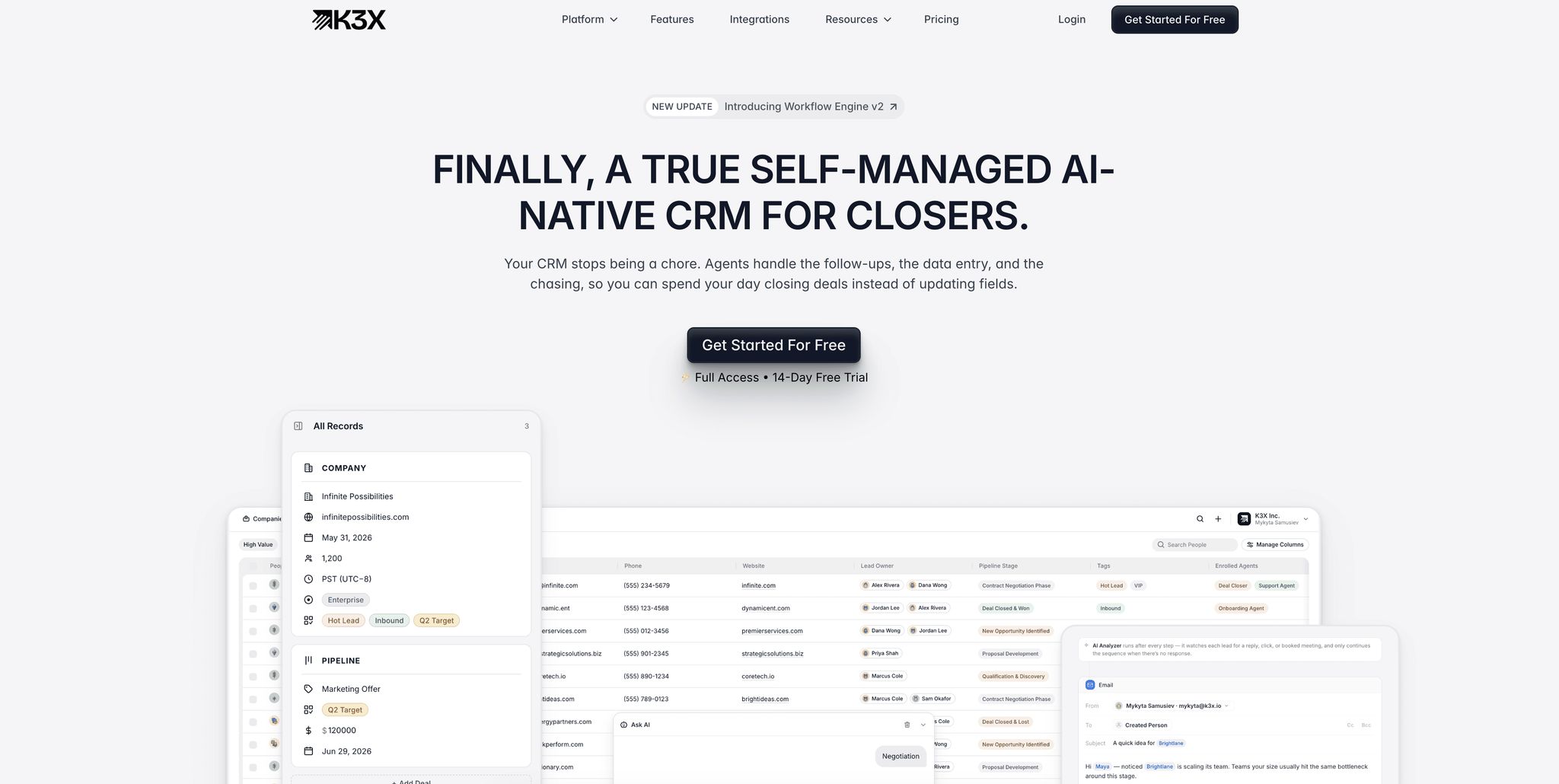
Tracking ROI can be a headache, especially when your CRM requires manual tagging, custom reports, and endless setup just to get basic insights. This is where K3X comes in - it’s designed to simplify the process.
K3X focuses on outcomes rather than workflows. It automatically captures activity data as deals progress through the pipeline, eliminating the need for manual data entry or reconciliation. Its real-time dashboards provide an up-to-the-minute view of pipeline value, follow-up activity, and deal progression. Every AI-driven action is logged in context, so you can easily see the revenue impact without asking, "Did the AI influence this deal?"
For teams running a 90-day pilot, this seamless data capture is a game-changer. With centralized data from day one, your baseline and results are consistent, and there’s no need to reconcile data from different systems. Plus, K3X is budget-friendly at $20 per seat per month, with no long-term contracts. This keeps the cost side of your ROI equation straightforward, ensuring your calculations are accurate and transparent.
Conclusion: Getting More from Sales with K3X
Key Takeaways on ROI Drivers
Looking at the data and real-world examples, it's clear that conversational assistants are reshaping how sales teams operate. They deliver measurable results by driving revenue growth (through higher conversion rates and shorter deal cycles), lowering costs (by cutting down on manual tasks), and enhancing customer experience (with quicker, more consistent follow-ups).
At the core of these benefits is time. Sales reps lose 45% of their quota-attainment potential to administrative tasks [7]. AI-powered tools give that time back, allowing reps to focus on what they do best: selling. These time-saving advantages highlight why the K3X platform stands out.
The K3X Advantage
While most CRMs focus on documenting past activities, K3X is designed to act in the moment. It uses goal-driven, adaptable logic to achieve outcomes like “Book a demo with non-responders,” without relying on rigid workflows or manual configurations. The system dynamically adjusts to lead behavior, ensuring smooth operations even when interactions don’t follow a predictable path.
This difference makes a big impact on ROI. Traditional systems often require extensive tagging and setup, and they can fall apart when leads respond unexpectedly. K3X eliminates these inefficiencies entirely.
The results speak for themselves: K3X has saved its users an estimated $12.4 million in operational costs and automated over 312,000 hours of manual work [8]. Teams like Ruby Capital Group have seen a 70% reduction in follow-up time within two days and achieved their highest close rates to date [8].
The real ROI of AI isn't one killer use case - it's the aggregate
FAQs
What’s the fastest way to prove ROI in 90 days?
The fastest way to show ROI in just 90 days is by using AI-powered tools designed to enhance efficiency. These tools can deliver measurable results, such as better lead qualification, smarter deal prioritization, and quicker movement through the sales pipeline. In fact, many businesses see a break-even point within 60 to 90 days, clearly demonstrating how these solutions can make an immediate difference in sales performance.
Which metrics matter most for AI sales ROI?
When evaluating the return on investment (ROI) for AI in sales, there are four metrics that stand out: outcome rate, cost per resolution, payback period, and revenue impact. Of these, outcome rate is considered the most dependable measure of business value.
These metrics collectively provide insight into how well AI tools perform in delivering results, managing expenses, and boosting revenue. By focusing on these indicators, businesses can better understand the efficiency and effectiveness of their AI investments.
What hidden costs can reduce ROI?
When calculating ROI, it's easy to overlook some less obvious expenses that can quietly eat away at your profits. These hidden costs often include:
Opportunity costs: Delayed follow-ups can result in missed chances to close deals or build relationships, which directly impacts revenue potential.
Implementation and integration expenses: Setting up new systems or tools often comes with added costs that aren't always accounted for upfront.
Employee churn: High turnover rates can lead to recruitment and training expenses, as well as productivity losses during transitions.
Ramp-up time: The time it takes for new employees or systems to reach full productivity can slow down operations and reduce efficiency.
Management overhead: Managing new processes, tools, or teams often demands extra time and resources from leadership, which can strain budgets.
These factors are often left out of traditional ROI calculations, but they can lead to unexpected financial setbacks if not properly managed.