Sales Automation
•
How AI Improves Opportunity Scoring Accuracy
Shows how AI leverages engagement, CRM and conversational signals to improve deal scores, cut forecast error, and trigger timely actions.

AI is transforming how sales teams prioritize deals by replacing outdated, rule-based methods with data-driven predictions. Traditional scoring systems often rely on pipeline stages or subjective judgment, leading to inaccurate forecasts and wasted time. AI, on the other hand, analyzes real-time signals like email responses, stakeholder engagement, and deal progression to predict outcomes more precisely.
Key insights:
AI doubles to triples accuracy compared to manual methods, with predictive rates of 40–60%.
It identifies 89% of potential deal failures early, giving teams time to act.
AI tools reduce forecast errors by 26% and help sales reps focus on deals most likely to close.
Clean CRM data and consistent activity tracking are critical for success.
AI doesn’t replace human judgment - it enhances it by providing actionable insights based on patterns no human can detect at scale. This shift helps sales teams close more deals faster while improving revenue forecasting.
Einstein Opportunity Scoring For Everyone | Salesforce
What the Research Shows
Did you know that only 7% of sales organizations achieve a forecast accuracy of 90% or higher? Most hover between 70% and 79% accuracy, according to research [6]. On top of that, Chief Revenue Officers (CROs) can spend as much as 30% of their week reviewing pipeline deals that ultimately don’t close [3]. This inefficiency doesn’t just waste time - it also leads to lost revenue. These challenges highlight why AI tools are becoming crucial for prioritizing sales opportunities.
AI Helps Teams Focus on the Right Deals
AI changes the game by shifting deal prioritization from subjective, time-based decisions to objective, data-driven probabilities. Sales reps often focus on deals they’ve already invested time in rather than those most likely to close. AI, however, uses scoring models to objectively rank deals based on their actual probability of success.
The results speak for themselves: 56% of sales professionals now use AI tools daily, and those who do are twice as likely to exceed their sales targets [4]. Even more impressive, AI-driven systems can identify up to 89% of potential deal failures before they happen [6]. This early detection gives teams a chance to address issues before they escalate.
"AI flags at-risk deals 41% earlier than manual review." - HatHawk Study, 2026 [6]
By helping teams zero in on high-priority deals, AI doesn’t just optimize focus - it also revolutionizes forecasting accuracy.
How AI Improves Forecast Accuracy
Traditional forecasting often relies on data that sales reps manually input into systems. Unfortunately, this data is frequently incomplete, outdated, or overly optimistic. AI eliminates these weaknesses by automatically collecting dynamic signals from sources like email, calendars, and call recordings. This creates a continuously updated and unbiased view of deal progress, independent of a rep’s input [6][1].
Here’s why that matters: AI updates scores in real-time. For example, if a key contact stops responding, an executive joins a call, or a close date changes, the system adjusts forecasts immediately. This constant stream of updates significantly reduces forecasting errors and provides a more accurate picture of deal health. To see how these real-time updates work in practice, you can join the K3X waitlist.
Signals AI Scoring Models Use
AI models rely on a variety of signals to deliver precise opportunity scoring. These signals provide insights that go beyond surface-level metrics, helping teams understand not just where a deal stands, but where it’s headed.
Signal Category | What It Measures | Why It Matters |
|---|---|---|
Engagement Velocity | Ratio of stakeholder responses to touchpoints over 14 days | Helps distinguish genuine buying interest from superficial engagement [3] |
Stakeholder Breadth | Number of unique contacts engaged within the account | Enterprise deals averaging $50K+ ACV typically involve 17 unique contacts [3] |
Stage Progression Rate | Time spent in the current stage vs. historical closed-won deals | |
Qualification Evidence Depth | Reduces reliance on overly optimistic qualification data [2][1] | |
Sentiment & Competitive Mentions | NLP analysis of buyer language and competitor mentions | Late-stage competitor references can shift close probabilities [2][6] |
"A deal score built on stage and amount tells you where a deal is. A score built on qualification evidence tells you where it is going." - Spotlight.ai [2]
How AI Opportunity Scoring Models Work
AI scoring models rely on historical data patterns to predict deal outcomes with greater precision. Let’s break down the key components that make these models effective: the data they learn from, the requirements for their success, and how they continuously improve.
What Data AI Models Learn From
Traditional rule-based systems often fall short because they can’t adapt to changing patterns. AI scoring models, on the other hand, are trained on diverse data sources, including historical deal outcomes, CRM activity logs, and conversational data. Typically, these models analyze two to three years of closed-won and closed-lost deals to identify patterns that drive success [4][8].
The data feeding these models includes:
CRM metadata: Information like deal size, stage duration, and changes to close dates.
Engagement signals: Metrics such as email reply rates, meeting acceptances, and call frequency.
Conversational intelligence: Insights from call transcripts and email threads [1][2].
"AI deal scoring doesn't ask reps what they think. It observes what's actually happening across dozens of data points and compares those signals against your organization's historical outcomes." - Fullcast [4]
Additionally, external intent data from platforms like 6sense or Bombora bolsters predictions. These external signals might include hiring activity within a buyer's department or updates to their technology stack [3]. The broader the range of data sources, the more precise the model becomes.
What You Need Before AI Scoring Can Work
The accuracy of AI scoring depends heavily on data quality. Unfortunately, only 35% of sales professionals fully trust their organization’s CRM data [8]. This lack of trust often stems from incomplete or inconsistent records, unclear stage definitions, and unstructured data entries like free-text fields.
For AI scoring to work effectively, you’ll need:
Clean data: At least 40 won and 40 lost deals, though 100 of each is preferable [4][7].
Clearly defined pipeline stages: Inconsistent or intuition-based deal progression can mislead the model.
Standardized closed-lost reasons: Using picklists instead of free-text notes ensures the AI can learn from structured data [8].
Data cleanup: A 30- to 60-day cleanup period is often recommended to ensure historical records are accurate before training begins [4].
"CRM data quality is the hard ceiling on AI accuracy. Low data trust limits what can be safely automated." - The Apollo Team [8]
With these prerequisites in place, AI scoring models can adapt dynamically to shifting sales conditions.
How AI Models Update and Improve Over Time
AI models continuously refine themselves by learning from every closed, lost, or stalled deal. Many systems retrain daily or even in real time as new data becomes available [8][9]. For example, if a key stakeholder stops responding, a close date is delayed, or an Economic Buyer joins the conversation, the model updates the score to reflect these changes [2][5]. This dynamic capability sets AI apart from static forecasting methods.
AI-driven systems also significantly improve forecast accuracy. They can reduce Mean Absolute Percentage Error (MAPE) to just 5–15%, compared to the 15–40% error rate common with traditional approaches [9].
To maintain this level of accuracy, quarterly calibration is recommended. Reviewing prediction accuracy against actual outcomes each quarter helps refine the model’s signal weightings as market conditions and sales processes evolve [4][8].
Comparing AI Opportunity Scoring Platforms
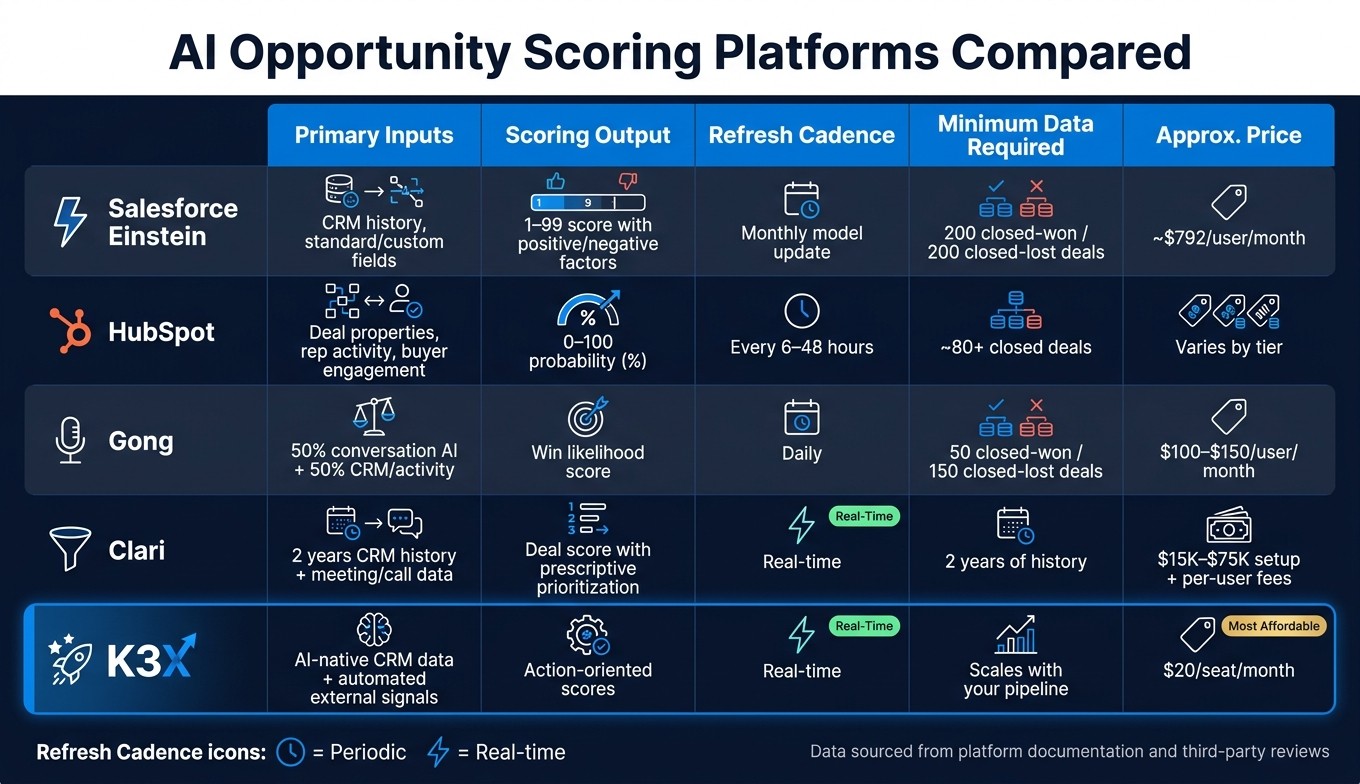
AI Opportunity Scoring Platforms Compared: Features, Pricing & Data Requirements
AI scoring tools come with varying data sources, refresh rates, and trigger mechanisms, all of which influence their effectiveness.
Platform Comparison: Features and Outputs
Here’s a breakdown of how five major platforms handle opportunity scoring:
Platform | Primary Inputs | Scoring Output | Refresh Cadence | Minimum Data Required |
|---|---|---|---|---|
CRM history, standard/custom fields [11] | 1–99 score with positive/negative factors [11] | Monthly model update [11] | 200 closed-won / 200 closed-lost deals [11] | |
Deal properties, rep activity, buyer engagement [5] | 0–100 probability (%) [5] | Every 6–48 hours [10] | ~80+ closed deals [10] | |
50% conversation AI and 50% CRM/activity [10] | Win likelihood score [10] | Daily [10] | 50 closed-won / 150 closed-lost deals [10] | |
2 years CRM history plus meeting/call data [10] | Deal score with prescriptive prioritization [10] | Real-time [10] | 2 years of history [10] | |
K3X | AI-native CRM data and automated external signals | Action-oriented scores | Real-time | Scales with your pipeline |
A few points stand out when comparing these platforms. For example, Salesforce Einstein updates its model monthly, which may not keep pace with rapidly changing deals. It also requires a fairly large dataset to activate [11]. Gong, on the other hand, draws half of its signals from call conversations, making it particularly helpful for teams that rely heavily on phone interactions [10]. Clari, designed for enterprise users, integrates data from CRM systems and meetings but comes with additional professional service fees ranging between $15,000 and $75,000, plus per-user costs [10].
Pricing varies widely across platforms. Salesforce Einstein costs around $792 per user/month, while Gong ranges from $100–$150 per user/month, which may not suit smaller or fast-growing teams.
One common drawback across many platforms is that their scores often remain as static reporting tools rather than actionable insights. As the Prospeo team notes, "A score on a deal record is useless if nobody acts on it." [10] This highlights a gap in how traditional scoring systems are used.
K3X stands apart by taking a more dynamic approach to opportunity scoring, integrating actionable follow-up mechanisms directly into its system.
How K3X Approaches Opportunity Scoring
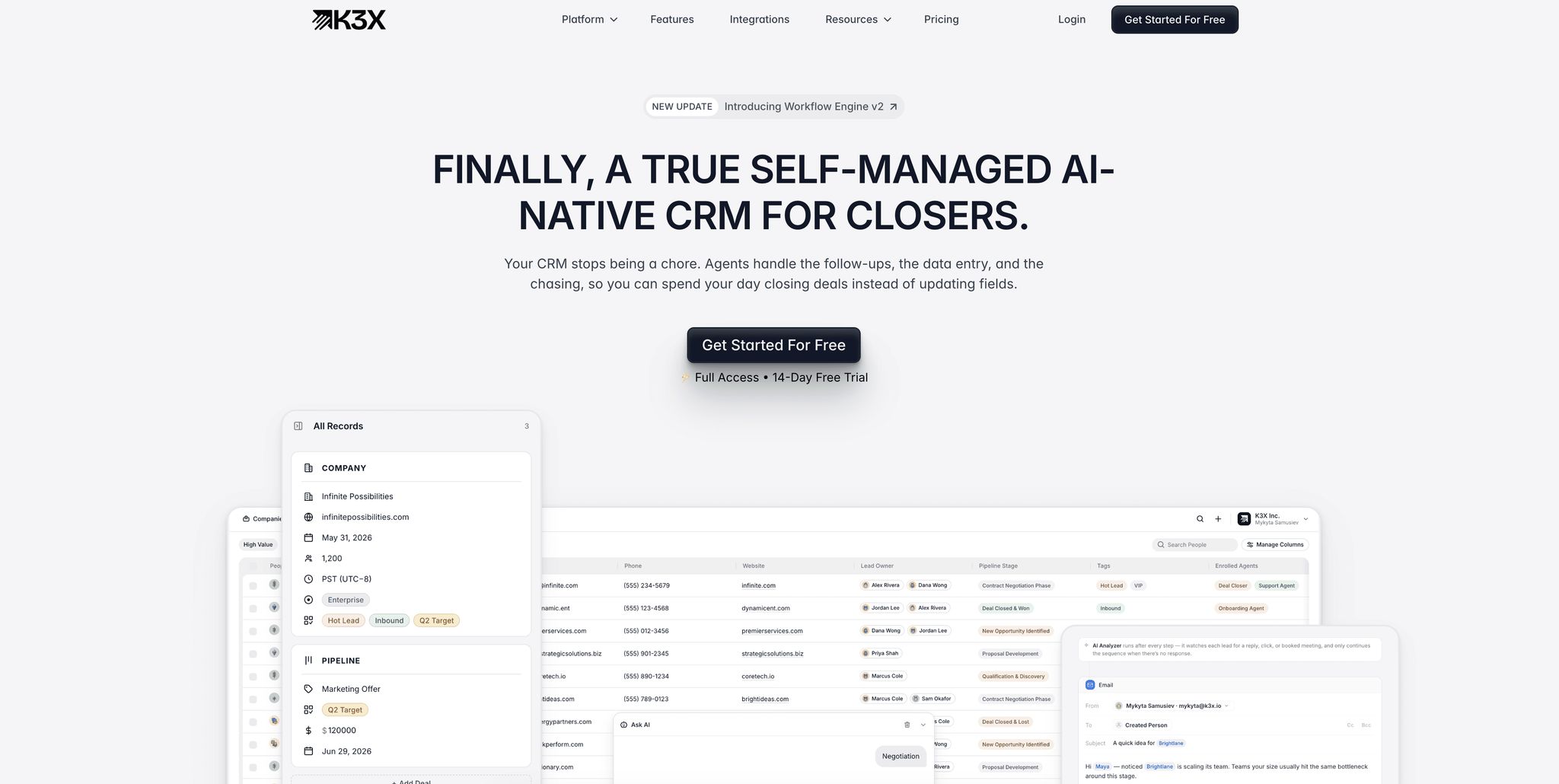
K3X reimagines opportunity scoring by embedding it into real-time workflows. Instead of layering AI scoring onto an already complex CRM, K3X connects scoring with immediate follow-up actions. For instance, if a deal score changes due to a key contact’s lack of response or a delayed close date, the platform automatically drafts a re-engagement email, updates the pipeline, and notifies the team.
This approach tackles a key issue: only about 25% of sales teams trust scores generated by conventional systems [12]. By creating a continuous feedback loop - where the model monitors signals, updates in real time, and triggers actions - K3X turns scoring into a hands-on revenue-driving tool.
K3X’s Adaptive plan is priced at $20 per seat per month, making it a cost-effective choice for smaller or fast-growing teams, especially compared to the high costs of many enterprise-focused platforms.
Best Practices for Rolling Out AI Opportunity Scoring
Start with Clean, Consistent CRM Data
The quality of your AI scoring depends entirely on the data it’s trained on. Before rolling out any scoring model, take time to audit your CRM. Incomplete or inconsistent data - like fields with less than 70% completion - can introduce errors that hurt accuracy [13]. Key fields such as industry, job title, and company size should use standardized dropdown options to help the model identify patterns [13][14]. Additionally, having a solid foundation of 500–1,000 closed deals is essential for creating a reliable baseline [13].
To fill in missing firmographic details, consider using enrichment tools like Clearbit or ZoomInfo. These can help ensure your data is as comprehensive as possible before training your model [13].
"AI deal intelligence fails when it is installed on top of a messy CRM and expected to produce clean forecasts." - Tribble [14]
Platforms like K3X's AI-native CRM simplify this process by automating data cleansing and standardization, ensuring your scoring models start with a clean slate.
Automate Activity Tracking
Once your CRM data is in good shape, the next step is automating activity tracking. Inconsistent logging of sales activities can obscure deal progress and lead to unreliable insights. Tools like Salesloft, Outreach, or HubSpot Sequences can automatically log emails, meetings, and stakeholder responses, maintaining consistent records [3].
One key metric to track is engagement velocity - the ratio of stakeholder responses to total touchpoints over a 14-day period. This metric highlights buying momentum in real time [3]. Teams that automate activity tracking report spending 80% less time on unqualified leads and 3x more time engaging with active buyers [17]. Additionally, setting alerts for deals with only a single contact can be valuable. Deals with multi-threaded engagement (three or more contacts from different departments) convert at 4.2x the rate of single-contact deals [12].
K3X makes this process seamless by integrating automated activity tracking directly into its platform, capturing engagement signals in real time.
Watch for Score Drift and Adjust Accordingly
Even with clean data and automated tracking, your scoring models need regular monitoring to stay accurate. Market conditions, customer profiles, and sales behaviors evolve, which can cause your model’s predictions to drift. To prevent this, establish a review process that includes weekly distribution checks, monthly comparisons of predicted versus actual win rates, and quarterly model re-analysis [16].
For instance, if your model predicts a 55% win rate for "Hot" deals but they’re closing at only 34%, it’s a clear sign the model needs retraining [13]. AI models can lose accuracy quickly - sometimes within two to five days during periods of rapid market change [15]. Major shifts like a product launch, pricing updates, or entering a new market should trigger immediate model reviews [16].
"The model you build today will start decaying the moment you deploy it. The difference between teams that get value from lead scoring and teams that abandon it is not sophistication. It is maintenance." - Jeff Ignacio, RevOps Impact [16]
K3X’s adaptive AI addresses this challenge by continuously monitoring for score drift and recalibrating automatically to reflect changes in the market and sales behaviors, keeping your forecasts on track.
Conclusion: Where AI Opportunity Scoring Is Headed
AI opportunity scoring has come a long way from basic lead ranking. Today’s models dive deep into behavioral signals - like how quickly leads engage or the range of stakeholders involved - delivering precise insights that drive real results. For instance, organizations using AI predictive scoring have seen their conversion rates jump from 20% to 31%, leading to a 55% increase in revenue without needing more leads [19].
The future of AI is shifting from just diagnosing problems to prescribing specific actions. Instead of flat data structures, advanced relational deep learning models are mapping complex connections between contacts, products, and outcomes. This shift allows AI to move from identifying risks to recommending tailored solutions. Confidence in these systems is growing rapidly: by 2026, 77% of sales professionals reported relying on AI to predict deal success with 90% accuracy, compared to just 37% in 2025 [18]. This evolution isn’t just about better predictions - it’s reshaping how deals are managed.
"Prescriptive AI represents the next leap. Current systems tell you what is wrong. Next-generation systems will tell you exactly what to do to fix it." - Fullcast [4]
The real game-changer, however, lies in how teams use the time AI saves. By reinvesting that time into high-impact sales activities, teams are 3.1 times more likely to exceed their conversion goals [19]. Platforms like K3X highlight this shift. Instead of just providing scores, K3X takes things further - triggering follow-ups, updating pipelines, and coordinating team actions in real time. The score becomes a starting point for action, not the end goal.
"The score is not the conversion lever. Changed rep behavior is." - Gartner [19]
What’s exciting is that AI opportunity scoring is no longer reserved for large, resource-heavy organizations. With the right data, consistent activity tracking, and platforms built to act on insights instantly, sales teams of any size can close deals faster, more effectively, and with greater precision. The tools are here - now it’s about using them to their full potential.
FAQs
What data does AI need to score opportunities well?
AI relies on clean, well-connected data from four main areas to accurately evaluate opportunities:
Historical CRM data: Includes details like closed-won or lost outcomes and stage histories.
Firmographics: Covers factors such as company size, industry, and revenue.
Behavioral signals: Tracks actions like email engagement, meeting frequency, and website visits.
External intent data: Encompasses insights like hiring trends or third-party research.
K3X simplifies this process by automatically gathering and merging these data points. This allows teams to focus their energy on closing deals rather than spending time managing and maintaining data.
How long until AI scoring improves forecast accuracy?
Platforms designed around general enterprise SaaS success patterns can often deliver helpful scoring right away. However, for the best results, fine-tuning a model to reflect your company’s specific sales dynamics usually takes about 60 to 90 days of data.
With K3X, there’s no need for lengthy setup or delays. Simply set your goals using prompts, and K3X starts adapting instantly. It learns from your lead activity in real time and grows alongside your business from day one.
How do you prevent AI deal scores from drifting over time?
To keep AI deal scores accurate over time, systems need continuous learning loops that retrain models using fresh outcome data. Unlike static, rule-based systems, modern AI dynamically adjusts feature weights as win-loss trends change.
K3X tackles this challenge by constantly adapting to real-time lead activity and user behavior. This approach ensures scoring stays precise, moving beyond outdated automation to focus on goal-oriented prompts and conversational control.