Platform Engineering
•
Webhook Event Storage: Scaling Without Downtime
Build durable webhook pipelines with buffering, idempotency, ordered processing, and zero-downtime migrations.

Scaling webhook event storage without downtime is essential for businesses handling high volumes of real-time data. Webhooks power critical workflows, such as payment updates or order notifications, but even small failure rates can disrupt operations. Missed events lead to lost data, delayed processes, and poor customer experiences. This article dives into how to build a system that processes webhooks reliably, handles traffic spikes, and ensures zero-downtime migrations.
Key Takeaways:
Webhooks and Reliability: Webhooks trigger real-time actions, but downtime or failures can cause retries, lost data, or system overloads.
Challenges: High traffic, database bottlenecks, and schema changes can disrupt webhook handling. AI systems relying on real-time data, like K3X, face additional risks from event loss or misordered processing.
Solutions:
Decouple Ingestion and Processing: Use durable buffers like SQS or Kafka to separate event intake from downstream processing.
Idempotency and Ordering: Prevent duplicates and ensure events are processed in the correct sequence using unique IDs and timestamps.
Database Design: Use append-only tables, partial indexes, and scheduled cleanups to maintain performance under heavy loads.
Zero-Downtime Migrations: Apply strategies like the Expand/Contract pattern and logical replication to update schemas without service interruptions.
Retry Mechanisms: Implement exponential backoff with jitter and dead letter queues to handle failed events gracefully.
This approach ensures webhook systems remain reliable and scalable, even during high traffic or migrations. Platforms like K3X demonstrate how these principles can support AI-driven workflows by maintaining consistent, ordered data streams.
Common Challenges When Scaling Webhook Event Storage
High-Volume Webhook Failures
Webhooks play a critical role in modern systems, but they can face serious hurdles under heavy traffic. The first signs of trouble often show up at the database layer. High webhook traffic can overwhelm the database, draining connection pools, spiking I/O usage, and leading to 500 errors. For instance, one system faced severe degradation when handling 200,000 events per hour [14]. These 500 errors prompt immediate retries from providers, which can snowball into a retry storm - a surge of retries hitting an already strained system [2][14].
If your system holds events in-process, traffic bursts can lead to out-of-memory crashes, causing immediate event loss [2][13].
"The correct design avoids both: accept events fast, defer processing, and return 429 when you genuinely cannot accept more work." - Dmitri Volkov, Distributed Systems Engineer, GetHook [13]
Schema Changes and Downtime Risks
Even routine schema updates, like adding a column or creating an index, can temporarily lock database tables. This can block incoming writes, which is a major problem for webhook endpoints. A few seconds of blocked writes can lead to rejected or dropped events. For example, Shopify’s webhook system times out after just 5 seconds [2], so any migration that delays handler responses can cause delivery failures at scale.
High-volume tables make migrations even more challenging. In January 2026, Dodo Payments experienced a 0.3% event loss during deployments. They addressed this by adopting a CDC-based stack (leveraging PostgreSQL triggers, Sequin, Kafka, and Restate), which reduced event loss to under 0.01% and brought median latency below 500ms [15].
"The core issue: in-process webhook delivery has no durability guarantees. Your application holds the webhook in memory. If that process dies - for any reason - the webhook dies with it." - Ayush Agarwal, Dodo Payments [15]
These issues highlight the unique demands of scaling webhook systems, especially for platforms reliant on real-time data.
AI-Native Challenges for Platforms Like K3X
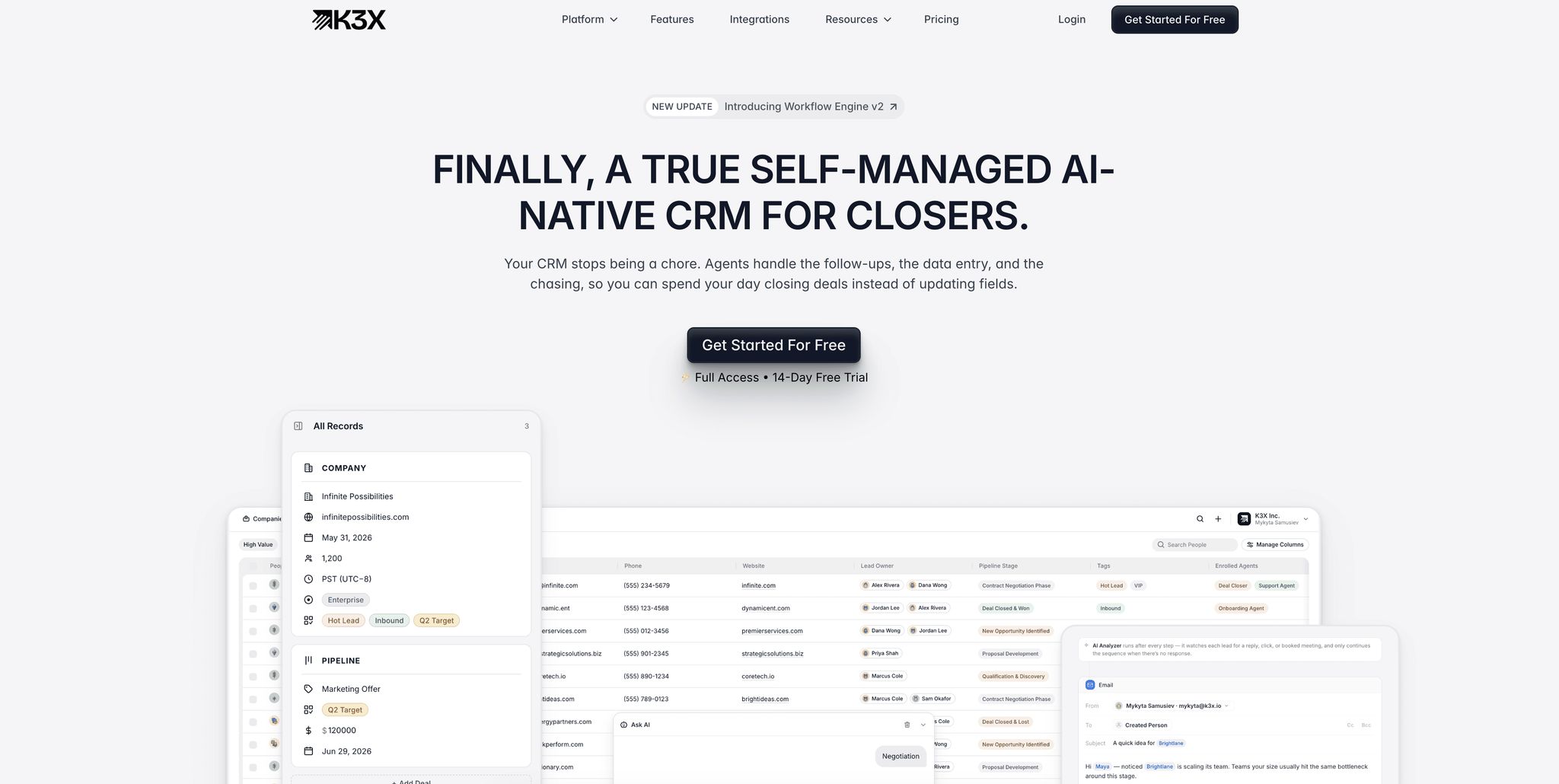
For AI-driven platforms like K3X, losing webhook events can have ripple effects. These systems rely on real-time data to make decisions, adapt to user behavior, and manage workflows. A missed webhook isn’t just a data gap - it can lead to incorrect actions, missed updates, or skipped time-sensitive tasks.
Even a modest event loss rate of 3–6%, common without robust retry mechanisms [2], can disrupt AI workflows. Event ordering is equally critical. If a "create" event is processed after an "update" due to parallel workers, the AI model may encounter an unrecognizable state. This isn’t just a minor glitch - it can trigger incorrect automations or prevent actions entirely.
"The problem is that your database and your job queue are two separate systems with independent durability guarantees... There is no distributed transaction that spans both." - Yuki Tanaka, Founding Engineer, GetHook [11]
These challenges emphasize the need for systems that ensure reliable, ordered event processing, even under heavy loads - a principle central to how K3X handles scalable webhook storage.
How to Build a Reliable Webhook Event Storage System
Decoupling Event Ingestion from Processing
To ensure smooth handling of webhook events, it's crucial to separate how events are received from how they're processed. The ingest endpoint should handle three key tasks: verify the HMAC signature using the raw request body, write the event to a durable buffer, and respond with a 200 OK - all within 100ms [12]. Once the event is safely buffered, background workers can process it at their own pace. This approach shields your database from sudden traffic spikes and avoids retry storms. The choice of buffering mechanism depends on your specific scale and latency requirements:
Queue Type | Pros | Cons |
|---|---|---|
SQS / Pub/Sub | Managed scaling, built-in DLQ, high durability | Higher latency compared to in-memory options |
Extremely low latency, easy to set up | Memory-bound; requires careful persistence setup | |
Kafka / Kinesis | High throughput, ordered partitions, replayability | More operational complexity |
To avoid dual-write failures (where the database update succeeds but the event enqueue fails), use a transactional outbox. This method writes webhook intents into the same database transaction as your business data. A relay process then forwards these intents to the queue. Yuki Tanaka, Founding Engineer at GetHook, explains this concept well:
"The fix is to eliminate the second system entirely during the critical path. Write your webhook delivery intent into the same database, inside the same transaction as your business data." [11]
This approach not only helps handle traffic spikes but also simplifies deduplication and ensures ordered processing. Once events are securely buffered, the next step is to enforce idempotency and maintain proper event order.
Idempotency and Event Ordering
With a reliable buffering system in place, the focus shifts to managing idempotency and event order. Providers like Stripe and GitHub use an at-least-once delivery model, so handling duplicate events is essential. Use the provider-supplied event ID (e.g., Stripe's id or GitHub's X-GitHub-Delivery header) as a unique key. To prevent duplicates, perform an INSERT ... ON CONFLICT DO NOTHING operation at the database level [5]. If the provider doesn’t offer a stable ID, create a SHA-256 hash of the normalized payload and use that as the deduplication key. Retain these keys for at least seven days to ensure effective deduplication.
Network retries can sometimes result in out-of-order delivery. For example, a "contact updated" event might arrive before a "contact created" event. To address this, include a version or updated_at timestamp in your payload. This allows consumers to compare the event with the current resource state and ignore outdated information [10]. For stricter ordering, consider using Amazon SQS FIFO queues (with a MessageGroupId for each resource) or Kafka partitions keyed by entity ID. These tools ensure events related to the same object are processed sequentially [12].
Database Schema Design for High-Volume Events
Once you’ve secured ingestion and controlled processing, it’s time to design a database schema that can handle a high volume of events efficiently. Begin with an append-only events table. Store the raw payload as JSONB, along with metadata such as the source, a status (e.g., pending, processed, or failed), an attempts counter, and a locked_until timestamp to manage worker concurrency. Keeping records immutable ensures a reliable audit trail [10][11].
When processing events, use queries like FOR UPDATE SKIP LOCKED. This allows multiple worker instances to claim rows without stepping on each other’s toes [11]. To maintain index performance as the table grows, use partial indexes - for example, indexing only rows where status = 'pending'. Additionally, schedule regular cleanup jobs to archive or delete processed records older than 7–30 days. This prevents table bloat and ensures write operations remain fast [5][11].
Webhook Architecture Design with Svix Founder & CEO Tom Hacohen
Zero-Downtime Database Migrations for Webhook Systems
When you're scaling a webhook storage system, keeping real-time data flowing without interruptions is critical. Zero-downtime migrations are a cornerstone of this process, ensuring your system evolves without causing disruptions. However, handling migrations under heavy load can often lead to unexpected downtime, making careful planning essential.
Core Principles of Zero-Downtime Migrations
Changing a live database schema isn’t something you can rush - it’s more like running a marathon than a sprint. As Palakorn Voramongkol, a Software Engineer Specialist, aptly explains:
"Schema changes are not atomic events, they are week-long campaigns." [17]
A key strategy for this is the Expand/Contract pattern. Instead of directly modifying a column, you add a new one alongside the existing one. Then, update your application to write to both columns, backfill historical data, switch reads to the new column, and only after all this, drop the old one. Each step is reversible, significantly lowering the risk of failure.
There are a few technical practices that make this process safer in production:
Set
lock_timeoutto 2 seconds before running any Data Definition Language (DDL) commands to avoid long transaction queues.For index changes, use
CREATE INDEX CONCURRENTLYand add constraints withNOT VALID. Validate them separately to minimize impact.In PostgreSQL 11 and later, adding a nullable column only updates metadata, avoiding a table rewrite altogether. [17]
For more complex migrations, such as switching to a new cluster or upgrading to a major database version, logical replication is your best bet. This method streams changes from the source database’s Write-Ahead Log (WAL) to the target in near real-time, typically with sub-second lag for moderate workloads. [8] Once replication lag stabilizes, you can gradually shift read traffic using a feature flag, starting with 1%, then 10%, and eventually 100%, while performing data consistency checks at each step.
Running Migrations Under Heavy Load
In July 2025, engineer Piyush Mehta successfully migrated a 50TB PostgreSQL 12 database to an Aurora PostgreSQL 14 cluster. This database handled over 100,000 queries per second at peak. The team used logical replication to keep the target in sync and implemented a database abstraction layer with feature flags to manage traffic shifts. The cutover occurred during a planned 4-hour window (2:00 AM–6:00 AM PST), resulting in significant improvements: query response times dropped from 2.3 seconds to 0.7 seconds at the 95th percentile, and infrastructure costs were reduced by 40%, saving approximately $9,950 per month. [16]
When backfilling historical data during live migrations, batch size is critical. Processing rows in chunks of 100–10,000 using keyset pagination (WHERE id > :last_id) and FOR UPDATE SKIP LOCKED prevents deadlocks and keeps replica lag manageable. [17] For example, at 5,000 rows per second, backfilling 200 million rows would take about 11 hours. Planning for this timeframe is essential. [18]
To maintain stability during deployment, configure maxUnavailable: 0 and maxSurge: 1 for replicas. Additionally, use a /readyz probe to ensure the database connection is live and event enqueuing is functioning properly. [7]
With the challenges of live migrations addressed, the next focus shifts to managing the historical data that accumulates over time.
Managing Historical Data Growth
As webhook volumes grow, managing historical data becomes crucial for maintaining performance. Even with a well-designed events table, unchecked growth can slow down index scans and degrade write performance - especially for partial indexes like those used by worker queries on the status column.
To manage this, implement table partitioning and scheduled archival. Partitioning the events table by time range (e.g., weekly or monthly) allows you to detach and archive older partitions without impacting the active data. Set up a schedule to delete or archive processed rows older than 7–30 days, depending on your audit and reporting needs. [11]
For platforms like K3X, retaining historical data isn’t just about compliance - it also supports model training and operational insights. Partitioning ensures that historical queries remain fast while keeping live ingestion efficient. Regularly monitor replication lag by comparing pg_replication_slots.confirmed_flush_lsn with pg_current_wal_lsn(). If the gap grows too large (e.g., several hundred megabytes), WAL segments can accumulate and risk filling your disk. [8]
Load Balancing and Fault Tolerance for High-Volume Webhooks
Once a solid database migration strategy is in place, the next hurdle is ensuring your webhook pipeline can handle sudden surges in traffic while staying reliable.
Horizontal Scaling of Webhook Handlers
To scale webhook handlers effectively, design them to be stateless. Offload tasks like deduplication and session management to external systems like Redis. This way, any handler instance can process incoming requests, and traffic can be distributed evenly across pods using a load balancer [9][19].
In Kubernetes, focus on scaling based on requests per second (RPS) or queue depth, rather than CPU metrics. Since webhooks are mostly I/O-bound, CPU usage won’t give you a clear picture during traffic spikes. Combine this with a RollingUpdate deployment strategy (maxUnavailable: 0, maxSurge: 1) to maintain capacity during updates [7].
For systems requiring high-throughput event ordering, use partitioned worker pools. For example, in Kafka-based setups, route events by keys like customer_id or order_id. This ensures all events for a specific entity are processed sequentially within the same partition, while other entities can be processed in parallel [9][6]. This approach also helps manage backpressure when processing falls behind.
Backpressure and Queue Management
Handling slowdowns in downstream services is crucial. Here’s a key insight:
"When a webhook consumer lags, the failure mode is critical." - Dmitri Volkov, Distributed Systems Engineer [13]
When buffers fill up, respond with a 429 Too Many Requests status and include a Retry-After header. Avoid returning a 500 Internal Server Error, as it often triggers aggressive retries from the sender, potentially worsening the situation. For events that repeatedly fail retries, route them to a Dead Letter Queue (DLQ) to isolate problematic payloads without disrupting the entire pipeline [9][6].
Implement exponential backoff with jitter for retries. For instance, use delays like 30 seconds, 2 minutes, and 10 minutes to avoid overwhelming a recovering service with simultaneous retry attempts [6].
Monitoring and Observability for Webhook Pipelines
Scaling and managing load are important, but continuous monitoring ensures the pipeline stays healthy and avoids bottlenecks. A key metric to watch is the estimated time to drain, which combines queue depth with event processing rate to show whether the pipeline is keeping up or falling behind.
Here’s a breakdown of critical metrics to monitor:
Metric | Alert Threshold | What It Signals |
|---|---|---|
Buffer Depth | > 70% of capacity | Processing is lagging |
p99 Ingest Latency | > 50ms | Stress in the ingestion layer |
HTTP 429 Rate | Any nonzero rate | Throttling is active |
Delivery Success Rate | < 99% | Delivery issues in the pipeline or destination |
Estimated Time to Drain | Rising trend | Processing is falling behind |
AI-driven platforms can take this a step further by using machine learning to detect anomalies - like sudden increases in error rates or unexpected schema changes - and offer solutions based on past issues [9][3].
"Retries handle minutes of failure, replay handles hours, and reconciliation handles everything else. Layer all three for comprehensive webhook reliability." - Hookdeck [1]
How K3X Uses Scalable Webhook Storage in Practice
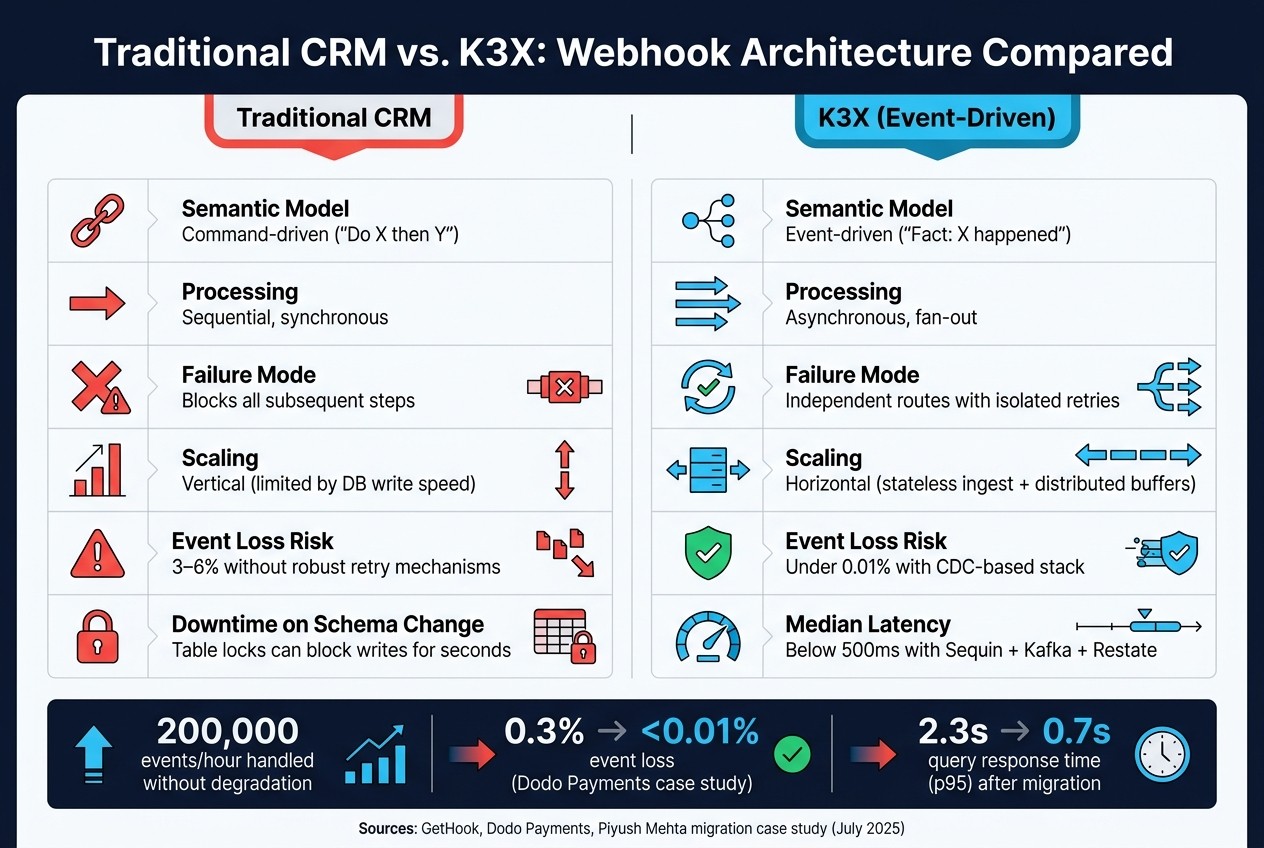
Traditional CRM vs. K3X Event-Driven Webhook Architecture
Workflow-Heavy CRMs vs. Outcome-Based Systems
Traditional CRMs often handle webhooks as a series of commands that must be executed in a specific order. If one step fails, the entire process grinds to a halt. K3X, however, approaches webhooks differently. Instead of treating them as commands, it views each webhook as an event - a piece of information about something that occurred. From there, AI-driven logic determines the next steps. This shift from a command-driven to an event-driven model allows K3X to use real-time AI to achieve better results.
This difference becomes critical when operating at scale. Legacy systems rely on sequential and synchronous processes, meaning even a minor issue like a slow database write or a failed API call can disrupt everything downstream. In contrast, K3X's architecture is asynchronous and employs a fan-out model, where one event can launch multiple independent automations at the same time. Each automation has its own retry mechanism, so a single failure doesn’t affect the rest.
Feature | Traditional CRM | K3X |
|---|---|---|
Semantic Model | Command-driven ("Do X then Y") | Event-driven ("Fact: X happened") |
Processing | Sequential, synchronous | Asynchronous, fan-out |
Failure Mode | Blocks subsequent steps | Independent routes with isolated retries |
Scaling | Vertical (limited by DB write speed) | Horizontal (stateless ingest + distributed buffers) |
"The first design decision is the semantic model of your webhooks: are they events or commands?" - Priya Nair, Developer Advocate, GetHook [10]
This event-driven design is the foundation of K3X's ability to handle third-party integrations effectively.
How K3X Processes Third-Party Webhooks
Building on its event-driven architecture, K3X showcases an efficient system for processing webhooks from third-party services like Stripe, Recall.ai, and Ademero. It follows a structured pattern: verify, enqueue, and acknowledge (ACK). When a webhook is received, the system first verifies the HMAC-SHA256 signature, queues the payload, and responds with a 202 status code. This ensures the process remains within the timeout limits set by providers - Stripe allows up to 20 seconds, while Shopify has a stricter 5-second limit [4].
Once the event is queued, background workers handle it in parallel, triggering multiple automations at the same time. For instance, a payment_intent.succeeded event from Stripe might simultaneously update a pipeline stage, schedule a follow-up task via Recall.ai, and initiate a document verification with Ademero. To avoid duplicate processing, K3X uses idempotency keys derived from provider-specific IDs, like Stripe-Webhook-Id. This safeguards against repeated processing, even if Stripe retries delivery over its 3-day retry window [5].
Ensuring Continuous Automation During Service Disruptions
K3X also excels at maintaining automation even during service outages. When an external service experiences downtime, K3X doesn’t discard events or fail silently. Instead, unprocessed events are stored in a durable buffer and retried using exponential backoff with jitter - delays might start at 30 seconds, increase to 2 minutes, then 10 minutes, and so on. This prevents overwhelming the recovering service. If retries are exhausted, the event is moved to a Dead Letter Queue (DLQ) for manual review, ensuring the main pipeline remains operational.
Since K3X users define their goals through prompts rather than rigid workflows, the platform can keep executing available automations even if one integration is temporarily unavailable. There’s no single point of failure. The system dynamically adjusts, and when the disrupted service comes back online, K3X ensures events are processed in the correct order. For example, a contact.updated event will never be handled before its corresponding contact.created event [9].
Conclusion: Building Webhook Storage That Scales
To create a webhook storage system that can handle growth and heavy loads, the techniques outlined earlier are key. A well-designed architecture ensures automation continues smoothly, even during peak usage. This involves combining strategies like the Transactional Outbox Pattern for reliable event capture, FOR UPDATE SKIP LOCKED for efficient parallel processing, and partial indexes to keep queries fast and responsive at scale [20].
For AI-powered CRMs like K3X, these methods are crucial for maintaining real-time automation and ensuring accurate decision-making.
Of course, no system is completely immune to hiccups. Features like Dead Letter Queues, exponential backoff, and circuit breakers are what separate a robust pipeline from one that risks losing data. As Nikhil Chacko and Dheeraj Kumar Ketireddy from Plane explain:
"If the system that captures these changes drops even one event, a webhook never fires, a notification never arrives, and an automation fails without notice." [20]
For platforms like K3X, the stakes are even higher. The AI layer relies on a steady, ordered stream of events to make precise decisions. Missing a single contact.updated event can result in outdated data, leading to incorrect AI responses - possibly triggering a chain reaction of missed opportunities. That’s why K3X’s architecture prioritizes durability as a core requirement.
FAQs
What’s the simplest way to add a durable buffer without rewriting my app?
The Transactional Outbox Pattern and Change Data Capture (CDC) offer straightforward solutions.
With the outbox pattern, events are stored in a dedicated table as part of the same transaction as your data. This ensures the events are durable and consistent. On the other hand, CDC uses the database's write-ahead log to monitor changes, making webhooks just as reliable as database writes. Both approaches involve only minor modifications to your application.
How do I guarantee idempotency and correct ordering across retries?
To maintain idempotency, rely on the unique event IDs that webhook providers supply and filter out duplicate events before processing them. For correct ordering, adopt an event-driven architecture where events are processed in sequence. Use retry mechanisms that preserve the event order.
Techniques like outbox patterns, message queues, exponential backoff retries, and dead-letter queues can work together to ensure events are processed in the right order, handle failures gracefully, and prevent duplicates.
How can I run PostgreSQL migrations on huge event tables with zero downtime?
To move large PostgreSQL event tables without causing downtime, logical replication is a great solution. This approach allows you to sync data to a new schema while keeping the original table active. Once the sync is complete, you can gradually redirect traffic to the new schema.
Pair this with the expand/contract pattern, which phases schema changes to prevent table locks. For backfilling data, process it in small batches to reduce contention and avoid overwhelming the database. Tools like pg_repack can also help by applying changes incrementally, ensuring minimal disruption during the migration process.