Sales Automation
•
How AI Adapts Follow-Ups to Lead Behavior
How AI reads email opens, clicks, and site signals to time and personalize follow-ups for higher conversion rates.
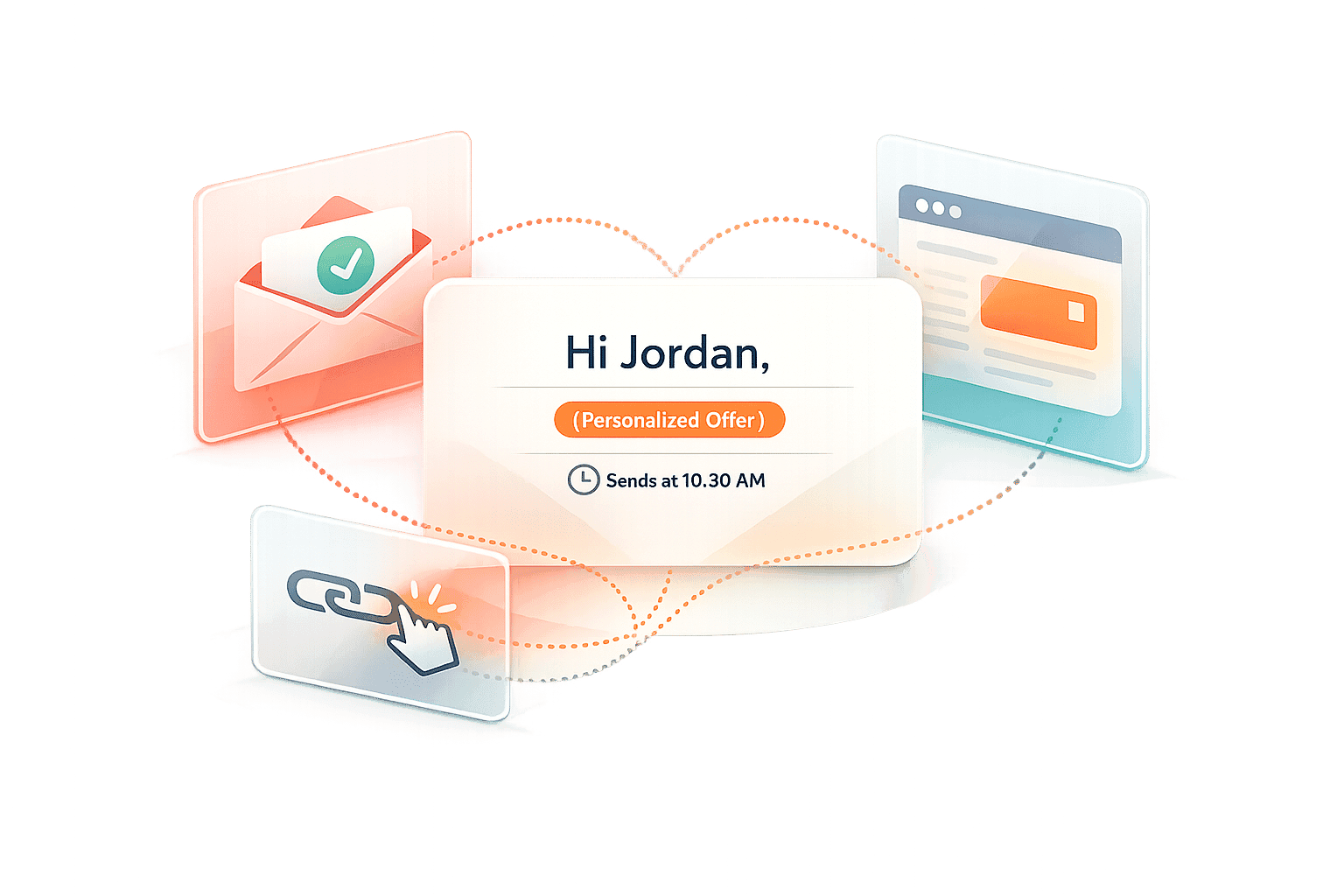
AI tools are transforming how sales teams handle follow-ups. Instead of rigid schedules, they now respond to live signals like email opens, page visits, or competitor research. This shift improves timing, content relevance, and overall efficiency. For example:
K3X: Automatically adjusts strategies based on real-time engagement, saving hours of manual work. Starts at $20/user/month.
Sendr: Focuses on high-volume, personalized email automation with real-time triggers.
monday CRM: Uses AI agents for multi-channel outreach and lead qualification but comes with higher costs ($50–$500/user/month).
HubSpot: Offers AI-driven personalization but relies on rules-based systems, priced at $90/user/month.
AI-driven platforms like K3X lead in efficiency and cost-effectiveness, while others like HubSpot and monday CRM cater to more complex needs. Choosing the right tool depends on your team's size, budget, and follow-up strategy.
How to Automate Follow Up With AI and Turn More Leads Into Sales
How AI Uses Behavior Data to Adjust Follow-Ups
AI systems analyze every action - email opens, link clicks, and visits to pricing pages - turning these into data points that reveal intent with an impressive 85–92% accuracy. Based on this data, they trigger immediate, context-aware follow-ups [4]. For example, if a lead opens an email at 9:00 AM on a Tuesday and clicks through to a product demo page, the AI identifies this as a high-intent signal and responds accordingly. By analyzing online behavior, such as how long someone stays on a page, whether they revisit, and which features they explore, these systems can predict intent and adapt their outreach strategies in real time. Platforms like K3X use this approach to refine follow-ups based on live engagement signals.
Unlike traditional tools that rely on pre-set schedules to send messages, AI platforms respond dynamically to real-world triggers like leadership changes, earnings reports, or hiring trends [3]. This responsiveness gives AI a distinct edge. Take Frontify, for example. When their sales team adopted signal-based workflows in 2026, they achieved a 42% increase in sales velocity year-over-year, a 35% rise in win rates, and cut 90% of the time spent researching leads before follow-ups [3]. Instead of guessing the right timing, their system acted on live buying signals, making the entire process more efficient.
AI also tailors the content and tone of follow-ups based on engagement levels, reducing the need for manual adjustments. For instance, if a lead repeatedly visits pricing pages without responding, the system might shift from sending educational materials to offering a direct meeting invite. If engagement drops further, it might soften its tone or pause outreach altogether. Cacheflow leveraged this approach to cut meeting prep time by 60% - from 90 minutes to just 30 - and tripled their average deal size, jumping from $5,000–$7,000 to $18,000–$20,000 [3]. The AI wasn’t just saving time; it was adapting its strategy in real time, responding to the lead’s behavior.
"Static follow-up sequences fail because they're timed to your calendar, not the buyer's reality." - Semir Jahic, CEO & Co-Founder, Salesmotion [3]
AI systems also maintain sender reputation by enforcing thoughtful guardrails. They cap daily outreach, respect local quiet hours, and stop sequences as soon as a lead replies [1][8]. This "stop-on-engagement" logic prevents awkward situations, like sending a follow-up email right after a prospect has already responded. By operating autonomously across time zones while staying responsive, these systems ensure outreach feels timely and human.
1. K3X
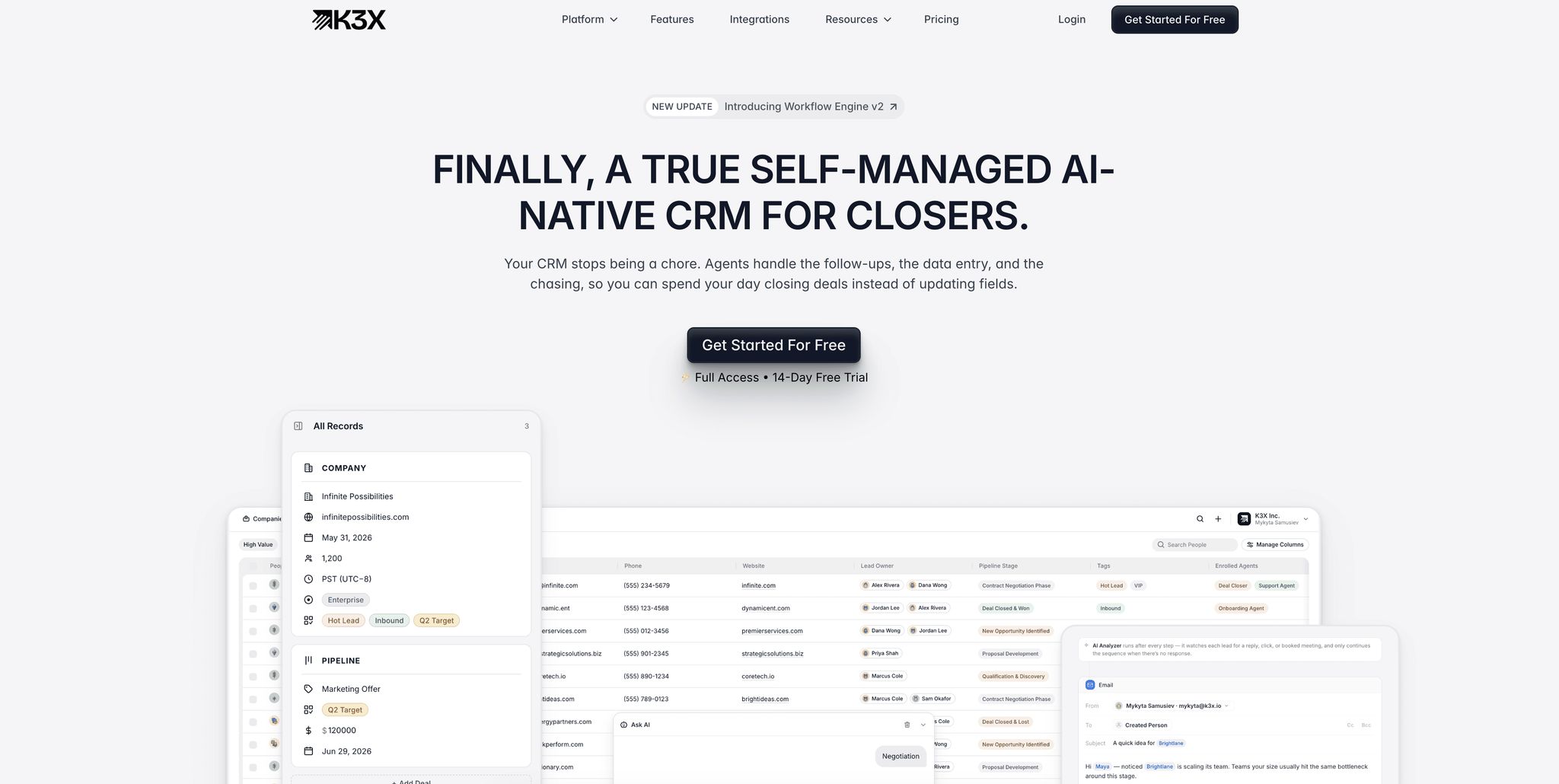
K3X showcases what an AI-powered CRM can achieve, transforming sales engagement by adapting follow-ups in real time. Its approach goes beyond conventional methods, focusing on outcomes and dynamic adjustments.
Follow-Up Adaptation
K3X takes a goal-driven approach, eliminating the need for pre-built sequences. You simply tell it what you want - like "Schedule demo calls with unresponsive leads" - and it determines the best course of action [2]. For example, if a prospect opens multiple emails but doesn’t reply, K3X shifts strategies, such as offering a direct meeting link instead of more educational content [7]. Once a lead responds or books a meeting, the automation halts immediately [8]. It continuously analyzes engagement patterns, adjusting the timing and tone of follow-ups. If someone visits your pricing page three times in two days, K3X interprets this as high intent and adapts its response accordingly [7].
Simplified Automation
K3X removes the complexity of traditional automation tools like flowcharts and "if-then" scripts. Instead, it uses plain language prompts, eliminating the need for manual workflow mapping or IT involvement [2][7]. In December 2025, Ruby Capital Group, led by CEO Michael Chkechkov, implemented K3X for its 125 employees. The setup was completed in just two days, cutting follow-up times by 70% and tripling ticket resolution speeds [2][7].
"Our sales team was spending half their day on admin work. Now they're talking to customers and closing deals." - Michael Chkechkov, CEO, Ruby Capital Group [2]
On average, K3X saves each employee eight hours per week [2]. Across its user base, the platform has automated over 312,000 hours, saving businesses $12.4 million in operational costs [2]. Unlike traditional CRMs, which often consume 30–40% of IT resources for workflow maintenance, K3X eliminates this burden entirely, cutting what some call the "rigidity tax" [7].
Advanced Personalization
K3X excels at personalization by pulling qualification data from unstructured sources like call transcripts and emails [7][8]. This context allows it to tailor follow-ups in meaningful ways. For instance, if a lead mentions budget concerns during a call, the next email might directly address pricing options. The platform operates at lightning speed, monitoring live signals and triggering follow-ups as soon as high-intent behaviors are detected [7][10].
Built-In Scalability
As lead volumes grow, K3X scales effortlessly. The platform starts at $20 per seat per month, which includes 1,000 AI credits, and its pricing adjusts based on activity levels [2][8]. Businesses using K3X report a 60% increase in workload capacity per sales rep and a 30% boost in revenue per rep [8]. Compared to static automation tools, K3X delivers efficiency gains of 70–90%, making it a game-changer for sales teams [7].
"Most CRMs record activity. K3X understands outcomes. It listens, knows what changed, and makes the next moves." - Mykyta Samusiev, Co-Founder & CEO, K3X [2]
Next, we’ll explore how Sendr takes a different yet equally effective approach to real-time insights.
2. Sendr
Sendr, also known as Smartlead, focuses on delivering scalable and personalized outreach. Its AI-powered features are tailored to handle large-scale campaigns while maintaining excellent deliverability.
Follow-Up Adaptation
Sendr takes a smart approach to follow-ups by analyzing "digital body language" - such as email opens, link clicks, and website visits. Based on this data, it triggers timely, context-aware follow-ups and pauses ongoing sequences when a lead engages [4][6][11][8]. By studying behavioral patterns and prior interactions, it determines the perfect moment to send the next message [4]. The platform’s "stop-on-engagement" feature ensures no unnecessary emails are sent after a lead responds or schedules a meeting [11][8].
This ability to adapt instantly to engagement makes Sendr a strong choice for businesses looking to streamline their outreach.
Scalability
Sendr is built to handle high-volume outreach with ease. It supports unlimited sending domains and email accounts, making it simple for teams to scale their efforts [5]. Users can create detailed nurture campaigns with unlimited sequences, all without worrying about per-contact or per-email fees. Advanced domain rotation ensures that even high-volume follow-ups land in the primary inbox [5].
This makes Sendr a go-to option for businesses managing large-scale prospecting campaigns where volume is a priority. While platforms like K3X focus on conversational prompts for immediate actions, Sendr sticks with a more traditional setup. This highlights a broader industry challenge that tools like monday CRM address in their own way.
3. monday CRM

monday CRM uses behavioral triggers - like form submissions, content downloads, and visits to pricing pages - to kick off real-time outreach. It employs AI SDR Agents to qualify leads and schedule meetings in seconds [6][12].
Follow-Up Adaptation
The platform tailors follow-up messages by analyzing factors such as company size, industry, and past interactions. Its "Timeline Summaries" feature compiles conversation histories, ensuring every message references previous touchpoints and aligns with the lead's current stage [6]. Victoria Landsmann from monday.com highlights how this goes beyond basic chatbot capabilities:
"The key difference from chatbots is contextual understanding. AI agents remember previous conversations, reference past interactions, and adapt their approach." [6]
An example of its impact comes from Ray White's operations team, led by Kyle Dorman, which implemented monday CRM automations in 2026. They reported a 70% boost in efficiency for tasks that were previously handled manually [13].
This adaptive messaging approach complements monday CRM's automation tools, making follow-ups more effective.
Automation Complexity
monday CRM builds on its adaptive messaging with automation tools designed to simplify workflows without losing depth. Its code-free interface uses "AI Blocks" to create custom workflows [6]. While this visual approach makes setup easier compared to traditional CRMs, it still relies on "if-then" logic. This works well for straightforward scenarios but can become cumbersome when managing complex lead-scoring systems, potentially requiring thousands of rules [7].
Samuel Lobao, Contract Administrator at Strategix, shared his experience:
"With monday CRM, we're finally able to adapt the platform to our needs - not the other way around. It gives us the flexibility to work smarter and scale with confidence." [13]
As the platform addresses the challenges of automation complexity, its ability to handle high volumes of leads becomes even more vital.
Scalability
monday CRM’s AI agents allow a single sales development rep to manage 15,000+ leads around the clock, focusing only on high-intent prospects [13]. Follow-ups are coordinated across multiple channels - email, SMS (with 98% open rates), LinkedIn, and phone calls - all tracked in a centralized dashboard [6]. Companies leveraging AI lead scoring report that they spend up to 80% of their time engaging with qualified leads, compared to just 30% with manual scoring [12].
4. HubSpot
HubSpot uses tools like Breeze AI and Sales Hub Sequences to tailor follow-ups based on lead behavior, such as visiting pricing pages or downloading content [15][16]. Its "Smart CRM" collects key data points, including website activity and conversation history, to help personalize outreach. However, despite its AI-driven features, the platform still leans on rules-based automation, which requires manual setup and maintenance [7].
Follow-Up Adaptation
HubSpot's email sequences are triggered by specific prospect behaviors, like visiting competitor pages [15]. AI drafts these messages and integrates dynamic email modules that adjust content - such as value propositions or proof points - based on the lead's lifecycle stage or industry [17]. For example, in 2025, Edward Arnold, Founding Account Executive at Flowla, used HubSpot's AI to automate post-demo follow-ups. This change saved him 30 minutes per call and resulted in a 12% boost in demo-to-deal conversions [15]. Similarly, Andrew Romanyuk, Co-Founder of Pynest, applied HubSpot AI agents to analyze open-source company data, reducing lead screening time by 32% [15].
Still, these adaptive features coexist with a more rigid rules-based system, which presents its own set of challenges.
Automation Complexity
To simplify workflows, HubSpot introduced Breeze AI, allowing users to create triggers using natural language prompts like "send a personalized follow-up email referencing their industry" [15]. However, the platform continues to rely on deterministic if-then logic, which can become cumbersome. Changes in business policies often require manual reprogramming, adding what some call a "rigidity tax" [7]. For instance, complex lead-scoring systems can involve thousands of rules, consuming up to 30% to 40% of IT resources for upkeep [7]. Unlike fully prompt-driven platforms like K3X, which avoid manual triggers altogether, HubSpot's rule-based framework remains a limitation. In December 2025, Lattice's sales team used Dock's AI, integrated with HubSpot, to pull data from Gong call recordings and create business case drafts in just a few clicks. This streamlined process led to a 25% year-over-year increase in late-stage win rates [15].
While automation has its hurdles, HubSpot continues to refine its approach with advanced personalization.
Personalization Depth
HubSpot employs a human-in-the-loop model to review AI-generated drafts for brand consistency and accuracy before sending. This approach has proven effective, with segmented emails achieving 30% higher open rates and 50% higher click-through rates [16][17]. While the platform excels in using structured CRM data for personalization, it remains heavily reliant on structured data and keyword triggers [7].
Scalability
HubSpot's AI-powered lead scoring improves qualification accuracy, reaching 70% to 85%, compared to the 30% to 40% seen with manual methods [10][8]. Additionally, AI-driven sales processes can increase leads and appointments by 50% [10][8]. However, the platform's rule-based system struggles with scalability in complex scenarios, where managing numerous variables can lead to inefficiencies [7]. Pricing is another consideration - at roughly $90 per month per user for professional features, HubSpot is significantly pricier than alternatives like K3X, which starts at just $20 per month per user [10].
Strengths and Weaknesses
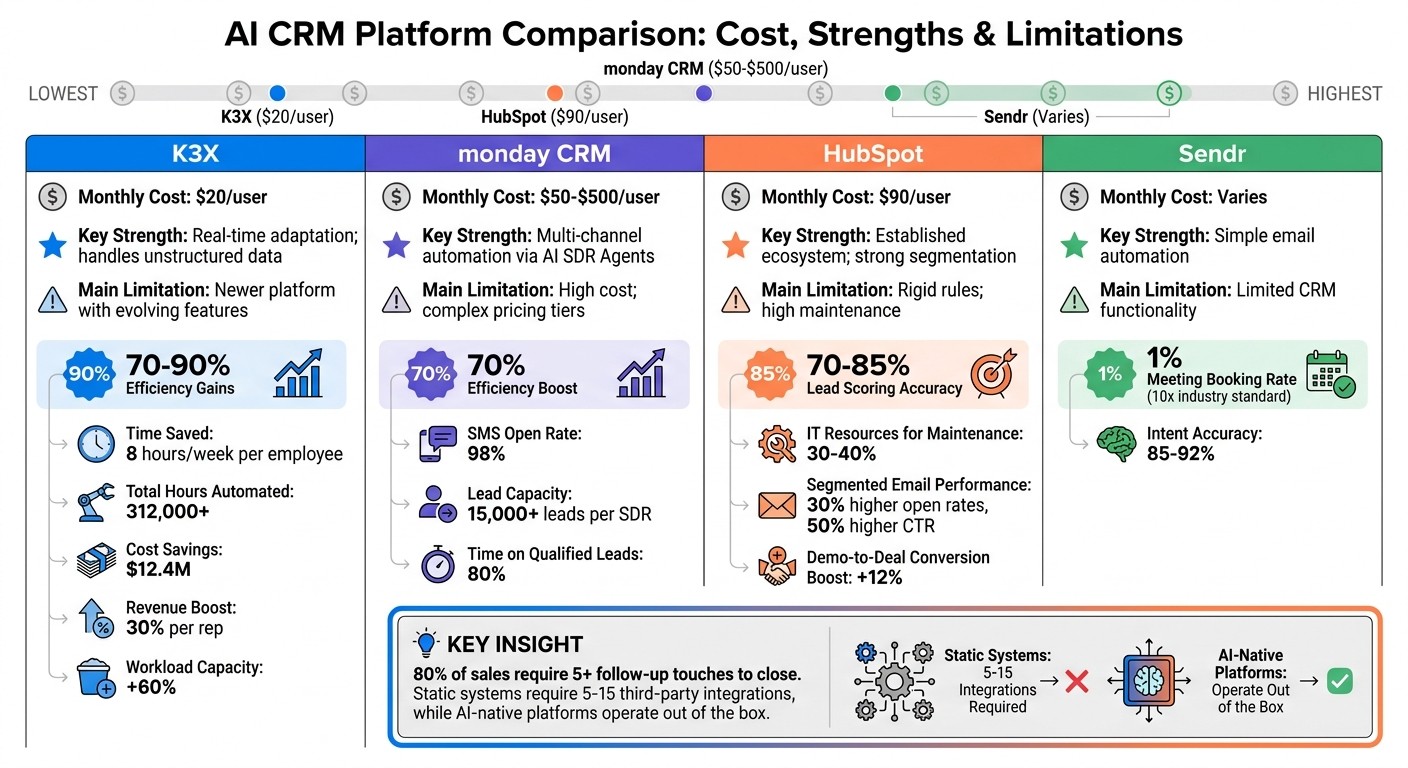
AI CRM Platform Comparison: Features, Pricing, and Performance Metrics
Let’s take a closer look at how these platforms stack up in terms of their strengths and weaknesses, especially when it comes to follow-up efficiency, cost, and ease of use.
Each platform brings something different to the table. K3X stands out for its straightforward setup and ability to adapt in real time. At just $20 per user per month, it eliminates the need for manual triggers and rule mapping, offering a seamless experience. What’s more, it excels at handling unstructured data - like emails and call transcripts - to generate context-aware responses. This results in efficiency gains of 70–90%, far surpassing the 40–60% typical of static automation systems [2][7].
"Most CRMs record activity. K3X understands outcomes. It listens, knows what changed, and makes the next moves." - Mykyta Samusiev, Co-Founder & CEO, K3X [2]
On the other hand, monday CRM offers multi-channel engagement through AI SDR Agents, covering email, SMS, and LinkedIn. However, its pricing varies significantly, ranging from $50 to $500 per user per month, making it a pricier option [6]. Meanwhile, HubSpot, priced at $90 per user per month, relies on a rules-based system that demands substantial manual upkeep - consuming 30% to 40% of IT resources for maintenance [7]. While Sendr is strong in email automation, it lacks the broader CRM capabilities offered by the others.
Traditional systems like HubSpot face challenges when leads respond out of sequence, as their static frameworks can’t adjust dynamically. In contrast, AI-native platforms like K3X use conversational prompts to adapt in real time [2][7]. This adaptability is crucial when you consider that static systems often require 5–15 third-party integrations to work effectively, whereas K3X operates out of the box [2]. This is a game-changer, especially since sales reps spend 21% of their time writing emails and 17% on data entry - adding up to about 13 hours of lost productivity per week [14].
Here’s a quick comparison of the platforms:
Platform | Monthly Cost | Key Strength | Main Limitation |
|---|---|---|---|
K3X | $20/user | Real-time adaptation; handles unstructured data | Newer platform with evolving features |
monday CRM | $50–$500/user | Multi-channel automation via AI SDR Agents | High cost; complex pricing tiers |
HubSpot | $90/user | Established ecosystem; strong segmentation | Rigid rules; high maintenance |
Sendr | Varies | Simple email automation | Limited CRM functionality |
AI-driven systems like K3X are redefining follow-up strategies by adapting in real time, unlike static automation tools. If you’re looking for a cost-effective and flexible option, K3X is a strong choice. For teams prioritizing multi-channel automation, monday CRM is worth exploring. And for those sticking with a well-known ecosystem, HubSpot offers reliability, albeit with higher maintenance demands. With 80% of sales requiring five or more follow-up touches to close [18], choosing a platform that minimizes manual intervention is essential for scaling your sales efforts efficiently.
Conclusion
These platforms are changing the game in sales automation by aligning follow-ups with real-time lead behavior. Take K3X, for example - it uses outcome-driven prompts to replace rigid sequences with flexible, real-time decisions. You set the goal, and the AI figures out the best approach, adjusting instantly when leads engage. On the other hand, Sendr uses real-time behavioral cues to trigger hyper-personalized, multi-channel outreach, while monday CRM employs AI SDR agents to qualify leads 24/7. HubSpot, by contrast, sticks to static, rule-based automation, which works well for predictable workflows but may falter when leads wander off the expected path.
Each platform caters to different needs based on team size and complexity. For smaller teams, K3X’s prompt-driven model - priced at $20 per user per month - offers real-time adjustments in under an hour [2]. Sendr is ideal for lean teams focused on precision, thanks to its Lipsync video technology, which boasts a 1% meeting booking rate on cold traffic - 10 times the industry standard [9]. Meanwhile, monday CRM is a solid choice for mid-market businesses, providing consistent, around-the-clock lead qualification with pricing between $50 and $500 per user per month [6].
FAQs
Which lead behaviors matter most for AI follow-ups?
Key behaviors that indicate a lead's interest during AI follow-ups include opening emails, clicking links, replying, accepting meeting invites, and spending time on a page. These actions provide critical signals that allow AI to fine-tune the timing and content of follow-ups, ensuring they remain relevant and engaging. Tools like K3X analyze these behaviors in real time, turning rigid outreach sequences into flexible, context-sensitive interactions. This approach minimizes excessive communication and boosts response rates.
How does K3X decide what to send next without sequences?
K3X takes a smart, AI-powered approach to managing follow-up actions, ditching rigid, pre-set sequences. Instead, it evaluates real-time lead behavior - things like email opens, link clicks, or levels of engagement - to adjust timing, messaging, and communication channels on the fly. This dynamic system works like human decision-making but on a much larger scale, ensuring every follow-up feels timely and tailored. Unlike traditional workflows that stay static, K3X keeps learning and adapting, crafting personalized strategies that boost both engagement and response rates.
How can AI follow up more without hurting deliverability?
AI takes follow-ups to the next level by analyzing lead behavior - things like opens, clicks, replies, and even how long someone spends on a message. This insight helps determine the perfect timing and frequency for sending follow-ups, ensuring messages land when leads are most likely to engage. Plus, it reduces the chances of being flagged as spam.
Tools like K3X go a step further by personalizing follow-ups in real time. Instead of sending the same old repetitive sequences, these systems adapt based on how the lead interacts, keeping the content fresh and relevant. The result? Higher engagement rates and a better sender reputation.