Sales Automation
•
AI in Sales: Automating Meeting Coordination
How AI automates scheduling, cuts admin time, reduces no-shows, and boosts revenue per rep with prompt-driven tools.

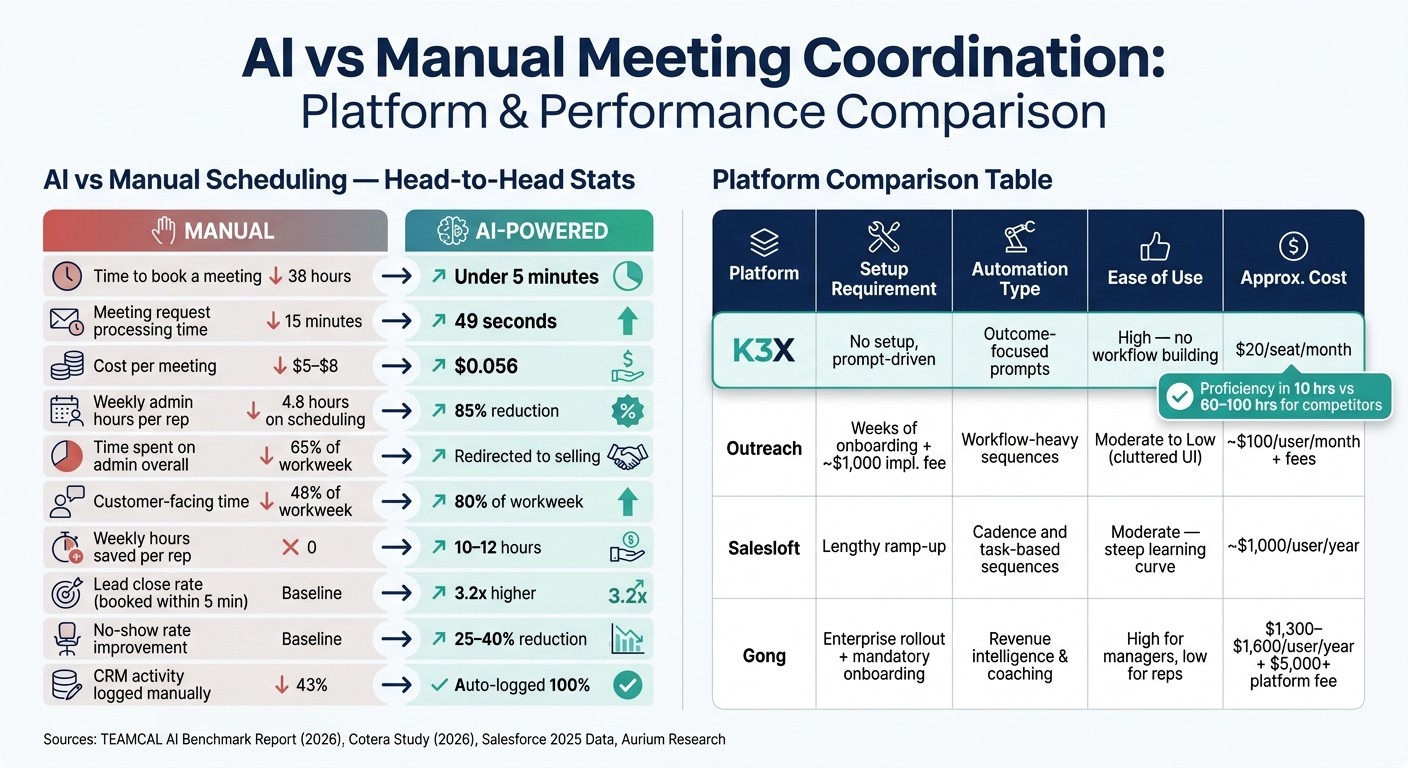
AI is transforming sales by automating meeting coordination, saving time, and improving revenue outcomes. Sales reps traditionally spend 65% of their time on admin tasks, with scheduling alone taking 4.8 hours weekly. AI tools reduce this burden, cutting scheduling time by 85% and boosting revenue by 41% per rep. Key benefits include:
Faster scheduling: Time-to-book reduced from 38 hours to under 5 minutes.
Higher lead conversion: Booking within 5 minutes increases close rates by 3.2x.
Reduced no-shows: Automated reminders lower no-show rates by 25–40%.
Time savings: Reps save 10–12 hours weekly, doubling customer-facing time.
Platforms like K3X simplify this process with prompt-driven automation, eliminating complex workflows. K3X users report faster adoption, lower costs, and significant productivity gains, making it an efficient choice for sales teams. AI in meeting coordination isn't just about saving time - it's about increasing revenue and improving sales efficiency.
Productivity Gains from AI Meeting Coordination
Time Saved Through Automation
AI meeting coordination is proving to be a game-changer when it comes to saving time. Sales reps report saving anywhere from 5 to 18 hours per week, with the average falling between 10–12 hours per week [3]. The biggest time-saver? CRM logging. When fully automated, this task alone frees up 6 hours per rep per week - more than any other activity [3].
The efficiency of AI is striking. Processing a meeting request manually takes over 15 minutes, but AI can handle it in just 49 seconds [6]. The cost difference is just as impressive. While manual scheduling costs between $5 and $8 per meeting in staff time, AI scheduling costs barely $0.056 in compute - slashing costs by 99% [6].
More Time for High-Value Sales Work
These saved hours don’t just disappear; they’re redirected into high-value activities. Automated scheduling and CRM tasks allow sales reps to spend more time with customers, increasing their customer-facing workweek from 48% to 80% [3]. This additional time is directly tied to stronger revenue outcomes. As Elay Cohen, CEO of Saleshood, explains:
"The number you report to the CFO is not hours saved. It is revenue per rep, quarter over quarter. Hours saved is the mechanism. Revenue per rep is the outcome." [3]
This shift in focus from administrative tasks to revenue-driving activities highlights the real power of AI in sales.
Case Studies: Measurable Productivity Improvements
Real-world examples show just how transformative AI meeting coordination can be. Take Anya, a sales rep featured in a March 2026 study by Cotera. By using an AI "meeting prep agent", which compiled LinkedIn profiles, Crunchbase funding data, and recent news into a quick one-paragraph summary, she cut her meeting prep time from 35 minutes to just 90 seconds per meeting. This saved her 3 hours daily and increased her pipeline value by 40% within a single quarter [5].
At a broader level, TEAMCAL AI's February–March 2026 benchmark report analyzed the impact of the Zara AI platform across 2,963 users in 128 organizations. Over just 30 days, Zara AI automated 207 meetings, saving 51.75 hours in scheduling time. Power users saw even greater benefits, averaging 69 AI-scheduled meetings per month, compared to just 20 meetings for those relying on manual scheduling - a 3.5x increase in capacity [6].
These examples underscore how AI doesn’t just save time - it amplifies productivity and drives measurable business results.
How AI Meeting Automation Affects Lead Conversion Rates
AI-Driven Lead Scoring and Prioritization
AI doesn’t just save time - it transforms how leads are prioritized. By analyzing implicit intent signals like visits to pricing pages, email interactions, and LinkedIn profile views, AI-powered scoring systems identify the most promising prospects and push them to the forefront [1][2]. This shift from instinct-based decisions to data-backed rankings delivers measurable results: lead conversion rates can rise from a 24.2% baseline to 34.1% [3].
Predictive no-show scoring is another game-changer. By tracking behaviors like whether a prospect has accepted a calendar invite or opened a confirmation email, AI can flag meetings at risk of being missed - up to 48 hours in advance. This early warning gives sales teams a chance to act, instead of dealing with the fallout after a no-show [2][7]. These tools not only streamline lead prioritization but also shorten the time it takes to secure meetings, speeding up the entire sales process.
Faster Sales Cycles Through Smarter Scheduling
Timing is everything in sales. Booking a meeting within 5 minutes can increase close rates by 3.2x, while every hour of delay cuts show rates by 6% [1][4]. Unfortunately, traditional back-and-forth scheduling can drain a prospect’s initial enthusiasm.
AI eliminates these delays by reducing the time-to-book from an average of 38 hours to under 5 minutes. Instead of sending a vague “pick a time” link, AI presents 3 to 4 specific time slots tailored to the prospect’s local timezone. This approach boosts booking conversions by 34% compared to traditional methods [1][2][4]. With fewer decisions to make, prospects are less likely to drop off before confirming a meeting.
Better Follow-Up and Engagement Rates
Even after a meeting is booked, follow-up is critical. Studies show that 70% of prospects are lost due to poor follow-up [9], and manual processes often fall short of the consistent touchpoints needed to close deals. On average, 80% of B2B deals require at least 5 touchpoints [8], a feat that’s hard to achieve without automation.
Take the example of MusicGrid, a B2B company that implemented AI-driven follow-up cadences in early 2026. By tailoring follow-ups to each prospect’s pain points and engagement history, they boosted their conversion rate from 2.17% to 22.11%. Additionally, their average deal close time dropped from 68 days to just 24 days, leading to a 60% increase in revenue per deal [8].
AI also enhances engagement through automated reminders and recovery strategies. A three-touch reminder system - featuring an instant confirmation, a 24-hour reminder with case details, and a 1-hour pre-meeting nudge - can increase show rates by 25–40% [1][4]. And for those who miss their meetings, automated recovery messages sent within 30 minutes can bring 15–20% of no-shows back into rescheduled calls [2]. These tools ensure that prospects stay engaged, even when obstacles arise.
AI for Sales: 7 Ways Meeting Assistants Help Close More Deals
Comparing AI Meeting Coordination Platforms
AI vs Manual Meeting Coordination: Key Stats & Platform Comparison
Feature and Benefit Comparison
AI meeting coordination platforms each bring their own strengths - and challenges - to the table. While tools like Gong, Outreach, and Salesloft have their merits, they often come with trade-offs that can slow down sales teams.
Platform | Setup Requirement | Automation Type | Ease of Use | Approx. Cost |
|---|---|---|---|---|
K3X | No setup, prompt-driven | Outcome-focused prompts | High - no workflow building needed | $20/seat/month |
Outreach | Weeks of onboarding; implementation fees starting around $1,000 [10] | Workflow-heavy sequences and cadences [10] | Moderate to Low - users report cluttered UI [10] | ~$100/user/month + fees [10] |
Salesloft | Lengthy ramp-up time [11] | Cadence and task-based sequences [11] | Moderate - steep learning curve noted [11] | ~$1,000/user/year [11] |
Gong | Enterprise-level rollout; mandatory onboarding [10] | Revenue intelligence and coaching [10] | High for managers; lower for reps [10] | $1,300–$1,600/user/year + $5,000+ platform fee [10] |
These distinctions highlight why tools with complex workflows can slow down teams looking to focus on sales.
Gong, for instance, is highly rated with a 4.8/5 on G2 based on over 6,400 reviews, particularly for its call insights and coaching features:
"Gong is built for leadership. Sales reps often describe it as something that watches them, not something that helps them." - Mamta Tainwala, Sybill.ai [10]
While these platforms offer a range of features, the added complexity often makes them less efficient - an issue that K3X aims to solve.
How K3X Addresses Common Platform Limitations
The challenges posed by workflow-heavy platforms often stem from their extensive setup and configuration requirements. For example, Outreach’s onboarding process can cost upwards of $8,000 and take several weeks to complete [10]. Meanwhile, Salesforce’s 2025 data reveals that sales reps manually log only 43% of scheduling-related activities [7]. This manual effort eats into valuable selling time.
K3X takes a completely different approach to CRM by focusing on AI-native automation. Instead of requiring users to build workflows, it simplifies the process through plain-language prompts. Users simply describe their needs, and the platform takes care of scheduling, follow-ups, pipeline updates, and data capture automatically. This eliminates the need for manual configuration entirely.
The result? K3X achieves user proficiency in just 10 hours, compared to the 60–100 hours typically required by other systems [12]. This faster adoption not only saves time but also ensures that teams can focus on what matters most - closing deals. By cutting out unnecessary complexity, K3X aligns directly with the goal of maximizing sales productivity from day one.
How K3X Handles Meeting Coordination for Sales Teams
K3X takes the hassle out of meeting coordination for sales teams by replacing complicated workflows with automation focused on delivering results.
Prompt-Driven Automation for Scheduling and Follow-Ups
K3X simplifies scheduling and follow-ups with plain-language prompts. You just describe what you need - like "Book demo calls with every lead who hasn't responded in three days" - and the system takes care of the rest. It adjusts in real time to changes in conversations, ensuring the process keeps moving even if a prospect goes off-script.
As Mykyta Samusiev, Co-Founder & CEO of K3X, puts it:
"Most CRMs record activity. K3X understands outcomes. It listens, knows what changed, and makes the next moves." [13]
This design not only cuts down on follow-up time but also ensures the system can scale effortlessly as your business grows.
A Scalable System That Grows with Your Business
K3X is designed to grow alongside your business. As the number of leads increases, the system ramps up its automation without requiring extra configuration or additional team members. The Adaptive Plan starts at $20 per seat per month and includes AI credits that adjust based on your usage needs. [13]
Over time, K3X learns your team's communication styles and pipeline trends, making it smarter and more efficient. So far, it has saved over 312,000 hours of work for more than 50 teams and reduced operational costs by an estimated $12.4 million for its clients. [13]
Take Ruby Capital Group, for example. In December 2025, this 125-person funding company implemented K3X and went live in just two days. The results? A 70% cut in follow-up time and a threefold boost in ticket resolution speed. CEO Michael Chkechkov shared:
"Our sales team was spending half their day on admin work. Now they're talking to customers and closing deals. The automation handles everything from lead qualification to contract routing." [13]
Built-In Tools for End-to-End Sales Coordination
K3X also comes packed with tools to streamline every step of sales coordination. Unlike other CRMs that rely on third-party integrations like Zapier or Make to connect communication channels and pipeline data, K3X offers a fully integrated suite. This includes native email, SMS, and a one-click power dialer. Every interaction is automatically logged - calls are recorded, emails are synced, and pipeline stages update in real time.
The Smart Team Flow feature ensures smooth handoffs by automatically assigning leads and sending instant notifications. Most teams are fully up and running within an hour of signing up, with no need for IT support or complex migrations. [13]
Conclusion: Where AI in Sales Coordination Is Headed
Key Takeaways on AI's Impact in Sales
AI-powered meeting coordination is becoming a game-changer for sales teams. Manual scheduling eats up valuable selling time, while faster scheduling directly improves close rates. The sales industry is moving away from outdated systems of record and embracing systems of action - tools that don’t just store data but actively perform tasks in real time [14]. Think automated follow-ups, rescheduling risky meetings, and logging interactions automatically to ensure sales reps focus on the most promising leads. In sales, every second counts.
As Aurium Research highlights:
"In 2026, the gap between interest and scheduled meetings is where most pipeline dies." [1]
This insight makes it clear why adopting an AI-driven system is no longer optional - it’s a necessity. Platforms that turn data into action are the future of sales.
Why K3X Is a Strong Choice for Sales Teams
K3X stands out because it tackles these challenges head-on. While traditional CRMs often require teams to build and manage complex workflows, K3X simplifies the process. Its prompt-driven system allows users to describe tasks in plain language, and the platform takes care of scheduling, follow-ups, pipeline updates, and even team handoffs effortlessly.
FAQs
How does AI schedule meetings without back-and-forth emails?
AI takes the hassle out of scheduling meetings by automating tasks like suggesting times, aligning schedules, and handling conflicts. With smart booking systems, automated reminders, and easy rescheduling options, it cuts down on manual back-and-forth, saving both time and energy.
What CRM tasks can AI log automatically after meetings?
AI can take care of tedious post-meeting tasks by automatically logging summaries, pinpointing decisions made, outlining next steps, drafting follow-up emails, and updating CRM records with crucial insights and action items. This eliminates the need for manual effort, making post-meeting workflows smoother and ensuring no important detail is overlooked.
How do automated reminders reduce no-shows and help reschedule?
Automated reminders help reduce no-shows by sending timely notifications such as instant confirmations, 24-hour reminders, and last-minute nudges an hour before. These alerts can increase attendance rates by as much as 40%, while also allowing for proactive rescheduling of meetings that might be missed. This ensures better coordination and fewer lost opportunities.