
Shift CRM from activity logs to measurable outcomes like win rate and CLV, using AI to automate follow-ups and speed deal cycles.
Outcome-centric CRM objectives focus on results rather than activities. Instead of tracking calls or emails, they emphasize metrics like revenue growth, customer retention, and faster deal cycles. This approach aligns CRM goals with business outcomes, improving efficiency and driving measurable success.
Key Takeaways:
Traditional CRMs measure activity (e.g., calls made). Outcome-focused CRMs measure impact (e.g., deals closed).
Metrics like win rates, pipeline velocity, and customer lifetime value replace outdated activity-based KPIs.
AI-powered tools like K3X automate tasks, reduce follow-up times, and dynamically adjust to customer behavior.
Companies adopting this model report higher win rates, faster sales cycles, and significant time savings.
By shifting from activity tracking to outcome measurement, businesses can better align CRM systems with real-world goals, ensuring every action contributes to meaningful results.
CRM implementation best practices that drive sales efficiency and maximize ROI
Aligning CRM Objectives with Business Goals
Without clear objectives, a CRM system risks becoming just an expensive data storage tool. The real value of a CRM lies in its ability to drive growth by aligning its objectives with actual business goals. Interestingly, half of all CRM implementations fail to meet management expectations, and one of the biggest reasons is a mismatch between CRM goals and business priorities.
Start by identifying where things break down in your customer journey. Are marketing-qualified leads slipping through the cracks before reaching sales? Is rising churn due to customer success teams missing early warning signs? These gaps can help you focus your CRM objectives. For example, a large real estate company worked with Itransition to tailor its Salesforce CRM to its unique sales cycle and goals. The result? A 15% boost in total sales and a 10% shorter sales cycle.
Connecting CRM Objectives to Business Strategy
To ensure your CRM objectives align with business goals, use the SMART framework - Specific, Measurable, Achievable, Relevant, and Timely. Instead of vague goals like "improve sales", aim for something concrete. For instance: "Reduce lead response time to under two hours to increase win rates by 20% this quarter."
Different goals require different CRM priorities. For revenue growth, focus on tracking high-value leads and improving win rates. For market expansion, measure how long it takes to close deals in new segments. For customer retention, monitor churn and set up proactive engagement tracking. Keep it simple: focus on three to five key metrics that directly tie to your goals.
Business Goal | Aligned CRM Objective | Key Metric (KPI) |
|---|---|---|
Revenue Growth | Focus on high-value, qualified leads | Win Rate / Average Deal Size |
Market Expansion | Reduce time-to-close for new segments | Sales Cycle Length |
Customer Retention | Proactive engagement with at-risk accounts | Churn Rate / CLV |
Operational Efficiency | Automate repetitive manual tasks | Lead Response Time |
Start by mapping your sales and service processes, letting your business strategy guide how you customize the CRM. Conduct quarterly reviews to ensure your CRM continues to reflect evolving priorities.
Once your CRM objectives are tied to clear business outcomes, the next step is getting all stakeholders on the same page.
Involving Stakeholders in CRM Objective Setting
A solid strategic foundation is just the beginning - collaboration across teams is critical. When sales, marketing, and customer service teams operate with different definitions of a "qualified lead" or "prospect", friction is inevitable. In fact, knowledge workers often need to connect with six people daily just to gather enough context to move projects forward. Standardizing language - like agreeing on when a lead becomes a prospect and who owns each stage - can help reduce this friction. Assign clear responsibilities: marketing oversees acquisition costs, sales focuses on pipeline velocity, and customer success takes charge of retention.
"A CRM only drives results if it's set up with clear goals, clean data, and consistent use."
_ - Michael Scheiner, CRM.org _
Executive support is equally important. When leadership actively uses the CRM, it sets an example for the rest of the organization. Additionally, tailored training for different roles - focusing on how each team actually uses the system - drives higher engagement than generic training sessions. Shared dashboards that highlight high-priority accounts can also prevent duplicate efforts and conflicting messages.
Defining and Measuring Outcome-Centric Objectives
Once your team is aligned, it’s time to turn strategic intent into measurable outcomes. This step bridges the gap between general business goals and actionable results. Vague goals like "improve customer engagement" won’t cut it - objectives need to be precise and measurable to have any real impact.
How to Define SMART CRM Objectives
The SMART framework (Specific, Measurable, Achievable, Relevant, Time-bound) ensures your objectives are clear and actionable. For example, instead of setting a broad goal like "increase sales", you might define an objective such as: "Reduce lead response time to under two hours to boost win rates." This specificity clarifies what to measure, who’s responsible, and when to check progress.
Start by auditing your current workflows to identify bottlenecks. If slow processes are holding you back, create objectives to address them. For instance, if your sales cycle is too long, you could aim to "decrease average deal velocity from 45 days to 30 days within Q3 2026 by automating contract routing and follow-ups."
Traditional CRMs often rely on rigid sequences (e.g., "send email, wait three days, send another email"). In contrast, outcome-focused systems prioritize results, such as scheduling a demo call with every unresponsive lead.
"Traditional CRMs react to scripts... K3X works on goals. Instead of defining steps... you define the objective."
_ - K3X FAQ _
Stick to three primary KPIs that directly tie to business outcomes. Before setting realistic targets, track your current performance over at least a month to establish a baseline. Without this foundation - like knowing your average deal size or win rate - you risk setting goals that aren’t grounded in reality.
Key Metrics for Measuring CRM Outcomes
Not all metrics are equally useful. Leading indicators (e.g., number of demos or pipeline value) help predict future success, while lagging indicators (e.g., total revenue or churn rate) confirm past results. Both types are essential: leading indicators guide where to focus your efforts, and lagging indicators show if your strategy is effective.
KPI | What It Measures | Why It Matters |
|---|---|---|
Win Rate | Percentage of qualified opportunities closed | Indicates sales effectiveness and deal quality |
Customer Acquisition Cost (CAC) | Total cost to acquire one customer | Highlights the efficiency of sales and marketing spend |
Customer Lifetime Value (CLV) | Total revenue expected from one account | Reflects long-term profitability |
Pipeline Velocity | Speed at which deals move through stages | Predicts revenue timing and identifies bottlenecks |
Churn Rate | Percentage of customers who stop doing business | Tracks retention and customer satisfaction |
Your focus metrics depend on your goals. For revenue growth, prioritize win rate and average deal size. For retention, keep an eye on churn rate and CLV. To improve efficiency, monitor lead response times and the time saved with automation. For example, Ruby Capital Group implemented K3X's AI-driven tools in December 2025 and saw a 70% reduction in follow-up times alongside a threefold increase in ticket resolution speed - within just two days, according to CEO Michael Chkechkov.
"What gets measured gets managed. Moving beyond simply collecting customer data to actively tracking your CRM KPIs is what separates successful companies from the rest."
_ - Jennifer Taylor, Product Demand Generation Specialist, Lark _
Review your metrics quarterly and adjust objectives as necessary. Market conditions, like new competitors or shifts in buyer behavior, may require replacing outdated KPIs. The SMARTER framework builds on SMART by adding Evaluate and Revise, emphasizing the importance of adapting goals to stay relevant.
With clear metrics in place, you’re ready to harness advanced CRM tools to turn these objectives into tangible results. This foundation is key to operationalizing outcome-focused strategies effectively.
Implementing Technology for Outcome-Centric CRM
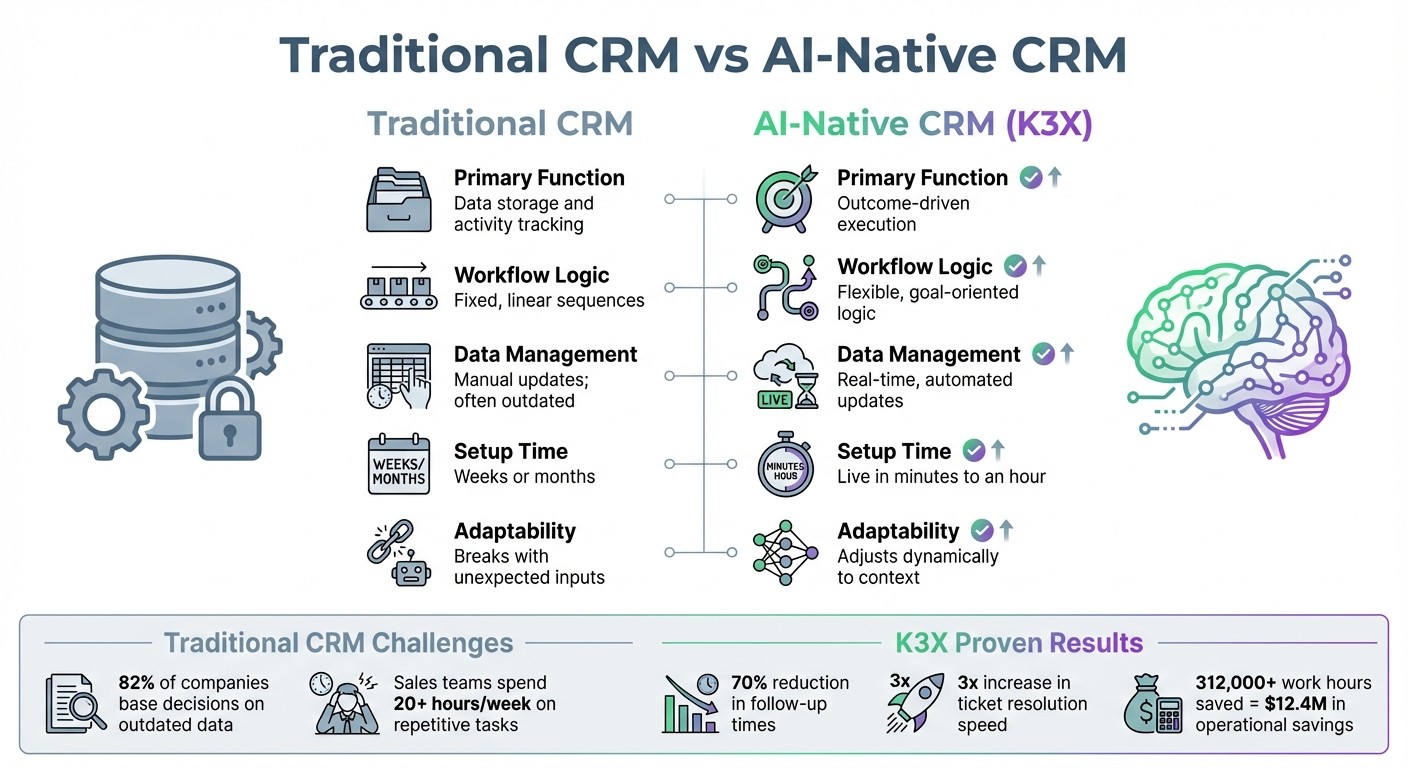
Traditional vs AI-Native CRM Systems Comparison
To meet outcome-focused goals, using the right technology is absolutely essential.
Why Traditional CRM Systems Struggle
Most traditional CRM systems function as little more than static databases - they store information but don't actively assist in achieving goals. Sales teams often find themselves bogged down, spending over 20 hours each week on repetitive tasks like data entry, copying notes, and updating pipeline stages.
These systems are built around rigid, linear processes that crumble when a prospect behaves unexpectedly. For example, if an automation is set to "send an email, wait three days, then send another email", and the prospect replies with a question mid-sequence, the entire workflow halts. Fixing these interruptions requires manual intervention, turning CRMs into outdated, unreliable data silos.
Additionally, traditional CRMs demand lengthy setup times and constant maintenance. Even after deployment, teams must regularly tweak workflows, triggers, and sequences to keep up with evolving business needs. Alarmingly, 82% of companies admit they base decisions on outdated data because their CRM systems can't handle real-time updates.
This is where AI-native CRMs change the game.
How AI-Native CRMs Like K3X Drive Outcome-Oriented Success

AI-native platforms completely rethink how CRMs operate. Instead of just tracking activity, they focus on understanding and achieving specific outcomes. Take K3X, for example: you can set a goal like "Schedule demo calls with unresponsive leads", and the system dynamically adjusts its actions in real time to meet that objective. If a prospect asks a question mid-process, K3X recalibrates instantly, keeping the momentum alive instead of sticking to a rigid script.
The results speak for themselves. In December 2025, Ruby Capital Group - a company with 125 employees - adopted K3X's AI-driven tools. Within just two days, they cut follow-up time by 70% and tripled their ticket resolution speed. CEO Michael Chkechkov highlighted how K3X automates lead qualification and contract routing, enabling the sales team to focus on closing deals rather than administrative work.
K3X also eliminates manual tasks by automatically logging emails, recording calls, and updating pipelines. To date, it has saved over 312,000 work hours for more than 50 teams, translating to $12.4 million in operational savings. And at just $20 per seat per month with usage-based scaling, it’s a cost-effective solution that avoids the hassle of complex migrations or third-party integrations.
"We're building a CRM that works the way people expect it to, not through menus, workflows, or complexity, but through intention. You tell it the outcome. The system figures out the work." - Mykyta Samusiev, Co-Founder & CEO of K3X
Feature | Traditional CRM | AI-Native CRM (K3X) |
|---|---|---|
Primary Function | Data storage and activity tracking | Outcome-driven execution |
Workflow Logic | Fixed, linear sequences | Flexible, goal-oriented logic |
Data Management | Manual updates; often outdated | Real-time, automated updates |
Setup Time | Weeks or months | Live in minutes to an hour |
Adaptability | Breaks with unexpected inputs | Adjusts dynamically to context |
Optimizing Outcome-Centric CRM Strategies
Keep refining your CRM strategy to stay aligned with your business's evolving needs.
Continuous Performance Monitoring and Adjustment
Improving your CRM is not a one-time task. As Michael Scheiner from CRM.org puts it, "A CRM only drives results if it's set up with clear goals, clean data, and consistent use".
Shift your focus to outcome-based KPIs rather than activity metrics. Conduct quarterly strategic audits to ensure your CRM aligns with your latest revenue goals. These audits should include removing outdated pipeline stages, checking data quality, and confirming that the system reflects your team's actual sales processes.
Real-time insights are essential. Instead of manually building reports, use dynamic dashboards that update automatically, offering instant visibility into sales, marketing, and support performance. For key metrics, set thresholds with green, yellow, and red indicators, and establish automated escalation paths when critical levels are reached.
AI-powered CRMs like K3X take this further by analyzing user behavior in real time. Features like Performance Insights pinpoint where deals slow down and suggest actionable improvements. Set overarching objectives, and let the AI break them into practical steps.
These ongoing adjustments not only improve immediate outcomes but also ensure your CRM system can grow alongside your business.
Scaling Outcome-Centric CRM Approaches
As your business becomes more complex, your CRM must scale efficiently. Many traditional CRMs struggle with rigid processes that fail to adapt to growth.
K3X’s adaptive model addresses this challenge by scaling dynamically with your usage. At $20 per seat per month, plus AI credits, costs adjust based on actual needs, allowing businesses to maintain ROI without paying for unused capacity.
For B2B companies, ensure every lead has a clearly defined "next action" until closure. This approach keeps opportunities moving through your pipeline. Additionally, limiting each sales rep to 50 outbound accounts, supported by detailed research, helps maintain relevance and has been shown to speed up deal cycles by 35%.
The key to success is constant optimization. Focus on measuring outcomes, maintaining clean data, and leveraging AI to handle repetitive tasks so your team can concentrate on closing deals.
Conclusion
Outcome-focused CRM objectives shift the emphasis from simply tracking activities to achieving measurable results - like booking demos, closing deals, or reducing response times. This approach can reclaim 20–25% of sales capacity by automating non-selling tasks, allowing teams to focus on what truly drives revenue.
This isn't just about efficiency; it's a reimagining of what CRM systems can do. Traditional CRMs often rely on rigid workflows that falter when customer behavior deviates from the expected. AI-powered platforms like K3X, on the other hand, adapt dynamically, ensuring deals keep progressing.
"Most CRMs record activity. K3X understands outcomes. It listens, knows what changed, and makes the next moves." - Mykyta Samusiev, Co-Founder & CEO of K3X
Companies that embrace outcome-driven automation report noticeable gains in efficiency, faster deal cycles, and higher win rates. For instance, K3X users save an average of 8 hours per week per employee by automating tasks like data entry, pipeline updates, and follow-ups.
The key is to focus on three measurable outcomes directly tied to revenue or operational efficiency. Instead of building complex workflows, you can define your goals with simple prompts. Automate repetitive tasks while your team zeroes in on closing deals. And with a price of $20 per seat per month, K3X scales based on actual usage.
This shift represents more than just operational tweaks - it’s a fundamental change in how CRM systems support businesses. By adopting an outcome-centric model, your team can work smarter, reduce costs, and rely on a system that continuously evolves to meet your needs. In short, this approach empowers your team to focus on what truly matters: achieving results that drive revenue.
FAQs
What’s the difference between activity-based and outcome-centric CRM objectives?
Activity-based CRM objectives are all about tracking the quantity of actions - things like the number of calls made, emails sent, or meetings scheduled. The focus here is on keeping tabs on how much activity is happening.
On the other hand, outcome-centric objectives shift the focus to results. These goals measure success by tangible achievements, such as closing deals or improving customer satisfaction. The idea is to align efforts with metrics that genuinely impact business performance.
Platforms like K3X take this a step further by using AI to prioritize outcomes over rigid workflows. This allows for real-time adjustments, ensuring the focus stays on driving meaningful results - not just logging activities.
Which 3 CRM metrics should I track first for revenue or retention?
To achieve outcome-focused CRM goals, prioritize tracking these key metrics: deal velocity, customer lifetime value (CLV), and churn rate.
Deal velocity: This metric shows how efficiently sales move through the pipeline and helps pinpoint bottlenecks that slow progress.
Customer lifetime value (CLV): CLV measures the revenue a customer is expected to bring over the course of their relationship with your business. It’s a critical figure for shaping retention strategies.
Churn rate: Churn rate reflects how many customers you’re losing over a specific period. It’s a direct indicator of your retention success.
Modern tools like K3X CRM simplify this process by automating these metrics. They provide actionable insights, enabling teams to focus on increasing revenue and improving retention - without the hassle of manual tracking.
How do I set outcome goals in K3X without building workflows?
In K3X, setting outcome goals is straightforward - just define them through prompts. The platform takes care of tasks like follow-ups, pipeline updates, and team coordination on its own. There's no need for complicated workflows or manual setups. This conversational system adjusts in real time, learning from how users interact and tracking lead activity to streamline operations effortlessly.