

Machine learning and NLP analyze CRM activity, engagement, and market signals to predict win probability, close dates, and next steps.
AI is transforming sales forecasting by analyzing CRM data and buyer behaviors to deliver accurate predictions and actionable insights. Traditional methods often rely on human intuition, leading to errors and missed forecasts. AI-driven tools, however, achieve 75–95% accuracy by processing data like email response times, deal stages, and customer engagement signals.
Key takeaways:
AI vs. Manual Forecasting: AI improves accuracy from 60–75% to 75–95%.
Technologies Used: Machine Learning (e.g., Random Forest, XGBoost) and NLP analyze structured and unstructured data.
Real-Time Updates: AI continuously refines predictions with new data, unlike static traditional forecasts.
Impact on Sales: Companies using AI report 79% forecast accuracy and substantial revenue growth.
AI doesn’t just predict outcomes - it also suggests next steps, flags risks, and improves lead qualification accuracy to 70–85%. Systems like K3X outperform legacy CRMs by automating tasks, reducing admin time, and delivering real-time, data-driven decisions.
AI in Zoho CRM – Part 3: Business Forecasting and Insights with Zia
How AI Predicts Sales in CRM Platforms
AI transforms CRM data into actionable sales forecasts by leveraging machine learning, natural language processing (NLP), and continuous learning. Here's a closer look at how these technologies work together to deliver accurate sales predictions.
Machine Learning and Data Models
AI-powered models dive deep into CRM data, analyzing deal stages, deal sizes, time spent in each stage, and activity patterns like calls or emails. They also consider buyer engagement signals, such as email opens and website visits, to pinpoint the factors that influence sales success.
Tree-based algorithms, like Random Forest and XGBoost, excel at understanding complex relationships - such as how deal size and a salesperson’s experience affect win rates. Logistic regression and Gradient Boosting, on the other hand, focus on historical win rates to predict the likelihood of a deal closing based on its stage and age. For longer sales cycles, LSTM (Long Short-Term Memory) neural networks track patterns over time, offering two key predictions: a general "Win Probability" (likelihood of closing) and a "Close Date Probability" (the expected closing month). These models are known to outperform traditional forecasting methods.
However, accuracy depends on clean, comprehensive data. AI models typically need at least 100 to 200 closed deals and 18 to 24 months of historical data to generate reliable forecasts.
Natural Language Processing in CRM
NLP complements machine learning by extracting insights from unstructured text, such as emails, call transcripts, and meeting notes. These often contain valuable clues about buyer intent, objections, and competitor activity.
Sentiment analysis, for example, evaluates the tone and urgency of communications, helping sales teams prioritize leads based on behavior rather than static demographics. NLP tools can also extract critical deal details, like BANT criteria (Budget, Authority, Need, Timeline), from conversations, ensuring CRM data stays up-to-date without manual input. Additionally, conversation intelligence tools analyze factors like talk-to-listen ratios, question frequency, and clarity on next steps to evaluate deal health and salesperson performance.
NLP can even flag risks in real time. For instance, if a key contact stops responding or a competitor is mentioned, the system adjusts forecasts immediately. This is crucial since leads contacted within five minutes are 21 times more likely to convert than those reached after 30 minutes. AI-driven lead qualification typically achieves 70–85% accuracy, far surpassing the 30–40% accuracy of manual methods.
Real-Time Updates and Continuous Learning
Unlike traditional forecasts, which rely on periodic manual updates, AI systems continuously update predictions to reflect the ever-changing sales pipeline.
Every closed deal - whether successful or not - feeds back into the system, refining its algorithms. For example, if a lead with a high predicted win probability doesn’t close, the model adjusts to improve future predictions. Over time, this feedback loop can boost lead conversion prediction accuracy from 60% to 75–85% within 6 to 12 months.
AI also captures real-time engagement signals, like a prospect repeatedly visiting a pricing page, and instantly adjusts the deal's win probability. Advanced platforms even incorporate external factors, such as market trends or competitor product launches, to fine-tune forecasts on the fly. This dynamic approach ensures that predictions remain accurate and sales teams can proactively manage deals, aligning with methodologies like the K3X approach.
Data Sources That Power Sales Predictions
AI systems, leveraging machine learning and NLP, excel at creating forecasts by analyzing a mix of data sources. The accuracy of these predictions hinges on both the quality and variety of the data. Modern CRM platforms tap into three main categories - internal engagement signals, historical pipeline patterns, and external market intelligence - to transform raw data into actionable insights.
Customer Behavior and Engagement Metrics
AI focuses on digital behaviors that strongly indicate purchase intent. Actions like visiting pricing pages multiple times, downloading competitor materials, attending webinars, and requesting whitepapers carry more weight than simpler actions, like opening a newsletter. Speed also matters - a one-minute response time can boost conversion rates by an impressive 391%. Because of this, AI closely monitors response times and how recently a prospect has engaged.
Emails and call transcripts provide another layer of insight. AI scans these interactions for buyer sentiment, objections, mentions of competitors, and pricing discussions, feeding this data into predictive models. It also tracks multithreading - engaging multiple contacts within a single account - which is a stronger indicator of deal success than relying on just one contact. On the flip side, warning signs like a drop in engagement, ghosting after pricing talks, or prolonged inactivity in a pipeline stage are flagged as risks.
While customer behavior is crucial, historical trends within the sales pipeline also play a significant role in shaping predictions.
Pipeline Data and Historical Sales Trends
AI digs into past deal data, identifying patterns like how deal size, time spent in each sales stage, and sales rep activity levels influence outcomes. Using this historical data, the system assigns probabilities for both winning deals and predicting close dates. Deals that linger beyond the usual time for a particular stage are marked as at risk.
To generate reliable forecasts, AI typically needs 12 to 24 months of clean historical data and a minimum of 100 to 200 closed deals. This ensures the system accounts for seasonal trends and sales cycle variations. Additionally, AI automates weighted pipeline calculations. For instance, if deals in the "Demonstration" stage historically close 60% of the time, that percentage is automatically applied to deals in that stage.
However, predictions become even sharper when internal data is enriched with external market insights.
External Market and Economic Factors
AI systems broaden their scope by incorporating external signals, such as job openings at target companies, changes in software usage (technographic data), and website visits from specific IP addresses. If a competitor launches a new product or adjusts pricing, AI quickly recalibrates its forecasts and provides updated strategy recommendations. Advanced models, like CNN-LSTM hybrids, combine historical sales data with real-time market dynamics to refine predictions.
"In 2026, sales forecasting is a science driven by AI that analyzes not only CRM data but also external factors such as market trends, customer behavior, and even global economic changes." - Vadim Volnitskyi, CRM Expert
However, integrating external data comes with challenges. Macroeconomic changes or shifts in market behavior can make models unreliable if they aren’t retrained regularly. AI amplifies patterns in data, so if more than 25% of the input data is flawed, even the most advanced systems may produce inaccurate results. This highlights the importance of maintaining high-quality data when using modern CRMs like K3X to integrate external intelligence effectively.
The 4-Step AI Sales Forecasting Process
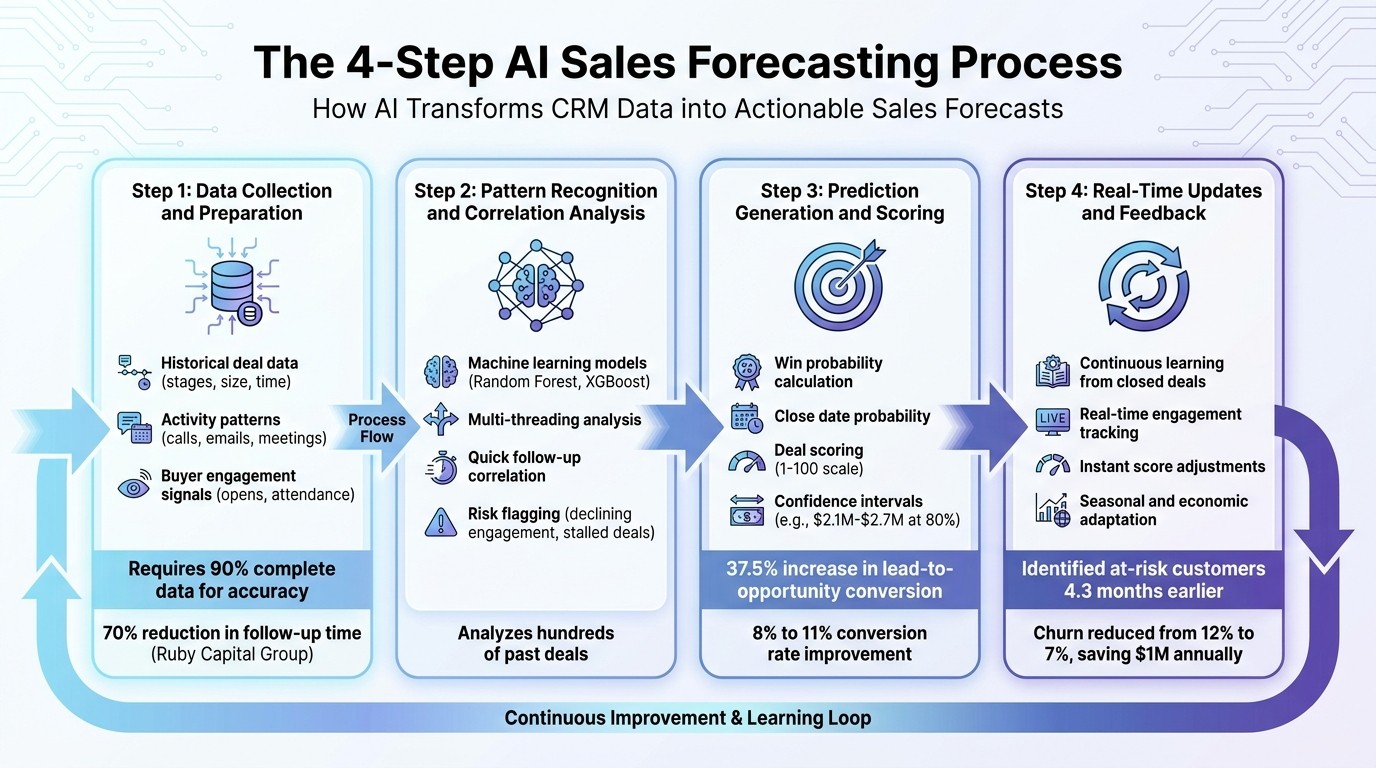
4-Step AI Sales Forecasting Process in CRM Systems
AI takes CRM data and turns it into actionable forecasts through a structured four-step process. By understanding how this works, sales teams can gain clarity on how predictions are made and where human input still plays a vital role.
Step 1: Data Collection and Preparation
The process begins with gathering historical deal data (like deal stages, size, and time spent in each stage), activity patterns (calls, emails, meetings), and buyer engagement signals (such as email opens and meeting attendance). However, raw data alone isn’t enough - it needs to be cleaned up. This preparation phase involves filtering out irrelevant data, such as test deals, duplicate accounts, or incomplete records, to ensure the AI model isn’t working with flawed inputs.
For example, Ruby Capital Group implemented K3X's AI tools in December 2025 and saw a 70% reduction in time spent on follow-ups in just two days. A big factor in this success? Their CRM data was already well-organized for AI processing.
To get similar results, ensure 90% of closed deals in your pipeline have complete and accurate data. Automating activity logging can also help capture critical engagement signals. Once the data is cleaned and organized, the AI can start identifying hidden patterns.
Step 2: Pattern Recognition and Correlation Analysis
After the data is prepared, AI-powered machine learning models get to work finding patterns that are often invisible to humans. For instance, the system might discover that multi-threading (engaging multiple stakeholders) and quick follow-ups are strongly linked to closing deals. Advanced models like Random Forest and XGBoost are particularly effective at analyzing complex relationships between factors like sales rep experience, deal size, and time spent in each stage.
AI also flags potential risks early. For example, if a deal shows declining engagement or has stalled beyond the usual timeframe for its stage, the system marks it as at risk. These insights are based on statistical analysis, not guesswork, using data from hundreds of past deals.
"A CRM saturated with data is only valuable if it provides clear, actionable foresight rather than retrospective guesswork".
These insights lay the groundwork for the next step: generating precise, data-driven forecasts.
Step 3: Prediction Generation and Scoring
Once patterns are identified, AI translates them into forecasts by calculating two probabilities: the win probability (likelihood a deal will close) and the close date probability (the most likely time frame for closing). Deals are then scored on a 1–100 scale with confidence intervals (e.g., $2.1M–$2.7M at 80% confidence).
This step offers more accurate forecasts compared to traditional manual methods. For example, a mid-market SaaS company using HubSpot’s predictive lead scoring saw their lead-to-opportunity conversion rate improve from 8% to 11% - a 37.5% increase - while also shortening their sales cycle from 47 days to 35.
That said, AI predictions aren’t perfect. To account for nuances not captured in the CRM, like verbal commitments made during informal conversations, managers should have the ability to manually adjust predictions for up to 10% of deals.
Step 4: Real-Time Updates and Feedback
Unlike static spreadsheets that require manual updates, AI systems continuously learn and adapt. For instance, if a prospect revisits a pricing page or stops responding to emails, the system updates the deal’s score instantly. This enables AI to respond to shifting buyer behaviors, seasonal trends, and broader economic changes in real time.
Feedback loops refine the system over time. If a deal with a 75% win probability ends up being lost, the AI recalibrates its scoring model to improve future predictions. For example, an industrial equipment distributor using Zoho CRM’s Zia AI identified at-risk customers 4.3 months earlier than expected, reducing their churn rate from 12% to 7% and saving $1M annually.
This continuous learning approach is what sets platforms like K3X apart. By staying updated with real-time sales dynamics, these systems replace outdated, static tools with adaptive CRMs designed to drive results.
"Most CRMs record activity. K3X understands outcomes. It listens, knows what changed, and makes the next moves".
How AI Improves Sales Performance
AI doesn’t just predict what might happen - it actively helps close deals and keeps customers coming back. By analyzing patterns across countless interactions, AI highlights which opportunities are worth pursuing and flags potential risks before they become problems. At K3X, our AI-native CRM takes these predictive insights to the next level, automating follow-ups and delivering real-time recommendations. This lets your team focus on meaningful customer interactions instead of getting bogged down by repetitive tasks.
Predictive Lead Scoring
AI’s ability to forecast outcomes makes lead scoring more precise and effective. By analyzing hundreds of data points - like website activity, email engagement, and social media behavior - AI ranks leads based on their likelihood to convert. Unlike old-school methods that rely on static rules (like job titles), AI uses historical data to identify what truly works for your business.
The results are clear: conversion rates improve, close rates jump, and sales teams can dedicate up to 80% of their time to qualified leads - compared to just 30% with manual methods. AI even categorizes leads into tiers like “Hot” (scores of 75+), “Warm” (50–74), and “Cool” (below 50), helping sales reps prioritize the top prospects.
Timing also plays a big role. Reaching out to a lead within five minutes can increase conversion rates by 21x compared to waiting just 30 minutes. AI systems ensure no time is wasted by instantly assigning high-scoring leads to available reps or engaging them through automated tools, catching prospects at their peak interest.
Churn Prediction and Customer Retention
AI doesn’t stop at finding new customers - it also helps keep existing ones. By monitoring customer health signals - like product usage, support interactions, and payment patterns - AI identifies which customers are at risk of leaving, often months in advance. It assigns churn scores to highlight the likelihood of a customer leaving and pinpoints areas of concern, such as specific products or services.
But detection is only part of the equation. AI also suggests actionable strategies to retain customers, like scheduling executive reviews, offering product training, or adjusting pricing. For example, a SaaS company with $5 million in annual recurring revenue could save $150,000 annually by reducing churn by just 3% with AI-driven interventions.
Pipeline Health Monitoring and Deal Scoring
AI takes the guesswork out of pipeline management by analyzing buyer engagement signals - such as stakeholder involvement, sentiment in communications, and timeline confirmations - rather than relying on subjective input from sales reps. Deal scoring uses advanced models to weigh factors like engagement frequency and qualification metrics, providing an accurate prediction of which opportunities are likely to close.
It also catches deals that might be stalling, such as those with declining email responses or missing key decision-makers, so they don’t turn into last-minute surprises. This allows sales leaders to focus energy on deals that have the best chances of success while deprioritizing less promising ones.
AI even goes a step further by recommending the best next steps - like adjusting pricing or scheduling a demo - to move deals forward. This aligns with K3X’s mission to streamline sales processes, enabling teams to spend less time managing tools and more time closing deals. By 2026, over 60% of B2B sales teams are expected to use machine learning-driven intent scoring as a core part of their pipeline strategy.
K3X vs. Traditional CRM Systems

Problems with Legacy CRM Systems
Old-school CRM systems often act more like digital filing cabinets than tools that drive results. They collect and store data, but they don’t actively help sales teams close deals. Reps are stuck entering data manually and navigating rigid workflows that are prone to breaking. Here’s the reality: sales reps spend just 28% of their week selling, and nearly half (47%) of CRM data becomes outdated within six months. Add to that the risk of manual entry mistakes, which can eat up as much as 15% of revenue, and you’ve got a recipe for inefficiency. In fact, 85% of salespeople admit they’ve lost deals because of incomplete or inaccurate CRM data. To top it off, legacy CRM systems have a failure rate of around 55%, often requiring weeks (or months) of setup and heavy reliance on IT consultants and extra tools just to automate basic tasks.
"The manual friction is the silent killer of revenue. It forces representatives to choose between selling and reporting." - Sami AZ, Founder, Klu
K3X flips this script entirely.
How K3X Works Differently
K3X tackles the flaws of traditional systems head-on by using AI to create real-time, goal-focused automation. Forget about clunky workflows or endless manual updates. With K3X, you simply set a sales goal in plain language - like “Book demo calls with every lead who hasn’t responded” - and the platform’s AI takes it from there. It automatically handles tasks like logging emails, recording calls, updating pipelines, and even adjusting to lead behavior on the fly.
Here’s a real-world example: In December 2025, Ruby Capital Group switched to K3X and saw follow-up times drop by 70%, while ticket resolution speeds tripled.
"Our sales team was spending half their day on admin work. Now they're talking to customers and closing deals." - Michael Chkechkov, CEO, Ruby Capital Group
So far, K3X has saved over 312,000 hours of work and cut operational costs by an estimated $12.4 million. Its AI-driven forecasting is also 15–30% more accurate than the static reports typical of legacy systems, freeing up an average of 8 hours per employee every week.
Feature Comparison: K3X vs. Traditional CRM
Here’s a side-by-side look at how K3X stacks up against traditional CRM platforms:
Feature | Traditional CRM (e.g., Salesforce, HubSpot) | K3X (AI-Native) |
|---|---|---|
Logic | Linear, script-based sequences | Goal-oriented, outcome-based prompts |
Entry Method | Manual – significant time lost to admin | Autonomous – auto-logs interactions |
Setup Time | Weeks to months; requires IT support | Under one hour; self-managed |
Automation | Rigid "if-then" rules that break on exceptions | Adaptive; manages exceptions |
Forecasting Accuracy | Static, historical reporting | Predictive, real-time (15–30% more accurate) |
Pricing | $90–$150 per user/month | $20 per seat/month (usage-based) |
"Most CRMs record activity. K3X understands outcomes. It listens, knows what changed, and makes the next moves." - Mykyta Samusiev, Co-Founder & CEO, K3X
Conclusion
AI is transforming the way businesses approach sales forecasting and deal management. Traditional methods, often reliant on intuition and manual updates, have left many companies struggling to meet their revenue targets - only 15% manage to achieve forecast accuracy within 5% of actual revenue. By leveraging AI, businesses can now analyze real buyer behavior, engagement signals, and historical data to deliver real-time, objective forecasts. Instead of relying on outdated monthly reports, sales leaders benefit from continuous updates fueled by data from calls, emails, and CRM activity.
This shift is further amplified by the transition from rigid workflow-based systems to outcome-driven platforms like K3X, an AI-native CRM. Unlike legacy CRMs that depend on inflexible "if-then" sequences prone to breaking under complex conditions, K3X allows teams to set straightforward goals in plain language. From there, it predicts and executes the necessary next steps, adapting dynamically to ensure optimal outcomes.
The results speak for themselves. K3X has saved over 312,000 hours, cut costs by $12.4 million, and improved forecasting accuracy by 15–30% compared to older systems. At just $20 per seat per month, it eliminates the need for costly consultants, additional tools, and the lengthy setups often associated with platforms like Salesforce and HubSpot.
Industry leaders recognize the value of AI-powered forecasting:
"AI sales forecasting helps sales leaders go beyond guesswork. It reduces manual forecasting, improves pipeline management, and brings data-driven insights into your revenue planning."
Alex Zlotko, CEO at Forecastio
AI-driven CRMs don’t just predict sales outcomes - they actively shape and accelerate them. Embrace AI-powered tools to streamline your sales process and close deals faster.
FAQs
What data do I need in my CRM for AI forecasts to be reliable?
To get accurate AI-driven forecasts in your CRM, start with clean and well-organized data. This includes details like historical deal information - such as stages, amounts, close dates, and win/loss results - as well as engagement signals like email activity, meetings, and buyer interactions. Incorporating revenue data, like subscription or payment records, can further enhance forecast precision. Regularly updating and maintaining structured data ensures the AI can identify patterns and make reliable predictions, leading to better sales forecasts.
How does AI update win probability and close dates in real time?
AI keeps win probability and close dates up-to-date by constantly evaluating lead behavior and interactions. Tools like K3X leverage predictive models and sentiment analysis to assign scores to leads and adjust these metrics in real time. By processing continuous data, AI delivers precise forecasts, enabling sales teams to concentrate on top-priority opportunities and adapt quickly to changes - eliminating the need for static, manual updates.
How does K3X use AI predictions to automate next steps in the pipeline?
K3X uses AI-driven predictions to evaluate lead behavior in real time. It continuously updates scores and suggests actions, such as follow-ups or adjustments to the sales pipeline. This approach allows for flexible, results-oriented automation, freeing teams to concentrate on closing deals instead of getting bogged down in managing workflows.