

Use AI to prioritize tasks by measurable outcomes—speed responses, increase revenue, reduce admin, and align teams.
Outcome-based task prioritization focuses on ranking tasks by their results rather than just completing activities. Instead of ticking off to-do lists, the approach starts with a clear goal - like increasing revenue or reducing response times - and works backward to determine the most effective steps. By tracking leading indicators (early metrics that signal progress), teams can adjust strategies in real-time to stay on track.
This method stands apart from older, rigid systems that rely on predefined workflows. It uses AI-powered tools to dynamically adapt to changing conditions, saving time and improving efficiency. For example, companies like Ruby Capital Group and TechFlow Inc. have seen faster ticket resolutions and higher revenue after adopting this approach.
Key benefits include:
Increased efficiency: Sales teams spend less time on admin tasks and more on selling.
Aligned goals: Teams work toward measurable outcomes rather than unrelated metrics.
Real-time flexibility: AI automates workflows, reducing manual updates.
AI tools like K3X make implementation simple, offering features like automated lead prioritization, multi-channel outreach, and real-time insights. Starting at $20 per user per month, K3X provides a cost-effective alternative to older platforms like Salesforce and HubSpot.
If you're looking to improve results, this approach shifts the focus from tasks to outcomes, offering a smarter way to prioritize work.
How Outcome-Based Prioritization Differs from Traditional Methods
Traditional Task Prioritization: Workflow-Driven Methods
Traditional task management often feels like following a rigid, pre-written script. These systems rely on linear "if-then" sequences to guide actions. For instance, if a lead fills out a form, the system sends an email; if they click a link, the lead is assigned to sales. Every step has to be explicitly programmed in advance. This setup essentially turns your CRM into a record-keeping system, focused on documenting past actions instead of actively driving what comes next.
But this rigidity comes at a cost. Experts refer to it as a "rigidity tax", with businesses dedicating 30% to 40% of their IT resources to maintaining and updating these static workflows. And when things don’t go as planned - like when a lead responds unexpectedly or provides unstructured information - the system often fails. Current CRMs only capture about 1% of actual customer interactions, leaving huge gaps in the data. This inefficiency forces sales reps to spend an average of 3.4 hours each week on manual data entry. On top of that, nearly 43% of CRM users only use half of the system’s features, largely because of its complexity.
"Traditional workflow automation is fundamentally incapable of handling the complexity and unpredictability of modern business operations."
Autonoly Team
While static automation can improve efficiency by 40–60%, it still requires manual intervention for 20–40% of transactions when the pre-set rules fail.
The Shift to Outcome-Focused Prioritization
Outcome-focused prioritization takes a completely different approach. Instead of programming every single step, you define the end goal - like "Book 20 qualified meetings this month" - using straightforward conversational prompts. The system then figures out the most effective way to achieve that goal. This approach shifts the focus from managing processes to delivering results.
What makes this method stand out is its ability to adapt in real time. It uses live data, engagement patterns, and intermediate outcomes to adjust dynamically. So, if a lead responds in an unexpected way or market conditions shift, the system recalibrates automatically - no manual reprogramming needed. This adaptability allows AI-driven workflows to achieve efficiency gains of 70–90%, far surpassing static systems. Beyond boosting performance, this flexibility simplifies operations, giving businesses a competitive edge.
A great example is Ruby Capital Group. In December 2025, they adopted K3X's outcome-based AI agents and saw incredible results: follow-up times dropped by 70%, and ticket resolution speeds tripled. The system autonomously handled tasks like lead qualification and contract routing, freeing up the sales team to focus on closing deals rather than administrative work.
"Most CRMs record activity. K3X understands outcomes. It listens, knows what changed, and makes the next moves."
Mykyta Samusiev, Co-Founder & CEO, K3X
The key difference lies in the mindset. Traditional systems ask, "What tasks need to be completed?" while outcome-based systems ask, "What result are we trying to achieve?" This shift not only reduces the burden of maintaining workflows but also enables teams to act faster. Research shows that responding to leads within five minutes makes them 21 times more likely to convert compared to waiting 30 minutes. By focusing on outcomes, platforms like K3X are transforming automation into something far more adaptive and responsive.
Benefits of Outcome-Based Task Prioritization
Better Efficiency and Productivity
Focusing on outcomes can dramatically improve how time is spent, especially in sales. On average, sales reps dedicate only 28–33% of their workday to selling, with the rest swallowed up by administrative tasks like logging calls and updating records. AI-driven systems that prioritize tasks based on revenue potential and deal urgency can change this dynamic. These systems have been shown to increase a rep's capacity by 60% and boost revenue per rep by 30%.
Take TechFlow Inc., for example. From April to October 2024, this logistics SaaS company swapped manual Salesforce updates for automated task prioritization. The results? Reps went from spending 120 minutes daily on data entry to just 15 minutes. This shift allowed a 50% increase in weekly customer meetings, improved their win rate from 23% to 31%, and grew their annual recurring revenue from $1.2 million to $1.78 million.
"This manual friction is the silent killer of revenue. It forces representatives to choose between selling and reporting."
Sami AZ, Founder, Klu
Better Goal Alignment Across Teams
Outcome-based prioritization doesn’t just make individuals more efficient - it aligns entire teams. Traditional systems often leave sales and marketing chasing separate metrics, creating silos and misaligned priorities. In contrast, outcome-focused platforms bridge this gap by translating high-level business objectives into actionable daily tasks for every role. Features like visual "Goal Trees" clearly connect individual efforts to the company’s overarching goals. Teams can also track leading indicators - like the number of qualified calls or proposals sent - to make adjustments before small issues grow into larger problems.
"AI turns vague intentions into precise, measurable objectives, giving leaders unprecedented clarity and control over performance while still preserving the human touch."
Emily Helen Arnold, People Strategy Specialist, Teamflect
Easier Scaling and Adaptation
When objectives are clearly aligned, scaling and adapting become far simpler. Traditional workflow systems can feel rigid and inefficient during growth or market shifts. Adapting to new policies or conditions often means manually reprogramming workflows, which consumes 30–40% of IT resources. As businesses grow, the complexity of static systems only increases - some lead scoring systems need over 5,000 rules to account for all variables.
Outcome-based prioritization avoids these headaches. Instead of relying on static rules, it uses dynamic prompts like “Book demo calls with every unresponsive lead,” which the system can execute without manual adjustments. This flexibility pays off: AI-driven workflows achieve efficiency gains of 70–90%, compared to 40–60% for static automation. Over time, these systems get even smarter, saving employees an average of 8 hours per week.
Outcome Based Planning
Use Cases for Outcome-Based Task Prioritization
Outcome-based prioritization has the power to streamline operations and improve results across various business areas, including sales, customer service, and process automation. Let’s take a closer look at how this approach makes a difference.
Improving Sales Pipelines and Lead Conversions
Sales teams often lose valuable time on tasks that don’t directly contribute to closing deals. In fact, the average salesperson spends just 33–36% of their time selling - the rest goes to administrative tasks like data entry. By shifting the focus to tasks that drive revenue, outcome-based prioritization changes the game.
Here’s why speed matters: responding to a lead within one minute can increase conversion rates by 391%. Even a small improvement - responding within five minutes instead of 30 - makes a lead 21 times more likely to convert. Yet, traditional CRMs tend to record activities instead of actively driving outcomes.
Take TechFlow Inc., for example. This logistics SaaS startup replaced manual Salesforce updates with automated prioritization. The results? A 50% increase in weekly customer meetings, an improved win rate (from 23% to 31%), and a jump in annual recurring revenue from $1.2 million to $1.78 million in just six months.
AI-native tools like K3X take things further by prioritizing leads based on real-time behavior - like multiple visits to pricing pages or downloading a whitepaper - rather than relying on static demographic data. Instead of building complex workflows, teams can use conversational prompts like “Book demos with unresponsive leads,” and the system dynamically handles the rest. This method achieves a lead qualification accuracy of 70–85%, compared to 30–40% with manual approaches.
The same principle applies to customer service, where prioritizing high-impact issues can transform operations.
Improving Customer Service Operations
In customer service, treating every ticket equally - using a simple first-in, first-out system - can lead to missed opportunities to resolve critical issues that directly affect customer loyalty. Research shows that 66% of customers may switch companies after poor service, and 92% expect a response to negative experiences within 24 hours.
With outcome-based prioritization, sentiment analysis flags urgent or high-impact tickets for immediate attention, while AI agents handle routine inquiries like password resets or billing questions. This approach can cut manual reply times by 60–70% and boost customer retention rates by 47%.
Ruby Capital Group, a funding company with 125 employees, adopted K3X’s AI-driven agents in December 2025. The setup took just two days, and the results were impressive: ticket resolution speed tripled, and time spent on follow-ups dropped by 70%. CEO Michael Chkechkov summed it up:
"Our sales team was spending half their day on admin work. Now they're talking to customers and closing deals."
Grubhub offers another success story. By using automated workflows, they managed a 100% increase in ticket volume while reducing contacts per order by 37%. Routing tickets based on agent expertise and workload, rather than arrival order, allowed them to resolve issues faster, keeping customers satisfied.
Automating Outcome-Focused Processes with Technology
The main difference between traditional automation and outcome-focused systems lies in adaptability. Static "if-then" workflows often struggle when customer behavior becomes unpredictable. These systems require weeks of setup and frequent updates, delivering only 40–60% efficiency gains. In contrast, AI-powered tools like K3X achieve 70–90% efficiency by learning and adapting in real time.
For example, GreenTech Solutions used an AI CRM from January to June 2024 to cut administrative work from 14.2 hours to just 2.1 hours per week per salesperson. This change increased their win rate from 16.8% to 21.3% and added $740,000 in annual value. Automated data capture - logging emails, transcribing calls, and updating records - eliminated the need for manual entry.
K3X also stands out for its simplicity. Its prompt-driven setup takes under an hour, compared to the weeks or months required for traditional CRMs. Users can define goals in plain language, like “Prioritize tickets from high-value accounts with unresolved issues over 24 hours,” and the system handles the rest. It even adjusts mid-process, pausing outreach if a lead goes cold or changing messaging if pricing questions arise.
At $20 per user per month, K3X offers a cost-effective alternative to platforms like Salesforce ($150/month) or HubSpot ($90/month). It includes unlimited workflow automations and 1,000 AI credits monthly. For teams bogged down by software management, outcome-focused automation isn’t just efficient - it’s a competitive edge.
How to Implement Outcome-Based Task Prioritization with K3X

If you're ready to embrace outcome-focused prioritization, here's how to make it work using K3X.
How K3X Automates Outcome-Driven Work
K3X simplifies the process with its prompt-driven system. For example, you can set an outcome like: "Book demo calls with every unresponsive lead." From there, the AI takes over, adjusting strategies in real time - tweaking messages, pausing outreach, or escalating high-priority prospects. This flexibility allows K3X to handle unpredictable lead behavior without requiring constant manual updates.
The results speak for themselves: companies using K3X have seen a 22% improvement in forecast accuracy and a 17% reduction in sales cycle length.
Key Features of K3X for Outcome-Based Prioritization
K3X is packed with tools designed to streamline your workflow, such as:
Smart Owner Assignment: Ensures leads are routed to the right team members.
Multi-Channel Outreach: Includes email, SMS, and WhatsApp for broader engagement.
"Stop on Engagement" Logic: Automatically pauses follow-ups once a lead responds.
Real-time dashboards provide visibility into stalled deals, helping teams act quickly. On top of that, WhatsApp outreach often achieves open rates exceeding 90%.
The platform has already saved users over 312,000 hours of work and cut operational costs by an estimated $12.4 million. On average, employees gain back 8 hours per week, thanks to automation.
Getting Started with K3X
Implementing K3X is straightforward and fits perfectly into an outcome-focused strategy. The setup process takes less than an hour:
Connect your existing tools.
Define outcome-based rules using prompts.
Let the AI handle execution.
Scale up as your needs grow.
One client reported cutting follow-up time by 70% while tripling their ticket resolution speed.
"Our sales team was spending half their day on admin work. Now they're talking to customers and closing deals. The automation handles everything from lead qualification to contract routing, and our close rates have never been higher." - Michael Chkechkov, CEO, Ruby Capital Group
K3X pricing starts at $20 per seat per month. This includes 1,000 AI credits, unlimited workflow automations, and built-in communication tools. The pricing model adapts based on your workload, making it scalable for businesses of all sizes.
K3X vs. Traditional Workflow-Heavy CRM Systems
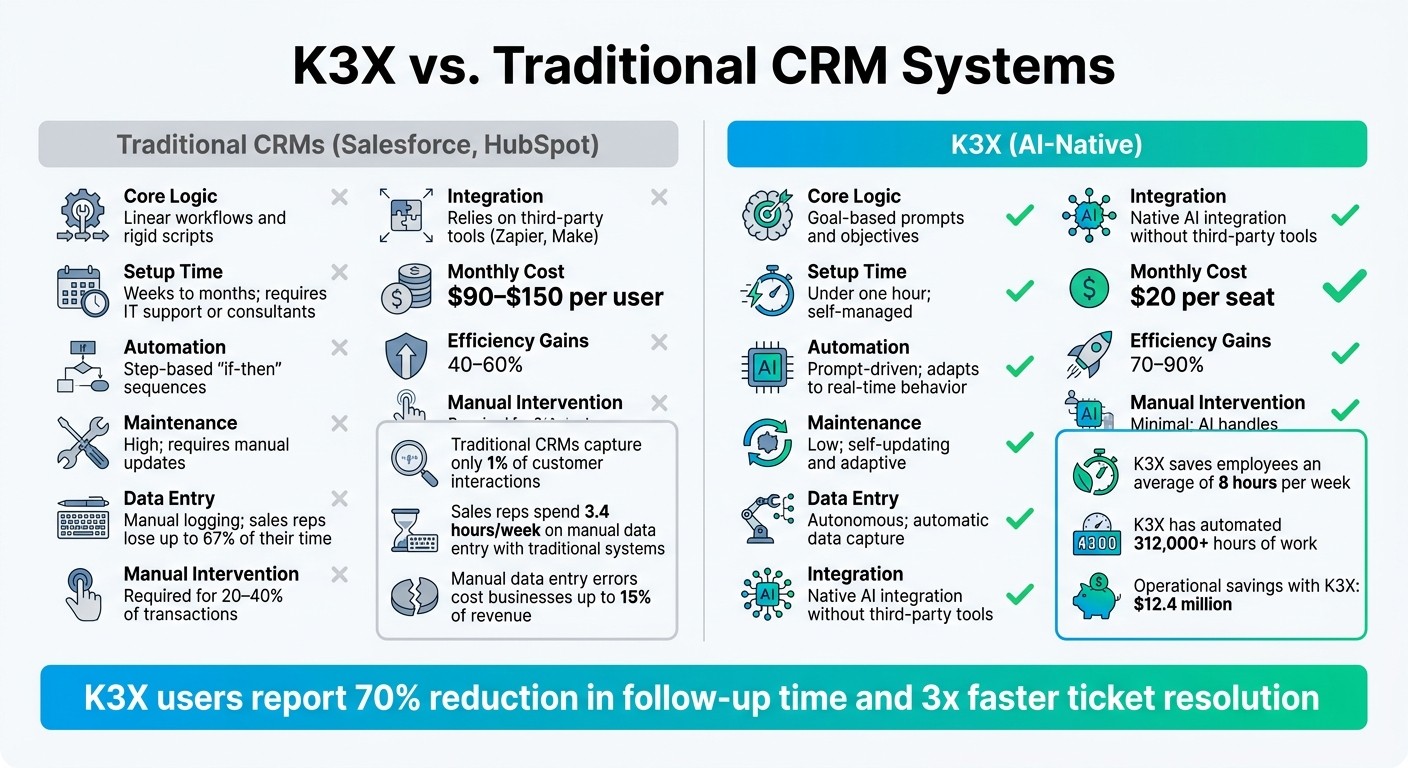
K3X vs Traditional CRM Systems: Features, Costs, and Efficiency Comparison
Key Differences in Approach and Execution
Traditional CRMs like Salesforce and HubSpot are designed to log past actions, acting more like a digital filing cabinet. K3X, on the other hand, takes a more dynamic approach, focusing on driving outcomes rather than just recording history. While traditional platforms depend on rigid "if-then" workflows - which can falter when leads behave unpredictably - K3X uses goal-based prompts that adapt in real time.
Another stark difference lies in setup time. Deploying traditional CRMs often takes weeks or even months and typically requires IT support or external consultants. With K3X, the entire setup can be completed in under an hour using natural language prompts - no technical expertise needed. This ease of use eliminates the administrative burden that traditional systems place on sales reps.
Pricing is another area where K3X stands out. Traditional CRMs like Salesforce charge $150 per user per month, and HubSpot comes in at $90 per user. In contrast, K3X starts at just $20 per seat per month and offers usage-based pricing. Unlike older systems that often require costly middleware, K3X provides an all-in-one, budget-friendly solution.
"Most CRMs record activity. K3X understands outcomes. It listens, knows what changed, and makes the next moves." - Mykyta Samusiev, Co-Founder & CEO of K3X
These distinctions make it clear why K3X offers faster deployment, easier integration, and greater efficiency compared to traditional CRMs.
Comparison Table: K3X vs. Competitors
Feature | Traditional CRMs (Salesforce, HubSpot) | K3X (AI-Native) |
|---|---|---|
Core Logic | Linear workflows and rigid scripts | Goal-based prompts and objectives |
Setup Time | Weeks to months; requires IT support or consultants | Under one hour; self-managed |
Automation | Step-based "if-then" sequences | Prompt-driven; adapts to real-time behavior |
Maintenance | High; requires manual updates | Low; self-updating and adaptive |
Data Entry | Manual logging; sales reps lose up to 67% of their time | Autonomous; automatic data capture |
Integration | Often relies on third-party tools (e.g., Zapier, Make) | Native AI integration without third-party tools |
Monthly Cost | $90–$150 per user | $20 per seat |
Manual data entry errors in traditional CRMs often cost businesses up to 15% of their revenue. K3X eliminates this issue by autonomously capturing data from calls, emails, and texts. This automation saves employees an average of 8 hours per week. To date, K3X has automated more than 312,000 hours of work, resulting in operational savings of about $12.4 million.
This comparison underscores how shifting the focus from workflows to outcomes can lead to a significant boost in operational efficiency.
Conclusion
Key Takeaways
Shifting to outcome-based task prioritization changes the game from simply completing tasks to achieving measurable goals. Instead of getting bogged down with endless to-do lists, the focus moves to impactful results - like closing more deals, speeding up onboarding, or boosting retention rates.
AI-native platforms are a game changer here, saving over 20 hours of admin work per week. But it’s not just about saving time - it’s about channeling that energy into activities that drive revenue. The real advantage lies in their ability to adapt dynamically. Unlike rigid "if-then" workflows that crumble when unexpected situations arise, outcome-based systems adjust in real time. For instance, Ruby Capital Group saw impressive results with K3X: a 70% cut in follow-up time and a tripling of ticket resolution speed. This was all thanks to focusing on outcomes rather than sticking to fixed scripts.
With these insights in mind, let’s look at how your business can take actionable steps toward this approach.
Next Steps for Your Business
Ready to align your team with an outcome-driven strategy? Here’s how to get started:
Audit how time is being spent. If your sales team is losing more than three hours a week on manual tasks like data entry, you're leaving money on the table.
Set clear, measurable goals. Swap vague objectives like "increase revenue" for specific targets like "book 15 demos with previously unresponsive leads this month" or "reduce customer response time to under five minutes."
Leverage K3X for agile execution. This AI-powered system simplifies the process. You describe your goal, and the platform handles the rest - from automating follow-ups to updating your pipeline in real time. With its ability to adapt dynamically, there’s no need for complex workflows or middleware - just more time to close deals.
FAQs
What are leading indicators, and how do I choose the right ones?
Leading indicators are metrics that can give you a glimpse into future outcomes by tracking specific activities or behaviors that drive results. To select the right ones, make sure they align closely with your goals, are actionable, and provide early signs of progress. For instance, monitoring lead response times in sales or evaluating onboarding quality to improve retention allows teams to make proactive adjustments instead of waiting to address issues after the results are already in.
How do I switch from task-based work to outcome-based prioritization without chaos?
Start by setting clear, measurable goals that align with your business objectives. These goals provide a roadmap for your team and help everyone stay on the same page. Give your team the freedom to make decisions while holding them accountable for achieving results - this balance fosters both creativity and responsibility.
Leverage tools like AI-driven platforms such as K3X to bridge the gap between objectives and actionable tasks. These platforms can help automate repetitive processes, streamline workflows, and keep your team aligned on priorities.
Keep a close eye on progress through key metrics. Use the data to adapt your strategies as needed, moving away from rigid workflows. Instead, focus on flexible, results-oriented approaches that reduce unnecessary chaos and keep your team on track.
What does it take to set up outcome-based prioritization in K3X?
Getting started with outcome-based prioritization in K3X is a breeze. Begin by connecting your existing tools and defining your goals through conversational prompts. K3X takes these prompts and translates them into measurable outcomes, making it easy to track progress.
Next, outline specific objectives, such as scheduling follow-ups or assigning tasks. Once everything is set up, K3X steps in to dynamically adjust your priorities in real time. It also delivers actionable insights to keep you focused on tasks that make the biggest impact, all while adapting seamlessly to changing needs.