


Standardized sales data frees reps from admin, improves forecasts, speeds lead responses, and drives higher conversion and ROI.
Standardized data transforms messy, inconsistent information into a reliable format, directly boosting sales performance and ROI. By eliminating errors and redundancies, it improves decision-making, increases lead conversion rates, and reduces operational costs. Here’s what you need to know:
Inconsistent Data Costs: Poor data quality costs businesses $15M annually and wastes 27% of a sales rep's time.
Improved Forecasting: Standardized data can increase forecast accuracy by 40%.
Efficiency Gains: Automation and standardization save hours of admin work, letting sales teams focus on selling.
Higher Conversion Rates: Faster lead responses (e.g., within one minute) can boost conversions by 391%.
Case Studies: Companies like Ruby Capital Group and TechFlow Inc. achieved measurable gains, including reduced admin time, higher win rates, and significant revenue growth.
Switching to AI-powered tools like K3X simplifies data standardization, automates repetitive tasks, and ensures real-time updates, delivering measurable ROI improvements across industries.
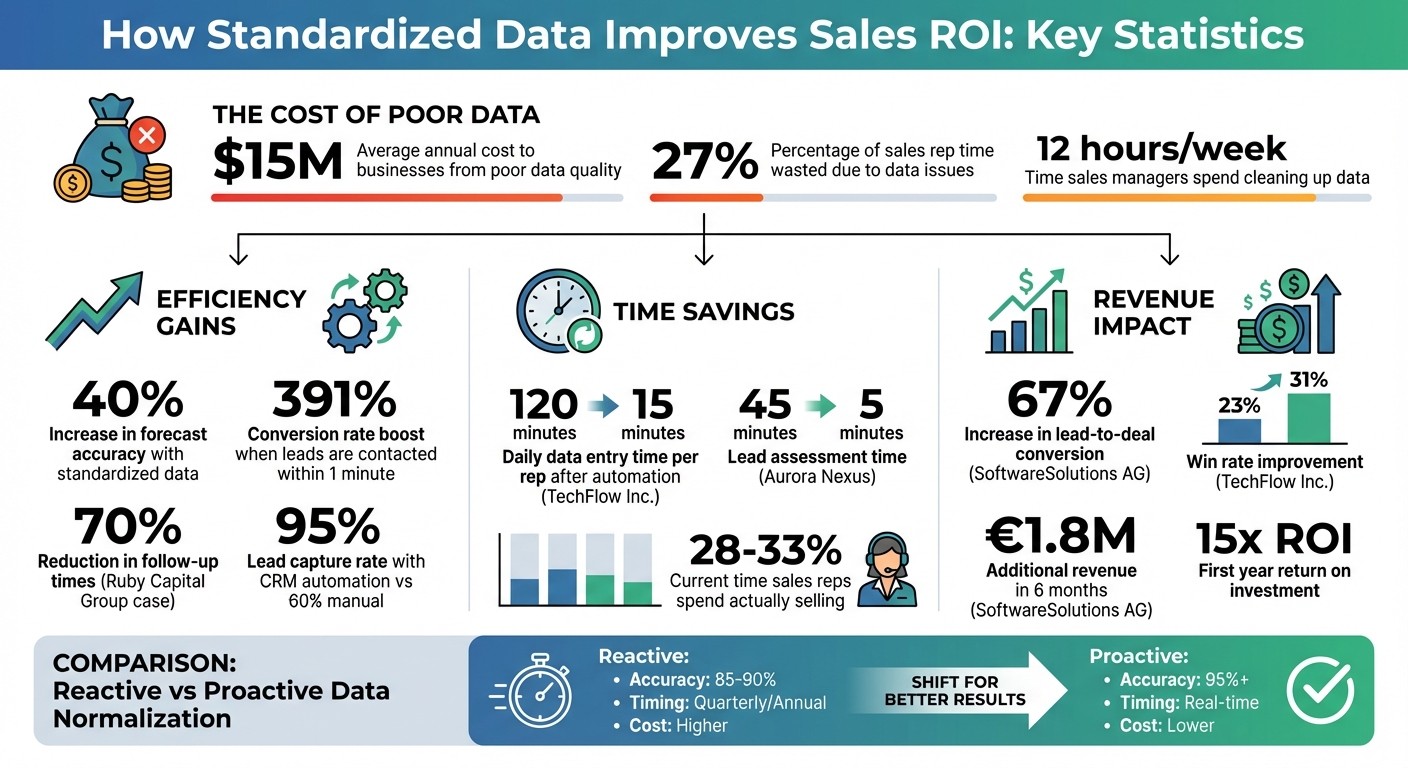
ROI Impact of Standardized Data on Sales Performance: Key Statistics
How Standardized Data Affects Sales Performance
Standardized data reshapes sales operations by improving decision-making, boosting conversion rates, and increasing efficiency. Its influence is particularly noticeable during pipeline reviews, forecast calls, and daily workflows. Let’s break down how these changes lead to more accurate decisions, better conversion rates, and reduced costs.
Better Decision-Making and Forecast Accuracy
Clean, standardized data eliminates the need for offline spreadsheets, making data more reliable and actionable. With consistent data, sales managers can focus on strategic tasks instead of spending an average of 12 hours each week cleaning up data.
For example, in early 2025, a Series B SaaS company introduced stage-gate validation rules requiring Account Executives to verify contact employment status before advancing deals to "Proposal Sent." This simple change boosted forecast accuracy from 68% to 89% in just one quarter by removing outdated contacts.
However, technical issues still exist. Salesforce reporting engines, for instance, truncate "Long Text Area" fields like call notes to 255 characters. By standardizing call outcomes into structured picklists, companies ensure that 100% of activity data is reportable and actionable.
"If the data is not good, the likelihood is you won't get the right insights… [and] sellers will immediately lose confidence in either the system or the leadership." - David Obrand, CEO, Salesloft
Improved Lead Conversion Rates
Standardized data has a direct impact on ROI by speeding up lead response times and improving conversion rates. Automated responses sent within one minute can increase conversion rates by 391%. This level of efficiency is impossible when sales reps are bogged down with manual data entry or when duplicate records - like "IBM" and "International Business Machines" - disrupt routing rules.
In January 2026, Aurora Nexus, a small legal consulting firm, automated its lead qualification process using standardized behavioral data. Lead assessment time dropped from 45 minutes to just 5 minutes per lead, boosting their close rate from 20% to 28% and adding $380,000 in annual billable time.
Similarly, TechFlow Inc., a logistics SaaS startup, implemented automated lead capture and activity logging between April and October 2024. This effort increased their win rates from 23% to 31% and grew their ARR from $1.2M to $1.78M in just six months. Teams using CRM automation capture 95% of leads, compared to just 60% with manual processes.
Lower Costs and Higher Efficiency
Streamlined lead responses not only improve conversion rates but also cut operational costs. Poor data quality costs businesses an average of $15 million annually, while missed follow-ups due to poor tracking can cost $127,000 each year. Addressing these inefficiencies significantly improves sales ROI.
In December 2025, Ruby Capital Group, a funding company with 125 employees, introduced AI-driven agents to manage CRM updates and follow-ups using standardized data fields. Within two days, they reduced follow-up times by 70% and tripled their ticket resolution speed.
"Our sales team was spending half their day on admin work. Now they're talking to customers and closing deals." - Michael Chkechkov, CEO, Ruby Capital Group
Time savings add up quickly. Sales reps currently spend only 28% to 33% of their time selling, with the rest consumed by administrative tasks. Standardizing call outcomes into structured picklists can save about 90 seconds per call, which, across hundreds of interactions, frees up significant time. At TechFlow Inc., daily data entry time per rep dropped from 120 minutes to just 15 minutes after automation.
Factor | Reactive Normalization | Proactive Normalization |
|---|---|---|
Cost | Higher (cleaning services/tools) | Lower (built into capture) |
Timing | Quarterly or annual projects | Continuous, real-time |
Accuracy | 85–90% | 95%+ |
Time to Insight | Days (after cleaning cycle) | Immediate |
Prevention | No (fixes symptoms only) | Yes (prevents problems) |
Companies that adopt AI-driven data hygiene report a 70% increase in productivity and need 17% fewer staff to manage high case volumes.
Case Studies: Measured ROI Gains from Data Standardization
Before and After Metrics
When companies standardize their data, the results often speak for themselves. Take SoftwareSolutions AG, for example. This B2B software company struggled with sales forecasts that were off by 30–40% due to inconsistent lead scoring. Between 2024 and 2025, Anna Schmidt, their VP of Sales, spearheaded the implementation of an AI-powered CRM system to standardize lead data and scoring criteria. The results were impressive: within six months, lead-to-deal conversion rates soared by 67%, forecast accuracy jumped from 60% to 85%, and the company generated an additional €1.8M in revenue - delivering a 15x ROI in just the first year.
"The AI-powered CRM system has transformed our sales process. Our reps now know exactly which leads to prioritize and when to follow up." - Anna Schmidt, VP of Sales, SoftwareSolutions AG
B2B Only, a lead generation firm, faced a different kind of problem. Their campaigns were faltering due to unreliable prospect data. Partnering with SalesIntel, they introduced verified data standards, which led to a 37% increase in project wins, a 32% boost in agent productivity, and a 26% rise in client satisfaction. Meanwhile, in the logistics sector, one company automated its RFQ (Request for Quotation) processing in January 2024. Tasks that previously took 2.5 hours with a 15% error rate now take just 20 minutes with a 3% error rate. This shift saved 86.7 hours per week and delivered a staggering 1,647% annual ROI.
Here’s how these ROI impacts stack up across industries:
Company | Industry | Key Improvement | ROI Impact |
|---|---|---|---|
SoftwareSolutions AG | B2B Software | 67% conversion increase, 85% forecast accuracy | €1.8M revenue, 15x ROI (6 months) |
B2B Only | Lead Generation | 37% more wins, 32% productivity gain | 26% client satisfaction increase |
Logistics Firm | Logistics | RFQ time: 2.5 hrs → 20 min, errors: 15% → 3% | 1,647% annual ROI |
Financial Services | Finance | Reduced churn, avoided hiring costs | $1.6M benefits, 101.3% ROI (3 years) |
These examples highlight the powerful role standardized data can play in delivering measurable results.
Key Takeaways from Successful Implementations
What sets successful data standardization projects apart? Three key traits stand out.
First, they prioritize normalizing data at the point of capture rather than relying on periodic cleanups. This proactive approach achieves 95%+ accuracy, compared to the 85–90% typically seen with reactive cleaning. Second, they focus on automating administrative tasks to free up valuable time. For instance, at Vectra, Senior Director Michael French introduced automated activity logging in Salesforce, cutting 350 hours of manual updates per week. This automation led to over 400 meetings and 500 emails being accurately logged each week. Finally, successful projects concentrate on high-impact fields, such as job titles (to identify decision-makers), company names (to avoid duplicates), and location data (for effective territory planning).
GreenTech Solutions is a perfect example. Between January and June 2024, they implemented an AI-native CRM that standardized data entry. This change reduced weekly admin time per sales rep from 14.2 hours to just 2.1 hours. The extra time was redirected to selling, boosting their close rate from 16.8% to 21.3% and generating $740,000 in annual value. By streamlining data processes, they not only cleaned up their records but also empowered their team to focus on activities that drive revenue, setting the foundation for even greater returns down the line.
How K3X Simplifies Data Standardization

K3X brings an AI-powered approach to data standardization, streamlining the process right at the point of capture. Instead of relying on complex automation setups or manual data cleanup, the platform uses goal-driven prompts to handle standardization automatically.
Automated Data Capture and Real-Time Updates
K3X eliminates the hassle of manual data entry by pulling information directly from emails, calls, and meetings. For example, if a prospect requests a contract during a call, the system logs the activity, updates the pipeline stage to "Contract Sent", and triggers the next step - all in real time.
A great example of this in action comes from Ruby Capital Group, a funding company with 125 employees. In December 2025, they adopted K3X to automate lead qualification and contract routing. Within just two days, CEO Michael Chkechkov reported dramatic results: a 70% reduction in follow-up time and a threefold increase in ticket resolution speed.
"Our sales team was spending half their day on admin work. Now they're talking to customers and closing deals. The automation handles everything from lead qualification to contract routing, and our close rates have never been higher."
Michael Chkechkov, CEO, Ruby Capital Group
By processing unstructured data from sources like emails and call transcripts, K3X ensures that important details are captured and updated instantly. These real-time updates keep sales teams moving faster and more accurately, directly improving ROI.
AI-Powered Analytics
K3X doesn’t just capture data - it makes sense of it. The platform analyzes information in real time, delivering insights that help teams make faster decisions. For instance, its AI-driven lead scoring can identify high-priority prospects using behavioral signals, achieving 70–85% accuracy compared to the 30–40% typical of manual methods.
The benefits don’t stop there:
Automated data capture improves forecast accuracy by 22% and shortens sales cycles by 17%.
Responding to leads within one minute can increase conversions by a staggering 391%.
On average, K3X saves employees 8 hours per week, automates over 312,000 hours of work across 50+ teams, and has saved businesses an estimated $12.4 million in operational costs.
Additionally, users report a 92% increase in report generation speed and near-perfect compliance accuracy at 99.8%. These results provide leadership with actionable insights almost instantly.
K3X vs. Legacy CRMs
Unlike traditional CRM systems that rely on rigid workflows, K3X uses goal-driven prompts to adapt to real-time changes. Legacy CRMs often falter when leads behave unpredictably, as they depend on fixed if-then logic. K3X, on the other hand, allows users to define outcomes - like "Book demo calls with every lead who hasn't responded" - and the AI figures out the steps needed to achieve them. This flexible approach leads to efficiency gains of 70–90%, far surpassing the 40–60% typical of static automation.
Here’s how K3X compares to popular CRM platforms:
Feature | K3X | Salesforce | |
|---|---|---|---|
Monthly Cost (Per User) | $20 | $150 | $90 |
Setup Time | Under 1 Hour | Weeks or Months | Weeks or Months |
Data Entry | Automated | Manual | Manual |
Workflow Logic | Goal-Oriented Prompts | Fixed Sequences | Fixed Sequences |
"Most CRMs record activity. K3X understands outcomes. It listens, knows what changed, and makes the next moves."
Mykyta Samusiev, Co-Founder & CEO, K3X
At just $20 per seat, K3X offers a cost-effective, scalable solution with no long-term contracts. Its ability to standardize data in real time ensures measurable results, making it a standout option for businesses looking to streamline operations and boost ROI.
Best Practices for Measuring and Improving ROI with Standardized Data
How to Calculate ROI
Measuring ROI from standardized data goes beyond just tallying cost savings. The formula to use is: ((Cost Savings + Revenue Lift + Decision Speed Value) - Total Investment) / Total Investment x 100%. Here’s how each component works:
Cost Savings: Comes from reduced administrative work and consolidating tools.
Revenue Lift: Results from improved conversion rates and reduced churn.
Decision Speed Value: Reflects the benefits of faster access to pipeline insights.
When calculating, always use fully loaded labor rates to accurately represent the total cost of labor. For example, if a sales rep earns $80,000 annually but costs $120,000 when benefits and overhead are included, use the $120,000 figure to determine time savings.
Let’s break it down with an example: A 10-person team using K3X at $2,400 per year can be compared to legacy systems like Salesforce ($18,000 annually) or HubSpot ($10,800 annually). Don’t forget to account for additional factors like implementation, training, and maintenance costs to get a full picture of Total Cost of Ownership.
A real-world case study from GreenTech Solutions (January–June 2024) illustrates this well. By cutting weekly admin time per rep from 14.2 hours to 2.1 hours and boosting close rates from 16.8% to 21.3%, they generated $740,000 in annual value. To ensure accuracy, track metrics like pipeline velocity and data completeness using real-time dashboards. Keep in mind that revenue-related metrics may take 6–12 months to fully materialize.
Achieving reliable ROI calculations requires not just accurate math but also solid data governance to ensure consistency from data collection through to analysis.
Setting Up Data Governance
Effective data governance is just as essential as accurate calculations. Start with a data dictionary - a tool that defines standardized formats for details like phone numbers, dates, company names, and job titles across your team. The goal is to normalize data at the point of entry rather than relying on costly cleanup projects down the line. For example, incoming data from emails, LinkedIn, or calls should automatically standardize variations like "VP Sales" and "Vice President of Sales" into a single title.
Proactive governance helps avoid hidden costs. Establish clear accountability frameworks, complete with audit trails, to maintain compliance and build trust. Collect baseline data - such as sales cycle length, win rates, and admin time - for 8–12 weeks to measure progress effectively. Regular monitoring significantly outperforms annual cleanups, achieving over 95% accuracy compared to 85–90% with reactive approaches.
"The winning ROI narrative is not 'we saved 200 hours,' but 'we turned 200 hours into 40 more qualified meetings and 10 more opportunities.'"
EverWorker
Conclusion
Having standardized data in your CRM can directly boost revenue. With clean and consistent information, your team can make quicker decisions, convert more leads, and spend less time on administrative tasks, leaving more room for actual selling. Companies using AI-driven data standardization have reported a 30% increase in revenue per representative. These productivity improvements allow sales teams to connect with more prospects and close deals faster.
K3X offers a fresh approach compared to older systems. Instead of requiring users to manage complex workflows, you simply tell the system what you want - like "Book demos with unresponsive leads" - and the AI takes care of the rest, adjusting dynamically to lead behavior. And it does this at a fraction of the cost of traditional CRMs. By automating tasks like data entry, follow-ups, and pipeline updates, K3X delivers exceptional efficiency. For example, Ruby Capital Group cut follow-up time by 70% within two days, and TechFlow Inc. reduced daily data entry from 120 minutes to just 15 minutes per rep.
"Most CRMs record activity. K3X understands outcomes. It listens, knows what changed, and makes the next moves."
Mykyta Samusiev, Co-Founder & CEO, K3X
Switching from manual data management to AI-powered standardization is what separates teams that simply meet their quotas from those that consistently exceed them. When your CRM works smarter, the hours saved on admin tasks turn into more time spent engaging prospects and gathering actionable insights to drive your next move.
FAQs
What sales data should I standardize first?
To maintain clean and consistent data throughout the sales process, start by standardizing it right at the point of entry. Pay particular attention to contact details (like name, email, and phone number), company data (such as name, industry, and size), and lead qualification information. This approach not only ensures accurate forecasting and better segmentation but also streamlines operations.
By addressing data quality from the beginning, you can avoid costly errors, save valuable time, and make more informed decisions. This becomes especially important when using AI-driven CRMs like K3X, which rely on accurate, real-time data for optimal performance.
How do I measure ROI from standardized sales data?
To gauge ROI effectively from standardized sales data, focus on tracking key metrics such as lead conversion rates, sales cycle length, and improvements in deal size. When your data is accurate and well-organized, it empowers smarter decision-making, which can translate into higher revenue and greater operational efficiency.
Ensuring continuous data validation is essential for maintaining accuracy. This step guarantees that your ROI calculations are grounded in reliable information. Additionally, real-time dashboards can be a game-changer. They allow you to monitor critical outcomes like faster lead response times, higher win rates, and an increase in customer lifetime value. These insights help quantify the tangible impact of your efforts.
How does K3X standardize data automatically?
K3X takes the hassle out of managing data by automatically collecting, sorting, and analyzing first-party inputs such as emails, recorded calls, and pipeline updates - all in real time. This process guarantees consistent, well-structured, and dependable information, eliminating the need for manual work.