

Compare legacy CRMs with AI-native platforms that automate data capture, deliver predictive insights, cut setup time, reduce costs, and improve sales outcomes.
AI-native CRMs outperform older systems by automating tasks, improving efficiency, and delivering actionable insights. Unlike older CRMs that rely on manual data entry and static workflows, AI-native platforms like K3X integrate machine intelligence at their core, saving time and boosting productivity.
Here’s a quick breakdown of the differences:
Data Entry: Older CRMs need manual updates, while AI-native systems automatically log and enrich data.
Workflows: Older systems use rigid "if-then" rules; AI-native platforms adapt dynamically based on context.
Insights: Older CRMs focus on past activity; AI-native systems predict outcomes and suggest next steps.
Setup: Older CRMs take months to implement; AI-native tools are ready in hours.
Cost: AI-native platforms are more affordable, with usage-based pricing.
Quick Comparison
Feature | Older CRM | AI-Native CRM (e.g., K3X) |
|---|---|---|
Data Updates | Manual | Automatic |
Workflow Logic | Rule-based | Context-driven |
Insights | Historical | Predictive |
Setup Time | 6–9 months | Under an hour |
Cost | $150–$300/month per user | $20/month per user |
AI-native CRMs simplify processes, reduce errors, and allow sales teams to focus on closing deals instead of managing data. Platforms like K3X represent a smarter, faster way to manage customer relationships.
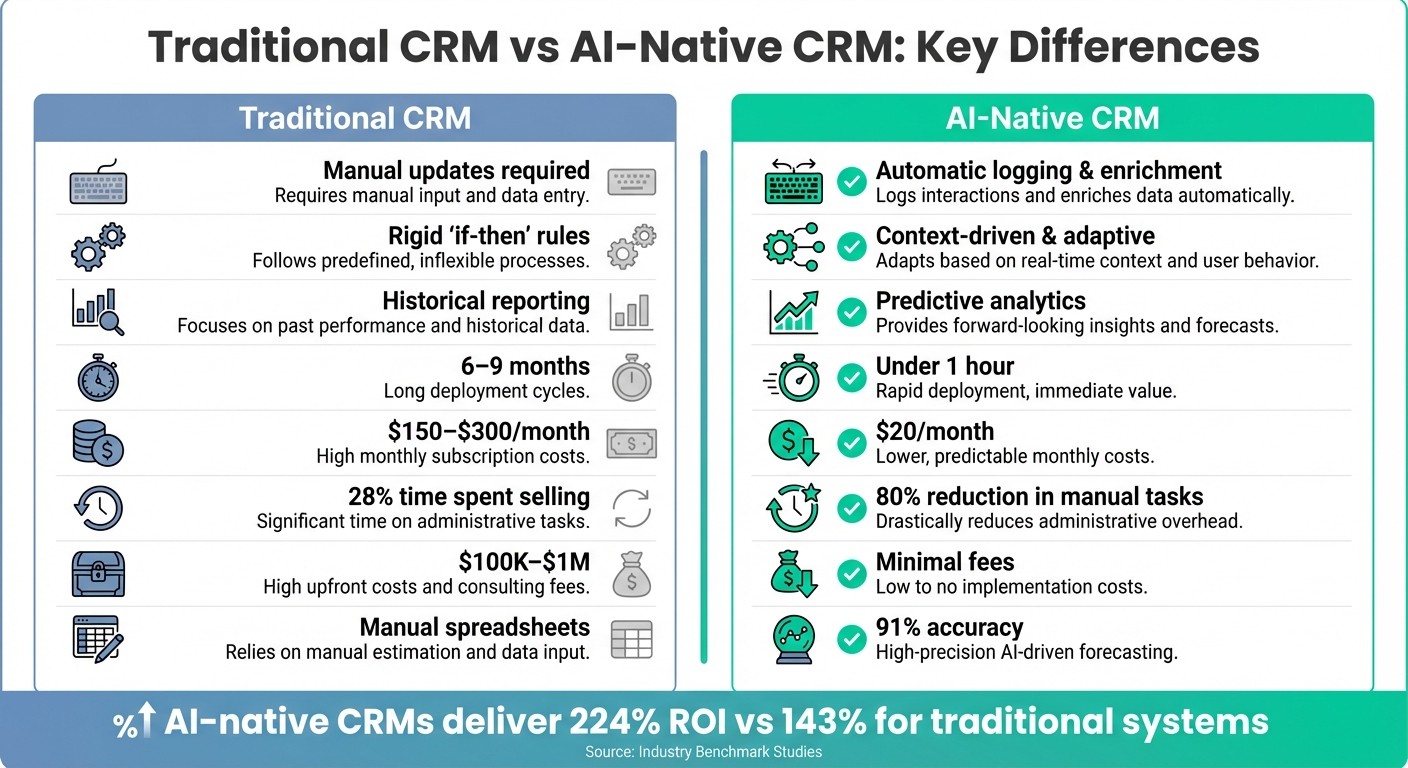
Traditional CRM vs AI-Native CRM: Feature Comparison Chart
AI CRM vs Traditional CRM: What's the Difference?
What is a Traditional CRM?
Traditional CRMs act as centralized databases, storing customer information like contact details and interaction history. However, these systems rely heavily on manual data entry - every call, email, and meeting must be logged by hand. Because of this, data often becomes static and outdated. The structure of these platforms is built around fixed categories - Contacts, Companies, Deals, and Tasks - designed for human input rather than leveraging machine intelligence.
At their core, traditional CRMs focus on contact management, sales tracking, email integration, and historical reporting. Sales teams use them to monitor pipelines, send templated emails, and produce reports based on past activity. While some automation exists, it’s limited to straightforward tasks like email reminders, scheduled follow-ups, and basic "if-then" workflows. This manual approach stands in stark contrast to the more dynamic capabilities of AI-powered CRMs.
The effectiveness of these systems hinges on users manually updating data. Every interaction must be logged to maintain accuracy, placing the burden squarely on the user. This process significantly slows down real-time decision-making and eats into time that could otherwise be spent on actual selling. These challenges have driven many businesses to explore AI-native systems that can automatically capture and update customer interactions.
As industry experts point out:
"Most CRMs added a ChatGPT integration on top of ten-year-old code. AI in that context is a feature. It is not an architecture. It cannot update records it was never designed to maintain." - DelveAnt Founding Team
This passive, reactive design limits traditional CRMs in critical ways. To function effectively, they often require 5 to 15 third-party integrations - tools like dialers, enrichment platforms, and analytics software. Each integration adds potential points of failure and creates data synchronization issues. The implementation process is lengthy, taking anywhere from 3 to 9 months, with costs ranging from $100,000 to $1 million for enterprise setups. The result is a fragmented tech stack where data silos emerge, making it difficult for sales teams to maintain a unified view of their operations. These shortcomings highlight the growing need for AI-native systems in today’s sales landscape.
What is an AI-Native CRM?
AI-native CRMs take customer relationship management to a new level by integrating artificial intelligence at their core, rather than as an afterthought. These systems are built from the ground up with AI, enabling them to autonomously handle tasks like data capture, enrichment, and prioritization. For instance, they can log emails, record calls, and update contact records automatically, eliminating the need for constant manual input.
What sets AI-native CRMs apart is how users interact with them. Instead of navigating through complicated menus or creating rigid workflows, platforms like K3X rely on simple, intuitive prompts. You define the desired outcome - such as "Schedule demo calls with unresponsive leads" - and the AI takes care of the rest. It determines the necessary steps and adjusts dynamically based on lead behavior. This outcome-driven approach replaces the traditional step-by-step logic, making the system far more adaptable and efficient.
The shift from tracking activities to understanding outcomes is a game-changer:
"Most CRMs record activity. K3X understands outcomes. It listens, knows what changed, and makes the next moves." - Mykyta Samusiev, Co-Founder & CEO, K3X
This approach has tangible benefits. K3X users report saving 80% of the time typically spent on manual tasks. In traditional CRMs, sales reps often spend only 25% to 30% of their day on actual selling, with the rest consumed by administrative tasks like data entry. By automating repetitive duties - such as updating deal stages, refreshing records, and identifying risks - K3X has saved over 245,000 work hours and reduced costs by approximately $12.4 million.
A compelling example of this efficiency comes from Ruby Capital Group. In December 2025, the 125-person funding company implemented K3X's AI-driven agents. The system was fully operational in just two days, a stark contrast to the weeks or months traditional CRM setups often require. The results? Ruby Capital Group cut follow-up time by 70%, tripled ticket resolution speed, and achieved its highest close rates ever. This rapid deployment and measurable impact highlight the transformative potential of AI-native CRMs.
Architecture: Bolt-On AI vs Built-In Intelligence
The key difference between traditional CRMs and AI-native platforms lies in how they are designed at their core. Traditional CRMs like Salesforce or HubSpot incorporate AI as an afterthought - a feature layered onto older, legacy systems. These platforms were originally built as digital filing systems, primarily for manual data entry and recordkeeping.
This approach has significant consequences for system functionality. In contrast, AI-native CRMs like K3X are designed with AI at their foundation. Here, intelligence isn’t just an add-on - it’s integrated into every part of the system, from data collection to decision-making. David Zhu from Reevo puts it succinctly: “Bolted-on AI runs on top of a passive database, whereas AI-native means the entire engine is an active system of intelligence, built from the ground up to be unified”.
This fundamental design difference impacts how data is handled and utilized. Traditional CRMs rely on rigid structures - Contacts, Companies, Deals - that are optimized for manual input. On the other hand, AI-native platforms use adaptable data models built for machine learning. This allows them to detect patterns and make decisions autonomously.
Another major distinction lies in how these systems integrate with other tools. Traditional CRMs depend on third-party solutions like Gong for calls, Outreach for sequences, or ZoomInfo for data enrichment. This creates fragmented data silos and what experts refer to as “data fog”. AI-native systems like K3X, however, consolidate all first-party data - emails, calls, meetings - into one platform. This unified approach provides complete visibility into customer interactions and automates data upkeep, cutting administrative tasks by 40–60%.
Below is a table summarizing these architectural differences:
Comparison Table: Traditional vs AI-Native Architecture
Feature | Traditional CRM (Bolt-On AI) | AI-Native CRM (Built-In Intelligence) |
|---|---|---|
Core Engine | Passive database for recordkeeping | Active system of intelligence |
Data Structure | Rigid, human-centric objects | Flexible, machine-learning optimized |
AI Integration | Fragmented third-party tools | Unified, first-party data foundation |
Data Capture | Manual entry and activity logging | Automatic capture and enrichment |
Workflow Logic | Rule-based "if-then" sequences | Dynamic, context-aware AI agents |
Analytics | Reactive, backward-looking reporting | Proactive, forward-looking insights |
Data Management: Manual Entry vs Automated Updates
Traditional CRMs often burden sales reps with tedious manual data entry tasks. These responsibilities can eat up a significant portion of their time - leaving sales reps with only about 35% of their work hours dedicated to actual selling activities [18, 19]. On average, manual data entry takes over 20 hours per week per employee. However, AI-native systems are changing the game by automating these processes, making data management smoother and more efficient.
Take AI-native CRMs like K3X as an example. These platforms automatically log interactions from emails, calendars, and phone systems. Whether it’s an email reply or a call with a prospect, K3X instantly records the details. It also enriches records in real time with useful information like job titles, company funding data, and LinkedIn profiles, completely removing the need for manual updates [18, 4]. This automation doesn’t just save time - it speeds up follow-ups and helps resolve tickets much faster.
Automation goes beyond just saving time on admin work; it also simplifies pipeline management. In traditional systems, sales reps have to manually update deal stages, which often results in outdated pipelines. With K3X, deal stages are automatically updated based on actual conversation outcomes, eliminating the need for manual clicks. For example, between November 2025 and January 2026, Arnaud Belinga, the founder of Breakcold, used an AI-native system to eliminate manual data entry for roughly 1,000 tasks, saving him 83 hours of administrative work in just three months.
Manual entry also introduces errors - typos, duplicate records, and incomplete fields - that can compromise data quality. AI-native systems solve this issue with continuous enrichment agents that automatically verify and update information [18, 4]. This automation not only improves data accuracy but also frees up an additional 8–12 hours per week per rep, allowing them to focus on engaging with customers and closing deals. The result? A direct boost to sales productivity [12, 18].
Comparison Table: Data Management Approaches
Feature | Traditional CRM | AI-Native CRM (K3X) |
|---|---|---|
Data Entry Method | Manual logging; copy-paste from emails and calls [12, 19] | Automated capture from email, calendar, and transcripts [12, 18] |
Data Freshness | Quickly outdated; requires regular audits [18, 21] | Continuously updated via real-time enrichment [18, 4] |
Pipeline Updates | Manual stage changes; leads may stagnate | Auto stage updates based on interaction outcomes |
Time Commitment | Over 20 hours per week per rep | 80% reduction in manual work |
Error Rate | High; prone to typos and duplicates [18, 7] | Minimal; standardized across verified sources |
Rep Focus | Administrative tasks ("data janitoring") [3, 4] | Focus on relationship building and closing deals [12, 18] |
Predictive Capabilities: Reactive Reporting vs Forward-Looking Insights
Traditional CRMs are all about looking backward. They track past interactions and generate dashboards showing completed activities - like how many calls were made or deals were closed in a given period. The problem? By the time these reports are ready, the window of opportunity may have already closed. Sales teams are left relying on outdated data and manually building reports, which slows down decision-making.
AI-native CRMs like K3X flip this script entirely. Instead of waiting for you to dig through data, K3X actively predicts what’s coming next by continuously analyzing emails, website behavior, and social signals. Take this example: if a prospect visits your pricing page multiple times in one week, K3X doesn’t just log it. It sends an alert to your sales rep and suggests the best time and method to follow up. This kind of proactive insight leads to sharper forecasts and more agile sales strategies.
The impact on forecasting is huge. Traditional systems often rely on manually updated spreadsheets, which can skew projections. AI-native platforms, on the other hand, use real-time data and machine learning to achieve forecasting accuracy rates as high as 91%. Some even go further, using Monte Carlo simulations that incorporate live pipeline data and economic trends to produce highly reliable revenue forecasts.
This evolution from reactive to predictive fundamentally changes the game for sales teams. Instead of wasting time combing through past reports, reps get real-time recommendations on who to contact, when to reach out, and how to engage - directly improving conversion rates. For example, dealerships using AI-driven CRMs reported a 29% jump in appointment bookings and a 32% increase in lead-to-sale conversions.
Automation and Workflows: Step-Based vs Prompt-Driven
Traditional CRMs often rely on rigid workflows built on "if-this-then-that" logic. Setting them up can be a headache, requiring technical know-how and significant manual effort. And when your sales process shifts, someone has to go back and reconfigure those workflows. These systems just don’t keep up with the pace of change. As a result, sales reps can end up spending 30% to 40% of their time on administrative tasks like data entry instead of focusing on selling.
AI-native CRMs, like K3X, offer a completely different approach. Instead of forcing you to predict every possible scenario upfront, K3X uses prompt-driven automation. It learns from your interactions - emails, calls, and social media - to handle tasks in real time. Leads move through the pipeline, follow-up actions are created, and records are updated automatically, all based on context rather than static rules. This makes routine tasks feel effortless.
"Traditional CRMs add AI features. AI-native CRMs run on AI." - Arnaud Belinga, Founder of Breakcold
One of the biggest drawbacks of traditional systems is their dependency on constant manual updates to keep pipelines accurate. This not only frustrates users but also leads to poor adoption rates. K3X, on the other hand, eliminates these pain points by pulling data directly from conversations, emails, and calls - no manual input required. For example, if a prospect responds to an email showing interest, K3X automatically updates the deal stage and suggests the next step.
This transition from step-based workflows to prompt-driven systems allows sales teams to reclaim 40% to 50% of their time. Instead of wrestling with dashboards or manually generating reports, sales reps can simply ask K3X natural language questions like, "Which deals are at risk?" and get immediate, actionable insights. The system doesn’t just summarize past activities; it actively guides what to do next.
Comparison Table: Workflow Automation
Feature | Traditional CRM (Step-Based) | K3X (Prompt-Driven) |
|---|---|---|
Setup Requirement | Extensive manual configuration and technical expertise | Minimal setup; learns and adapts automatically |
Workflow Logic | Rigid "if-then" rules requiring constant updates | Dynamic, context-aware decisions based on real-time behavior |
Data Management | Manual entry for every contact and pipeline change | Automated capture from emails, calls, and social interactions |
Lead Movement | Manual stage updates or simple trigger-based rules | Automated lead progression based on conversation context |
User Interaction | Navigate complex menus and dashboards manually | Natural language prompts and conversational queries |
Adaptability | Static; requires reconfiguration when processes change | Self-updating; adapts to business needs in real time |
Deployment and Scalability: Complex Setup vs Fast Implementation
When it comes to deployment and scalability, traditional CRMs and AI-native systems like K3X couldn't be more different. Traditional CRMs are notorious for their lengthy implementation timelines - typically stretching from 6 to 9 months - and their heavy reliance on IT resources and consultants. Even with all this effort, 72% of these projects fail to meet their objectives.
The costs associated with traditional CRMs are equally daunting. Monthly fees range from $150 to $300 per user (often locked into 1–2-year contracts), and the total cost of ownership over three years can balloon to $500,000 to $4 million. This figure includes $100,000 to $1 million in implementation fees alone. As businesses expand, scaling these systems adds even more expenses, with costs for new users, integrations, and workflow adjustments ranging from $10,000 to over $100,000.
AI-native CRMs like K3X completely flip this script. Ruby Capital Group, with 125 employees, managed to implement K3X in just 2 days. The result? A 70% cut in follow-up time and ticket resolution speeds that tripled. Setting up K3X is refreshingly simple - connect your email and phone tools, define a few rules using prompts, and you're ready to go. The whole process takes anywhere from a few minutes to less than an hour.
"It just works! No third-party apps, Zaps, or Makes - it works right out of the box, as you'd expect." - Mykyta Samusiev, Co-Founder & CEO, K3X
Scaling is another area where K3X shines. Traditional CRMs often require hiring additional administrative staff as teams grow. In contrast, K3X scales automatically, charging $20 per seat per month with no long-term contracts. Costs adjust dynamically based on usage, and during slower months, expenses go down. The AI handles increased data volumes effortlessly, reducing administrative work by 40% to 60%. These efficiencies lead to tangible results: companies using AI-native CRMs report an average ROI of 224%, compared to 143% for traditional systems.
Comparison Table: Deployment and Scalability
Feature | Traditional CRM | K3X (AI-Native) |
|---|---|---|
Setup Time | 6–9 months | Minutes to <1 hour |
Implementation Cost | $100,000 to $1,000,000 | Minimal fees |
Monthly Cost per User | $150–$300 | $20 (usage-based) |
Total 3-Year Ownership | $500,000–$4,000,000 | Much lower; 224% ROI |
Scalability Model | Linear; more staff needed | Exponential; AI scales automatically |
Integration Complexity | 5–15 third-party apps | Works natively |
Customization | Code-heavy, expensive | Prompt-driven, automatic |
Contract Terms | 1–2 year commitments | No long-term contracts |
These differences make it clear why AI-native CRMs like K3X are redefining efficiency and delivering faster, more impactful results for businesses.
Sales Outcomes: Activity Tracking vs Results Optimization
Traditional CRMs primarily act as digital logbooks, requiring sales reps to manually record calls, emails, and meetings. While they excel at tracking the sheer number of activities, they fall short in showing how these actions influence deal progression. This focus on activities rather than results means sales teams spend more time on data entry and less on actual selling. The result? A system that reveals what reps are doing but doesn’t help them close deals faster or improve conversion rates. To truly drive sales success, the conversation needs to shift from tracking activities to optimizing outcomes.
AI-native CRMs, such as K3X, take a completely different approach. Instead of just keeping tabs on activities, they prioritize measurable results - like increasing conversion rates, accelerating deal cycles, and generating predictable revenue growth. These platforms analyze the context of every interaction and autonomously work toward specific goals, whether that’s scheduling a demo or finalizing a deal. By using goal-oriented logic rather than rigid, step-by-step processes, AI-native CRMs adapt dynamically to how prospects respond.
"Most CRMs record activity. K3X understands outcomes. It listens, knows what changed, and makes the next moves." - Mykyta Samusiev, Co-Founder & CEO, K3X
The impact of these advancements is significant. AI-native CRMs can boost lead-to-opportunity conversion rates by 25–40%, cut sales cycle times by 35%, and increase annual revenue by 6–10%. For instance, Ruby Capital Group adopted K3X in December 2024 and saw a 70% reduction in follow-up time while tripling ticket resolution speed. This allowed their team to spend more time closing deals instead of managing administrative tasks.
Beyond just improving outcomes, these platforms dramatically reduce the burden of manual work. AI-native CRMs can eliminate 40% to 60% of repetitive tasks, freeing up nearly half of a sales rep’s day for actual selling. Take T‑Mobile, for example: in 2025, they reported a 30% increase in lead conversion rates and a 15% boost in sales productivity after integrating AI-native tools. Similarly, SuperAGI achieved a 25% uptick in qualified leads and slashed manual tasks by 40% after transitioning to an AI-native system. These changes don’t just enhance efficiency - they create a ripple effect that drives sustained revenue growth. The move toward optimizing sales outcomes is a logical next step, building on the real-time insights and smarter data management that AI-native CRMs provide.
Conclusion: Why AI-Native CRMs Deliver Better Results
Traditional CRMs focus on documenting past events, while AI-native platforms like K3X are built to shape future outcomes. Instead of retrofitting AI into an outdated framework, platforms like K3X embed intelligence at their core, creating a system designed to deliver consistent, forward-looking results. This fundamental difference translates into measurable performance improvements.
Consider this: sales reps using traditional CRMs spend just 28% of their time actually selling. In contrast, K3X users report an 80% reduction in manual tasks, automating over 245,000 hours and saving an estimated $12.4 million in operational costs. Moreover, companies leveraging AI-native systems are three times more likely to achieve meaningful business outcomes compared to those trying to retrofit legacy solutions.
K3X takes a prompt-driven approach, allowing users to set specific goals - like "Book demo calls with unresponsive leads" - and then autonomously executing the necessary steps. Traditional CRMs rely on rigid "if-then" workflows, while K3X dynamically adapts to how prospects engage, continuously pursuing the desired outcomes.
Another standout advantage? Deployment. Traditional CRMs often require three to nine months of complicated setup. K3X, on the other hand, can be up and running in under an hour, with no technical expertise or third-party tools required. This streamlined implementation process helps businesses quickly unlock revenue-driving capabilities.
K3X reimagines CRM entirely, shifting it from a passive data repository to an active revenue engine. With lead scoring accuracy reaching 89% and sales forecasting accuracy hitting 91%, K3X doesn't just monitor sales activity - it actively drives growth. By automating repetitive tasks, delivering actionable insights, and supporting real-time decision-making, K3X transforms CRM into a tool that fuels continuous revenue generation.
FAQs
How does an AI-native CRM keep data accurate without manual entry?
An AI-powered CRM keeps your data accurate by analyzing interactions and updating leads, pipelines, and follow-ups automatically. This eliminates the need for manual updates, ensuring your information stays current. By using AI-driven insights and automating tasks, it simplifies workflows and minimizes errors, saving both time and effort.
What data does K3X use to generate predictions and next-step recommendations?
K3X uses real-time data, such as customer interactions and activities, to create predictions and suggest next steps. It continuously updates leads, pipelines, and follow-ups with this information, delivering precise and actionable insights.
How hard is it to migrate from a traditional CRM to K3X?
Migrating to K3X is designed to be straightforward and user-friendly. Unlike older CRM systems that often involve complicated setups and require extensive technical know-how, K3X simplifies the process with its prompt-driven approach. It automatically updates leads, pipelines, and follow-ups in real-time, cutting down on manual work and technical hurdles. This makes the transition far smoother and more efficient than what you'd typically encounter with traditional CRM migrations.