

10 warning signs your sales team needs CRM automation — stop losing time to manual data entry, missed follow-ups, messy spreadsheets, and slow reporting.
Your sales team is losing time and money on manual tasks. If your team spends more time on spreadsheets than selling, or if follow-ups and reporting are a nightmare, you're overdue for CRM automation. Here's why:
Missed follow-ups cost businesses $127,000 annually.
Sales reps spend just 36% of their time selling. The rest goes to admin work.
Teams with CRM automation capture 95% of leads vs. 60% with manual processes.
Manual data entry eats up hours, disrupts focus, and leads to errors.
Without automation, reporting is slow and unreliable, delaying key decisions.
CRM automation tools streamline workflows, reduce admin tasks, and boost productivity. They handle repetitive work like data entry, follow-ups, and lead scoring, freeing your team to focus on closing deals. If you're still relying on spreadsheets or struggling with siloed data, it's time to rethink your approach.
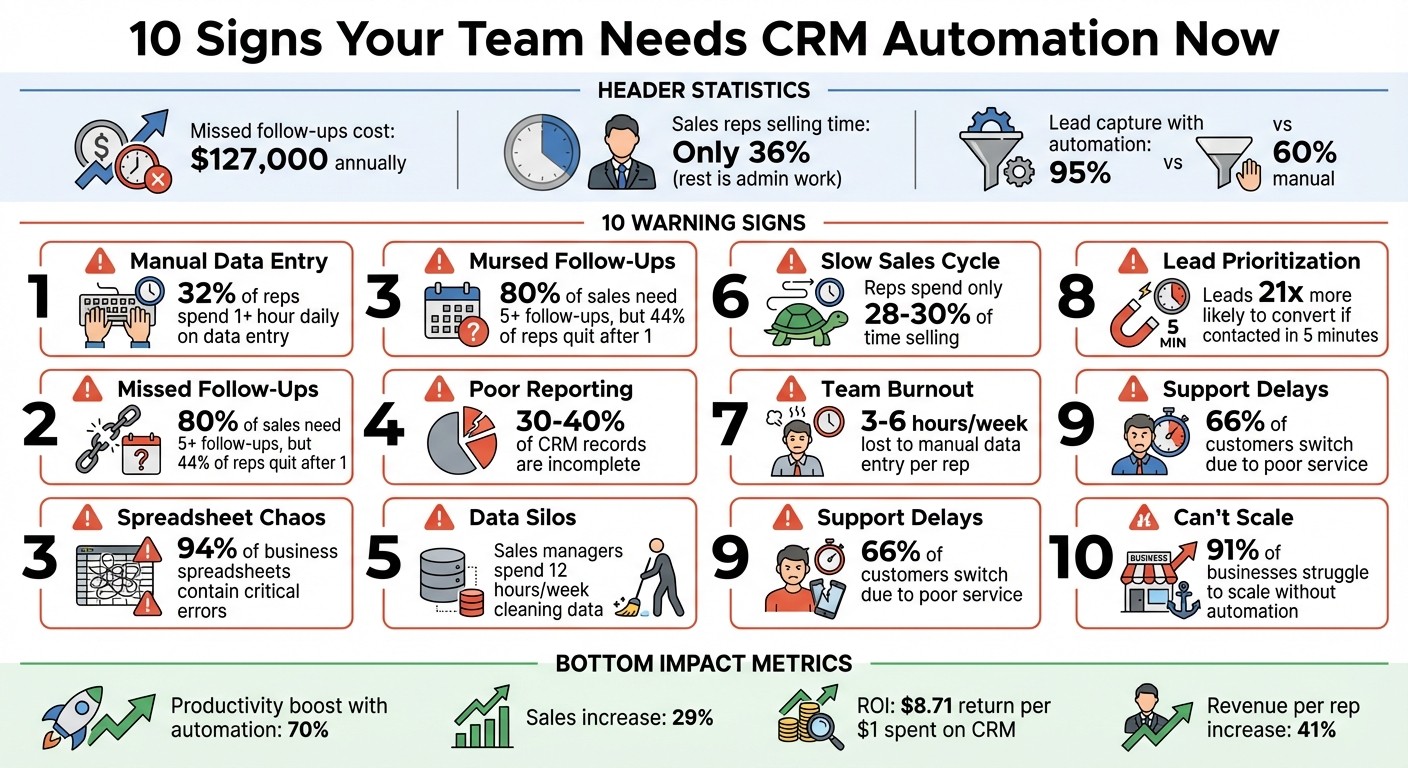
10 Signs Your Team Needs CRM Automation: Key Statistics and Impact
CRM Automation: 5 Tips & Best Practices for Streamlining Sales & Support
1. Manual Data Entry Takes Up Too Much Time
Did you know that 32% of sales reps spend over an hour every day on manual data entry instead of connecting with customers? That’s a huge drain on time and revenue. For a 10-person team, just 30 minutes lost per rep each day adds up to 25 hours of missed selling time every week - costing the company around $60,000 annually.
Switching between conversations and CRM updates doesn’t just waste time - it disrupts focus. This "resumption lag", as researchers call it, creates mental friction that breaks a salesperson's flow. Sami AZ, Founder of Klu, sums it up perfectly:
"This manual friction is the silent killer of revenue. It forces representatives to choose between selling and reporting".
Time Saved Through Automation
Here’s a real-world example: from April to October 2024, TechFlow Inc., a logistics SaaS startup, replaced manual Salesforce updates with Optifai's automated system for their 12-person team. The results were incredible. Daily data entry time per rep dropped from 120 minutes to just 15 minutes. With this extra time, the team increased weekly customer meetings by 50%, improved their win rate from 23% to 31%, and grew their ARR from $1.2M to $1.78M in just six months.
AI tools like K3X make this possible by automatically capturing data from emails, calendars, and meetings. They transcribe calls, pull out action items, and update CRM contact records - leaving reps to simply review summaries instead of entering everything manually.
Impact on Team Productivity
When manual data entry becomes too much, sales reps often ditch the official CRM for "shadow CRMs" - think personal spreadsheets, sticky notes, or email folders. This scattered approach makes it harder for leadership to track progress, undermines forecasting, and creates chaos during handoffs to customer success teams.
Automation changes the game. With AI-powered tools, reps can cut data entry time from 5–15 hours a week to just 0–1 hour spent reviewing AI updates. That’s the difference between treating your top performers like clerks and freeing them up to focus on what they do best - building relationships and closing deals.
Up next, let’s look at how missed follow-ups can derail your sales pipeline.
2. Your Team Misses Follow-Ups and Loses Deals
Did you know that 80% of sales require at least five follow-ups to close, yet a staggering 44% of sales reps give up after just one attempt? That gap is where revenue quietly slips away. When follow-ups aren’t handled consistently, opportunities are lost - and so are deals.
Relying on manual methods like sticky notes or calendar reminders makes it easy for prospects to fall through the cracks. Sales reps often juggle dozens of leads at different stages, and without a structured system, follow-ups can easily get overlooked. As Nikias Kray aptly says:
"Follow-up is not an action. It's a process with rules".
Without a proper process, timely responses - critical for conversions - become the exception rather than the rule.
Impact on Team Productivity
Timing is everything in sales. Companies that respond to leads within five minutes are nine times more likely to convert them. Plus, 35–50% of sales go to the vendor who responds the fastest. Relying on manual tracking is like rolling the dice on perfect timing - and more often than not, it doesn’t pay off.
This is where CRM automation shines. It reacts to real-time triggers, like when a prospect opens a pricing email or visits a case study page. Instead of relying on memory, the system sends instant alerts to your team or even dispatches follow-up messages automatically.
Improvement in Customer Experience
From a buyer's perspective, inconsistent follow-ups can feel like being ignored. A delayed, generic “just checking in” email doesn’t cut it, especially when a prospect has already shown interest. Buyers expect personalized, timely communication that reflects their specific needs.
Modern CRM tools make this possible with multi-channel follow-up orchestration. Whether it’s email, WhatsApp, or SMS, these tools ensure your message reaches prospects where they’re most active. AI-powered systems can even sort incoming replies by intent, directing “I’m interested” responses to the right rep while filtering out-of-office replies or unsubscribes. This allows your team to focus on high-value conversations instead of wasting time on administrative tasks.
Take K3X, for example. By using AI-driven automation, it fine-tunes follow-ups to match buyer behavior in real time. This ensures that the necessary 5–8+ touchpoints required in B2B sales actually happen, every single time. With CRM automation, your team eliminates delays and taps into its full revenue potential.
3. Spreadsheets Are Messy and Hard to Manage
If your team is still juggling leads in outdated files like "Client_Database_final_v3.xlsx", you're not alone - but you're likely falling behind. Spreadsheets often lead to chaos: multiple versions, conflicting data, and outdated information. Let’s dive into how these issues hurt team productivity and growth.
Impact on Team Productivity
Here’s a startling fact: 94% of business spreadsheets contain critical errors that can cost time and money. A small mistake - like a typo, a deleted row, or a misplaced column - can lead to quoting incorrect prices or losing essential customer details. Even worse, sales reps often spend 5 to 10 hours per week on manual data entry instead of closing deals.
Steli Efti, CEO of Close, puts it this way:
"Spreadsheets are a huge step up from Post-it notes and email threads... That said, it doesn't have the mobility and features that a true CRM software does."
CRM software eliminates these headaches by automating lead capture, keeping records up to date in real time, and providing everyone access to one centralized system. Take Avison Young, for example. In 2025, the real estate advisory firm ditched four separate CRMs for 1,600 brokers across North America. Within just four months, they increased user adoption from 23% to 90% and tracked 95% of their revenue in a unified system.
Scalability and Adaptability of the Solution
Spreadsheets aren’t just prone to errors - they’re also limited in scope. They show static data like "last contacted" dates but lack the depth of interaction histories or automated follow-ups. As your team grows, managing spreadsheets becomes an even bigger headache.
Kevin Bossons, Senior Digital Strategist at WT Digital, explains:
"The longer you stay in spreadsheets, the more leads you lose, the more time you waste, and the harder it becomes to scale."
Modern CRMs like K3X solve these problems with automated workflows and real-time dashboards. Instead of scrolling through endless rows and columns, your team gets instant insights, automated task assignments, and up-to-date deal tracking. By replacing spreadsheets with AI-powered systems like K3X, you don’t just recover lost productivity - you create a foundation for long-term growth.
4. You Can't Get Clear Reports When You Need Them
When data entry is inefficient and follow-ups are inconsistent, reporting issues only add to the chaos. Imagine spending 6 hours piecing together data from scattered spreadsheets - this not only drains time but also compromises accuracy. By the time you’ve compiled last month’s numbers, the market may have shifted, leaving you chasing opportunities that have already slipped away.
Impact on Team Productivity
Reporting is one of the biggest pain points in manual CRM processes. Sales managers, for example, spend around 12 hours each week just cleaning CRM data for reports. On top of that, 30–40% of CRM records in manual systems are incomplete, which makes reports unreliable. It’s a vicious cycle - when your data is flawed, your reports are flawed too. As Vincent Roulois from Praiz aptly puts it:
"Your CRM isn't broken; it is starving for truth. Most databases today are essentially data graveyards, clogged with obsolete, incomplete, or flat-out wrong information."
Without accurate, up-to-date data, teams are left relying on gut feelings instead of solid insights. This lack of clarity makes it hard for leadership to identify which deals need attention, which reps are struggling, or where bottlenecks exist in the sales funnel. Unlike data entry issues, reporting delays directly impact decision-making. The consequences are costly - 78% of businesses lose potential customers because they lack systems to properly track and nurture leads, resulting in an average of $127,000 in missed revenue annually.
Time Saved Through Automation
Automation completely changes the game. Tasks that once took hours - like generating reports - can now be done in seconds with automated dashboards. Take this example: in 2025, a B2B SaaS startup with a small, 5-person sales team adopted automated CRM reporting. The results? Their sales cycle shrank from 120 days to 62 days - a 48% improvement. Forecasting accuracy shot up to 94%, and they closed 28 deals instead of the expected 18, bringing in an extra $560,000 in revenue within just six months.
Tools like K3X streamline the process by automatically pulling data from emails, calls, and meetings, eliminating the need to chase team members for updates or reconcile mismatched spreadsheets. Instead of spending hours compiling reports, you get real-time dashboards that show exactly where each deal stands. It’s no wonder that top-performing sales teams are 1.5 times more likely to use fully automated CRM processes compared to their underperforming counterparts. With automated reporting, you’re not just saving time - you’re transforming static data into actionable insights that drive smarter decisions and better results.
5. Departments Don't Share Information Well
When sales, marketing, and support teams operate in separate systems, vital information gets stuck in silos. This leads to duplicated efforts, mixed messages, and inefficient handoffs, which can make team responsibilities unclear.
Impact on Team Productivity
Siloed data makes existing inefficiencies even worse. Hours are wasted as team members search for missing context, reconcile conflicting records, or repeat tasks. For instance, sales managers can spend up to 12 hours a week just organizing data to create reports. Stephanie Trovato from monday.com highlights the solution:
"A collaborative CRM changes that by giving sales, marketing, and support a shared view of every interaction, so context travels with the customer instead of getting lost between departments."
Automation plays a crucial role in breaking down these barriers by connecting information across departments.
Time Saved Through Automation
With CRM automation, all key information - like emails, calls, notes, and purchase history - is centralized in one place, creating a single source of truth. Automated workflows ensure seamless handoffs. For example, when a deal closes, the customer success team is instantly notified, allowing onboarding to begin without delays. Tools like K3X take this further with features like Smart Owner Assignment, which automatically routes leads to the right team member based on criteria like region, industry, or lead score.
Ruby Capital Group, a funding company with 125 employees, implemented K3X's AI-driven agents in December 2025. Within just two days, they cut time spent on follow-ups by 70% and tripled their ticket resolution speed. Michael Chkechkov, CEO of Ruby Capital Group, shared:
"Our sales team was spending half their day on admin work. Now they're talking to customers and closing deals."
Improvement in Customer Experience
Automation doesn’t just save time - it also improves the customer experience. With every department having access to a complete interaction history, customers no longer have to repeat themselves or deal with inconsistent information. This is crucial, as 92% of consumers expect brands to respond to negative experiences within 24 hours. Rachel Fagan, VP of Marketing at Happy Wax, explained:
"Having everything in one place is a game changer. Everything is just so much more tailored to the customer, which then increases loyalty, increases purchase frequency, and will also affect our lifetime value."
By unifying systems, businesses can tailor every interaction, driving customer loyalty, repeat purchases, and higher lifetime value. Additionally, unified dashboards provide leadership with a complete view of key metrics - like lead conversion rates and customer satisfaction - enabling smarter decision-making. Teams using CRM automation report impressive results, with 67% more likely to see high ROI. On average, every dollar spent on a CRM system generates about $8.71 in return.
This streamlined approach not only improves collaboration but also sets the stage for tackling administrative delays. Next, we’ll look at how these burdens further slow the sales cycle.
6. Admin Work Slows Down Your Sales Cycle
Sales reps spend just 28–30% of their week selling, while the rest of their time is swallowed up by administrative tasks like logging calls, updating records, and drafting follow-ups. This imbalance can severely impact revenue. Justin Herrick from Reevo puts it bluntly:
"Your top account executive, the $150,000 seller you hired to close deals, spends less than 30% of their time actually selling. The other 70% of their time? They're a data-entry clerk."
Impact on Team Productivity
After every sales call, reps often face a 15–45 minute "cleanup" period to log details, update deal stages, and plan next steps. It’s no surprise that 71% of salespeople say they spend too much time on data entry instead of selling. On top of that, constant interruptions - averaging 1,200 per day - can derail focus, with each disruption requiring up to 23 minutes to recover.
The consequences of these inefficiencies are clear. Companies that respond to leads within five minutes are 100 times more likely to make contact compared to those that wait 30 minutes. Delayed responses and unrecorded data can mean missed opportunities and lost deals.
Time Saved Through Automation
Automation changes the game by handling repetitive tasks. AI-powered CRMs can automatically capture details from email signatures, transcribe meetings, log calls, and create post-call summaries with actionable next steps - all in real time. Instead of spending 45 minutes on post-call admin, reps can review AI-generated notes in under a minute. This speed not only reduces administrative delays but also allows teams to respond to leads faster, keeping the sales cycle on track.
K3X takes automation even further with its conversational interface. Reps can interact with the system using prompts instead of navigating forms. The platform automatically logs emails, calls, and meetings while updating pipeline stages in real time. At only $20 per seat per month (including 1,000 AI credits), K3X offers unlimited workflow automations and built-in communication tools - without the usual complexity of traditional CRMs.
By cutting down on busywork, automation doesn’t just improve day-to-day productivity - it lays the groundwork for long-term growth.
Scalability of Automation
The benefits of automation extend far beyond immediate time savings. As deal volumes grow, traditional CRMs often require more manual effort, forcing companies to either hire additional support or risk losing opportunities. AI-powered systems, on the other hand, scale effortlessly, ensuring productivity stays consistent no matter the workload.
Take the example of a 5-person B2B SaaS sales team. In 2025, they implemented stage-based pipeline automation and automated meeting scheduling. The results? Their average sales cycle dropped from 120 days to 62 - a 48% reduction - while admin time for reps fell from 40% to just 10% of their week. Sami AZ from Klu sums it up perfectly:
"True productivity does not come from making the form easier to fill out. It comes from removing the form entirely."
7. Your Team Is Overworked and Burned Out
When your top performers are stuck handling endless administrative tasks, it becomes obvious - and costly. Sales reps, on average, spend 3 to 6 hours every week on manual data entry. But the problem goes deeper than time lost. Pete Artemiou from Aspire Digital captures the issue perfectly:
"Every minute your best reps spend wrestling with manual data entry or searching for information across multiple systems is time they could spend building relationships and closing deals."
How Productivity Takes a Hit
Reps lose nearly 30% of their work week - equivalent to almost two full days - on tasks like updating spreadsheets and logging data. This misuse of talent leads to "CRM fatigue", a term for the mental strain caused by repetitive data entry. It disrupts focus and contributes directly to burnout. Add in the constant need to switch between tasks, which research shows takes 23 minutes to recover from each time, and the problem compounds.
Automation offers a way to break this cycle.
Automation: A Game-Changer for Time Management
By automating repetitive tasks, your team can focus on what they do best - selling. CRM automation eliminates the "6-hour black hole" of admin work. Take Acme Manufacturing, for example: in July 2025, they adopted CRMLeaf's CRM + ERP platform and slashed their team's administrative workload by 75%. Quote generation, which used to take 2 hours, now takes just 15 minutes. This shift enabled their team to close 20% more deals in one quarter. Similarly, a legal consulting firm automated their lead qualification process in January 2026, cutting the time from 45 minutes to just 5 minutes per lead. This saved them 720 hours annually - translating to $144,000 in billable time.
A Scalable Solution That Fits Seamlessly
K3X takes the burden of data entry off your team, reducing both CRM fatigue and burnout. Its conversational interface means reps can work naturally while the system logs everything automatically. For just $20 per seat per month (including 1,000 AI credits), teams get automated data logging, real-time pipeline updates, and built-in communication tools - all without the complexity that traditional CRM systems bring. This streamlined approach not only boosts productivity but also keeps your team engaged and focused. As the Aktify Team puts it:
"Automation doesn't replace your salespeople. It amplifies them, allowing them to focus on what matters most: building relationships and closing deals."
8. You Can't Tell Which Leads to Focus On
When every lead is treated the same, sales reps are left guessing which prospects deserve their attention. Without a system to distinguish high-intent buyers from casual browsers, valuable opportunities often slip through the cracks. Here's a striking fact: leads are 21 times more likely to convert if contacted within 5 minutes compared to waiting 30 minutes. Yet, with reps dedicating only 36% of their time to selling, this guessing game wastes time and undermines revenue - a problem automation can solve quickly.
Impact on Team Productivity
Manually evaluating leads slows everything down. Reps frequently rely on intuition rather than data, which means they often focus on the wrong prospects. Take Aurora Nexus, an 8-attorney legal consulting firm, as an example. Before automating their lead scoring, their process was inefficient and time-consuming. After implementing automation, they cut lead assessment time from 45 minutes to just 5 minutes per lead. This change boosted their close rate from 20% to 28%, saved 15 hours per week, and generated an additional $380,000 in annual billable time. Their Managing Partner explained the difference:
"We were wasting attorney time on people who couldn't afford our services. The automated qualification process ensures we only spend time with serious prospects."
Scalability and Adaptability of the Solution
AI-powered lead scoring doesn’t just save time - it continuously improves. These systems analyze behaviors like visits to your pricing page, email engagement, and proposal downloads to identify "hot leads". Within six months, machine learning algorithms can reach 85% accuracy in predicting conversions.
K3X's prompt-driven platform is a great example of how automation simplifies CRM tasks. For just $20 per seat per month (including 1,000 AI credits), your team gains access to dynamic lead scoring that adapts in real time. It also automates routing leads to the right reps and sends instant alerts when a prospect shows buying signals - all without the complexity of traditional workflows.
As Aarij Khan from Blazeo puts it:
"The top 25% of 'Elite' responders aren't winning because they care more about their customers - they're winning because they've accepted that speed is no longer a human task; it's a systems task."
9. Customer Support Responses Take Too Long
Slow support responses can damage customer trust just as much as inefficiencies in sales. When customers are left waiting for hours, frustration builds, and many won't hesitate to take their business elsewhere. In fact, 66% of customers switch companies due to poor service experiences. The problem often isn't a lack of care from your team - it's the manual processes that bog them down. Support reps are stuck juggling systems, categorizing tickets, and digging through customer histories.
Time Saved Through Automation
AI-powered chatbots can handle repetitive tasks instantly. Routine issues like password resets, billing inquiries, and FAQs are resolved in seconds by pulling answers directly from your knowledge base. This allows agents to focus on more complicated problems. Intelligent ticket routing ensures that every request goes to the right person immediately, based on factors like expertise, territory, or workload. This eliminates the dreaded "let me transfer you" experience.
With automated triage, manual reply times can be reduced by 60–70%, freeing up agents to tackle more complex issues.
Impact on Team Productivity
Automation doesn’t just save time - it transforms how your team works. By removing the need for manual follow-ups and data entry, team members can save 10 to 15 hours per week. With instant access to a complete customer history, agents no longer need to ask repetitive questions or gather information the system already knows. This streamlines interactions and allows agents to provide faster, more personalized service.
These efficiency gains directly enhance the overall customer experience.
Improvement in Customer Experience
Speed matters in customer service. 78% of B2B customers buy from the first vendor who responds, and a response time of just one minute can increase conversions by 391%. Yet, the average B2B lead response time is a staggering 42 hours. Automation bridges this gap. AI chatbots provide 24/7 support, instantly answering common questions. For after-hours inquiries, automated systems create tickets, set clear follow-up expectations, and route requests based on real-time working hours. This ensures customers aren’t left wondering if their message was received. With CRM automation, customer retention rates can improve by 47%.
Scalability and Adaptability of the Solution
AI-driven systems grow with your business, learning from every interaction to improve their responses over time. Companies using AI CRM automation report a 70% boost in productivity and a 17% reduction in staff required to handle higher case volumes.
Take K3X, for example. Its platform scales effortlessly, offering automated triage, sentiment-based alerts, and intelligent routing - all for $20 per seat per month (including 1,000 AI credits). This ensures your support team can handle increased demand without missing a beat.
10. You Can't Grow Without Adding More People
If every new client or sales milestone forces you to hire more staff, you're caught in a frustrating cycle of linear growth. This approach quickly becomes unsustainable. As headcount grows, inefficiencies pile up, and scaling becomes a nightmare. In fact, 91% of businesses struggle to scale effectively without CRM automation. When your revenue growth depends on matching it with new hires, profit margins shrink, and operations become unnecessarily complicated.
Time Saved Through Automation
Did you know that sales reps lose over 15 hours a week just on manual data entry? That’s nearly two workdays gone. CRM automation can fix this. For example, it slashes post-call admin time from 15 minutes to just 30 seconds and cuts lead qualification from 45 minutes down to 5. This means one sales rep can manage 3,000 contacts - the equivalent workload of two or three Sales Development Representatives (SDRs).
Now, think about the cost. Hiring one SDR, including salary, benefits, and onboarding, runs between $75,000 and $100,000 annually. Compare that to an automation platform priced between $37 and $97 per month. The math speaks for itself.
Impact on Team Productivity
Sales teams typically spend just 28% to 30% of their week actually selling. The rest? Bogged down by tasks like data entry, lead follow-ups, and admin work. CRM automation changes the game. By automating these routine tasks, a 10-person sales team can reclaim 25 hours of selling time per week - essentially adding the output of a part-time hire without the extra salary.
The results are impressive: companies using CRM automation report a 70% productivity boost and an average 29% increase in sales. Smart workflows can even make a 5-person automated team as effective as a 10-person manual team. This isn’t just about saving money - it’s about empowering your team to focus on what truly matters: building relationships and closing deals.
Improvement in Customer Experience
Speed is everything in sales. Seventy-eight percent of B2B customers go with the first vendor who responds. Leads contacted within 5 minutes are 21 times more likely to convert than those reached after 30 minutes. Yet, the average response time for B2B leads is a shocking 42 hours. CRM automation bridges this gap effortlessly. AI-powered systems ensure every lead gets a response within that critical 5-minute window.
Self-service tools also play a huge role. Features like AI chatbots and knowledge bases allow 81% of customers to resolve issues on their own before needing human assistance. For example, in 2025, Vagaro integrated a Zendesk AI agent with its knowledge base and saw its lead deflection rate jump from 4% to 47% in just one day. Similarly, Grubhub handled a 100% increase in ticket volume by using automated workflows to reduce contacts per order by 37%.
Scalability and Adaptability of the Solution
Scaling without adding more staff is one of the biggest advantages of CRM automation.
"A strong CRM should increase your team's capacity, not their workload." - Allied Insight
Automation separates revenue growth from labor costs. Automated interactions are 25–30% cheaper than those handled by humans, and businesses report a 41% increase in revenue per sales rep after adopting CRM tools. This allows companies to grow their service capacity by 30–50% without hiring more people.
Take K3X, for example. Its prompt-driven interface, priced at $20 per seat per month (including 1,000 AI credits), is a game-changer. Unlike traditional CRMs that require complex setups, K3X uses natural conversation to control the system. This makes it easy for teams to implement dynamic, behavior-based actions without the hassle of step-by-step automations. With tools like K3X, your team can handle more leads, close more deals, and serve more customers - all without adding extra staff. This is the future of sustainable growth.
Conclusion
Looking at the ten warning signs, it’s evident that sticking to outdated processes isn’t sustainable. If your team is grappling with issues like manual data entry, missed follow-ups, messy spreadsheets, or sluggish response times, it’s time to act. These inefficiencies don’t just hurt your bottom line - they also exhaust your best talent. With sales reps spending only 28–30% of their week actually selling, productivity and competitiveness take a major hit.
Here’s the upside: solving these problems doesn’t require a massive operational overhaul or hiring outside consultants. AI-native CRM platforms like K3X are designed to work smarter, not harder. Unlike traditional systems that demand rigid workflows and technical expertise, K3X focuses on outcomes. All you need to do is set a goal - like “Book demo calls with every lead who hasn’t responded” - and the AI handles the rest. No confusing diagrams. No steep learning curve. Most teams are up and running in under an hour.
"Most CRMs record activity. K3X understands outcomes. It listens, knows what changed, and makes the next moves."
Mykyta Samusiev, Co-Founder & CEO, K3X
Start by auditing your team’s "ghost hours" - the 3 to 6 hours per week lost to tasks like post-call cleanup, hunting for contacts, and manually creating tasks. Check if your reps are relying on external tools like shadow spreadsheets. Then, calculate the cost: multiply the number of reps by their weekly admin hours and hourly rate. The result will show just how much money is being wasted on unnecessary busywork. Recognizing these inefficiencies is the first step toward embracing AI-native tools like K3X, turning wasted time into meaningful growth.
FAQs
What should I automate first in our CRM?
Automating manual data entry in your CRM is a game-changer. Think about all the time spent updating contact details, logging notes, or tracking follow-ups - it adds up quickly and often leads to errors or missed opportunities. By automating these repetitive tasks, you not only improve accuracy but also give your team more time to focus on what really matters: building relationships, prospecting, and closing deals. Tackling these routine processes first is a smart way to see immediate efficiency improvements and ensure your data stays organized and reliable.
How do I estimate the ROI of CRM automation for my team?
To figure out ROI, focus on two main areas: cost savings and revenue growth. Start by calculating how much time automation saves, such as cutting down on administrative tasks. Multiply those saved hours by the hourly wages of your team to determine labor cost reductions.
Automation also helps improve accuracy and ensures timely follow-ups, which can lead to higher conversion rates and increased sales. Keep an eye on key performance indicators (KPIs) like lead conversion rates, the length of your sales cycle, and customer retention. These metrics will help you track how CRM automation impacts your business over time.
How can we automate CRM tasks without hurting data accuracy or rep adoption?
To handle CRM tasks efficiently while keeping data accurate and ensuring teams actually use the system, lean on AI-powered tools. These tools consolidate data and manage tasks intelligently, cutting down on manual errors and making workflows smoother - all without sacrificing precision.
Take platforms like K3X as an example. They’re created with simplicity and integration in mind, making it easier for teams to get on board without major disruptions. Pairing these tools with regular training sessions and open communication about how automation helps can build trust and encourage your team to embrace the changes.