


Structure buyer-focused stages, track win rate and sales velocity, remove zombie deals, and use CRM + AI to improve forecasts and close rates.
Sales pipeline management is about tracking and guiding sales opportunities from the first interaction to closing the deal. It helps teams focus on what matters - closing deals, identifying risks, and taking immediate action. Companies with defined pipeline processes grow revenue up to 18% faster, while those prioritizing pipeline quality are twice as likely to exceed acquisition goals.
Here’s why it matters:
Clarity: Visualize where prospects are in their buying journey.
Accountability: Break down the sales process into clear, trackable tasks.
Cross-Team Alignment: Marketing, finance, and leadership benefit from shared insights.
Better Forecasting: Accurate data helps predict revenue and spot bottlenecks.
Key Takeaways:
Structure your pipeline around buyer milestones, not sales tasks.
Track metrics like win rate, sales velocity, and pipeline coverage.
Use tools like CRMs and AI-powered platforms to automate tasks and improve accuracy.
Keep data clean and enforce stage movement criteria to avoid "zombie deals."
Align sales and marketing teams to improve lead quality and conversion rates.
By following these practices, you can reduce inefficiencies, improve forecasts, and focus on driving revenue growth.
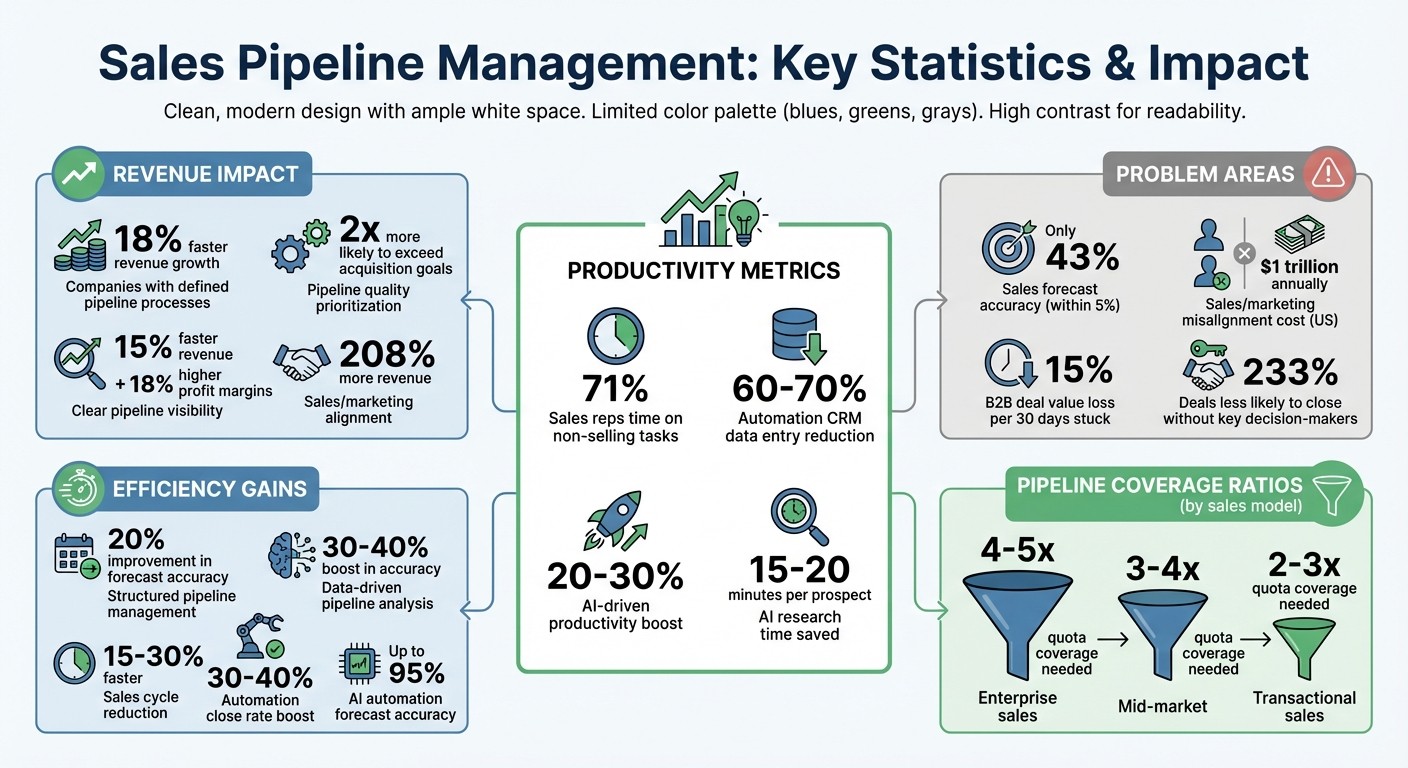
Sales Pipeline Management Key Statistics and Benefits
Steal My Perfect Sales Opportunity Pipeline (Setup for Beginners)
How to Structure Your Sales Pipeline Stages
A well-structured sales pipeline is key to keeping your team aligned and driving measurable results. By focusing on buyer commitments rather than internal activities, you can track deals more effectively and allocate resources where they’ll have the most impact.
Aligning Pipeline Stages with Your Sales Process
Your pipeline stages should be based on buyer commitments, not just sales tasks. For instance, instead of using activity-based stages like "Sent Email", opt for buyer-driven milestones such as "Problem Confirmed".
"Stages are not activities. 'Sent email' is an activity. 'Discovery completed and pain confirmed' is a stage gate." – Tushar Bhargava
Most B2B sales pipelines perform best with 5 to 8 stages. Keeping it simple reduces confusion and prevents "stage gaming", where sales reps manipulate the system to inflate forecasts. Kenny Keesee, Sr. Director of Support at Apollo.io, highlights the importance of this structure:
"Sales pipeline stages define the structured journey prospects take from initial contact to closed deal"
When stages are tied to clear buyer milestones, it’s easier to establish movement criteria and track progress effectively.
Setting Clear Criteria for Stage Movement
Every stage in your pipeline should have defined entry and exit criteria. For example, a deal should only move to the "Proposal" stage after completing discovery and documenting the buyer's pain points and ROI expectations. Similarly, advancing to "Negotiation" might require a verbal commitment from the decision-maker.
To enforce objectivity, use proof fields in your CRM and apply qualification frameworks like BANT or MEDDIC. Additionally, every open deal in your pipeline should have a clear next step and a specific date. If a rep can’t answer, “What happens next, and when?” the deal likely doesn’t belong in the pipeline. This approach helps eliminate "zombie deals" that inflate forecasts without real progress. Consider this: 80% of sales require five or more follow-ups, yet 44% of reps give up after just one.
By focusing on these criteria, you create a foundation that allows your pipeline to adapt to different sales models.
Adapting Pipelines for Different Sales Models
Different sales models require tailored pipeline structures. For example, enterprise sales often involve multiple decision-makers and can take 6–12 months to close. These deals may need additional stages such as technical validation, security reviews, legal approvals, and procurement processes. Notably, deals are 233% less likely to close when key decision-makers aren’t involved.
On the other hand, SMB or transactional sales typically close faster - sometimes within days or weeks. These models work better with fewer, activity-focused stages. Meanwhile, product-led growth (PLG) models track product usage signals and expansion triggers instead of traditional prospecting stages.
The key is to align your pipeline with your sales motion. For instance, a SaaS company might include a "Technical Validation" stage, while a services firm may need stages for scoping and refining a Statement of Work. Tools like K3X's AI framework make it easier to adapt pipeline stages to fit both complex enterprise sales and fast-paced SMB models. By 2026, 65% of B2B sales organizations are expected to shift from intuition-based approaches to data-driven decision-making.
Tracking Pipeline Health with Key Metrics
Once your pipeline stages are established, tracking the right metrics ensures deals are progressing as they should. One essential metric is the pipeline coverage ratio, which gauges whether you have enough deals to meet your sales targets. The required ratio varies by sales model: enterprise sales typically need 4–5x quota coverage, mid-market requires 3–4x, and transactional sales aim for 2–3x.
Two other critical metrics are win rate and sales velocity, which measure how efficiently your team converts opportunities into revenue. Win rate reflects the percentage of deals successfully closed, while sales velocity shows how quickly revenue flows through your pipeline. The formula for sales velocity is:
(Number of Deals × Average Deal Size × Win Rate) ÷ Sales Cycle Length.
A real-world example: In late 2024, TechStart Inc., a SaaS company with $5M ARR and an 18-person sales team, boosted their win rate from 14% to 19% in just 60 days by implementing structured pipeline tracking. Within 90 days, they also cut their sales cycle length by 15–25%.
Let’s dive into the core metrics that provide a clear picture of pipeline health.
Core Metrics for Pipeline Performance
Stage conversion rates are key to identifying where deals are getting stuck or dropping off. Low conversion rates at specific stages often indicate process inefficiencies. Another vital metric is average deal size, which helps you determine if your team is targeting the right customer profiles. Similarly, sales cycle length reveals how efficiently your team moves deals through the pipeline.
"Organizations that prioritize sales pipeline quality are 2x more likely to exceed customer acquisition expectations." – Alex Zlotko, CEO, Forecastio
Slippage rate is another important metric, as it tracks missed close dates, which can erode forecast reliability. Alarmingly, only 43% of sales forecasts are accurate within a 5% margin of the actual outcome, often due to poor pipeline management. On top of that, B2B deals lose an average of 15% of their value for every 30 days they remain stuck in negotiations.
By closely monitoring these metrics, you can quickly identify and address bottlenecks before they impact your pipeline.
Spotting Problems and Bottlenecks
Using these metrics, you can analyze deal flow trends through pipeline waterfall analysis. This method tracks new deals added, deals slipped, deals lost, and deals won over a specific period, offering insights into what's driving growth - or holding it back. For instance, if proposals are taking far longer than expected to move to the negotiation stage, it might signal pricing concerns, missing stakeholders, or unclear value propositions.
To avoid stagnant deals, adopt a "no zombies" rule: requalify or close any deal that hasn’t had customer interaction for 21 days. This prevents overestimating potential revenue. Companies with structured pipeline management see up to a 20% improvement in forecast accuracy, while leveraging data-driven pipeline analysis can boost accuracy by 30–40%.
Using Real-Time Dashboards for Visibility
Real-time dashboards turn pipeline metrics into actionable insights. These tools can flag risks - like slipping close dates, inactive deals, or incomplete data - before they derail your forecast. Unlike manual updates, dashboards automatically pull in activity data from emails, calls, and meetings, ensuring accuracy. For example, TechStart Inc.’s CEO used dashboard insights to forecast revenue 90 days ahead, solving earlier visibility challenges.
Dashboards also help identify deals that exceed the average duration for a stage, triggering alerts to prompt timely coaching. To maintain pipeline health, set alerts for deals stuck beyond service level agreements and require "proof fields", such as the decision-maker's name or a mutual action plan link, to validate late-stage opportunities. Tools like K3X’s AI-powered dashboards take this a step further by analyzing stage movement and duration patterns automatically, eliminating the manual effort traditional CRMs demand while giving teams the real-time insights they need to act quickly.
Using Tools and Automation for Pipeline Management
Did you know that sales reps spend 71% of their time on tasks like manual data entry, scheduling, and tracking deal details - leaving precious little time for actual selling? That’s why tools and automation are game-changers for managing pipelines. They keep things running smoothly while freeing up reps to focus on what they do best: closing deals.
By building on the basics of pipeline management, automation tools can simplify processes and help teams work more efficiently.
Why CRMs Are Key to Pipeline Management
A CRM (Customer Relationship Management) system is the backbone of pipeline management. It centralizes every deal, interaction, and stage update in one place. Without a CRM, information often ends up scattered across emails, spreadsheets, and memory, making accurate forecasting nearly impossible. Modern CRMs solve this issue by automatically capturing emails, calls, and meetings, cutting manual data entry by 60–70%. They also route leads instantly to the right rep based on criteria like territory, deal size, or industry.
But CRMs don’t just organize data - they actively help prevent deals from slipping through the cracks. For instance, they can trigger follow-ups for specific stages or flag deals that have been stagnant for 14 days. The payoff? Companies with clear pipeline visibility see 15% faster revenue growth and 18% higher profit margins. A well-implemented CRM isn’t just a tool - it’s a revenue accelerator.
And when you add AI-powered tools into the mix, things get even more dynamic, offering smarter ways to manage your pipeline.
How AI-Powered Tools Like K3X Transform Pipeline Management

Traditional CRMs often feel like static databases that require constant manual updates. AI-powered platforms like K3X flip that script. These systems let you interact with your pipeline through simple prompts instead of complex configurations. For example, you can tell K3X, “Flag deals with no activity for 14 days,” and it takes care of the rest.
What makes K3X stand out is its ability to analyze engagement data from emails, calls, and meetings in real time. It provides deal health scores and even suggests the next best action to keep deals moving. A great example comes from Pigment, which used Gong’s Revenue AI Platform in 2024 to identify over $4 million in at-risk deals. By addressing stalled deals and missing stakeholders, they achieved their highest win rates since 2023 and boosted sales coaching adoption by 50% year-over-year.
Unlike older systems that rely on rigid rules, K3X adapts in real time to buyer behavior. It adjusts follow-up timing and communication channels based on what’s working. Plus, its AI-powered forecasting models analyze historical win/loss data, delivering revenue predictions that are 25% more accurate than manual estimates. All of this comes at a surprisingly accessible price - just $20/month per user, including 1,000 AI credits [K3X Pricing].
Cutting Down Manual Work with Automation
AI-driven automation doesn’t just improve forecasting and visibility - it also slashes repetitive tasks, speeding up the sales process.
Automation takes care of the time-consuming chores that bog reps down. For example, automated follow-up sequences ensure no deal goes cold, pausing automatically when prospects respond. This alone can boost close rates by 30–40%. AI research agents save reps 15–20 minutes per prospect by instantly pulling together briefs from web searches and past interactions, eliminating the need for manual research.
Early warning systems notify managers when close dates are repeatedly pushed back or when key stakeholders are missing from late-stage deals. One 250-person sales team saw dramatic results by integrating AI sales coaching with their CRM in early 2026. Over six months, their revenue forecast accuracy jumped from 68% to 91%, allowing leadership to predict quarterly revenue within a 5% margin. This gave them the confidence to allocate resources more effectively and present solid forecasts to their board.
"A well-automated sales pipeline reduces administrative overhead, improves forecast accuracy, and ensures that no deal falls through the cracks." – Digital Applied
The numbers speak for themselves: companies using AI automation report up to 95% accuracy in revenue forecasting, and AI-driven engagement can increase sales-qualified leads by 50%. By cutting down on busywork, automation lets sales teams focus on what matters most - strategic selling and driving results.
Best Practices for Managing Pipelines as a Team
Streamlining your pipeline with tools like K3X is a great start, but tools alone won't guarantee success. To truly see results, your team needs to stick to disciplined practices. Pipeline management works best when everyone is committed to maintaining accurate data, collaborating across departments, and following consistent processes. Here's how to make it happen.
Keeping Pipeline Data Clean and Accurate
Bad data can wreck your forecasts. In fact, professionals often spend 60% to 80% of their time just cleaning and preparing data. That’s time better spent selling. The solution? Make data hygiene a regular habit. For example, set up weekly reviews to clear out inactive opportunities and use automated rules to close leads after a set period - like 21 days of no activity. This keeps your pipeline free of "zombie deals" that inflate numbers and mislead your forecasts.
Standardizing required information at each stage is another must. Fields like close date, deal amount, and key contacts ensure your reports are accurate. Automating data capture - such as emails, calls, and meeting notes - through your CRM can also save time and reduce manual errors. Companies that manage their pipelines well can see up to a 20% improvement in forecast accuracy and generate 18% more revenue.
"A clean pipeline also reduces wasted sales efforts on low-probability deals." – Alex Zlotko, CEO, Forecastio
Set clear, buyer-focused milestones for moving deals forward - like "Budget Confirmed" or "Executive Sponsor Engaged" - to avoid letting optimism skew your pipeline. Also, keep an eye on your "slippage rate", which measures how often deals miss their original close dates. High slippage often signals issues with your qualification process.
Once your data is clean, the next step is aligning your sales and marketing teams to turn that data into actionable strategies.
Coordinating Sales and Marketing Teams
When sales and marketing don’t work together, it’s more than just a headache - it’s costly. In the U.S., this lack of alignment wastes an estimated $1 trillion annually. But when these teams are on the same page, companies can see up to 208% more revenue.
Start by setting shared goals. Instead of marketing focusing only on lead volume and sales prioritizing deal quality, align both teams around common metrics like pipeline value, revenue closed, and customer acquisition costs [33, 34]. Use Service Level Agreements (SLAs) to define what qualifies as a Marketing Qualified Lead (MQL) versus a Sales Qualified Lead (SQL), and agree on specific follow-up timelines.
Alignment Strategy | Marketing Responsibility | Sales Responsibility |
|---|---|---|
Common Goals | Pipeline value and MQL quality | Revenue targets and SQL conversion |
Commitments | Lead volume and data accuracy | Follow-up speed and lead updates |
Journey Mapping | Awareness and interest stages | Negotiation and closing stages |
Technology | Marketing automation integration | CRM upkeep and activity logging |
A unified CRM or revenue platform can give both teams real-time visibility into prospect interactions and deal progress [33, 34]. Regular syncs - like biweekly meetings - help review shared KPIs, address bottlenecks, and improve handoffs. Joint "win/loss" reviews can also refine targeting strategies [33, 34]. When sales and marketing collaborate effectively, businesses experience 36% higher customer retention rates and 25% better lead quality.
With these teams working in harmony, you can turn your attention to sharpening your forecasting practices.
Improving Forecast Accuracy Through Consistent Practices
Forecasting isn’t about gut feelings - it’s about discipline. Leaders who skip a structured approach often miss their targets by 25% or more. The key is to rely on evidence, not optimism.
Every deal in your pipeline should have a documented next step and date. If it doesn’t, it’s not a real opportunity - it’s just wishful thinking. Use stage-based probabilities grounded in historical conversion data rather than relying on individual reps’ optimism. For deals in later stages, require proof points like identifying the economic buyer, linking a mutual action plan, or documenting the decision-making process.
Create a rhythm for your team. This could include daily updates from reps, weekly decision-focused manager meetings, and quarterly reviews to refine stage definitions. Track sales velocity using this formula:
(Number of Opportunities × Average Deal Size × Win Rate) / Sales Cycle Length.
This helps pinpoint whether you need to adjust volume, deal size, win rate, or speed. With these practices, you’ll move from guessing to making informed, reliable forecasts that guide strategic decisions.
Conclusion: Improving Sales Results with Better Pipeline Management
Pipeline management is more than just tracking deals - it's the backbone of predictable revenue growth. Companies with a well-defined pipeline process can see revenue grow by up to 28% while cutting sales cycles by 15–30%. Hitting quotas consistently depends on disciplined, data-driven practices.
The secret lies in transforming your pipeline into a repeatable system. This involves enforcing next-step discipline for every deal, setting stage criteria based on buyer commitments (not seller actions), and keeping data clean through regular reviews. These steps create a strong foundation for automation and better forecasting. When forecasts are built on historical conversion rates and documented proof points, accuracy improves by as much as 20%.
Modern automation tools take these structured practices to the next level. By eliminating manual tasks, tools like K3X let sales teams focus on selling. AI takes care of activity tracking, deal scoring, and identifying at-risk opportunities. With its simple, prompt-driven interface, K3X doesn’t require complex setup or technical expertise - just state your needs, and it adjusts to your workflow. This approach boosts productivity by 20–30% and can increase win rates by up to 35%.
"Pipeline management exists to prevent that quiet failure and to turn selling into a repeatable system instead of a heroic act." – Tushar Bhargava, ZNI
To get started, focus on the basics: clean, accurate data; clear stage definitions; and consistent team practices. From there, layer on automation to reduce busywork and uncover insights faster. By combining these strategies with smart tools, you can achieve 15% higher revenue growth and 18% higher profit margins. Make your pipeline work for you.
FAQs
How do I choose the right pipeline stages for my team?
Mapping your sales process is a game-changer when it comes to staying organized and focused. The key is to structure each stage around buyer actions, rather than just your internal steps. A simple framework like prospecting, qualification, proposal, and closing works well to keep things clear and actionable.
For each stage, define exit criteria - specific checkpoints that must be met before moving forward. For example, before transitioning from discovery to proposal, you might require confirmation of the buyer's budget and timeline. This approach helps maintain an accurate pipeline, keeps things manageable, and ensures your process aligns with your team’s workflow.
What’s the fastest way to identify and remove zombie deals?
The fastest way to identify and clear out "zombie deals" is to routinely examine your pipeline for opportunities that have stalled - those lingering in the same stage without any movement. Establish specific criteria for advancing deals through each stage, and if an opportunity shows no activity, mark it as "Closed Lost." This approach keeps your pipeline clean and ensures your energy is focused on active, promising deals.
How can AI improve forecast accuracy without extra CRM work?
AI helps boost forecast accuracy by taking over tasks like data cleaning and analysis, ensuring more reliable results with less manual work. For instance, AI-powered CRM tools can automatically update fields while evaluating historical data, customer behavior, and market trends. This not only minimizes human bias but also sharpens precision and simplifies pipeline management. The result? Sales teams can reach accuracy levels as high as 98%, all without increasing their CRM workload.