



How AI finds sales anomalies in real time, scores severity, pinpoints causes, and automates prioritized follow-ups to improve conversions.
AI-powered tools are changing how sales teams operate by identifying unusual patterns in real time and enabling faster responses. Whether it's spotting a stalled deal or a sudden spike in interest, AI systems like K3X analyze data continuously to flag deviations that could impact sales outcomes. Traditional CRMs often miss these opportunities due to rigid workflows and outdated data, but AI overcomes these limitations by learning what "normal" looks like for your business and acting instantly when anomalies arise.
Key takeaways:
What are sales anomalies? Unexpected changes in sales behavior, like a lead revisiting your pricing page multiple times in a day.
Why real-time detection matters: Responding within 5 minutes increases lead conversion rates by 21x compared to waiting 30 minutes.
How AI works: Tools like K3X use algorithms (e.g., Isolation Forests, Autoencoders) to detect anomalies and assign severity scores.
Impact: AI can cut follow-up time by 70%, triple ticket resolution speed, and improve prediction accuracy to 75–85% within 6–12 months.
Setup simplicity: K3X integrates with your tools in under an hour, using plain text prompts to define monitoring rules and automate actions.
AI anomaly detection transforms sales pipelines by uncovering hidden opportunities and automating responses, saving time and driving results.
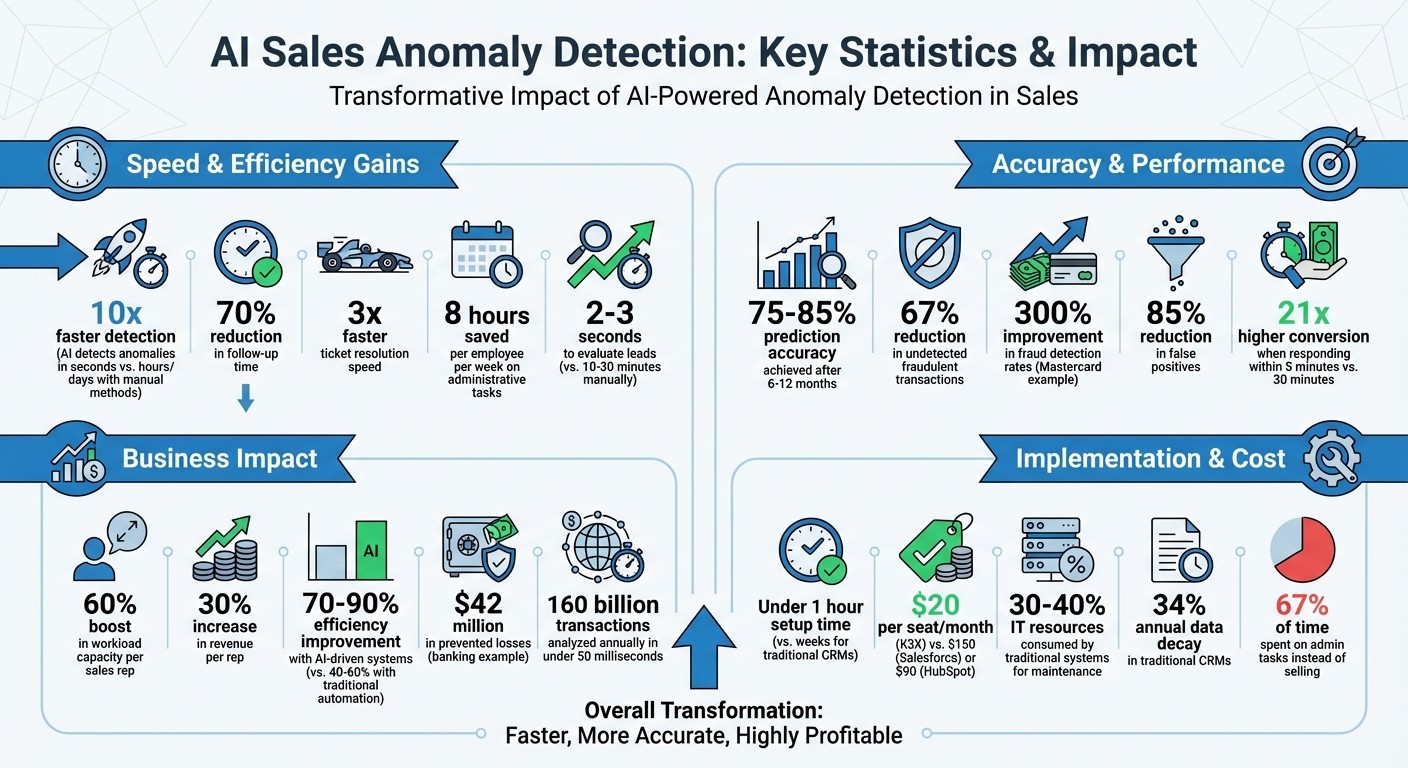
AI Anomaly Detection Impact: Key Statistics and Performance Metrics
AI in Data Engineering : Anomaly Detection in Retail Sales Transactions using Isolation Forest
How AI Detects Sales Anomalies
AI identifies sales anomalies by first learning what "normal" looks like for your business. It analyzes historical data to understand patterns, including seasonality and natural fluctuations. Once this baseline is set, the system continuously monitors new data, comparing it against these expectations.
When something unusual happens - like a sudden drop in conversion rates or a spike in demo requests from a specific region - AI assigns an anomaly score. This score reflects how severe and confident the system is about the deviation. The scoring system helps cut through the noise, ensuring only the most pressing issues grab your attention. Impressively, AI-powered tools can detect anomalies 10 times faster than manual methods, reducing detection time from hours or days to mere seconds.
AI Techniques for Anomaly Detection
AI employs three types of learning to detect anomalies:
Unsupervised learning: Spots deviations without needing labeled data.
Supervised learning: Identifies known anomalies based on past examples.
Semi-supervised learning: Focuses on "normal" data to flag anything that doesn't fit.
These approaches rely on specific algorithms. For example, Isolation Forests are used to pinpoint anomalies in complex sales data. Autoencoders, a type of neural network, compress and reconstruct data; if the system struggles to recreate a pattern, it flags it as unusual. Clustering methods like K-means and DBSCAN group similar data points and mark outliers in low-density regions as anomalies. For time-sensitive metrics, techniques like ARIMA and Z-score analysis track performance over time, identifying deviations from historical trends.
The impact of these tools is significant. Mastercard's Decision Intelligence platform, for instance, analyzes up to 160 billion transactions annually in under 50 milliseconds, improving fraud detection rates by up to 300%. In finance, AI-based anomaly detection has reduced undetected fraudulent transactions by 67%. AI can also evaluate leads in as little as 2–3 seconds, compared to the 10–30 minutes it might take manually. After 6–12 months of data processing, prediction accuracy often reaches 75–85%. These capabilities enable sales teams to act quickly, addressing problems and capitalizing on opportunities.
The Role of Data in AI Anomaly Detection
The quality of your data plays a huge role in how well AI detects anomalies. AI systems rely on both explicit data - like job titles, company size, and deal values - and implicit signals, such as website visits, email sentiment, and engagement speed, to spot changes in buyer behavior. Unlike traditional rule-based systems that only handle structured data and keywords, AI platforms like K3X can process unstructured data from sources like emails and call transcripts. This gives them a much deeper understanding of your sales pipeline.
For accuracy, AI needs a mix of historical and live data. Historical data (typically 12–18 months) helps establish what "normal" looks like, while real-time data streams allow the system to detect anomalies as they happen. This dual approach helps AI differentiate between gradual changes, like shifts in customer demographics, and urgent issues that need immediate attention. When an anomaly is flagged, the system quickly analyzes related metrics and segments to pinpoint the root cause in seconds - something that could take a human team hours or even days.
Setting Up AI Anomaly Detection with K3X

Configuring K3X for Anomaly Detection
Getting started with K3X is surprisingly straightforward. You can connect your tools, set up monitoring rules using simple text prompts, and activate real-time tracking - all in less than an hour. This ease of use reflects K3X's philosophy of replacing rigid automation with intuitive, outcome-driven logic.
Here’s how it works: First, link your current tech stack (like email or phone systems) directly to K3X. No IT assistance or data migration is required. Next, define your monitoring rules using plain text prompts instead of complicated workflows. For instance, you could type something like, "Alert me if a high-value deal stays in the same stage for over 48 hours". Finally, activate the system, and K3X will immediately start logging data, tracking workflows, and monitoring your sales pipeline.
Take Ruby Capital Group as an example. In December 2025, they used this streamlined setup to quickly improve their processes - without needing any technical expertise.
Using K3X's Real-Time Dashboards
K3X’s real-time dashboards give you live insights into your sales performance. They highlight anomalies, such as bottlenecks in deals, activity logs, and behavioral signals. For example, if a lead visits your pricing page three times in one day, K3X identifies this as a strong intent signal and flags it on the dashboard. This level of context doesn’t just show you what’s happening - it helps you understand why it matters.
By automating routine tasks like data entry and monitoring, K3X also frees up your team’s time. On average, employees save 8 hours per week, allowing them to focus on tasks that drive results. And K3X doesn’t stop at detection - it takes action, turning insights into automated responses.
Automating Responses to Detected Anomalies
When K3X spots an anomaly, it doesn’t just notify you - it takes immediate action. The platform can handle follow-ups, update pipeline stages, and assign tasks to team members based on the goals you’ve outlined in your prompts. Unlike traditional CRMs that rely on rigid if-then rules, K3X uses outcome-based logic to adapt to unexpected situations. Mykyta Samusiev, Co-Founder & CEO of K3X, puts it best:
"We're building a CRM that works the way people expect it to, not through menus, workflows, or complexity, but through intention. You tell it the outcome. The system figures out the work."
Need to tweak how K3X handles a specific scenario? Just update the prompt. The system adjusts instantly, without disrupting your existing workflows. For example, if deals are stalling at the proposal stage, you could add a prompt like, "Schedule demo calls with leads who haven’t responded." K3X will immediately implement this across your pipeline. This seamless process ties together detection, analysis, and action, making it a powerful tool for managing your sales pipeline effectively.
K3X vs. Traditional CRM Tools
After diving into how AI detects anomalies in real time, it’s worth comparing this approach to the limitations of traditional CRM systems.
Challenges with Workflow-Driven Systems
Traditional CRM platforms primarily focus on logging past activities rather than identifying anomalies as they happen. Their rigid automation rules struggle to handle unexpected lead behaviors, like when a lead reacts in an unforeseen way. This can cause workflows to break and leads to get stuck in the pipeline.
These systems also come with hefty implementation requirements. Weeks of setup and significant IT involvement are the norm. Even after deployment, they demand ongoing maintenance. In fact, traditional automation platforms can consume 30% to 40% of IT resources just to keep thousands of rules updated and functional. The sheer number of rules required to cover every sales scenario makes these systems unwieldy.
Data accuracy is another major issue. With data decaying at a rate of 34% annually - and up to 80% of it being inaccurate - sales teams end up spending 67% of their time on administrative tasks instead of selling. Modern tools aim to address these inefficiencies, reducing both maintenance burdens and manual work.
How K3X Tackles These Issues
K3X takes a more streamlined and adaptive approach. Instead of relying on a maze of workflows, users simply define desired outcomes through conversational prompts, and the AI takes care of the rest. Mykyta Samusiev, Co-Founder & CEO of K3X, puts it succinctly:
"Most CRMs record activity. K3X understands outcomes. It listens, knows what changed, and makes the next moves."
This shift from activity tracking to outcome-oriented execution is a game-changer. K3X’s AI adapts on the fly to unexpected situations, detecting and addressing unusual lead behaviors without the need for complex rules. It interprets intent and sentiment from unstructured data - like emails and calls - spotting high-priority signals that traditional systems might overlook.
K3X also delivers a major boost in efficiency. While traditional automation can improve efficiency by 40–60%, AI-driven systems like K3X push that to 70–90%. Implementation is incredibly fast - often under an hour compared to the weeks required by traditional systems. Pricing is notably affordable too, starting at $20 per seat per month, well below the $150 per user per month for Salesforce or $90 per user per month for HubSpot. Plus, there’s no need for a dedicated IT team, complex migrations, or middleware tools like Zapier.
Best Practices for Responding to Sales Anomalies
Effectively addressing sales anomalies is crucial for converting leads. By leveraging real-time detection and following these practices, your team can act on insights that drive results.
Prioritizing Detected Anomalies
Not all anomalies are created equal, so it’s essential to prioritize them based on their potential impact. A tiered system can help your team focus on what matters most. Consider using a scoring framework to classify anomalies into three categories: Hot (75-100 points), Warm (50-74 points), and Cool (below 50 points). For example:
Hot anomalies: A lead visiting your pricing page twice in 24 hours. These require immediate follow-up, ideally within two hours.
Warm anomalies: Leads that show moderate interest, which benefit from personalized nurturing.
Cool anomalies: Leads with lower engagement, suited for automated, long-term outreach sequences.
Timing and precision often determine whether a lead converts or slips away. Take Ruby Capital Group as an example: after implementing K3X's AI-powered agents in December 2025, they cut their follow-up time by 70% and tripled ticket resolution speed.
K3X simplifies prioritization by enabling goal-driven prompts, such as “focus on leads visiting our pricing page twice this week.” It ranks key events automatically and sends notifications - via email, SMS, or Slack - for Hot anomalies, ensuring rapid response. To keep priorities fresh, older anomalies lose 25% of their score each month if left unaddressed, helping teams focus on actionable opportunities.
Using AI for Root Cause Analysis
Once anomalies are prioritized, understanding why they occurred is the next step. This involves analyzing both external and internal factors to uncover the root cause.
K3X enhances this process by integrating external data - like holidays or weather patterns - with internal factors, such as marketing campaigns or product launches, to explain behavioral shifts. Through causal inference, the platform identifies key drivers and assigns a likelihood percentage to each cause. For instance, Amazon Lookout for Metrics found that "orders" accounted for 81.84% of a specific revenue anomaly.
Additionally, K3X extracts critical details like BANT (Budget, Authority, Need, Timeline) and objections directly from call transcripts and emails. This allows your team to take informed, corrective actions without wasting time.
Improving Detection Over Time
AI-powered anomaly detection improves as it learns. During the initial months, it’s important to review every alert and flag false positives. This feedback helps the system refine its understanding of what constitutes a real anomaly. Start small by monitoring key metrics, such as revenue and conversion rates, for 2-4 weeks before expanding to other data points or enabling broader alerts.
AI systems are far more effective than manual monitoring. For example:
Mastercard’s Decision Intelligence platform, analyzing up to 160 billion transactions annually, reduced false positives by over 85%.
An international bank using AI anomaly detection achieved a 67% drop in undetected fraudulent transactions, preventing $42 million in potential losses.
K3X’s adaptive learning ensures the system gets smarter over time. Typically, AI-driven anomaly detection accuracy reaches 75-85% after 6-12 months of consistent data processing. The system evolves by learning from your team’s response patterns, shifting from a static tool to an active partner that helps pinpoint the anomalies that truly matter.
Conclusion
The transformation is undeniable. Real-time anomaly detection has reshaped sales operations by enabling teams to engage prospects at the peak of their interest. Imagine your CRM identifying a lead who revisits your pricing page multiple times in a short span and immediately triggering the right response - this is how you connect with prospects when it matters most.
Traditional CRMs often force teams to choose between rigid automation that falters under dynamic conditions and manual monitoring that eats up over 20 hours a week. K3X eliminates this dilemma with goal-based prompts that adapt to actual lead behavior. Instead of programming endless scenarios, you simply tell the system the outcome you want - like “Book demo calls with unresponsive leads” - and it takes care of the rest.
This results-driven approach enhances efficiency while remaining cost-effective. At just $20 per seat per month, K3X offers a streamlined and affordable alternative to traditional systems. The results speak volumes: when Ruby Capital Group implemented K3X in December 2025, they reduced follow-up time by 70% and tripled ticket resolution speed. Companies using AI-native CRMs have reported a 60% boost in workload capacity per representative and a 30% increase in revenue per rep.
On average, K3X saves employees 8 hours per week by automating tasks like data entry, call transcription, and pipeline updates - allowing your team to focus on driving revenue. Over time, the platform becomes even smarter, achieving 75–85% accuracy in predicting conversions after 6–12 months of data processing.
From spotting critical signals to automating decisive actions, AI-native CRMs are redefining sales operations. They shift the role of a CRM from a static tool that records activity to an active partner that understands and drives outcomes.
"Most CRMs record activity. K3X understands outcomes. It listens, knows what changed, and makes the next moves." – Mykyta Samusiev, Co-Founder & CEO, K3X
FAQs
What sales signals should I monitor first?
When working with AI tools like K3X, it's essential to focus on lead activity and engagement patterns. Pay close attention to details like response times, delays in follow-ups, and noticeable changes in customer behavior. These indicators can reveal potential issues or highlight new opportunities early on.
Additionally, keep an eye on pricing inconsistencies and transaction anomalies. These can signal hidden risks to your revenue. By zeroing in on these critical areas, AI tools can adjust in real time, tackle urgent problems, and simplify sales workflows for better efficiency.
How much data is needed for accurate anomaly detection?
When it comes to detecting anomalies, the amount of data you need depends on the approach and the specific situation. For example, statistical methods like the 3-sigma rule rely on a large dataset to identify patterns effectively. On the other hand, AI systems like K3X often require millions of transactions during training to perform well.
If you're working on real-time detection, having a sufficient amount of recent data is crucial to establish what "normal" looks like. However, in cases where anomalies are very obvious, smaller datasets can still be effective. That said, the general rule is: the more data you have, the better your accuracy will likely be.
How do I reduce false alerts without missing real issues?
To reduce false alerts while catching genuine issues, fine-tune your AI system's sensitivity and thresholds. Many advanced tools let you customize these settings, helping strike the right balance between false positives and negatives. Pairing AI with statistical approaches, such as baseline models and contextual data, can also improve accuracy. Additionally, platforms offering root cause analysis and event correlation features make it easier to separate real anomalies from routine fluctuations, ensuring dependable detection without overwhelming you with unnecessary alerts.