
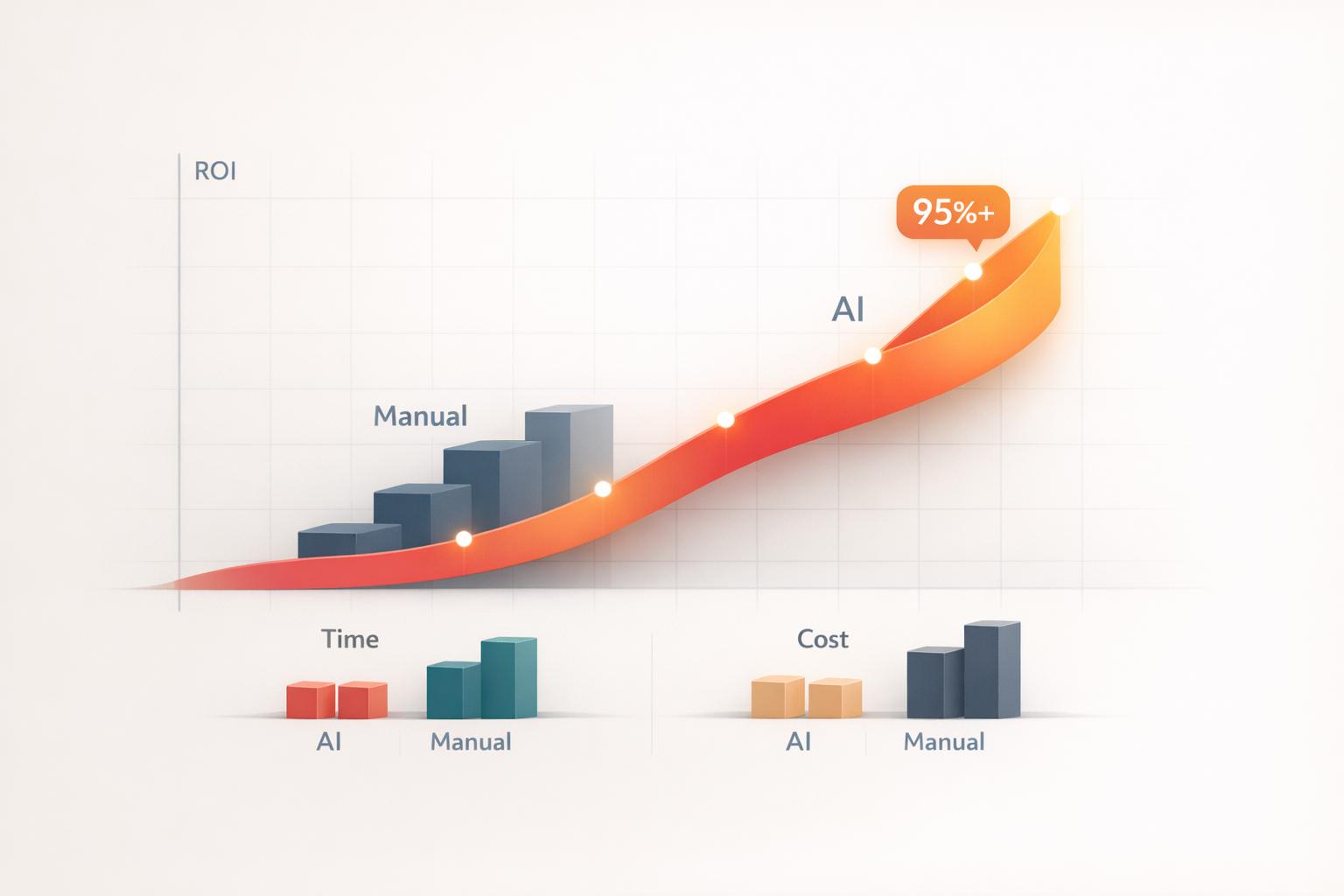

AI beats manual revenue forecasts with real-time updates, 95%+ accuracy, and major time and cost savings—compare ROI, benchmarks, and best practices.
AI-driven revenue forecasting is faster, more accurate, and cost-effective compared to manual methods. Here's why:
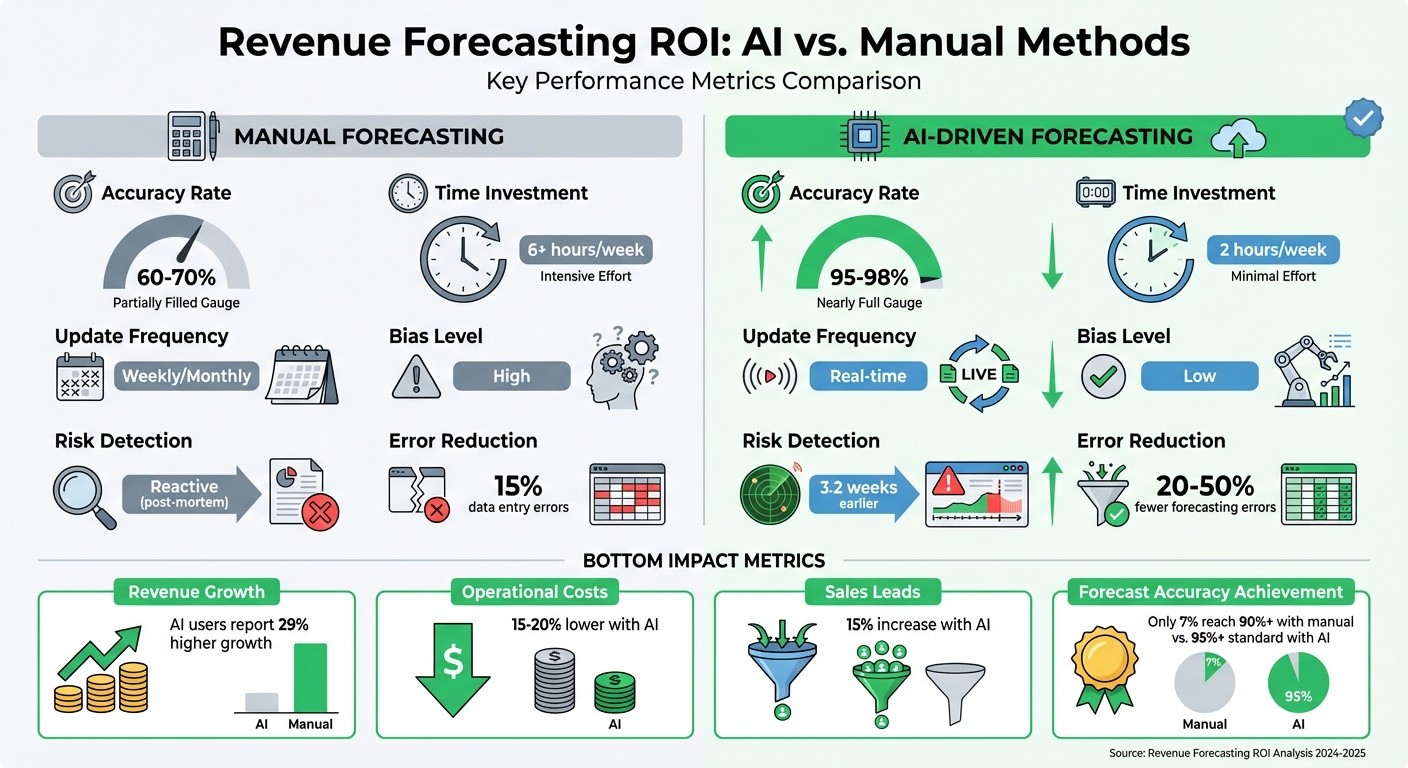
Accuracy: AI forecasting achieves 95%-98% accuracy versus 60%-70% for manual methods.
Efficiency: AI reduces forecasting time from hours or days to minutes, saving managers 6+ hours weekly.
Real-time Updates: Unlike static manual updates, AI uses real-time data for continuous adjustments.
Cost Savings: AI minimizes errors by 20%-50%, reduces inventory costs, and improves resource allocation.
Key Findings:
Manual forecasts often rely on intuition, leading to biases and errors.
AI eliminates human bias, processes vast data instantly, and identifies risks weeks earlier.
Companies using AI report 29% higher revenue growth and 15%-20% lower operational costs.
Quick Comparison:
Feature | Manual Forecasting | AI-Driven Forecasting |
|---|---|---|
Accuracy | 60%-70% | 95%-98% |
Update Frequency | Weekly/Monthly | Real-time |
Bias Level | High | Low |
Manager Effort | 6+ hours/week | 2 hours/week |
Cost | High (errors, delays) | Lower (fewer mistakes) |
AI systems like K3X simplify forecasting, reduce costs, and improve decision-making. By automating manual tasks and delivering precise forecasts, AI transforms forecasting into a competitive advantage.
AI vs Manual Revenue Forecasting: ROI Comparison
Revenue Forecasting Using AI Explained | Financial Modeling Using ChatGPT
Manual Revenue Forecasting: Problems and Costs
Despite advancements in AI-driven forecasting, many businesses still rely on manual methods, which come with significant challenges and inefficiencies.
Human Error and Data Problems
Manual forecasting often hinges on the instincts of sales reps and the judgment of managers - an inherently shaky foundation. Sales reps tend to overestimate close probabilities by 20–30%, a behavior known as "happy ears" (over-optimism) or "sandbagging" (lowering expectations on purpose). These biases intensify as forecasts move up the management chain, where differing judgment styles further distort accuracy. Nathan Thompson from Fullcast highlights this issue:
"A seasoned rep often knows a champion is leaving... but the problem shows up in the roll-up. One manager is conservative, another is optimistic, and the result is a forecast that changes with the room rather than the data".
The numbers paint a stark picture: manual sales forecasts are only 67% accurate on average. Even worse, 93% of sales leaders fail to predict revenue within a 5% margin, even in the final two weeks of the quarter. This isn't just about inaccurate predictions - it’s also about disconnected data. Key deal signals, like buyer hesitation or mentions of competitors, often fail to make it into the forecast due to fragmented data systems. Additionally, 67% of opportunities lack essential qualification details or next steps in CRM systems because reps don’t consistently update fields.
Time-Consuming Processes
Manual forecasting eats into valuable time that could be spent selling. Managers often dedicate more than six hours each week to auditing deal data, reviewing call recordings, and piecing together "deal stories" for forecast meetings. This process leaves aggregated data outdated by the time it's compiled. Compounding the issue, over half of B2B sales leaders lack confidence in their manual forecasting methods. This uncertainty forces CFOs to hold extra cash reserves or make tough decisions like premature hiring freezes or layoffs when forecasts miss the mark. Every hour spent verifying data is an hour taken away from revenue-generating activities. These inefficiencies highlight the need for more agile, AI-powered CRM solutions.
Scaling Problems for Growing Businesses
As businesses grow, manual forecasting becomes increasingly unsustainable. Scaling these methods often requires adding RevOps personnel or dedicating more management time, which isn’t feasible when deal volumes surge. Human analysts can’t effectively cross-reference thousands of historical deal signals with rapidly changing pipeline dynamics. The result? Only 7% of sales organizations achieve 90% or higher forecast accuracy using traditional methods. Furthermore, 69% of sales operations leaders report that forecasting has become more difficult due to fragmented data and the complexity of modern deals.
As teams expand, the biases of individual reps compound, leading to forecasts shaped more by sentiment than hard data. Today’s revenue landscape is far too complex for manual oversight, with factors like larger buying committees, unnoticed pipeline decay, and usage-driven expansion signals often escaping manual tracking. Over-forecasting and under-delivering can have severe consequences, from eroding board trust to budget misallocations and layoffs. These challenges make it clear why AI-driven forecasting, which adapts in real time, is becoming the preferred approach for modern businesses.
Benefits of AI for Revenue Forecasting
AI-powered forecasting tackles the challenges of manual methods by handling vast amounts of data in real time, uncovering patterns beyond human recognition, and delivering forecasts with consistent precision.
Better Accuracy with Machine Learning
Machine learning eliminates subjective biases, avoiding both overconfidence and overly cautious estimates by analyzing thousands of data points objectively. It uncovers complex relationships within years of historical data and real-time inputs - patterns that manual methods often overlook.
Unlike static manual models that require constant updates, AI adapts continuously. It updates predictions as new data becomes available - whether it’s a change in deal stages, buyer engagement, or market trends. Instead of producing a single static number, AI delivers probability-based forecasts with confidence intervals, such as a "70% chance of landing between $48 million and $52 million". This approach gives finance teams the clarity needed to make informed decisions. AI also shifts focus to forward-looking indicators - like buyer engagement and sales cycle speed - rather than relying primarily on past performance, a common limitation in traditional spreadsheets.
For example, in 2025, a SaaS company using Spiky's platform saw a 27% improvement in forecast accuracy within two quarters by analyzing buyer engagement metrics like meeting attendance and email sentiment. Similarly, a retail company leveraging SuperAGI's predictive platform improved accuracy by 25%, leading to a 15% reduction in inventory costs and a 10% boost in total sales.
This adaptability allows businesses to make instant adjustments, streamlining operations and decision-making.
Real-Time Data Processing and Adjustments
AI processes data as it’s generated, moving beyond outdated batch processes that rely on yesterday’s numbers. This capability is especially crucial for usage-based pricing models, where revenue can shift significantly by the hour. Without real-time insights, monthly reports often become little more than "educated guesses". In fact, 63% of enterprise use cases require data to be processed within minutes to remain actionable.
AI also tracks subtle signals that humans may miss - such as pipeline decay when a buyer hasn’t responded in 10 days, risks tied to stakeholder changes, or churn patterns linked to usage. These systems act as a "living model", instantly re-forecasting the pipeline whenever a deal stage or usage signal changes, ensuring forecasts reflect the latest activity. Companies adopting real-time analytics have been able to reduce forecasting errors by 5% to 10%.
"Metronome has saved us hours each month by automating manual workflows and managing customer pricing and usage data more effectively."
Ariana Grush, Senior Finance Transformation Manager, Databricks
Higher Efficiency and Lower Costs
AI automates the tedious process of consolidating data, shrinking the time needed to create forecasts from days to just minutes or hours. For instance, Nicole Ward, Senior Director of Revenue Enablement at OneSource Virtual, achieved 95%+ forecast accuracy for four consecutive quarters after implementing AI tools. What once took several days was reduced to just a few hours. Similarly, at HydroCorp, David Taub, Senior Director of Revenue Operations, cut his forecasting process down to 10 minutes while maintaining 93%+ accuracy most months.
AI also reduces manual data entry errors by around 15%. By lowering forecasting errors by 20% to 50%, businesses can better allocate resources, plan headcount, and manage inventory. Automating administrative tasks and CRM updates gives sales teams more time to focus on selling, potentially shortening sales cycles by up to 30%. Companies that have embraced AI-driven sales strategies report a 15% increase in sales leads and a 10% to 20% reduction in marketing expenses. In 2024, revenue teams using AI experienced 29% higher revenue growth compared to their peers.
These productivity gains translate into better ROI, highlighting AI’s clear edge over traditional forecasting methods.
AI vs. Manual Methods: Side-by-Side Comparison
When comparing AI to manual forecasting, the differences are striking. Manual methods often depend on intuition and experience, commonly referred to as "gut feel" by sales leaders. AI, however, leverages data and algorithms to remove guesswork. This divide is evident across critical metrics like accuracy, speed, cost, and scalability.
The contrast becomes even more apparent when examining the metrics that directly impact ROI.
Comparison Table: Key Metrics
Feature | Manual/Traditional Forecasting | AI-Driven Forecasting |
|---|---|---|
Primary Driver | Intuition, Experience, & "Gut Feel" | Data, Algorithms, & Machine Learning |
Accuracy | 67% - 79% (Median) | 95% - 98% |
Update Frequency | Static (Weekly/Monthly) | Real-time / Continuous |
Bias Level | High (Optimism/Sandbagging) | Low (Objective Calculation) |
Manager Effort | High (6+ hours/week) | Low (2 hours/week) |
Risk Identification | Reactive (Post-mortem) | Proactive (3.2 weeks earlier) |
Scalability | Low (Hard to manage large teams) | Infinite (Handles any volume) |
These differences explain why AI consistently delivers better ROI. For example, AI-driven forecasts achieve 95% to 98% accuracy, far surpassing manual methods. Such precision leads to smarter resource allocation, improved hiring decisions, and fewer unexpected budget issues.
Why AI Delivers Better ROI
The performance gap between AI and manual methods directly translates into savings, faster results, and lower operational costs. Manual forecasting often hides costs that finance teams overlook. For instance, human data entry errors average 15%, causing misallocated budgets and wasted resources. AI eliminates these errors by automating the process, requiring minimal oversight.
AI also identifies risks earlier. By analyzing subtle patterns - like declining email response rates or missing stakeholders - AI flags at-risk deals 3.2 weeks earlier than manual methods. This early detection allows teams to adjust strategies before revenue is lost. Companies using AI report 80% revenue growth, compared to 60% for those relying on traditional approaches.
"AI doesn't work because it's smart - it works because it pays attention to everything humans don't have time to track." - Sonny Aulakh, Founder of MaxIQ
Cost-wise, AI is just as compelling. Traditional revenue intelligence tools can cost up to $500 per user per month when combining conversation intelligence and forecasting platforms. AI-native systems consolidate these features at about one-fifth the cost. With reduced errors (down 20% to 50%), faster sales cycles (up to 30% quicker), and a 15% increase in sales leads, the financial benefits are clear. Only 15% of companies using manual methods hit forecast accuracy within 5% of actual revenue, while AI systems regularly exceed this benchmark within just 90 days of implementation.
K3X AI Revenue Forecasting: A Modern Approach

How K3X Changes Revenue Forecasting
K3X simplifies revenue forecasting by cutting out the manual, time-consuming tasks often associated with traditional methods. Instead of relying on complex workflows or multi-step automations, users simply set goals using prompts. From there, the platform takes over - updating pipelines, coordinating teams, capturing data, and fine-tuning forecasts in real time. This shift lets sales leaders focus on actionable insights rather than system configurations.
One standout feature of K3X is its ability to pull signals from emails, calendars, and calls to keep forecasts up-to-date. This eliminates the inconsistencies that often arise in data recording. By analyzing details like response times, meeting patterns, sentiment changes, and commitment language, K3X uncovers risks such as silent pipeline decay - an issue manual methods can easily miss. Instead of relying on sales reps’ optimism or guesswork, K3X bases its forecasts on actual buyer behavior. This focus on outcomes rather than processes is what sets K3X apart from traditional CRMs.
K3X vs. Traditional CRM Systems
Traditional CRMs often reduce forecasting to a tedious exercise in data entry. Sales reps manually update fields, and managers are left combing through spreadsheets to piece together deal progress. This approach struggles to capture the nuances of deal dynamics. K3X flips this model by emphasizing revenue context - connecting decision-making processes to actual results. Instead of just logging activities, it identifies predictive signals that reveal whether deals are likely to close.
Legacy systems also require managers to spend valuable time tracking updates and resolving conflicting data. K3X eliminates this hassle by automating the collection of signals and continuously updating forecasts as new information becomes available. By focusing on revenue context, K3X not only improves resource allocation but also maximizes ROI. Unlike traditional platforms that lock users into rigid workflows, K3X offers a flexible, conversational interface. Users can adjust goals with simple prompts, and the AI instantly reconfigures operations to match evolving business needs.
K3X ROI: Measurable Benefits for Businesses
K3X delivers clear, measurable benefits that outpace legacy systems. By replacing subjective decision-making with data-driven precision across thousands of data points, the platform achieves a level of forecast accuracy that manual methods simply can’t match. This accuracy leads to smarter resource use, fewer budget surprises, and earlier identification of risks compared to traditional approaches.
The platform also drives ROI by reducing operational costs, improving forecast accuracy, and speeding up deal closures. K3X’s adaptive pricing - starting at $20 per month per seat with 1,000 AI credits and no long-term contracts - offers a scalable solution that contrasts sharply with the heavier costs and constraints of legacy systems. By combining essential forecasting tools into one user-friendly platform, K3X minimizes errors tied to manual data entry and accelerates deal progress through proactive risk and opportunity management.
Measuring ROI: Metrics and Benchmarks
Key Metrics for Calculating ROI
AI-driven forecasting offers clear financial advantages, and the best way to measure its impact is by focusing on three areas: Time Savings (Hard ROI), Revenue Impact (Soft ROI), and Cost Avoidance (Strategic ROI). Among these, forecast accuracy stands out as the most important metric. AI tools typically achieve a variance of ±3–5%, compared to the much higher ±15% variance seen with manual methods.
AI also significantly reduces the time spent preparing forecasts - from 4–5 hours to under 30 minutes. Beyond saving time, it boosts revenue velocity by identifying high-probability deals and highlighting risks weeks earlier than traditional methods. Manual data entry errors, which average around 15%, are largely eliminated with AI, contributing to cost avoidance.
Another key improvement is update frequency. AI systems allow for weekly or even daily updates, compared to the monthly or quarterly updates common with manual methods. This represents a roughly 400% increase in update frequency. With this real-time visibility, businesses can adapt quickly to market changes, improving decisions around staffing, marketing budgets, and inventory management. These metrics set a clear standard for evaluating performance. For more insights on optimizing your sales stack, explore our latest AI strategy articles.
Setting Performance Benchmarks
Before implementing AI tools, it's critical to establish a baseline by tracking your current forecasting performance for 2–4 weeks. Key metrics to document include time spent on administrative tasks, forecast variance, and close rates. Traditional forecasting methods generally achieve an accuracy of 51–67%, whereas AI-driven models, when fed clean historical data, can reach accuracies of 90–98%.
A crucial benchmark is the "CFO Confidence Threshold" - 85% forecast accuracy. At this point, finance teams are more likely to rely on forecasts for major decisions like budgeting and staffing. Data shows that 84% of U.S. companies missed their revenue targets in at least one quarter in 2025. To build trust, consider running a backtest with 12 months of historical data; a strong AI model should exceed 85% accuracy in these tests.
A phased rollout of AI forecasting tools is often the best approach. Running AI forecasts alongside manual ones for several cycles helps demonstrate the performance gap. It's also important to maintain pipeline coverage at 3× to 5× of quota, as forecast accuracy tends to drop when this ratio falls below the recommended range. Another useful benchmark is "time-in-stage" tracking - flagging deals as risks if they remain in a stage 1.5× longer than the historical median.
"The goal is not just to predict a number, it is to hit the target. Success is defined by hitting the plan, not just predicting the miss." – Fullcast
These benchmarks provide a solid framework for evaluating the ROI of AI solutions like K3X and highlight why they outperform older, more cumbersome systems.
Case Study: ROI Results with K3X
In 2024, GreenTech Solutions, a B2B SaaS company with $8.2M ARR and 12 sales reps, launched an AI-driven CRM optimization project. By automating 85% of manual tasks, the company cut rep administrative time from 14.2 hours per week to just 2.1 hours. This freed up time for customer-facing activities, raising their close rate from 16.8% to 21.3% and reducing churn from 31% to 22%. The project delivered $740,000 in annual value against an $8,352 investment, resulting in an ROI of 8,759% with a payback period of just 4.1 days.
OneSource Virtual, led by Nicole Ward, Senior Director of Revenue Enablement and Operations, also saw success with AI tools. Forecast accuracy exceeded 95% for four straight quarters, while forecast preparation time dropped from multiple days to just a few hours. Similarly, at HydroCorp, David Taub, Senior Director of Revenue Operations, led a team from having no formal forecasting process to achieving 93%+ accuracy most months. Forecast-building times shrank from half a day to just 10 minutes.
Another example comes from a global industrial goods manufacturer that used AI to address declining forecast accuracy. Their AI-integrated system improved accuracy by 50%, leading to better labor planning, reduced inventory costs, and stronger operating margins. These examples highlight how AI forecasting delivers measurable results in saving time, improving accuracy, and driving revenue growth.
Conclusion: Choosing the Right Revenue Forecasting Method
Key Takeaways: AI vs. Manual Methods
Manual forecasting methods achieve an accuracy range of 51% to 67%, while AI-driven systems consistently deliver 95% to 98%. This isn't just an improvement - it's a game-changer. Traditional approaches rely heavily on intuition and subjective updates, but AI takes a more precise route, analyzing behavioral signals like email response times, stakeholder involvement, and meeting frequency to create an objective and reliable truth set.
AI also saves time by eliminating the "manager tax", which can eat up over six hours per week per sales manager as they sift through spreadsheets and call recordings. Additionally, AI spots at-risk deals an average of 3.2 weeks earlier than manual methods, giving sales teams the opportunity to act before the quarter closes. Companies using AI-driven forecasting report 29% higher revenue growth compared to those sticking to manual processes. The inefficiencies, biases, and blind spots inherent in spreadsheet-based forecasting simply can't compete with the precision and speed of real-time, data-driven insights. This is where K3X stands out, offering a level of accuracy and efficiency that outdated methods cannot match.
Why K3X is the Better Revenue Forecasting Solution
K3X goes beyond traditional AI forecasting by embedding its capabilities into an AI-native CRM, removing the complexities of older systems. Forget rigid workflows or manual automations - K3X allows users to set goals through natural prompts. From there, the platform automatically updates pipelines, coordinates team efforts, captures critical data, and adjusts forecasts in real time based on actual deal progress and buyer behavior.
Unlike legacy CRMs, which often require manual data entry, K3X captures information directly from emails, calls, and meetings. This ensures your forecasts are based on clean, reliable data. And at just $20 per month per seat, K3X delivers enterprise-grade forecasting at a fraction of the $500+ per user cost associated with traditional tools. By cutting out manual tasks and identifying risks earlier, K3X not only enhances forecast accuracy but also delivers measurable ROI. The platform adapts to your team’s behavior, offering a dynamic, real-time view of your revenue pipeline.
Next Steps for Your Business
Switching to an AI-driven solution like K3X is a strategic choice. Start by auditing your current forecasting process for two to four weeks - track time spent, variance, and close rates. This will help you understand the true cost of manual methods and highlight the ROI potential of AI. Next, focus on cleaning up your CRM data. Ensure accurate entry of key details, like next steps and economic buyers, and establish one reliable source for all data.
To ease the transition, consider running K3X alongside your current system for one or two cycles. This lets you compare performance without disrupting your existing workflow. Pay close attention to behavioral signals such as time since the last response, multi-threading validation, and stakeholder engagement. The goal isn’t just to predict a number - it’s to hit your revenue target. With K3X, you gain the precision, efficiency, and adaptability needed to turn forecasting into a competitive edge.
FAQs
What data do I need to start AI revenue forecasting?
To get started with AI revenue forecasting, having clean and precise data from your CRM and sales records is a must. The key data points to focus on include:
Historical and current sales figures
Details about deals and opportunities
Pipeline status updates
Customer interactions and engagement metrics
For even better accuracy, consider adding information from other sources like emails, call transcripts, and meeting notes. The quality of your data plays a critical role - well-maintained, high-quality data ensures your AI predictions are as reliable as possible.
How quickly can AI forecasting deliver ROI for my team?
AI forecasting typically begins to deliver a return on investment (ROI) within 2 to 4 years, though certain solutions can yield results in as little as 9 months. The timeline largely depends on factors like how quickly the system is implemented, how well it’s adopted by users, and the specific tools being used. By enhancing efficiency, improving accuracy, and reducing costs, AI often achieves ROI much faster than traditional manual methods.
How does K3X keep forecasts updated without manual CRM entry?
K3X leverages AI-driven automation to monitor and analyze data in real time, removing the hassle of manual updates. The platform adjusts seamlessly to changes in lead activity and team objectives, keeping forecasts precise and current while cutting down on administrative tasks.