


Compare real-time data validation vs manual cleanup: how AI checks improve accuracy, speed, and scalability for CRM data.
Real-time data validation and manual data cleanup tackle the same problem - data errors - but in vastly different ways. Real-time validation catches mistakes as they happen, ensuring clean data enters systems immediately. It uses AI to maintain up to 98% accuracy while saving time and reducing costs. Manual cleanup, on the other hand, involves fixing errors after they’ve already entered the system, which is slow, labor-intensive, and prone to human error.
Key takeaways:
Real-time validation: Automated, fast, and scalable. Detects and corrects errors instantly, reducing costs and improving accuracy.
Manual cleanup: Reactive, time-consuming, and error-prone. It struggles to keep up with growing datasets and data decay.
For businesses managing large or fast-changing datasets, real-time validation is the clear choice to maintain data quality and save resources.
Real-Time Data Validation API for SQL Server
What is Real-Time Data Validation?
Real-time data validation ensures that every piece of data is checked for accuracy before it enters your system. This proactive process stops errors in their tracks, avoiding the mess and expense of cleaning up bad data after it has already caused problems.
Picture it like an airport security checkpoint. Instead of letting everyone board the plane and sorting out who doesn’t belong later, the checkpoint screens passengers first. Similarly, real-time validation examines data as it moves through your system, allowing only accurate, clean records to pass through.
Thanks to AI-driven tools, this process has evolved far beyond basic rule-based checks. Machine learning now helps define what "normal" data looks like, flagging irregularities that traditional methods might miss. Issues like silent data drift, unexpected volume changes, or subtle formatting errors are detected using techniques like Z-score anomaly detection. This means sudden spikes in order values or unusual customer behavior patterns don’t slip through unnoticed. The result? Systems achieve 98% data accuracy and a 99% real-time synchronization rate - far superior to manual methods.
As Streamkap puts it:
"The economics of data quality follow a simple rule: the earlier you catch a problem, the cheaper it is to fix."
Correcting a data issue at the source is estimated to cost ten times less than fixing it once it has corrupted downstream processes. Poor data quality isn’t just an annoyance - it costs businesses an average of $12.9 million annually.
How Real-Time Validation Works
Real-time validation uses automated layers of checks, all happening in milliseconds as data flows into your system. The first layer is schema enforcement, which blocks or quarantines data that’s improperly formatted or missing critical fields. For example, if a contact record lacks an email address or has a phone number in the wrong format, it’s flagged instantly.
The system checks for:
Format validation: Using pattern matching (like regex) to ensure emails, phone numbers, and dates follow the correct structure.
Range checks: Making sure numeric values fall within logical bounds, such as ensuring order amounts are positive or ages are realistic.
Business logic validation: Applying specific rules, like preventing an order marked "shipped" from being changed back to "pending".
Invalid records are sent to dead-letter queues for review, allowing teams to fix errors without disrupting the main workflow.
A great example comes from Siemens Healthineers. In 2025, under Scott Elfering’s leadership, they implemented a real-time streaming platform that processes 8 million messages daily. This system instantly detects manufacturing defects and monitors equipment remotely, ensuring consistent diagnostic accuracy throughout the lifecycle of their technology.
Benefits of Real-Time Validation
One of the biggest advantages of real-time validation is speed. AI-powered systems can reduce error detection times from 6–10 hours to just 1–2 hours. Companies report a 90% faster error detection rate compared to manual methods. Unlike manual cleanup, which often relies on sampling, real-time validation examines every single record as it’s created.
Another major benefit is the reduction in human error. Automated systems apply consistent rules across all data, leading to fewer mistakes. Businesses using continuous monitoring report a 50–60% drop in median fraud losses. For instance, Ruby Capital Group introduced K3X AI agents in late 2025, cutting follow-up time by 70% and tripling ticket resolution speed within days.
These systems are also built to handle enormous data volumes. As businesses scale, manual methods simply can’t keep up. Automated validation, however, processes millions of records daily without breaking a sweat.
Where Real-Time Validation is Used
This proactive approach is indispensable in industries where accuracy is critical.
Finance: Banks and investment firms use real-time validation to monitor transactions, detect fraud, and ensure compliance. Even a single error in financial reporting can cost millions, so instant validation is essential. Continuous monitoring has helped reduce fraud losses by up to 60% in this sector.
E-commerce: Platforms rely on real-time validation to process orders, verify payments, and manage inventory. This prevents issues like overselling or shipping errors.
CRM Systems: Tools like K3X integrate real-time validation to streamline workflows. K3X automatically logs emails, tracks calls, and updates contacts as data flows in, eliminating the manual data entry that typically eats up over 20 hours per week for sales teams.
As Mykyta Samusiev, Co-Founder and CEO of K3X, explains:
"Most CRMs record activity. K3X understands outcomes. It listens, knows what changed, and makes the next moves."
Adopting real-time validation has had measurable impacts. For example, Gupshup saw a 50% boost in Sales Qualified Leads (SQLs) per SDR after implementing the AI agent "Alice" from 11x. With clean, enriched CRM data, sales teams could act with confidence and speed.
Manufacturing and Healthcare: These industries also rely heavily on real-time validation. Siemens Healthineers’ platform, for instance, catches equipment issues and manufacturing defects instantly, preventing costly recalls and ensuring patient safety.
How Manual Data Cleanup Works
Manual data cleanup involves exporting CRM data into spreadsheets, correcting errors, and reimporting the cleaned data back into the system. This process is typically performed periodically, especially when data quality begins to decline.
The workflow starts with an audit to identify common issues like missing values, duplicate records, and formatting inconsistencies. Deduplication is next, where team members manually merge records that refer to the same entity - such as determining whether "IBM" and "IBM Corp" are the same company. After that comes standardization, which ensures uniformity in formats for phone numbers, state abbreviations, and capitalization. Finally, teams validate the data against business rules and fill in missing information by researching or inferring values manually.
To handle these tasks, teams often rely on spreadsheet tools. Functions like =TRIM() help remove unnecessary spaces, =PROPER() corrects capitalization, and =VLOOKUP() retrieves missing values from other sheets. Features like "Remove Duplicates", "Find & Replace" (Ctrl+H), and "Conditional Formatting" allow users to quickly identify and fix issues like typos or blank cells.
Steps in Manual Data Cleanup
The process generally follows these five stages:
Audit the dataset for duplicates, missing data, and inconsistent formatting.
Deduplicate records by merging variations, such as "IBM" and "IBM Corp".
Standardize formats for consistency, like phone numbers in (555) 123-4567 format or two-letter state abbreviations.
Validate records to ensure compliance with business rules, such as checking email formats or verifying that order amounts are positive.
Research and fill in missing data, often by manually looking up or inferring values - a step that can be especially time-consuming.
For a mid-sized database of 50,000 records, this process can take around 1,667 hours if each record requires just two minutes of review. That’s nearly a full year of work for one person dedicated solely to data cleanup.
Problems with Manual Data Cleanup
The biggest drawback of manual cleanup is that it doesn't scale. As businesses expand and databases grow, the workload increases proportionally. For example, adding 500 new leads weekly or acquiring a new customer database can quickly overwhelm a team. What works for a small dataset of 5,000 records becomes unmanageable for larger databases.
Human error is another major issue. Manual processes typically carry error rates between 1% and 5%, which means that cleanup efforts can inadvertently introduce new problems. As Databar.ai explains:
"Manual cleaning introduces new errors while fixing old ones. Typos during data entry. Incorrect merge decisions. Formatting inconsistencies between team members."
Another challenge is the time delay. CRM data decays at rates of 22.5% to 70% annually, depending on the type of data. By the time a manual cleanup is complete, much of the cleaned data may already be outdated. For instance, 3–4% of the B2B workforce changes jobs each month, meaning contact information becomes stale faster than manual processes can keep up. Automated systems, on the other hand, validate data in real time, preventing these issues before they arise.
Lastly, there’s the opportunity cost. High error rates, significant time delays, and the diversion of valuable employee hours can severely impact a company’s bottom line. Sales reps, for example, spend about 64% of their time on non-selling tasks like data verification, and manual data entry alone can take up more than 20 hours per week for some employees. Poor data quality costs businesses an average of $15 million per year, with 44% of companies reporting revenue losses exceeding 10% annually due to CRM data decay.
These inefficiencies highlight why many businesses are turning to automated solutions for real-time data validation, which offer both scalability and accuracy for managing growing datasets.
Real-Time Validation vs. Manual Cleanup: Side-by-Side Comparison
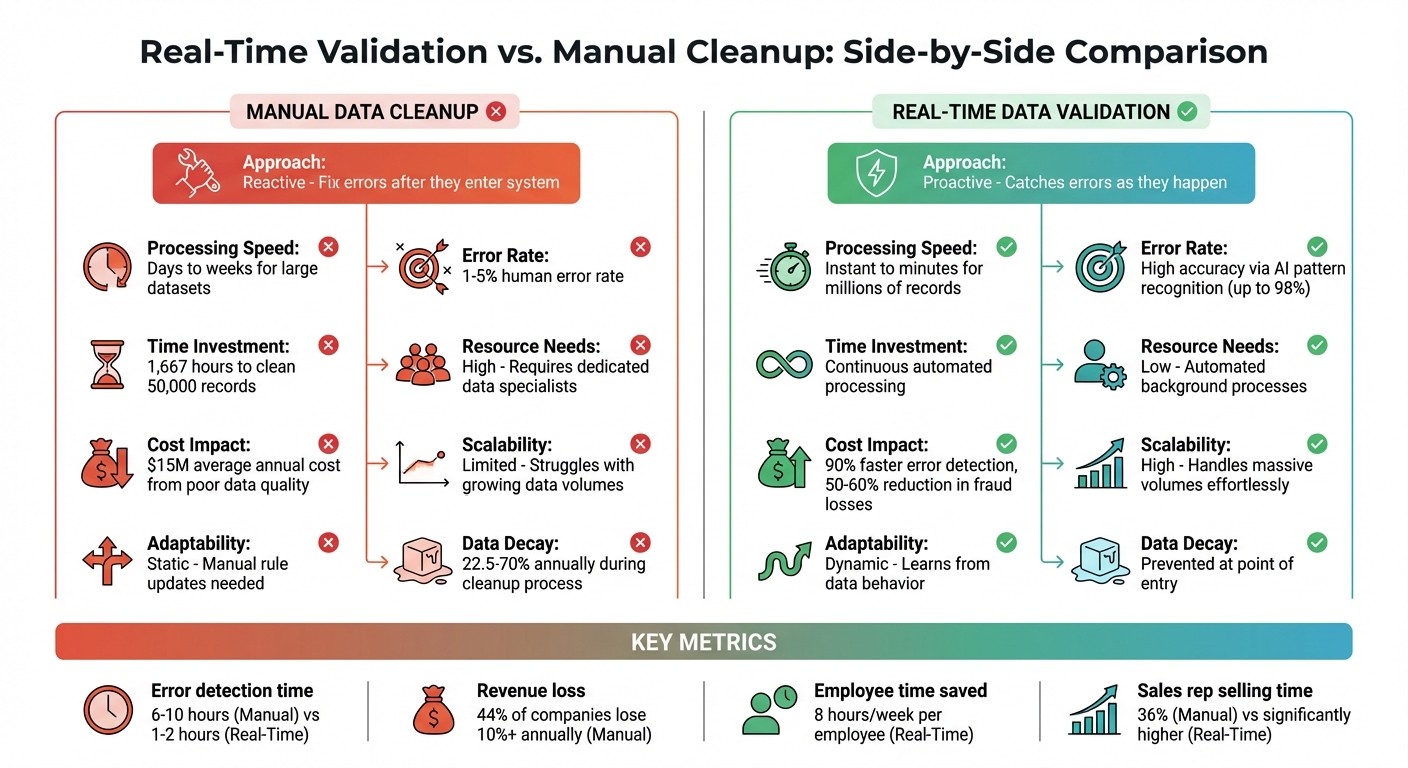
Real-Time Data Validation vs Manual Data Cleanup Comparison
When you compare the two approaches, the differences are clear. Manual cleanup is a reactive process: you export data, fix the errors, and then reimport it - only for the same issues to crop up again as data continues to degrade over time. On the other hand, real-time validation stops bad data in its tracks, catching errors as they happen and preventing them from ever entering your system.
Let’s talk speed. Manual cleanup can take anywhere from days to weeks to process, while real-time validation works in minutes. For example, cleaning up a database with 50,000 records manually can eat up around 1,667 hours. In contrast, real-time systems handle large datasets instantly and continuously, without the need for human involvement.
Accuracy is another big differentiator. Manual cleanup methods typically have an error rate of 1–5%. As Databar.ai points out:
"Manual data processes carry error rates of 1-5%, meaning your cleanup effort might be creating nearly as many problems as it solves."
Real-time systems, powered by AI, use advanced tools like pattern recognition and fuzzy matching to catch anomalies that humans might overlook. This ensures consistently better accuracy, even when dealing with millions of records.
Cost is another area where real-time validation shines. Poor data quality costs companies an average of $15 million annually, with 44% of businesses losing more than 10% of their revenue due to dirty CRM data. Manual cleanup requires dedicated teams and recurring labor costs, while automated systems operate on subscription fees. These can range from $20 per user for platforms like K3X to $500 or more for mid-market tools. Solutions like K3X don’t just save money - they also reclaim up to 8 hours of productivity per employee each week.
Here’s a quick look at how the two approaches stack up:
Comparison Table: Real-Time Validation vs. Manual Cleanup
Metric | Manual Data Cleanup | Real-Time Validation |
|---|---|---|
Processing Speed | Days to weeks for large datasets | Instant to minutes for millions of records |
Error Detection Accuracy | 1–5% human error rate | High accuracy via pattern recognition |
Resource Needs | High; requires dedicated data specialists | Low; automated background processes |
Cost-Effectiveness | Low; high labor costs and revenue loss | High; reduces long-term operational costs |
Scalability | Limited; struggles with growing data volumes | High; handles massive volumes effortlessly |
Adaptability | Static; manual rule updates needed | Dynamic; learns from data behavior |
Real-time validation doesn’t just improve efficiency - it transforms how organizations manage and maintain their data.
Why Real-Time Validation is Becoming the Standard
Switching from manual data cleanup to real-time validation is crucial to combat the relentless pace of data decay and rising costs. Here's the reality: by the time manual cleanup is done, much of the data has already become outdated. Real-time validation changes the game by catching errors right at the point of entry. This prevents bad data from infiltrating dashboards, reports, or financial models, acting as a safeguard for accuracy and reliability. This proactive approach - often called a "shift-left" strategy - tackles problems before they grow, effectively addressing the financial losses discussed earlier.
Handling Growth and Efficiency Requirements
Scalability is another major reason companies are embracing real-time validation. As businesses expand, manual cleanup becomes unsustainable. For example, cleaning 50,000 records manually can take around 1,667 hours. Real-time systems, on the other hand, naturally scale with data volume.
The efficiency benefits are striking. AI-powered validation slashes error detection times from 6–10 hours to just 1–2 hours - a 90% improvement. Companies using continuous monitoring report a 50–60% reduction in fraud losses, while AI workflows boost efficiency by 70–90%, compared to the 40–60% gains achieved with traditional automation.
Simplifying Data Validation with K3X

K3X simplifies the process of maintaining clean data, avoiding the complexity of traditional CRM systems. Instead of relying on rigid if-then rules, K3X allows users to define goals conversationally. For example, you could set a goal like, "Book demo calls with every lead who hasn't responded", and the AI takes care of the rest. It automatically logs emails, tracks calls, and updates contacts - eliminating the need for manual data entry.
In December 2025, Ruby Capital Group adopted K3X's AI-driven tools and saw impressive results: a 70% reduction in follow-up time and a threefold increase in ticket resolution speed within just two days. At a cost of $20 per seat per month, K3X saves an average of 8 hours per employee each week. That’s time employees can spend closing deals instead of cleaning up data. K3X transforms CRMs from static databases into active systems that understand goals, adapt to changes, and execute next steps automatically.
This shift highlights why modern, goal-driven platforms like K3X are reshaping how businesses approach data validation.
Conclusion: Selecting the Right Method for Your Business
For many businesses, transitioning from manual data cleanup to real-time data validation isn't just a choice - it’s a necessity. Manual cleanup may work for smaller datasets under 10,000 records, but it quickly becomes impractical as databases grow. For example, cleaning a mid-sized database with 50,000 records can take thousands of hours, all while data continues to degrade during the process.
If your sales team is struggling with unreliable CRM data, your database exceeds 10,000 records, or your marketing emails are bouncing more frequently, these are clear indicators that it’s time to consider real-time validation. Manual methods simply don’t scale. They often introduce errors, with rates between 1% and 5%, and can’t keep up with the pace of data changes. Real-time validation, on the other hand, addresses errors as they occur, ensuring data accuracy from the start.
The inefficiencies of manual cleanup extend beyond data accuracy. Misallocated resources are another major issue. Sales representatives, for instance, spend only 36% of their time selling, with the rest eaten up by administrative tasks. Justin Herrick from Reevo highlights this problem:
"Your top account executive, the $150,000 seller you hired to close deals, spends less than 30% of their time actually selling."
Given these lost opportunities, automation becomes a game-changer. For businesses ready to move beyond manual data management, platforms like K3X provide an easy solution. At $20 per seat per month, K3X automates tasks like data capture, updates, and validation, saving employees an average of 8 hours per week. Instead of juggling complex workflows, you can set clear goals - like "Book demo calls with every lead who hasn't responded" - and let the AI handle the rest. This shifts your CRM from a passive tool to an active, adaptive system that evolves with your business. By adopting real-time validation, you’re not just upgrading your CRM - you’re streamlining your entire sales process.
FAQs
How do you add real-time validation to an existing CRM?
Real-time validation can be achieved by using AI-powered systems that continuously monitor data streams, spot anomalies, and verify data integrity right at the source. This approach eliminates the need for manual checks, replacing them with automated processes that quickly identify and address errors. The result? Fewer issues in reports and dashboards.
For example, platforms like K3X provide AI-native CRMs equipped with built-in real-time validation. If you're using an existing CRM, you can integrate AI tools to keep your data accurate and current - no manual effort required.
What happens to records that fail real-time validation?
Records that don’t pass real-time validation are either rejected outright or flagged for review before they make it into the system. This process stops invalid data right at the source, keeping it from spreading or causing disruptions in workflows.
When should a team stop manual cleanup and automate validation?
When manual processes start falling behind in managing data decay - which can hit rates of up to 70% per year - it’s time for teams to consider automated validation. Frequent changes like updated contact details or company mergers make manual data cleanup not just time-consuming, but also increasingly ineffective.
AI-powered validation steps in to address this challenge by ensuring data stays accurate in real-time. This approach minimizes errors, saves valuable time, and lets teams shift their focus from repetitive updates to achieving meaningful results. Tools such as K3X streamline the entire process, automating data validation so your team can prioritize what really matters.