

AI-driven predictive learning turns CRM activity into accurate forecasts, prioritizes high-value deals, shortens sales cycles, and reduces admin work.
Predictive learning is reshaping sales pipelines by turning static CRM data into actionable insights that drive revenue growth. It uses AI and machine learning to analyze real-time engagement, historical trends, and external signals, helping businesses:
Improve Forecast Accuracy: AI-driven models achieve 75–95% accuracy, compared to under 20% of companies hitting 75% accuracy with older methods.
Prioritize High-Value Deals: Identifies subtle behaviors (e.g., email responsiveness, stakeholder involvement) to focus on leads most likely to convert.
Accelerate Sales Cycles: Flags stalled deals and automates follow-ups to keep momentum, reducing sales cycle lengths by 25–60%.
Cut Admin Work: Automates data entry and updates, freeing reps to focus on selling.
For example, companies like Piano and Crayon have seen revenue projection accuracy jump to 90% and reduced forecasting time by 66% after adopting predictive tools. Platforms like K3X further simplify the process with AI-native designs that automate tasks based on simple prompts, delivering faster results at $20/seat per month.
Key Metrics to Track:
Forecast accuracy (+20–30%)
Lead-to-customer conversion rate (+50%)
Sales cycle length (-25–60%)
Quota attainment (+33%)
Predictive learning eliminates guesswork, helping sales teams make smarter, faster decisions while reducing inefficiencies.
Introducing the Predictive Revenue System
What Is Predictive Learning and How Does It Work?
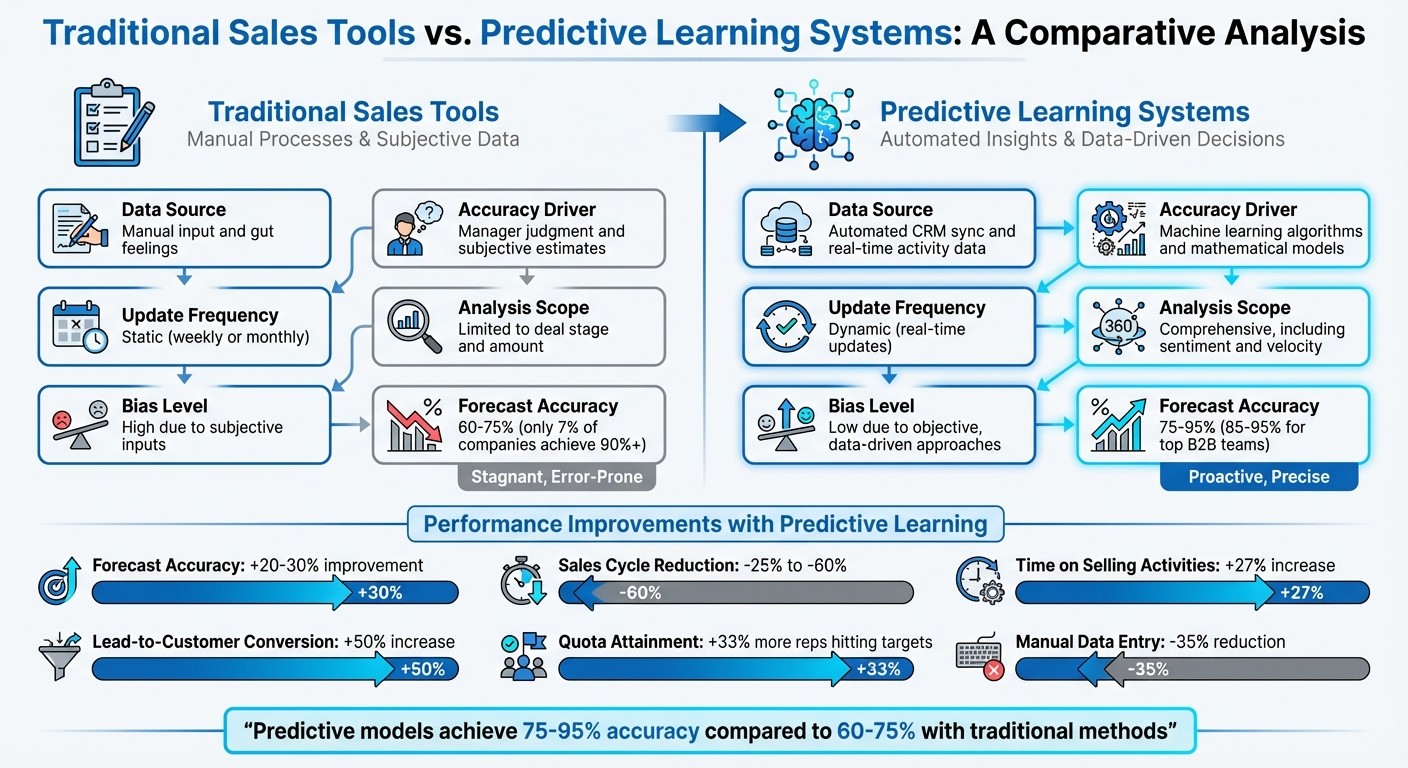
Traditional vs Predictive Sales Tools: Key Differences and Performance Metrics
Predictive learning uses machine learning (ML) and artificial intelligence (AI) to analyze historical data, behavioral trends, and market signals. By spotting intricate patterns - like deal age, pipeline velocity, and engagement indicators - it generates highly accurate revenue projections.
Here’s how it works: the system studies thousands of past deals to uncover the factors that lead to success. It tracks real-time engagement metrics, such as email response rates, meeting frequency, and website activity, to assign dynamic probability scores to each opportunity. Some advanced systems even incorporate external data, like demand changes, competitor pricing, and seasonal trends. They also use natural language processing (NLP) to turn call transcripts and emails into actionable insights. As new data flows into the CRM, these systems continuously refine their algorithms, adapting to evolving buyer behaviors. This constant learning process helps businesses gain sharper insights into what drives deal success.
"A CRM saturated with data is only valuable if it provides clear, actionable foresight rather than retrospective guesswork." – FindMyCRM
The impact is hard to ignore. Predictive sales forecasting often improves accuracy by 20–30% over traditional methods. Data-driven models typically achieve accuracy rates between 75% and 95%, with top-performing B2B teams reporting levels as high as 85–95%.
Predictive Learning vs. Traditional Sales Tools
Traditional sales tools depend heavily on manual inputs and subjective judgments. Sales managers often rely on weekly pipeline reviews where reps provide their "gut feeling" about deal probabilities. These estimates, influenced by optimism or pressure to meet quotas, create static snapshots that quickly become outdated.
Predictive learning systems take a completely different approach. They automatically pull data from CRM activity and buyer engagement, analyzing hundreds of variables far beyond deal stage or size. With continuous, real-time updates, these systems eliminate bias by focusing on objective, data-driven insights instead of human judgment.
Factor | Traditional Sales Tools | Predictive Learning Systems |
|---|---|---|
Data Source | Manual input and gut feelings | Automated CRM sync and real-time activity data |
Accuracy Driver | Manager judgment and subjective estimates | Machine learning algorithms and mathematical models |
Update Frequency | Static (weekly or monthly) | Dynamic (real-time updates) |
Analysis Scope | Limited to deal stage and amount | Comprehensive, including sentiment and velocity |
Bias Level | High due to subjective inputs | Low due to objective, data-driven approaches |
The real strength of predictive systems is their adaptability. Unlike traditional tools that need manual updates when conditions change, predictive systems adjust automatically by learning from every new data point. This ability to evolve ensures more accurate, reliable forecasts.
Core Components of Predictive Learning
Predictive learning systems rely on three key components:
Data Collection: They gather information like deal history, engagement trends, and external market signals from multiple sources.
Pattern Recognition: AI identifies links between activities and outcomes. For instance, it might discover that deals with multiple stakeholders and weekly touchpoints are more likely to close than those with less engagement.
Probability Scoring and Insights: The system assigns a closing likelihood to each deal based on identified patterns. It also offers actionable recommendations, such as which leads to prioritize or which deals require immediate attention, transforming the CRM into a strategic tool.
These components help tackle pipeline bottlenecks and reduce forecasting errors by delivering timely, actionable insights.
"Predictive models are only as good as the data they're based on. Incomplete or inconsistent CRM data directly affects forecasts." – FindMyCRM
Before diving into predictive tools, it’s essential to ensure your data is solid. If more than 25% of your CRM data is unreliable, the algorithms will likely produce flawed forecasts. Start by auditing your data and setting clear standards, such as defining entry and exit criteria for each pipeline stage. Begin with simple models, gradually adding complexity as data quality improves.
How Predictive Learning Improves Sales Pipelines
Predictive learning takes sales pipelines to the next level, turning static data into a dynamic system that reflects actual buyer behavior. Instead of relying on intuition or periodic updates, sales teams gain data-driven insights that show exactly where deals stand and what steps can push them forward. This results in more accurate forecasts, better prioritization of leads, and quicker deal closures.
Better Forecasting Accuracy
Traditional forecasting often falls short because it’s influenced by human bias. Sales reps might under-report to exceed expectations later or overestimate when quotas are looming. Predictive learning removes these emotional factors by analyzing thousands of variables - like deal velocity, historical performance, and even call sentiment.
For context, only 7% of companies using manual methods achieve 90%+ forecast accuracy, while machine learning models typically hit 85%–95%. AI-driven forecasting can reduce errors by 20–50%, cutting administrative costs and minimizing lost sales.
Take Piano, a data analytics company, as an example. In February 2025, they implemented Gong Forecast to centralize pipeline data from Salesforce, Google Drive, and Slack. Under Peter Lastowski, their VP of Revenue Operations, this move boosted quarterly revenue projection accuracy to 90%, bridging a multi-million-dollar gap between forecasts and actual results.
"The progress we've seen from what the CRM, sales managers, and even the CRO used to tell us was going to land is astronomical... We've closed the gap by millions. With Gong, our end-of-quarter forecasts are solid." – Peter Lastowski, VP of Revenue Operations, Piano
Unlike spreadsheets that quickly become outdated, predictive models update in real time as new data flows in. This creates "rolling forecasts" that adjust to market changes, helping managers refine strategies before the quarter ends.
A mid-sized SaaS company with 40 sales reps and $25M in annual recurring revenue saw incredible results after adopting predictive lead scoring and AI forecasting. Their forecast accuracy jumped from 68% to 89%, close rates improved by 34% (rising from 23% to 31%), and their sales cycle shortened from 47 to 35 days. This approach transforms forecasting into a proactive tool for tackling pipeline challenges.
Focus on High-Value Opportunities
Beyond forecasting, predictive learning sharpens lead evaluation by identifying high-value opportunities. It replaces outdated scoring systems with machine learning models that recognize patterns tied to successful conversions. Instead of assigning arbitrary points for actions like downloading a whitepaper, AI looks at subtle behaviors - such as repeated website visits in a short timeframe or specific language cues in emails.
These systems also track intent signals in real time, flagging risks like reduced responsiveness or single-threaded communication (where only one stakeholder is involved). When risks are detected, managers can step in before deals stall.
What makes this even more effective is the prescriptive guidance provided. AI doesn’t just highlight promising leads - it suggests actionable next steps, like scheduling a demo or involving senior leadership, based on what has worked for similar deals in the past. Addressing objections earlier in the process can boost win rates by 35%.
In early 2025, Crayon, a competitive intelligence firm, replaced manual Google Sheet tracking with AI-driven forecasting. This change cut their weekly forecasting call times by 66%, from 60 minutes to just 20, while giving the entire sales team better access to historical data.
"I have throughout my career said that there are two really dangerous things that I hear from salespeople or sales managers, and that is I think or I feel. Gong gives us the ability to move out of that very dangerous realm of emotion and into the realm of knowledge." – Crayon Sales Leadership
Another example comes from an industrial equipment distributor with $60M in annual revenue. By using Zoho's Zia AI to monitor 47 customer health signals, they identified at-risk customers 4.3 months earlier than expected. This proactive approach cut their churn rate from 12% to 7%, saving them $1M annually.
Faster Deal Progression
Once high-value leads are identified, predictive systems ensure deals don’t get stuck. They flag opportunities that linger too long at certain stages, like a proposal sitting idle for over 45 days, allowing managers to intervene before it’s too late.
AI tools can also automate follow-ups for stalled deals, freeing sales reps to focus on active negotiations. By monitoring "engagement velocity" - how quickly prospects respond to emails or schedule meetings - these systems alert managers when momentum slows, enabling immediate coaching.
By assigning probability scores to every deal, teams can shift their focus from low-probability deals to those most likely to close. Companies that align their KPIs with AI insights are 3 times more likely to see financial gains compared to those sticking to traditional metrics.
"Predictive intelligence is like having a crystal ball for your pipeline – except it's grounded in real data and statistical rigor." – Harry Hawk, Principal Consultant, RevSure
Predictive systems also support scenario planning. Leaders can simulate changes - like improving win rates by 5% - to understand the immediate impact on forecasts and refine their strategies accordingly. This shifts forecasting from a backward-looking activity to a forward-thinking system that continuously enhances pipeline performance.
K3X: AI-Native CRM for Predictive Sales Pipeline Management

K3X takes CRM capabilities to a new level by shifting the focus from managing tasks to delivering outcomes. Unlike older systems that rely on manual workflows, K3X uses predictive learning to automate processes based on simple, outcome-driven prompts. This AI-native CRM eliminates the need for complex triggers or sequences, making sales pipeline management faster and more intuitive.
Here’s how it works: instead of creating a web of "if-then" rules, you simply tell K3X what you want to achieve. For example, you might say, "Book demo calls with every lead who hasn't responded." The AI takes care of the rest, figuring out the steps needed to make it happen. This approach streamlines the entire sales process, allowing teams to focus on results rather than the mechanics of the software.
How K3X Uses Predictive Learning
K3X tackles common CRM pain points - like tedious data entry and static forecasting - by delivering a dynamic, data-driven experience. It doesn’t just record actions; it understands outcomes. The system listens to interactions, tracks changes, and acts accordingly. For instance, if a lead replies to an email, K3X automatically updates the pipeline stage, logs the interaction, and decides whether to send a follow-up, schedule a meeting, or escalate the lead. All of this happens in real time, without human intervention.
The platform is designed to adapt continuously. If a prospect responds out of sequence or raises an unexpected issue, K3X recalibrates its approach instead of freezing up like traditional workflow-based systems. A great example of this adaptability comes from Ruby Capital Group. In December 2025, the company implemented K3X and saw immediate results: within just two days, they cut follow-up time by 70% and tripled their ticket resolution speed. CEO Michael Chkechkov shared how this transformation allowed the sales team to focus on closing deals while the system handled lead qualification and contract routing.
"Our sales team was spending half their day on admin work. Now they're talking to customers and closing deals. The automation handles everything from lead qualification to contract routing."
– Michael Chkechkov, CEO, Ruby Capital Group
By leveraging real-time engagement data, K3X eliminates bottlenecks and keeps deals moving forward. It ensures data accuracy, which provides managers with a solid foundation for reliable forecasting. Across its user base, K3X has already automated over 312,000 hours of work and saved businesses an estimated $12.4 million in operational costs.
K3X vs. Traditional CRMs
The difference between K3X and older CRM systems is all about adaptability. Traditional systems follow rigid workflows that can break when something unexpected happens. K3X, on the other hand, focuses on achieving outcomes and adjusts its actions dynamically to meet those goals.
Feature | Traditional CRMs | K3X AI-Native CRM |
|---|---|---|
Logic Type | Linear; follows fixed steps | Goal-oriented; pursues outcomes |
Data Entry | Manual; consumes 20+ hours weekly | Automated; driven by prompts |
Adaptability | Breaks when unexpected changes occur | Adapts in real time to replies and patterns |
Setup Time | Weeks or months for implementation | Deployed in under an hour |
Forecasting | Subjective; based on rep "gut feel" | Data-driven; relies on real-time engagement |
Pipeline Updates | Manual stage movement | Auto-updates stages in real time |
One of K3X’s standout features is its simplicity. You don’t need technical expertise to use it. Just describe what you want to achieve in plain language, and the system takes care of the details. This natural language interaction removes the need for coding or building complex workflows. Starting at $20 per seat per month, K3X offers cost-effective scalability. During busy periods, pricing adjusts with usage, returning to the base rate in slower months - keeping it budget-friendly year-round.
"We're building a CRM that works the way people expect it to, not through menus, workflows, or complexity, but through intention. You tell it the outcome. The system figures out the work."
– Mykyta Samusiev, Founder & CEO, K3X
This adaptive, user-friendly approach lays the groundwork for measurable improvements in sales pipeline performance, setting the stage for the next section on impact metrics.
Measuring the Impact of Predictive Learning
When predictive learning reshapes pipeline management, it’s essential to measure its impact. Without tracking results, improvements might go unnoticed. By zeroing in on a few key metrics tied to revenue and efficiency, you can gain clear insights into how well the system is working.
Key Metrics to Track
To understand the real outcomes of predictive learning, focus on metrics that directly reflect performance and efficiency.
Forecast Accuracy: This metric shows how closely your predictions align with actual outcomes. Traditional forecasting methods typically hit 60–75% accuracy, while predictive models powered by data can achieve 75–95% accuracy. An improvement of 20–30% in forecast accuracy is a strong indicator that your model is effective.
Lead-to-Customer Conversion Rate: This measures how well the system identifies and prioritizes high-value opportunities. Sales teams using AI tools often see conversion rates increase by up to 50% compared to teams using traditional methods.
Sales Cycle Length: This tracks the time it takes for deals to move through the pipeline, from first contact to close. Machine learning has been shown to reduce sales cycles by 25% to 60%. Pay attention to deals that stall longer than expected, as these can signal process inefficiencies.
Pipeline Velocity: A comprehensive metric that combines deal count, conversion rate, deal size, and sales cycle length, providing a clear picture of revenue flow.
Quota Attainment: Sales reps using machine learning tools are 33% more likely to hit their quarterly targets. Additionally, these tools help teams allocate their time more effectively, with a 27% increase in time spent on direct selling and a 35% reduction in manual data entry.
Model Drift Rate: Predictive models can lose accuracy over time as market conditions shift. Regular updates to your system can help maintain reliability, and companies that do this often see profit margins increase by around 24%.
Metric | What It Measures | Target Improvement |
|---|---|---|
Forecast Accuracy | How closely predictions match actual results | 20–30% increase |
Sales Cycle Length | Time from first contact to close | 25–60% reduction |
Quota Attainment | Percentage of reps meeting their targets | 33% higher success rate |
Time in Selling Activities | Hours spent on selling vs. admin tasks | 27% increase |
Implementation Best Practices
To maximize the benefits of predictive learning, follow these steps:
Baseline Audit: Start by documenting your current win rates, average deal sizes, and sales cycle lengths. This baseline will serve as a benchmark to measure improvements. Make sure your CRM data is clean and accurate before deploying any models.
90-Day Pilot: Test predictive learning with a single team or segment over 90 days before rolling it out company-wide. This trial run allows you to measure results and compare them to a control group.
Objective Stage Criteria: Define clear entry and exit rules for each pipeline stage based on concrete buyer actions, such as “proposal reviewed by decision-maker.” Avoid relying on subjective judgments, as this ensures the AI learns from meaningful data.
Regular Reviews: Schedule weekly meetings to assess active deals and monthly sessions to evaluate broader pipeline trends. Use these reviews to address AI-flagged risks, stalled deals, and engagement patterns, enabling proactive adjustments.
Human-AI Collaboration: While AI is great at spotting patterns and risks, human oversight is crucial for strategic decisions and handling unique buyer situations.
Model Retraining: As buyer behaviors and market conditions change, retrain your models quarterly. Regular updates prevent accuracy drift and keep predictions reliable. Companies that actively refine their systems often see profit margins rise by about 24%.
Conclusion
Predictive learning transforms sales pipelines into proactive tools for driving revenue. Instead of relying on subjective instincts or outdated data snapshots, these systems leverage real-time insights - such as email sentiment, meeting frequency, and engagement metrics - to flag potential deal risks weeks before they stall. By shifting from guesswork to science-backed scoring, businesses typically see a 20–30% improvement in forecast accuracy. Data-driven models often achieve 75–95% accuracy, far surpassing traditional methods.
Teams using AI-powered tools report impressive results, including a 50% increase in lead-to-opportunity conversions and a 40% reduction in sales cycle length. Ruby Capital Group provides a striking example: in December 2025, they achieved a 70% reduction in follow-up times and tripled their ticket resolution speed, leading to their highest close rates ever.
This shift is best captured by the words of Mykyta Samusiev, Co-Founder & CEO of K3X:
"Most CRMs record activity. K3X understands outcomes. It listens, knows what changed, and makes the next moves." - Mykyta Samusiev
Unlike traditional CRMs that depend on manual updates and rigid workflows, K3X uses natural language prompts to define outcomes and autonomously execute actions. This approach eliminates the administrative tasks that often consume over 20 hours per week, freeing sales teams to focus on closing deals instead of managing software.
With only 7% of companies achieving 90%+ forecasting accuracy without machine learning, adopting AI-native tools like K3X is quickly becoming a necessity for sustained revenue growth. Starting at just $20 per seat per month, K3X offers an adaptive pricing model that grows with your business, making predictive pipeline management both accessible and straightforward.
FAQs
What data is needed for predictive learning to work well?
Predictive learning thrives on accurate and well-organized data to provide reliable outcomes. This involves combining historical opportunity records, current lead and customer information, and real-time activity monitoring. These components work together to uncover patterns and enhance the precision of forecasts.
How do I tell if a deal is truly stalled in my pipeline?
If a deal lingers in the same stage longer than the usual cycle time, lacks recent buyer engagement, or shows no progress despite ongoing efforts, it’s likely stalled. This is where AI tools come in handy. They can evaluate deal progression, track engagement trends, and analyze communication data to pinpoint bottlenecks before they become major issues. This allows sales teams to prioritize active opportunities and steer clear of deals that risk prolonged inactivity.
How fast can K3X improve forecasting and follow-ups?
K3X improves forecasting and follow-ups in real time by actively managing goals, updating pipelines, and aligning teams based on ongoing interactions. Instead of functioning like a passive database, it takes on the role of an active operator, simplifying workflows and improving efficiency. This approach frees up teams to concentrate on closing deals rather than spending time navigating and managing software.