


AI pipeline stage alerts boost sales productivity, forecast accuracy, and ROI—actionable insights that shorten cycles and rescue stalled deals.
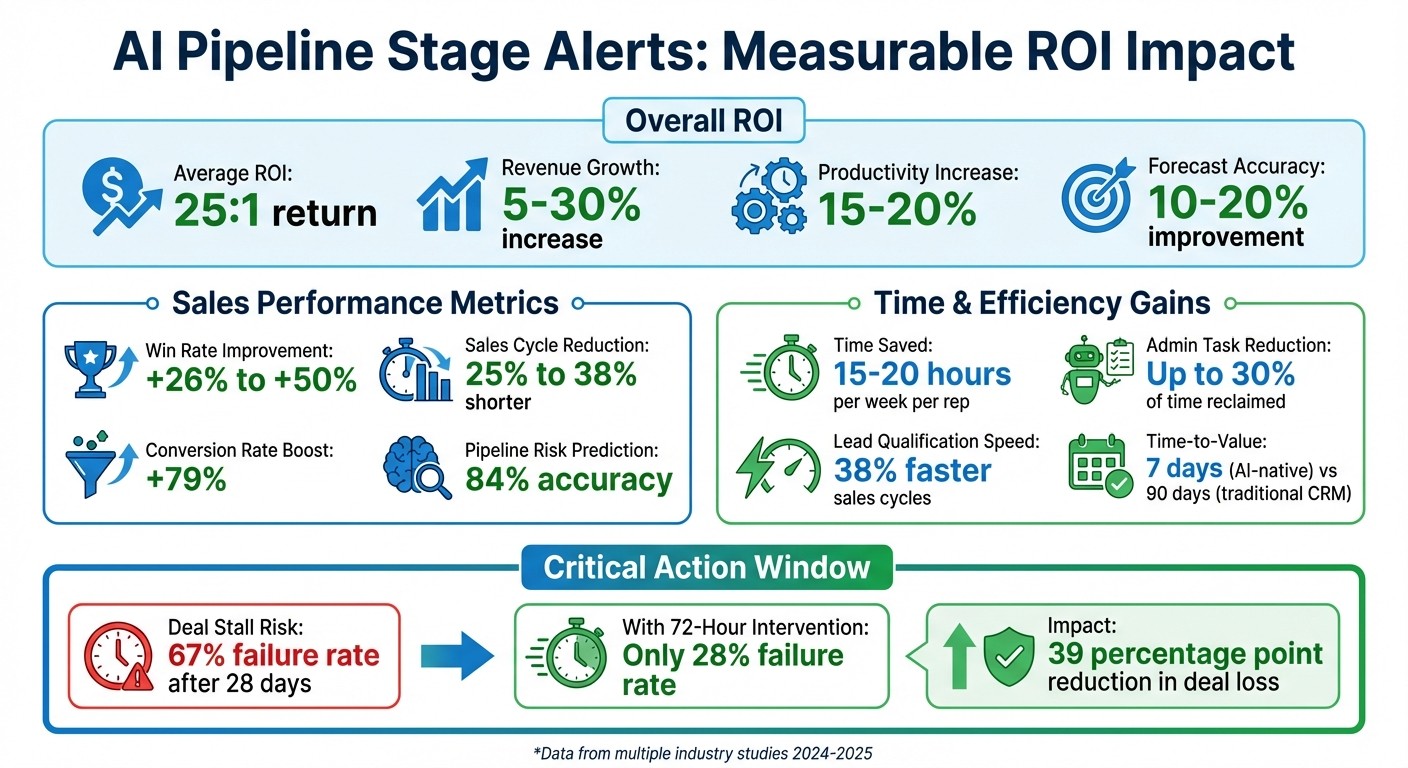
AI pipeline stage alerts are transforming sales operations by automating manual tasks, improving accuracy, and boosting productivity. Companies using AI see a 15–20% productivity increase, 10–20% better forecast accuracy, and a 25:1 ROI on average. Yet, many struggle to measure the impact effectively. Here's what you need to know:
AI Pipeline Alerts: These systems track sales pipeline activity, send actionable notifications, and even update CRM data automatically, saving time and reducing errors.
Benefits: Sales reps reclaim 15–20 hours weekly, pipeline risks are predicted with 84% accuracy, and sales cycles shorten by up to 38%.
Key Metrics: Win rates improve by 26–50%, revenue grows 5–30%, and conversion rates jump 79%.
Why It Matters: Acting on alerts within 72 hours can lower deal failure rates from 67% to 28%.
AI tools like K3X simplify CRM management with prompt-driven actions, eliminating the need for complex workflows. This allows teams to focus on selling, not admin tasks, driving measurable results like higher close rates and faster sales cycles. AI isn't just a tool - it's reshaping how sales teams operate.
ROI Impact of AI Pipeline Stage Alerts in Sales Operations
8 AI Sales Automations That Feel Like Cheating (PROVEN Systems)
How AI Pipeline Stage Alerts Work
AI pipeline stage alerts keep a close watch on your sales data, sending notifications when certain conditions are met. Unlike older systems that rely on manual inputs or rigid rules, these AI-driven tools analyze natural language from sources like emails, call transcripts, and meeting notes. This allows them to provide a fuller picture of deal progress, improving accuracy and supporting better ROI.
Core Functions of AI Pipeline Alerts
One of the main goals of these alerts is to close the gap between what happens during a deal and what actually gets logged in the CRM. Using tools like Whisper or GPT-4, these systems analyze conversations based on BANT criteria (Budget, Authority, Need, and Timeline). For instance, if a prospect mentions their budget during a call, the AI can automatically update the deal stage to "Qualified to Buy" and explain the update in the CRM - no manual input needed.
These tools also help sales teams prepare for pipeline reviews by flagging critical deals and offering insights on objections and next steps. After the review, they log key details like ownership, deadlines, and tasks, sending automated summaries to the team. This transforms the CRM from a static database into a dynamic sales operations tool.
"An alert that says 'Problem Detected' is noise. An alert that says 'Problem Detected. Here is the solution. Click to execute,' is orchestration." - Jonathan M Kvarfordt
Data Types Monitored by AI Systems
AI pipeline alerts track a wide range of data. They review call transcripts, emails, meeting notes, and CRM metadata to identify buying signals, highlight inactive deals, and compare current sales cycles to historical trends. For example, they apply staleness rules, flagging deals with no activity for over 14 days, and spot "zombie deals" by comparing current cycles to past conversion rates. By analyzing team activity - like sales reps’ response times and productivity - these systems address pipeline accuracy issues that 77% of sales leaders face.
This multi-layered analysis feeds real-time alerts, helping sales teams tackle risks and improve ROI.
Benefits of Real-Time Alerts
Real-time alerts, powered by these rich data insights, allow sales teams to act quickly and see measurable results. Instead of realizing there’s a problem after losing a deal, AI can predict pipeline risks with 84% accuracy up to four weeks in advance. This early detection is crucial - deals that stall for more than 28 days are 67% less likely to close. However, intervening within 72 hours of spotting an issue can lower failure rates from 67% to 28%.
AI-powered tools also save time and streamline workflows. By automating routine tasks, sales reps can reclaim up to 30% of their time. Companies using AI for lead qualification have cut their sales cycle length by 38%. Additionally, by delivering actionable alerts directly through platforms like Slack or Teams, these tools reduce the need for constant app-switching, saving an average of 23 minutes per interruption.
Measuring ROI: Research and Metrics
Research provides concrete numbers to back up the benefits of AI adoption, offering clear insights into ROI.
Key ROI Metrics from Research Studies
AI pipeline alerts are transforming revenue and operational efficiency. Studies reveal that businesses leveraging these alerts see 5%–10% revenue growth in the first year, with some achieving as much as 20%–30%. Additionally, companies that fully integrate AI recommendations report 50% higher win rates and sales cycle reductions of up to 38%. McKinsey supports these findings, stating, "Companies that adopt AI-powered sales tools can expect to see a 5% to 10% increase in revenue within the first year of implementation".
Efficiency gains are equally striking. AI-driven lead qualification reduces sales cycles by 38%, while AI-powered lead scoring boosts conversion rates by 79%. Forecast accuracy improves by 10%–20%, with some companies achieving 98% accuracy, far surpassing the industry average of 78%. Sales teams also benefit from productivity gains of 15%–25%, with reps saving over 6 hours per week on administrative tasks.
AI-native tools significantly outperform traditional systems. Platforms with a high AI Native Score (above 80) deliver an ROI of 241%, nearly 2.8 times higher than the 87% ROI of non-AI tools. Time-to-value is another standout metric - AI-native CRMs deliver results in as little as 7 days, compared to 90 days for traditional CRMs.
"Average win rates increased by a whopping 50% in deals where reps completed all their AI-recommended to-dos compared with those who didn't." - Dan Morgese, Director of Content Strategy and Research at Gong
Metric | Impact of AI Adoption |
|---|---|
Win Rate | +26% to +50% increase |
Sales Cycle Length | 25% to 38% reduction |
Conversion Rates | +79% increase |
Forecast Accuracy | 10–20% improvement |
Revenue Growth | 5% to 30% increase |
Time Savings | 6+ hours per rep per week |
Average ROI | 25:1 return |
While these numbers highlight AI's potential, ROI outcomes often depend on specific industry factors.
Factors That Affect ROI Across Industries
The impact of AI varies by industry, deal complexity, and company size. For example, SaaS companies lead with an average ROI of 241% and 89% prediction accuracy, though their deals tend to stall quickly - within just 24 days. In contrast, manufacturing firms see a 156% ROI and 78% prediction accuracy, but their deals can endure longer cycles, stalling after 35 days. Meanwhile, financial services firms report a 134% ROI with 80% prediction accuracy, as their more regulated and complex deals typically stall at 42 days.
Company size also influences deal dynamics. Small businesses (5–50 employees), often led by founders, see deals at risk after just 21 days. Mid-sized companies (50–200 employees), with more structured processes, hit warning thresholds at 28 days, while larger organizations (200–500 employees), dealing with multi-stakeholder approvals, don’t see critical delays until 35 days.
Data quality is a crucial factor in maximizing AI's potential. Companies with clean, well-maintained data are 2.5 times more likely to achieve significant revenue growth using AI. Without accurate data, even the most advanced AI tools face limitations. This underscores why AI-native platforms, like K3X, deliver faster results compared to systems bogged down by complex workflows.
Case Studies: AI Pipeline Alerts in Action
Across industries, companies are leveraging AI alerts to solve challenges and achieve impressive outcomes. These real-world examples highlight how AI-driven insights are transforming business operations and delivering measurable results.
Case Study 1: SaaS Company Achieves 27% Growth in ARR
When it comes to financial performance, this SaaS company’s experience demonstrates how timely alerts can significantly impact revenue. TechVantage saw its Annual Recurring Revenue (ARR) jump by 27% - from $12 million to $15.2 million - in just six months, thanks to AI alerts and predictive scoring. The system flagged at-risk deals in real time, allowing the team to proactively address stalled negotiations. This approach helped maintain momentum and unlock previously delayed opportunities.
Case Study 2: Manufacturing Firm Cuts Sales Cycle by Nearly Half
This case underscores how AI can streamline even the most complex sales processes. TechForge Industrial, a small manufacturing firm with only 15 employees, adopted an AI-native platform in January 2024 to replace its outdated CRM. The company faced challenges managing a massive 106,000-SKU catalog and navigating lengthy engineering approval cycles. By implementing AI-powered lead scoring and "pause logic" - which allowed deals to remain in specific stages for 30 to 180 days without triggering irrelevant alerts - the firm reduced its sales cycle from 52 days to just 28, a 46% improvement. Additionally, pipeline velocity increased by 48%.
The transition, led by VP of Sales Sarah Martinez, took only three weeks and integrated seamlessly with QuickBooks and ZenDesk, eliminating the need for manual data entry. This streamlined approach not only saved time but also enhanced operational efficiency.
Case Study 3: AI Alerts Rescue a High-Stakes Deal
This example highlights how AI alerts can mitigate risks and prevent deal losses. A manufacturing company faced the potential collapse of an $89,000 deal stuck in the "Negotiation" stage. AI alerts flagged four critical issues: a stalled deal, an unconfirmed budget, a delayed next step, and a competitor mention. Within 24 hours, an executive escalation uncovered that the client’s procurement team was comparing vendors based on total cost of ownership (TCO).
The sales team acted quickly, delivering a detailed 3-year TCO analysis tailored to the client’s concerns. This timely intervention, occurring within a crucial 72-hour window, salvaged the deal and ensured its successful closure.
K3X: Prompt-Driven AI CRM for Better ROI

How K3X Delivers Better AI Pipeline Alerts
K3X takes a fresh approach to pipeline stage alerts, moving away from rigid "if-then" workflows. Instead, you simply provide the outcome you want, and the AI figures out the rest. For instance, if you prompt it with "Book demo calls with every lead who hasn't responded", the system dynamically adjusts to real-time interactions to make it happen.
By removing the need for middleware like Zapier or Make, K3X is ready to use right away. It automatically logs emails, tracks calls, and progresses deals through stages based on actual activity - no manual data entry required. This ensures that your pipeline alerts are driven by up-to-date, actionable data, offering a clear edge over traditional CRMs that rely on complex workflows.
Ruby Capital Group, a funding company with 125 employees, adopted K3X in December 2025. In just two days, they cut follow-up time by 70% and tripled their ticket resolution speed. CEO Michael Chkechkov noted that the sales team transitioned from spending half their day on admin tasks to focusing entirely on closing deals, resulting in record-breaking close rates.
"Our sales team was spending half their day on admin work. Now they're talking to customers and closing deals. The automation handles everything from lead qualification to contract routing."
Michael Chkechkov, CEO, Ruby Capital Group
K3X has automated over 312,000 hours of work for its users, saving an estimated $12.4 million in operational costs. On average, each employee gains about 8 extra hours per week.
Comparison: K3X vs. Workflow-Heavy Systems
K3X stands apart from traditional CRMs when it comes to ease of use, maintenance, and cost. Here's how they compare:
Feature | K3X (Prompt-Driven AI) | Traditional Workflow-Heavy CRMs |
|---|---|---|
Setup Time | Minutes, not weeks | Weeks to months |
ROI Speed | Immediate (out-of-the-box) | Slow (requires lengthy implementation) |
Logic Type | Outcome-based/goal-oriented | Linear/script-based |
Maintenance | Self-managed via simple prompts | Requires IT or RevOps specialists |
Pricing | $20/month (adaptive, usage-based) | High fixed costs plus integration fees |
Scalability | Scales naturally with volume | Requires additional resources for scaling |
K3X's pricing starts at $20 per seat per month, scaling automatically with your workload and seasonal needs. This includes 1,000 AI credits, unlimited integrations, unlimited contacts, and a built-in power dialer. In contrast, traditional CRMs often come with high fixed costs and additional fees for integrations and third-party tools. K3X’s flexible design allows sales teams to adapt quickly without the delays common in conventional systems.
"Most CRMs record activity. K3X understands outcomes. It listens, knows what changed, and makes the next moves."
Mykyta Samusiev, Co-Founder & CEO, K3X
Why K3X Fits Modern Sales Teams
K3X tackles a major issue for sales reps: the overwhelming amount of time spent on administrative tasks. With only 28% to 36% of their time spent selling, this busywork eats into productivity. K3X reduces this by up to 80%, freeing up more time for closing deals. The platform adapts to your team’s habits, streamlining pipeline management without constant manual adjustments.
Unlike traditional systems that struggle when leads behave unpredictably - such as asking unexpected questions or responding out of sequence - K3X’s outcome-driven logic thrives in these situations. It focuses on achieving the goal rather than sticking to a rigid script. For example, acting on pipeline alerts within 72 hours can slash deal failure rates from 67% to 28%.
K3X also delivers actionable alerts, with AI-driven recommendations boosting action completion rates from 8% to 38%. This ensures that follow-ups, escalations, and updates happen on time, translating directly into a stronger ROI.
For sales teams aiming to maximize the impact of AI pipeline alerts, K3X eliminates technical hurdles and administrative tasks. The result? Faster execution, cleaner data, and more time spent on what really matters - driving revenue.
Conclusion: Improving Sales Performance with AI Pipeline Stage Alerts
AI-powered pipeline alerts take the hassle out of manual tasks and help maximize ROI by automating data entry and keeping deals on track. Consider this: poor productivity costs the U.S. economy an estimated $1.8 trillion every year. But companies that use AI-driven sales tools report impressive results, including an average ROI of 25:1, a 30% boost in sales velocity, and a 25% reduction in sales cycles.
Timing is everything in sales. Acting within 72 hours of a detected stall can slash deal failure rates from 67% to 28%. AI systems make this possible by predicting potential issues 2–4 weeks ahead with 84% accuracy. For instance, Salesforce generated a $37 million pipeline impact in just four months, while HubSpot achieved a 30% increase in sales velocity.
What sets K3X apart from traditional CRMs is its simplicity and scalability. With K3X, you can define outcomes using straightforward prompts - no need for workflows, triggers, or middleware. And all of this comes at just $20 per seat per month, with unlimited integrations and full scalability.
The evidence is clear: AI is no longer optional for modern sales operations. As AgentiveAIQ aptly states:
"AI is no longer a 'nice-to-have' - it's becoming as essential as the CRM itself."
Success in sales often hinges on speed, context, and consistency - areas where AI excels. By eliminating technical and administrative burdens, K3X allows your team to focus on what truly matters: building strong relationships and closing deals.
FAQs
What data does an AI pipeline alert system need to work well?
An effective AI pipeline alert system hinges on having accurate, real-time data at its core. This includes deal information, risk signals, pipeline coverage metrics, velocity, and historical trends. By integrating these inputs into live, interactive dashboards, teams gain the ability to make timely decisions and stay ahead with proactive management. This setup not only helps spot opportunities and risks but also plays a key role in improving overall sales performance.
How do I calculate ROI for AI pipeline stage alerts in my sales team?
To figure out the ROI of AI pipeline stage alerts, you’ll need to compare the value they bring against their costs. The formula is straightforward: ROI = (Incremental Revenue + Cost Savings + Productivity Improvements - Total Costs) / Total Costs × 100%.
Start by tracking key metrics such as faster deal closures, higher pipeline conversion rates, and less manual labor. Then, subtract the costs of implementing and maintaining these alerts. This will help you gauge how they influence sales performance and overall efficiency.
How fast should we act on alerts to prevent deals from stalling?
When it comes to keeping deals on track, timing is everything. Acting on alerts within 72 hours can make a huge difference. By addressing potential issues early in this window, the failure rate drops sharply - from 67% to 28%. That’s a massive improvement and a clear reason to act fast when concerns arise.