

AI lead scoring, instant follow-ups, and predictive analytics cut response times, lower acquisition costs, and boost lead-to-customer conversion rates.
Want to close more deals faster? Automation is your answer.
Here’s why: Sales teams spend only 28% of their week selling, while 78% of customers buy from the first company to respond. Automation tools like AI-powered lead scoring, instant follow-ups, and predictive analytics can slash response times, prioritize high-value leads, and boost conversions by up to 391%.
Key takeaways:
Respond within 1 minute to increase qualification rates by 391%.
AI lead scoring achieves 98.39% accuracy, outpacing manual methods.
Businesses using automation cut customer acquisition costs by 40% and see an ROI of 544% over three years.
Platforms like K3X simplify workflows with conversational AI, handling tasks like lead routing and follow-ups. This frees up your team to focus on closing deals, not admin work.
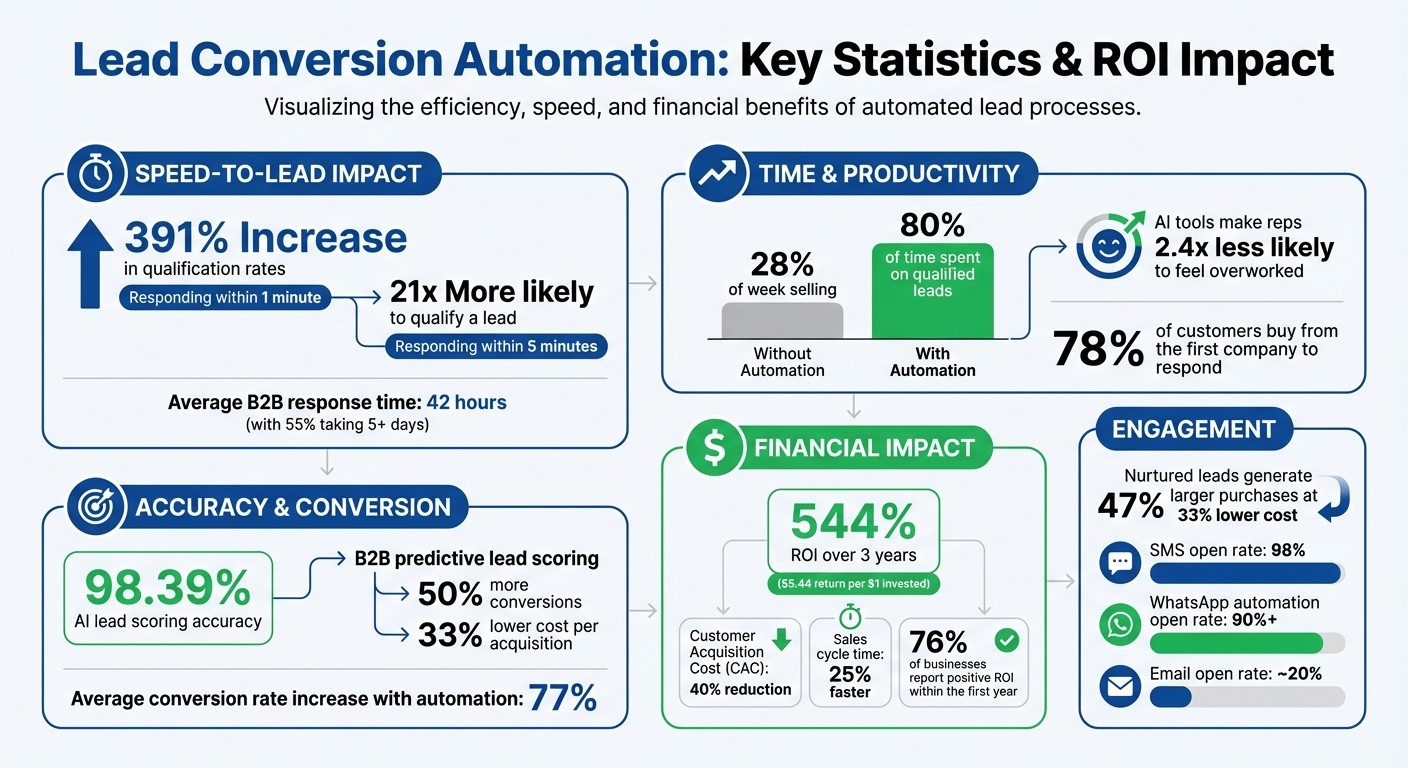
Lead Conversion Automation Statistics and ROI Impact
HOW TO BUILD AN AUTOMATED SALES SYSTEM THAT TURNS FOLLOWERS INTO PAYING CLIENTS
Benefits of Automation in Lead Conversion
Automation has completely reshaped how sales teams manage their workflows. Instead of spending hours manually sorting through leads or handling tedious data entry, teams can now focus on what they do best: selling. With AI tools in the mix, sales reps are 2.4 times less likely to feel overworked, and they can dedicate up to 80% of their time to qualified leads - compared to just 30% without automation.
The financial perks are hard to ignore. Businesses that adopt automated lead generation workflows report a 40% cut in customer acquisition costs and a 25% faster sales cycle. Even more impressive, AI-powered lead generation delivers an average ROI of 544%, meaning every $1 invested returns $5.44 over three years.
Accuracy is another game-changer. AI lead scoring achieves up to 98.39% accuracy in identifying high-value prospects, far surpassing manual methods that often rely on guesswork. For B2B companies, predictive lead scoring can lead to 50% more conversions at a 33% lower cost per acquisition.
How Automation Improves Lead Scoring
Traditional lead scoring relies on rigid, assumption-based rules, like assigning points for downloading a whitepaper or visiting a pricing page. AI-powered scoring, on the other hand, uses machine learning to analyze a wide range of data points - firmographics, behavior, intent signals, and engagement history. By learning from your actual "closed-won" and "closed-lost" deals, these systems pinpoint which signals truly predict conversions.
AI also spots patterns that manual methods might miss. Scores are updated in real-time, so when a lead shows high intent - like requesting a demo or revisiting a pricing page - their score adjusts instantly, flagging them for immediate follow-up. Tools like Clearbit or Hunter enhance this process by filling in missing data, such as company size or job title, ensuring the scoring model has complete information to work with.
Data Type | Signals Analyzed | Relative Impact |
|---|---|---|
Firmographic | Company size, industry, revenue, location | 25-30% |
Behavioral | Website visits, content engagement, emails | 30-35% |
Intent Signals | Pricing page visits, demo requests, research | 25-30% |
Recency/Frequency | Last engagement date, engagement velocity | 10-15% |
Reducing Response Time with Speed-to-Lead Automation
Speed matters when it comes to lead conversion. Responding within 5 minutes makes you 21 times more likely to qualify a lead compared to waiting 30 minutes. Yet, many B2B companies take an average of 42 hours to respond, with 55% taking five or more days.
Automation eliminates these delays. AI systems can engage leads within seconds, capturing their attention when interest is at its peak. For example, if a prospect fills out a form after hours, an AI chatbot can immediately respond, answer questions, and even schedule a meeting.
Smart routing further improves efficiency. Leads are instantly assigned to the best-suited sales rep based on factors like industry expertise or territory. If the assigned rep doesn’t respond quickly, the system escalates the lead to ensure no opportunity slips through the cracks.
Modern AI tools go beyond simple chatbots. They can conduct discovery conversations via SMS or web chat, qualify leads based on their responses, and filter out low-intent prospects before passing them to a human rep. This ensures sales teams focus only on leads with genuine buying potential.
Personalization at Scale for Higher Engagement
Once scoring and outreach are automated, personalization takes engagement to the next level. Generic emails simply don’t cut it anymore. AI-powered systems deliver tailored messages at scale.
Unlike traditional automation, which might only personalize a name or company, AI digs deeper. It analyzes recent company news, funding updates, and digital behavior to craft messages that feel timely and relevant. For instance, if a healthcare lead downloads a compliance case study, visits the pricing page, and reads about integrations, the system can send a follow-up referencing these actions, highlighting compliance features, and addressing specific needs - all without human input.
Real-time actions trigger dynamic responses, too. A lead revisiting the pricing page could receive an email answering common pricing questions, while downloading a case study might prompt a follow-up with similar success stories.
The results speak for themselves. Nurtured leads generate 47% larger purchases at a 33% lower cost than non-nurtured ones. For example, a UK financial services company using AI-driven scoring in 2025 reduced its sales cycle from 45 days to 28 while increasing conversions by 32%.
AI also coordinates outreach across multiple channels - email, LinkedIn, SMS, and phone - hitting prospects where they’re most likely to respond. It even learns which channels work best for each lead. While some might prefer email, others may engage more with SMS, which boasts a 98% open rate.
"Manual processes force reps to choose between volume and quality, while AI workflows deliver both by automating mechanical work and preserving the human touch."
– Sean O'Connor, Content Specialist, monday.com
Automation Strategies to Improve Lead Conversion Rates
AI-powered tools can make a noticeable difference in how effectively you convert leads into customers.
Implementing AI-Powered Lead Scoring
To get the most out of AI lead scoring, your CRM data needs to be at least 95% complete, with 500–1,000 historical deals available for the machine learning model to analyze. Start by auditing and centralizing data from your CRM, marketing automation platforms, and website analytics. This ensures there are no blind spots in your data. Once your data is clean, set clear thresholds for lead handoffs. For instance, you might define a Marketing Qualified Lead (MQL) at 50 points and a Sales Qualified Lead (SQL) at 75 points. This removes any confusion about when marketing should pass a lead to sales.
Negative scoring is another crucial element. Deduct points for red flags like competitor email domains, generic addresses (e.g., Gmail for B2B), or locations that fall outside your target market. This helps filter out unqualified leads and saves your sales team valuable time.
Real-world examples highlight the impact of these strategies. Lenovo used Pardot's score decay feature to trim their active lead database by 40%, which improved MQL quality and conversion rates. Similarly, Adobe boosted conversion rates by 45% by creating scoring models tailored to different personas, such as creative professionals versus marketing managers, to better reflect their buying journeys.
To refine the process further, configure routing rules. For example, "Hot Leads" (score 81+) can be flagged for immediate follow-up, while SQLs (scores between 61–80) can be sent directly to sales reps. Regular feedback loops between sales and marketing are also essential. Monthly or quarterly reviews allow you to adjust scoring criteria based on real-world outcomes. While AI can adapt using new data from closed deals, human insights ensure the model aligns with actual field conditions.
With lead scoring optimized, the next step is to automate follow-ups.
Automating Lead Follow-Up Sequences
Speed is critical when following up with leads. Responding within 60 seconds can increase your chances of closing a deal by nearly 400%. Yet, many businesses still take hours - or even days - to respond. Automation can eliminate these delays entirely.
Start by mapping the entire journey from lead capture to conversion. Pinpoint where leads tend to "go cold", whether it’s after downloading a whitepaper, attending a webinar, or requesting a demo. These are the moments where automated follow-ups should step in.
Behavior-based triggers are key to effective follow-up automation. For example, if a prospect visits your pricing page three times in two days, the system can automatically send pricing FAQs or an invitation to schedule a meeting. Similarly, if someone downloads a case study, the system should send related success stories within hours.
Tools like Agentic AI take personalization to the next level by researching prospects across multiple channels. Instead of sending generic templates, these systems generate tailored messages that reference specific details - like a recent funding round or a new job posting that hints at company growth. This approach leads to response rates of 35-40%, compared to less than 8% for generic emails.
A multi-channel strategy works best. Combine email, SMS, LinkedIn, and phone calls to reach prospects on their preferred platforms. For instance, WhatsApp automation boasts open rates above 90%, far outpacing the roughly 20% open rates common with email. Vary your approach by mixing soft nudges (like sharing helpful resources), value-driven insights (like industry trends), and direct asks (like meeting requests).
One golden rule: stop the sequence once the prospect engages. If someone replies or books a meeting, the automated follow-ups should pause immediately. Receiving a "just checking in" email after responding can erode trust. Use CRM triggers to alert managers or reps when a high-intent deal has been inactive for seven days, ensuring no opportunities fall through the cracks.
"The best way to get new clients is to talk to people who are already interested in what you do. The sooner you respond, the more likely you are to make the sale."
– Brian Tracy, Sales Expert
With follow-ups running smoothly, predictive analytics can take your pipeline management to the next level.
Using Predictive Analytics for Pipeline Management
Predictive analytics offers a broader perspective by forecasting conversion probabilities and identifying potential pipeline gaps. By analyzing historical data, machine learning models can highlight which deals are likely to close and which ones may stall.
Start by categorizing leads into actionable tiers. For instance:
Hot (70+ points): Immediate sales contact
Warm (40-69 points): Targeted nurturing sequences
Cold (under 40 points): General awareness campaigns
This system ensures your sales team focuses on high-value leads while automated nurturing handles the rest. Unlike static scoring, predictive models update in real-time. A lead marked "cold" yesterday could jump to "hot" today based on high-intent actions, like multiple visits to your pricing page or a demo request. Set up real-time alerts in your CRM to notify reps when a lead reaches a high-intent threshold, so they can act quickly.
Pipeline gap analysis is equally important. Monitor conversion rates by lead source, industry, or sales rep to identify areas where leads drop off. For example, if webinar leads convert at 15% but paid ad leads only convert at 5%, it may signal a need to adjust your targeting or messaging. These insights help you address issues before they impact your overall conversions.
Companies like Qlik have seen impressive results using these methods. By implementing Salesloft for lead automation, they influenced $14 million in pipeline per quarter and reduced the time to first MQL for new hires from 21 days to just 7 days. Paycor, on the other hand, used Gong’s conversation intelligence to boost deal wins by 141%, thanks to insights that identified and replicated top-performing behaviors among their reps.
Regular calibration is essential to keep predictive models accurate. Review scoring weights every 3–6 months to ensure behaviors like webinar attendance or whitepaper downloads still correlate with conversions. Speed-to-lead SLAs are also critical - set response benchmarks like 5–15 minutes for demo requests to capture prospects at peak interest.
K3X has successfully leveraged these predictive techniques, using real-time alerts to improve pipeline management.
ROI Driver | Improvement | Source |
|---|---|---|
Customer Acquisition Cost (CAC) | 40% reduction | U.S. Dept. of Commerce |
Sales Cycle Time | 25% faster | U.S. Dept. of Commerce |
Lead Follow-Up Coverage | 100% engaged (vs 27% manual) | Drift/HBR/Velocify |
Rep Selling Time | 50%+ of week (vs 28% manual) | Rep Blog |
"ROI doesn't come from automating everything. It comes from automating the right things. Simplicity plus speed beats complexity."
– Nadeem Azam, Founder, Rep
How K3X Improves Lead Conversion Automation

Traditional CRMs often rely on complicated flowcharts and rigid rules, making setup and maintenance a hassle. K3X changes the game. Instead of forcing you into predefined workflows, it lets you focus on what really matters: your goals. For example, simply tell K3X, "Book demo calls with non-responsive leads", and the system takes care of the rest. This straightforward, goal-driven approach slashes setup time and eliminates the headaches of traditional systems.
The real magic lies in how K3X operates. While traditional CRMs follow strict scripts, they often fail when a lead goes off-script - like replying out of order or asking unexpected questions. K3X, however, adapts to real conversations, keeping things moving no matter what. This flexibility ensures it stays aligned with your goals, boosting lead conversion rates by focusing on outcomes rather than rigid processes.
"Most CRMs record activity. K3X understands outcomes. It listens, knows what changed, and makes the next moves." – Mykyta Samusiev, Co-Founder & CEO, K3X
K3X Features for Lead Conversion
K3X simplifies your workload by automating tedious tasks like data entry and follow-ups. For instance, when a lead shows high intent - such as repeatedly visiting your pricing page - the system sends real-time notifications to prompt immediate action.
Its built-in tools handle everything from follow-ups to pipeline updates without needing external integrations. Features like native email, calling, SMS, and a one-click power dialer make it easy to scale with your growing workload. The Adaptive Plan, starting at $20 per seat per month, includes 1,000 AI credits and adjusts automatically during busy periods.
Take Ruby Capital Group as an example. This funding company, with 125 employees, implemented K3X in December 2025. CEO Michael Chkechkov managed to set it up in just two days. The results? A 70% reduction in time spent on follow-ups, triple the ticket resolution speed, and record-high close rates.
"Our sales team was spending half their day on admin work. Now they're talking to customers and closing deals. The automation handles everything from lead qualification to contract routing." – Michael Chkechkov, CEO, Ruby Capital Group
So far, K3X has automated over 245,000 hours of work and saved an estimated $12.4 million in operational costs. Users report an average of 80% time saved on manual tasks, allowing teams to focus on what truly drives growth.
K3X vs. Traditional CRM Systems
To see how K3X stacks up against traditional CRMs, check out this comparison:
Feature | K3X (AI-Native) | Traditional CRM Systems |
|---|---|---|
Logic Basis | Goal-oriented (pursues outcomes) | Script-oriented (follows fixed steps) |
Interface | Prompt-driven (natural language) | Rigid rules, code, or clunky flowcharts |
Setup Time | Minutes | Weeks or months |
Third-party Tools | Not required (native automation) | Often requires tools like Zapier or Make |
Data Entry | Fully automated data entry | Manual entry consuming 20+ hours/week |
Adaptability | Adjusts to out-of-order replies | Flows break if interactions vary from script |
Where traditional systems treat automation like a checklist, K3X approaches it like a dynamic conversation. You define the result you want, and K3X adapts to achieve it - even if leads take an unexpected path. This adaptability makes it a game-changer for teams looking to save time and close more deals.
Measuring Success: Tracking ROI and Efficiency Gains
Once automation strategies are in place, measuring their impact becomes crucial for ongoing improvement. Automation isn't just about implementing tools; it’s about tracking results and refining processes. For instance, automation can increase conversion rates by an average of 77%. Even better, companies report a financial return of $5.44 for every dollar invested over a three-year period.
Key Metrics to Track Lead Conversion Success
To understand how automation influences your sales funnel, focus on key conversion metrics like MQL-to-SQL, SQL-to-Opportunity, and Opportunity-to-Closed-Won. These stages highlight where leads might drop off and show where automation has the most impact.
One critical metric is Speed-to-Lead. Responding to a lead within 5 minutes makes qualification 21 times more likely. Automation powered by AI can reduce response times by up to 31%. Another area to monitor is how much time your reps spend selling, as this reflects productivity gains from automation.
Cost-related metrics like CPQL (Cost Per Qualified Lead) and CAC (Customer Acquisition Cost) are also essential. Automated workflows can cut CAC by 40%. Additionally, tracking engagement signals - such as email reply rates or behavioral triggers like repeat visits to a pricing page - provides deeper insights into prospect interest.
By focusing on these metrics, you can clearly see the financial and operational impact of automation.
Demonstrating ROI from Automation
To truly understand the value of automation, calculating ROI is essential. Start by adding up the revenue generated from automated workflows, subtracting your total investment (including software, setup, and training costs), and dividing by that investment. However, the real proof lies in the outcomes. For example, Paycor saw a 141% increase in deal wins after using Gong for conversation intelligence. Similarly, Lattice leveraged AI to create business cases from call transcripts, leading to a 25% year-over-year increase in late-stage win rates.
"Before automation, opportunities would sit dormant for weeks. Now, our system flags stalled deals instantly, and follow-up sequences activate without human intervention." – Sales Director, Seraleads
Automation also delivers significant time savings, which directly impact revenue. A London-based SaaS company implemented automated meeting scheduling, saving each sales rep about 15 hours per week - time they reinvested into high-value selling activities. Likewise, Advanced used Salesloft to focus on response speed, achieving a 31% increase in BDR-generated leads, exceeding their initial 25% target.
These examples highlight how automation not only improves efficiency but also drives measurable business growth.
Conclusion
Automation has become a game-changer for modern sales teams aiming to boost lead conversion rates. Companies leveraging AI and automation report an average of 77% higher conversion rates. And here’s a striking fact: responding to leads within just 5 minutes makes you 21 times more likely to qualify them. These numbers highlight how automation is reshaping the way sales teams operate.
This shift in technology transforms traditional workflows. Conventional CRMs often leave sales teams spending only 28% to 29% of their week actively selling, with the rest swallowed up by manual data entry and administrative tasks. AI-powered platforms like K3X eliminate these inefficiencies by automating lead scoring, follow-ups, and data enrichment. With its prompt-driven interface, K3X adapts seamlessly to your business needs - no complex setup required.
"80% of UK sales interactions will involve AI or automation, with businesses using these technologies reporting 77% higher conversion rates on average." – Taavid Mikomägi, Head of Growth, Seraleads
The benefits go beyond saving time. Companies that adopt lead-generation automation see a jaw-dropping 544% ROI over three years, generating $5.44 for every dollar invested. Even better, 76% of businesses report positive ROI within the first year. This isn’t about replacing human salespeople - it’s about empowering them. Automation takes care of research, qualification, and initial engagement, leaving sales teams free to focus on building relationships and closing complex deals.
Start small by automating one high-impact area, then expand your strategy with K3X’s adaptable, cost-efficient platform. With K3X, your sales process evolves from being bogged down by data tasks to delivering strategic, results-driven engagement.
FAQs
What should I automate first to boost conversions fastest?
To see faster conversions, prioritize automating your lead response process with a focus on speed-to-lead. Reaching out to inbound leads within 5 minutes dramatically increases the chances of qualifying them.
By setting up workflows that handle lead capture and trigger instant follow-ups, you can guarantee quick engagement. This kind of prompt response is key to boosting conversion rates and seeing results quickly.
How much CRM data do I need for accurate AI lead scoring?
The effectiveness of AI lead scoring hinges on the quality and variety of your CRM data rather than hitting a specific volume. By incorporating behavioral, demographic, and engagement data, you can create a stronger, more reliable model. Larger datasets that are continuously updated enhance prediction accuracy and help AI adjust to changes over time. While there's no set minimum for data, having a solid collection of relevant and meaningful information is key to producing dependable results.
How do I measure automation ROI without complex reporting?
Measuring automation ROI doesn’t have to involve elaborate reports or complicated analytics. Instead, focus on clear, easy-to-track metrics that show the impact directly. For example, look at cost and time savings, reduced manual effort, and faster task completion.
You can also monitor improvements in results, such as higher conversion rates, fewer escalations, or better scalability. These simple, visible indicators provide a practical way to evaluate ROI without the need for complex KPIs or in-depth analysis.