


AI replaces hours of manual work by generating hyper-personalized emails at scale, increasing engagement and revenue.
AI is transforming email marketing by making personalization faster, easier, and more effective than ever. Businesses can now create thousands of tailored emails in minutes, increasing engagement and revenue significantly.
Problem: Manual email personalization is time-consuming and resource-intensive, taking 30–45 minutes per lead.
Solution: AI tools like K3X automate data analysis, content creation, and email delivery, reducing production time to seconds.
Impact: Companies using AI-driven personalization report up to 41% higher revenue and over 300% more clicks.
Key Features of AI-Powered Email Personalization:
Builds detailed customer profiles from multiple data sources (e.g., LinkedIn, company websites).
Dynamically updates email segments based on real-time behaviors.
Creates custom content and optimizes send times with AI.
Continuously improves performance through automated testing and learning.
Platforms like K3X simplify the process further by using natural language prompts to define goals, eliminating complex workflows. This approach enables businesses to scale personalized outreach effortlessly, achieving better results at a fraction of the cost compared to manual methods.
How to Personalize Cold Emails with AI in 2026
How AI Enables Email Personalization at Scale
AI has revolutionized email personalization, turning what used to be a labor-intensive task into an automated process that can reach thousands of contacts at once. By rapidly analyzing vast amounts of customer data, generating tailored content, and adapting to individual behaviors, AI systems eliminate the need for manual research. These tools not only create personalized content but also ensure that emails are sent at the most effective times.
Using AI for Data Analysis
AI gathers and processes data from multiple sources to build detailed profiles for each contact. This includes pulling information from platforms like LinkedIn (job titles, recent activity), company details (funding milestones, tech stack), and real-time events such as job changes or product launches. With these insights, AI creates a complete, up-to-date picture of each prospect without requiring manual effort.
Machine learning algorithms go a step further by identifying patterns in real-time behaviors, such as website visits, browsing time, device usage, and past email interactions. These insights help differentiate between engaged subscribers and those who may be losing interest. Instead of relying on static email lists, AI dynamically updates micro-segments as behaviors shift. For instance, a segment like "Marketing Managers at SaaS companies in Series B funding stages using specific technologies" evolves automatically as prospects' situations change.
This automation slashes the time needed for prospect research - from 10 minutes per contact to as little as 15–60 seconds. Companies like Amazon use AI to analyze browsing habits and purchase histories, enabling them to send personalized product recommendations. This approach has led to a 35% boost in email open rates and a 30% increase in conversions. Similarly, DFS, a furniture retailer in the UK, saw a 4.2% rise in conversion rates and a 3.9% revenue increase by implementing AI-driven product recommendations. Beyond research, AI also streamlines content creation and delivery timing for even greater personalization.
Automating Content and Send Times
Once AI systems understand your audience, they take over content creation and delivery. Tools powered by Natural Language Processing (NLP) and generative AI craft subject lines, email body text, and calls-to-action tailored to specific segments or individual needs. Dynamic content blocks - like product recommendations or localized offers - adjust in real time based on a recipient's lifecycle stage or recent activity. Meanwhile, Send-Time Optimization (STO) analyzes engagement patterns to determine the best time to send emails, ensuring they land in inboxes when recipients are most likely to check them.
AI doesn't stop there. It continuously runs A/B tests to identify what works best, shifting focus to top-performing variations. This approach delivers impressive results: AI-driven campaigns achieve 52% higher open rates, 332% more clicks, and a staggering 2,361% increase in conversions compared to non-automated campaigns.
Yum! Brands provides a great example of how AI can transform email marketing. By using AI to adjust email timing, subject lines, and content based on customer data, the company saw double-digit improvements in customer engagement compared to traditional methods. AI also fine-tunes email frequency, reducing sends to disengaged users to avoid fatigue while increasing them for highly active subscribers. This level of precision pays off, with businesses earning an average of $36 to $40 for every dollar spent on email marketing.
How K3X Handles Email Personalization

K3X makes email personalization easier by using conversational prompts to define objectives, removing the need for complicated workflows. It manages everything - data enrichment, content creation, and delivery timing - without requiring technical skills or manual updates. By leveraging AI's ability to analyze data and create content, K3X turns insights into a smooth, goal-focused email strategy.
Setting Goals with Simple Prompts
Traditional CRM setups can be a headache, involving multi-step workflows, triggers, and decision trees. K3X eliminates this hassle with natural language prompts. Instead of configuring a complex sequence, you could simply say, "Follow up with marketing managers at Series B SaaS companies who visited our pricing page in the last week." K3X takes it from there, handling segmentation, timing, and execution based on live customer data.
This approach cuts down on setup time drastically. Companies using AI-powered CRM systems have reported 20-30% revenue growth within the first year. Why? Because teams spend less time on admin tasks and more time closing deals. Once goals are set, K3X automatically generates and refines email content to align with those objectives.
Creating and Adjusting Content Automatically
Once goals are in place, K3X generates personalized email content by analyzing over 50 data points per prospect - like LinkedIn profiles, company websites, and recent news. The system fine-tunes this data, simplifying formal names (e.g., "Internal Revenue Service" becomes "IRS") and standardizing job titles. This ensures emails remain conversational and relatable.
K3X taps into over 150 sources to create highly personalized emails, which can achieve transaction rates 6 times higher than generic outreach. Considering that 71% of consumers expect tailored interactions and 76% get frustrated when they don’t, this feature meets a pressing need. It’s no surprise that 92% of retailers are boosting AI investments to deliver this level of personalization.
Continuous Learning and Improvement
K3X doesn’t stop once emails are sent - it keeps learning. By tracking metrics like open rates, click-throughs, responses, and unsubscribes, it identifies what works and adapts accordingly. For example, if a specific subject line performs better for a segment, K3X will prioritize it, all without manual adjustments.
"AI will monitor your key metrics... and make the necessary adjustments on its own in real time." - Cohere
This constant refinement delivers results. AI-driven personalization can boost open rates by 20% on average, and segmented campaigns have been shown to increase revenue by up to 760%. K3X also updates customer profiles in real time by analyzing behaviors like page visits, time spent, and interaction frequency. Unlike traditional CRMs that rely on static lists, K3X tests thousands of variations continuously, improving faster than any human team could.
K3X vs. Traditional CRM Systems
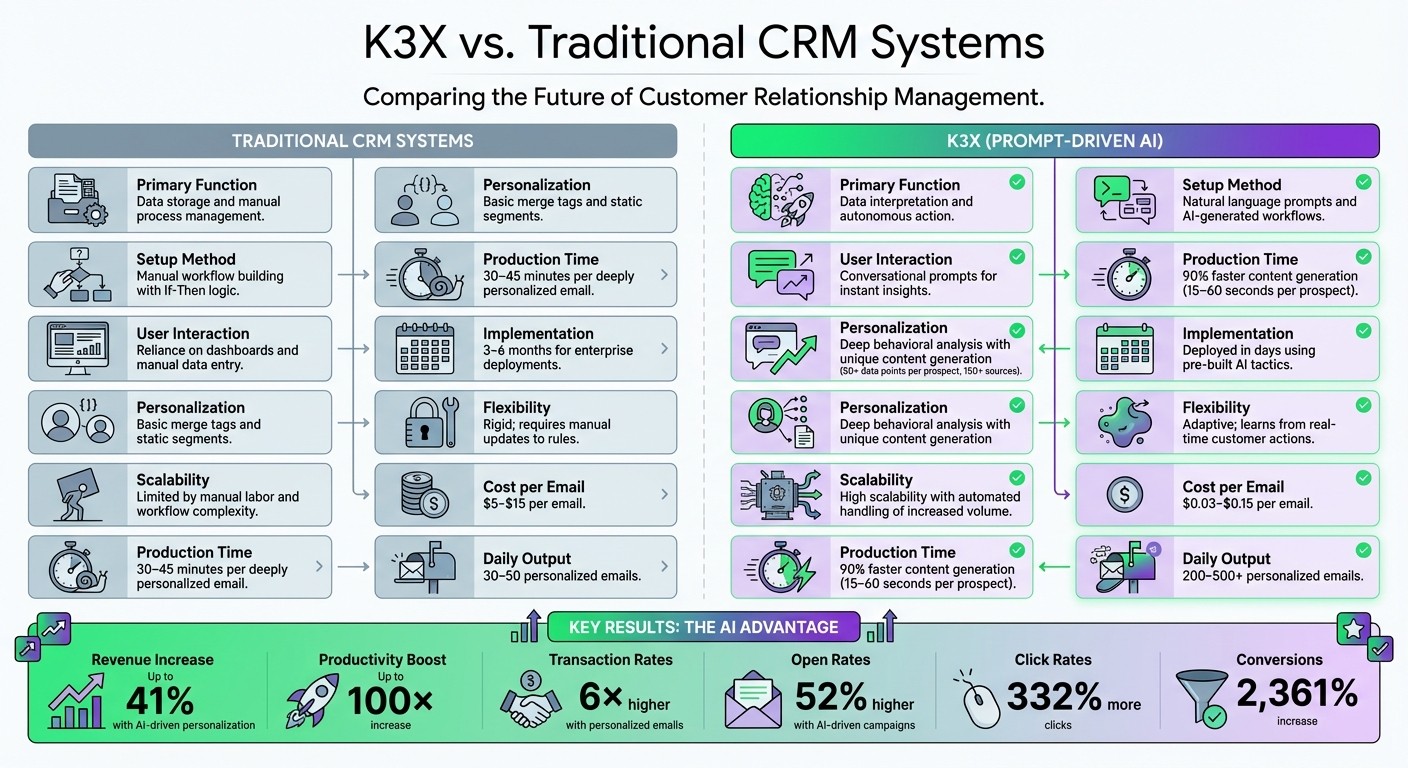
K3X AI vs Traditional CRM Systems Comparison
Traditional CRM systems rely heavily on manual processes to store and organize customer data. They require users to set up complex workflows and rules to manage operations. K3X, on the other hand, operates as an intelligent system. It doesn’t just store data - it interprets it, learns from it, and acts on it autonomously, streamlining tasks like email personalization at scale in ways traditional CRMs simply can't match.
"Traditional CRM systems are built to store and organize customer data - they're systems of record. By contrast, AI-enabled CRM is a system of intelligence. It doesn't just hold data, it interprets it, learns from it, and acts on it." - SAP
This difference becomes even more apparent when looking at setup times, scalability, and costs. Traditional CRM systems often take 3–6 months to deploy for enterprise use, while K3X can be up and running in days with minimal manual effort. Personalization is another area where K3X shines. Tasks like researching prospects, which typically take 5–15 minutes per person, are completed in just 15–60 seconds with K3X. This efficiency allows teams to send out 200–500+ personalized emails daily compared to the 30–50 emails possible with traditional methods. That’s a massive increase in productivity - up to 100× - without compromising on relevance.
The cost savings are just as striking. Manually crafted, hyper-personalized emails can cost $5–$15 each when you factor in labor. K3X’s AI-driven approach reduces that cost to just $0.03–$0.15 per email. These efficiencies translate into measurable revenue gains. Companies using AI-driven personalization report revenue increases of 5–15%, and businesses that excel at personalization can see up to 40% more revenue from their efforts.
Comparison Table: K3X vs. Traditional CRMs
Feature | Traditional CRM Systems | K3X (Prompt-Driven AI) |
|---|---|---|
Primary Function | Data storage and manual process management | Data interpretation and autonomous action |
Setup Method | Manual workflow building with If-Then logic | Natural language prompts and AI-generated workflows |
User Interaction | Reliance on dashboards and manual data entry | Conversational prompts for instant insights |
Personalization | Basic merge tags and static segments | Deep behavioral analysis with unique content generation |
Scalability | Limited by manual labor and workflow complexity | High scalability with automated handling of increased volume |
Production Time | 30–45 minutes per deeply personalized email | 90% faster content generation |
Implementation | 3–6 months for enterprise deployments | Deployed in days using pre-built AI tactics |
Flexibility | Rigid; requires manual updates to rules | Adaptive; learns from real-time customer actions |
The advantages of prompt-driven AI platforms like K3X are clear. A case in point: In February 2024, Tata Harper Skincare adopted AI-powered form optimization and saw a 65% increase in sign-up submissions within 30 days. Their welcome flow revenue grew by 27%, and total revenue from automated flows surged by 139% year-over-year. By cutting production times and reducing costs, K3X enables businesses to achieve effective, large-scale personalization with ease.
Conclusion
AI-powered platforms like K3X are changing the game for email personalization, replacing hours of manual work with systems capable of generating up to 100 highly targeted emails per hour. Considering that personalized emails achieve transaction rates six times higher than generic ones, and AI-driven programs can boost revenue by up to 41%, the impact is hard to ignore.
In contrast to traditional CRMs, which often rely on complex workflows and rigid logic, K3X takes a fresh approach. You simply outline your goals in plain language, and the platform takes care of everything - prospect research, crafting tailored content, optimizing send times, and even adapting to engagement data in real time. It doesn’t just store information; it interprets and acts on it autonomously.
This shift to AI-driven personalization lets your team focus on what really matters: strategy, building relationships, and closing deals. With 70% of marketers predicting that up to half of their email operations will be AI-powered by 2026, the real question is no longer if you should embrace AI personalization, but how soon you can get started.
K3X’s intuitive, conversational interface makes it accessible to businesses of all sizes. It allows companies to scale personalized outreach quickly and efficiently, without compromising on quality or relevance. This isn’t just about a single platform; it reflects a broader move toward smarter, faster, and more impactful email marketing.
FAQs
What data does AI use to personalize emails?
AI leverages customer data to craft personalized emails, drawing from over 50 data points per prospect. It taps into behavioral cues and contextual details to ensure every email feels relevant and specific. This level of personalization helps boost both engagement and conversion rates.
How do I keep AI-personalized emails from sounding generic?
To steer clear of generic, AI-generated emails, focus on providing clear and specific instructions that align with the recipient’s unique context, challenges, and interests. Start by using structured templates that include:
Personalized greetings that go beyond superficial placeholders like "{{First Name}}."
Relevant problem statements that reflect the recipient's actual pain points or goals.
Tailored value propositions that directly address how your solution can help them.
Tap into detailed customer data and behavioral insights to craft messages that feel authentic and relatable. This approach ensures your emails resonate on a deeper level, leaving a lasting impression. Thoughtful frameworks combined with rich data inputs are key to creating emails that genuinely engage the recipient.
What do I need to get started with K3X?
To begin using K3X, request an invitation to join the platform. Once you're in, all you need to do is outline your goals using prompts. From there, K3X takes care of the rest - managing follow-ups, updating data, and coordinating your teams automatically. There's no complicated setup or manual processes involved, so you can dive straight into reaching your sales and support goals without any hassle.