


How AI uses real-time data and automation to update CRM stages, speed follow-ups, improve forecasting, and save sales teams hours weekly.
AI is transforming sales pipelines by automating tedious tasks, analyzing real-time data, and updating CRM stages without manual input. Sales reps save time, avoid outdated data, and focus on closing deals. Key benefits include:
20–30% improvement in forecasting accuracy using AI-driven insights.
85–90% lead scoring accuracy, compared to 30–60% with traditional methods.
70% faster follow-ups and 8 hours saved per week per employee with tools like K3X.
AI reduces lead response times from 12 hours to under 90 seconds, boosting close rates by up to 35%.
Platforms like K3X simplify the process further with prompt-driven workflows. Instead of rigid CRM setups, you set goals (e.g., "Follow up with all unresponsive leads"), and AI handles the rest. This makes sales pipelines smarter, faster, and more efficient.
Pipeline Shouldn’t Be This Hard: How AI Automates Inbound & Outbound
How AI Improves Pipeline Stages Using Data and Automation
AI takes the guesswork out of sales pipelines by analyzing actual conversations - calls, emails, and SMS messages - to evaluate deal progress with precision. It captures and transcribes interactions (using tools like Whisper), then applies large language models to assess key factors like BANT (Budget, Authority, Need, and Timeline). Based on identified triggers, it adjusts pipeline stages automatically. This process not only saves time but also allows for immediate reactions to new developments.
"The future of forecasting is about making the pipeline itself intelligent, that senses, learns, and self-corrects." – Abhishek Shanbhag, Saxon AI
The results speak for themselves. AI-powered forecasting improves accuracy by 25–30% and significantly reduces deal slippage. Companies leveraging machine learning to understand customer behavior report a 10–15% increase in sales. Even more impressive, AI can cut lead response times from an average of 12 hours to under 90 seconds, boosting the chances of closing a deal by up to 35% through timely, data-informed follow-ups.
Using Real-Time Data for Automatic Adjustments
Real-time data takes automated pipeline adjustments to the next level, ensuring continuous updates and accuracy. Unlike traditional systems that often become outdated within 24–48 hours, real-time insights eliminate "pipeline mirages" by keeping deal statuses current.
This level of visibility has a direct impact on resource allocation. AI pinpoints bottlenecks - whether it’s document collection, credit checks, or resolving technical issues - and provides actionable insights. Managers can then quickly reassign tasks, focusing experienced reps on high-value leads while delegating simpler tasks to less experienced team members. Additionally, AI ensures every interaction is informed by a complete relationship history, so reps avoid repetitive questions that can stall negotiations. The payoff is clear: 73% of sales leaders say that removing manual pipeline management improves forecast accuracy.
Core AI Techniques in Pipeline Optimization
Several advanced AI methods are reshaping pipeline management. One standout is Retrieval-Augmented Generation (RAG), which works alongside Knowledge Graphs to give AI a deeper understanding of context while reducing errors like hallucinations. By combining real-time RAG with streaming data ingestion and GPU-accelerated vector search, AI can retrieve relevant information in under 50 milliseconds. Continuous batching further enhances efficiency by dynamically managing processing loads, cutting delays.
AI also relies on classification models (like logistic regression and random forest) to predict the likelihood of deal progression, while regression models estimate potential revenue risks. Together, these tools shift the workflow from "tool-assisted human operations" to "AI-led, human-supervised" systems. In this setup, AI agents autonomously recommend and execute next-best actions, leaving humans to oversee and refine the process.
K3X's Approach to Real-Time Pipeline Optimization

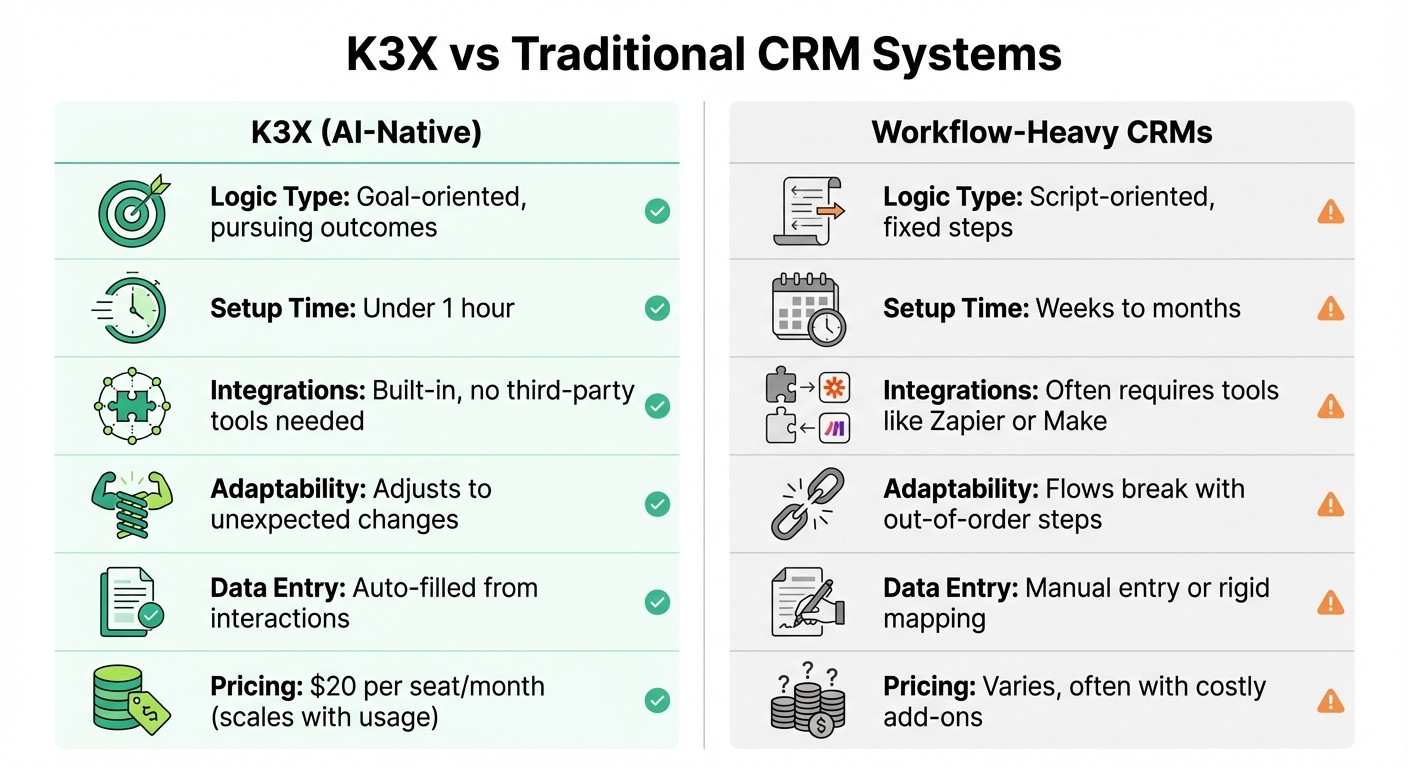
K3X vs Traditional CRM Systems: Feature Comparison
K3X takes a fresh approach to pipeline management, stepping away from the traditional CRM model. Instead of relying on complex flowcharts or rigid "if-this-then-that" workflows, it simplifies the process through conversational prompts. For instance, users can type something as straightforward as, "Book demo calls with every lead who hasn't responded", and the system automatically determines the necessary actions to achieve that goal.
"Unlike CRMs that merely record activity, K3X focuses on outcomes. It listens, knows what changed, and makes the next moves." – Mykyta Samusiev, Co-Founder & CEO, K3X
The platform automates tasks like follow-ups, pipeline updates, data entry, and team assignments. If a lead responds in an unexpected way, K3X adjusts instantly, avoiding the common pitfalls of script-based automation. This built-in flexibility also eliminates the need for external tools like Zapier or Make.
Take Ruby Capital Group as an example. In December 2025, this 125-employee funding company, led by CEO Michael Chkechkov, adopted K3X. The team set up the system in just two days, cutting follow-up times by 70% and tripling the speed of resolutions. According to Chkechkov, K3X allowed his sales team to shift their focus entirely to closing deals, as the system took over lead qualification, contract routing, and other administrative tasks.
K3X users report saving around 8 hours per employee every week. To date, the platform has automated over 312,000 hours of work and slashed operational costs by about $12.4 million. Most teams can fully set up the platform in under an hour.
Prompt-Driven Workflow Automation
K3X builds on its adaptive automation with a prompt-driven system that simplifies pipeline management even further. By focusing on outcomes instead of rigid sequences, users can state their goals, and the AI figures out the best way to achieve them. This eliminates the need for repetitive tasks, like manually moving deals to "Closed" when a contract is signed.
The system continuously learns from user behavior and lead interactions, refining its processes over time. For example, if a lead's status changes after a phone call, email, or text, K3X automatically updates the pipeline, logs the interaction, and assigns the next steps. By taking over these routine inputs, the platform allows sales teams to dedicate their energy to closing deals. To ease the transition, K3X suggests starting in "shadow mode", where it recommends changes for two weeks before taking full control.
Comparison with Workflow-Heavy CRM Systems
Traditional CRMs often rely on rigid, step-by-step processes that can fall apart when unexpected scenarios arise. K3X, on the other hand, adapts in real time, ensuring smoother operations. Here's how it stacks up:
Feature | K3X (AI-Native) | Workflow-Heavy CRMs |
|---|---|---|
Logic Type | Goal-oriented, pursuing outcomes | Script-oriented, fixed steps |
Setup Time | Under 1 hour | Weeks to months |
Integrations | Built-in, no third-party tools needed | Often requires tools like Zapier or Make |
Adaptability | Adjusts to unexpected changes | Flows break with out-of-order steps |
Data Entry | Auto-filled from interactions | Manual entry or rigid mapping |
Pricing | $20 per seat/month (scales with usage) | Varies, often with costly add-ons |
K3X streamlines the entire process by automatically capturing and updating data from every interaction, ensuring the pipeline stays accurate in real time. This dynamic, outcome-driven system moves beyond the limitations of outdated CRMs, offering a modern solution for real-time pipeline optimization.
Steps to Implement AI-Driven Pipeline Optimization
Data Collection and Real-Time Monitoring
Start by combining all your data sources into one unified system. Bring together communication channels like email, phone, SMS, and meeting tools, along with internal systems like your CRM and ERP, to create a single source of truth. Without this integration, AI can't get the full picture it needs to work effectively.
Standardizing your sales process is the next step. Define clear pipeline stages with specific criteria for moving leads forward. For example, frameworks like BANT (Budget, Authority, Need, Timeline) or confirming the economic buyer before progressing can ensure consistency. Clean, reliable data is critical for AI analysis, and manual data entry - taking about 3.4 hours a week - often leads to missed opportunities for 85% of salespeople.
Automate data capture by using webhooks and native integrations to log every interaction automatically. This includes call recordings, sentiment analysis, and other key interactions. Real-time dashboards and alerts can track metrics like "time-in-stage", "pipeline velocity", and "stalled deals." AI transcription and sentiment analysis can transform unstructured voice data into actionable insights.
"You can't improve what you can't see: Real-time pipeline visibility means you always know what's happening with every lead... without waiting on end‑of‑day reports." – Octavius AI
Once your data is unified and processes are standardized, you're ready to let AI take over adjustments and validation.
AI-Driven Adjustments and Validation
AI can automatically fine-tune your pipeline by analyzing patterns like response times, engagement levels, and deal progression. It flags leads that need immediate attention or identifies when deals have stalled. This level of automation can improve sales efficiency by 10–15% and increase forecast accuracy by 25–30%.
Start cautiously with a "shadow mode", where AI suggests updates in CRM notes for about two weeks to test its accuracy. Customize fields like "Product Interest" or "Last Marketing Campaign" so sales reps always have the right context during interactions. Set AI rules to automatically move soft rejections (e.g., "not interested at this time") into nurture stages to avoid bloating your pipeline.
AI continuously learns from user behavior, refining its processes over time. For example, if a lead's status changes after a call or email, the AI updates the pipeline, logs the interaction, and assigns the next steps - completely removing manual work.
To maximize the effectiveness of these updates, selecting the right batching strategy for processing is crucial.
Choosing the Right Batching Strategy
How your AI processes pipeline updates can significantly affect performance. Continuous (streaming) processing updates data instantly with every event, providing near-zero latency and removing the need for manual entry. Chunked (micro-batch) processing updates data in small, regular batches, balancing speed and resource use. On the other hand, manual (batch) processing, a legacy method, updates data in bulk with high latency, often resulting in outdated information and "zombie deals".
Strategy | Latency | Throughput | Resource Efficiency | Best Use Case |
|---|---|---|---|---|
Continuous (Streaming) | Milliseconds to seconds | High (event-by-event) | Low (always-on infrastructure) | Real-time lead alerts, live dashboards, fraud detection |
Chunked (Micro-batch) | Minutes (1–5 min) | High (small groups) | Medium (periodic bursts) | Near-real-time reporting, hourly activity logs |
Disaggregated (Batch) | Hours to days | Very high (bulk) | High (off-peak/scheduled) | Historical trend analysis, ML model retraining, monthly billing |
"The real question is not 'Streaming or Batch?' but 'Where do you need speed, and where do you need scale?'" – Nitin Kaushal, AI Architect
For most sales teams, continuous processing offers the greatest advantage by keeping information current and preventing deals from slipping through the cracks. If you’re working with limited expertise or a tight budget, you can start with batch processing and move to streaming when real-time insights become essential. A hybrid approach - using streaming for immediate updates and batch processing for deeper, retrospective analysis - can strike the perfect balance.
Measuring Impact: Sales Outcomes and Efficiency Gains
Key Performance Metrics to Track
To determine if your AI-powered pipeline is delivering results, tracking the right metrics is essential. Metrics like pipeline velocity measure how quickly deals move through stages, while stage latency identifies where bottlenecks occur - whether it’s during document collection, credit checks, or waiting for decision-makers to respond. Another important metric, resource utilization, shows how much of your team’s time is spent on administrative tasks versus actual selling. Traditional systems often demand heavy manual data entry, but AI-driven platforms like K3X handle this automatically, saving employees an average of 8 hours per week.
Instead of relying on outdated reports, live dashboards now provide real-time insights. Key metrics to monitor include speed-to-lead (how quickly leads are contacted, ideally within 15 minutes), no-touch deals (opportunities with no activity in 48 hours), and risk indicators like zombie deals or delayed close dates. These dashboards enhance visibility into pipeline health by 3x, enabling managers to quickly identify and resolve bottlenecks instead of waiting for weekly reviews. The result? Faster decision-making and improved efficiency that directly impact business performance.
Measurable Business Outcomes
The numbers speak for themselves. From February to May 2025, Salesforce piloted its Agentforce Sales Coach and Data Cloud tools, delivering 24,000 personalized recommendations to sellers. This effort generated $28M in pipeline and $9M in closed annual contract value (ACV) in just four months. AI-driven recommendations also boosted action completion rates from 8% to nearly 38%.
Ruby Capital Group reported a 70% reduction in time spent on follow-ups and a 3x increase in ticket resolution speed after adopting K3X. CEO Michael Chkechkov shared:
"Our sales team was spending half their day on admin work. Now they're talking to customers and closing deals... our close rates have never been higher"
Organizations integrating AI into their lead engagement and qualification processes have seen 30–50% faster lead responses, a 60% drop in response latency, and a 20–40% improvement in conversion rates. AI-powered automation can reduce lead triage time by 80%, while AI-driven voice interactions cut manual workloads by 30–40% and increase contact rates by up to 50%. Across more than 50 companies, K3X has eliminated an estimated $12.4M in operational costs and automated over 312,000 hours of manual tasks.
Metric | Traditional Impact | AI-Optimized Impact |
|---|---|---|
Action Completion | ~8% baseline | ~38% with AI guidance |
Weekly Admin Work | 20+ hours per employee | 8+ hours saved per employee |
Forecast Accuracy | Based on "gut feel" | 20% improvement via AI patterns |
Lead Triage Time | High manual effort | 80% reduction via AI classification |
Response Latency | High/Variable | 60% reduction |
Conclusion
AI is reshaping pipeline management by leveraging real-time data and prompt-driven automation. With AI-powered optimization, teams can ditch time-consuming manual tasks, reclaiming an average of 8 hours per employee every week. This transition shifts the focus from tracking activities to driving outcomes, transforming your CRM from a static tool into a dynamic system that adjusts in real time.
K3X simplifies this process with its prompt-driven approach, eliminating the need for complex workflows or third-party tools. Instead of building detailed flowcharts, you just set a goal - like "Book demo calls with leads who haven't responded" - and the AI takes care of the execution. Most teams are up and running in less than an hour.
The results are hard to ignore. Ruby Capital Group's success story highlights how teams can significantly improve follow-up times and resolution speeds. Across over 50 companies, K3X has saved a staggering 312,000 hours of manual work and cut operational costs by an estimated $12.4 million. Mykyta Samusiev, K3X Co-Founder & CEO, sums it up perfectly:
"We're building a CRM that works the way people expect it to, not through menus, workflows, or complexity, but through intention. You tell it the outcome. The system figures out the work."
Say goodbye to manual updates and missed opportunities. For just $20 per seat per month, K3X offers 1,000 AI credits, unlimited integrations, and a built-in power dialer - all without the headaches of enterprise-level complexity. Ready to take your sales operations to the next level? Visit k3x.ai and discover how prompt-driven pipeline optimization can boost your revenue growth.
FAQs
How does AI know when to move a deal to the next stage?
AI helps decide when to move a deal forward by analyzing real-time data from various interactions and activities, such as follow-ups, communication frequency, and engagement levels. Tools like K3X leverage AI to automatically update sales pipelines based on buyer behavior and activity trends. This ensures deals progress at the right moment, cutting down on manual effort and simplifying sales workflows by adjusting dynamically to the flow of interactions.
What data sources do I need for real-time pipeline updates?
To keep your pipeline updated in real time, you'll need data from your CRM - things like lead details, deal stages, activity logs, and interaction history. AI taps into this information to adjust pipeline stages dynamically, monitor progress, and fine-tune operations as needed. By integrating tools like Salesforce, HubSpot, or Pipedrive, AI can analyze activity logs and changes in deal statuses, making real-time updates possible and boosting sales performance.
How can I roll out AI stage automation without breaking my current process?
To integrate AI-driven stage automation smoothly, using an AI-native CRM like K3X can be a game-changer. It works with your existing workflows by allowing you to set goals through straightforward prompts. From there, the system takes over tasks like managing follow-ups, updating pipelines, and coordinating team activities in real time. This approach reduces manual effort and limits disruptions, making it easier to adopt AI gradually while keeping your current processes intact - and enjoying ongoing improvements along the way.