


AI-powered CRMs automate lead scoring, routing and follow-ups to improve response times, boost rep capacity, and let sales teams focus on closing deals.
Sales teams lose over 20 hours weekly to tasks like data entry, leaving less time for selling. This inefficiency contributes to only 41% of reps meeting quotas. AI-powered CRMs, like K3X, solve this by automating workflows, prioritizing leads, and improving response times.
Key Highlights:
Time-Saving: Automates follow-ups, lead scoring, and pipeline updates, cutting admin time by 70%.
Data-Driven Lead Prioritization: Uses behavioral signals, sentiment analysis, and predictive models to rank leads.
Faster Conversions: Responding to leads within 5 minutes increases conversion rates by 21x.
Dynamic Workflows: Adjusts in real-time based on lead behavior, avoiding rigid processes.
Proven Results: Companies using AI CRMs report 60% more capacity per rep and 30% higher revenue.
AI CRMs streamline sales processes, enabling teams to focus on closing deals instead of managing software. Platforms like K3X offer affordable solutions starting at $20/month per user, delivering measurable results like faster follow-ups and increased efficiency.
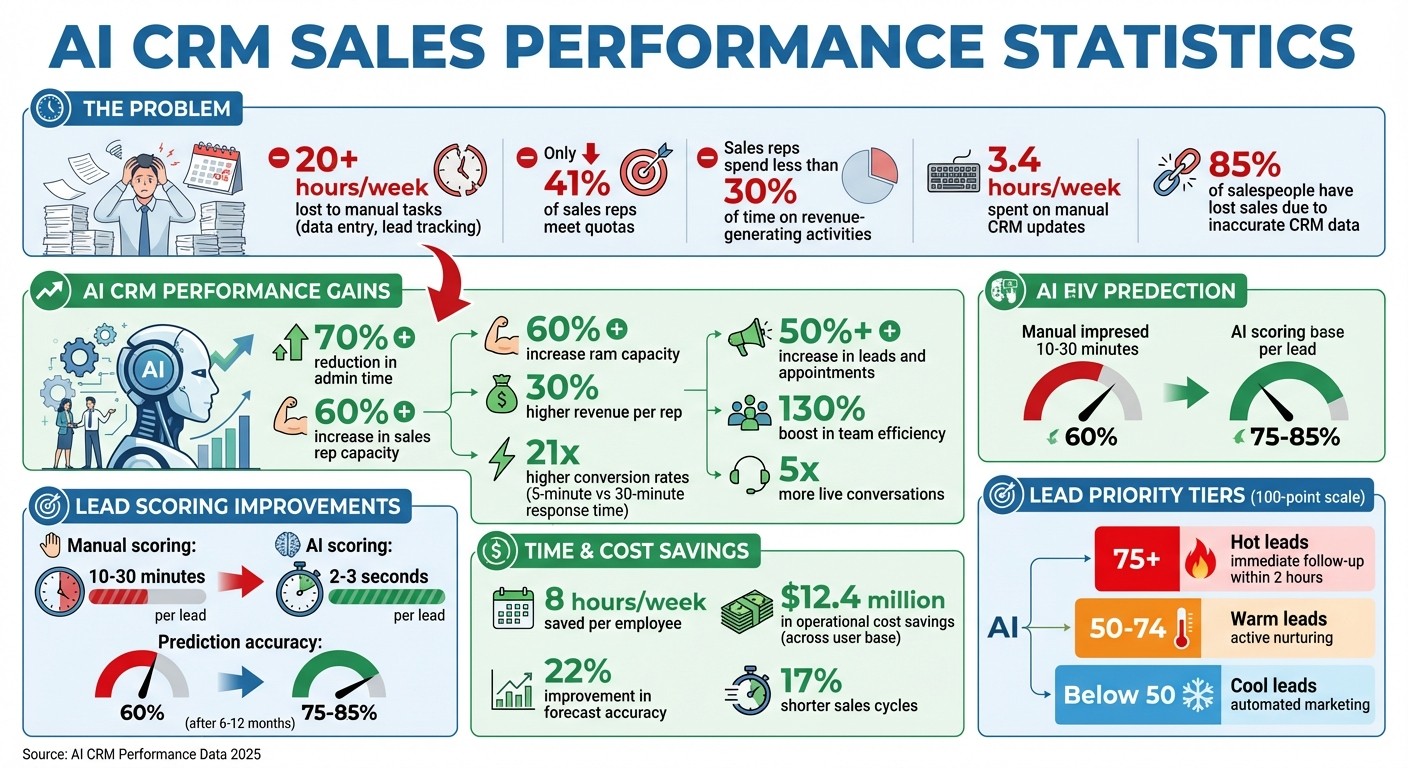
AI CRM Impact on Sales Performance: Key Statistics and ROI Metrics
Best AI Agents for Sales Productivity & CRM Automation | ClickUp
How AI CRMs Rank and Prioritize Leads
AI-powered CRMs evaluate leads using a mix of firmographic data, behavioral signals, and timing. They can process these evaluations in just 2–3 seconds, compared to the 10–30 minutes it takes manually. By removing manual delays and reducing bias, these systems address common challenges like decision fatigue and incomplete data.
The technology analyzes both explicit data - such as job title or company size - and implicit signals, like website visits or email interactions. For example, if a prospect visits a pricing page multiple times within 24 hours, that indicates much higher intent than simply opening an email once. AI also tracks engagement speed and uses sentiment analysis to gauge the tone and urgency of communications, like emails or form submissions. This data-driven approach helps create dynamic priority tiers, ensuring timely follow-ups.
Advanced systems take it a step further by using predictive models based on historical sales data. These models identify patterns in successful deals, such as a VP from a target industry downloading a whitepaper and visiting a demo page - signals that often correlate with closed sales. On the flip side, the system can deduct points for factors like using personal email addresses, affiliations with competitors, or high bounce rates.
From Manual Scoring to AI-Driven Lead Analysis
Traditional lead scoring relies on static, human-defined rules. In contrast, AI-driven systems continuously learn from sales history to adjust scoring factors dynamically, such as activity levels or response times. This adaptability is a significant advantage, as static systems often lead to trust issues - only about one-third of salespeople fully trust their data, and around 25% of inquiries never result in a purchase.
Machine learning algorithms uncover patterns that might go unnoticed otherwise. For instance, they can detect how mobile visits to pricing pages correlate with deal speed or how delayed email responses impact conversion likelihood. Companies leveraging AI in sales have seen lead and appointment increases of over 50%, while lead conversion prediction accuracy often jumps from 60% to 75–85% after 6–12 months of data processing.
Platforms like K3X simplify the process further by eliminating the need for manual rule configuration. Instead of building complex scoring systems, users can set straightforward goals using conversational prompts, like “prioritize leads who visited our pricing page twice this week.” The system handles the analysis and execution automatically. This shift allows sales teams to spend less time managing software and more time connecting with high-intent prospects.
Creating Lead Priority Tiers
AI insights help businesses group leads into clear priority tiers based on real-time scores. A common framework uses a 100-point scale, where:
Scores of 75+: These leads are "Hot" and require immediate follow-up, ideally within two hours.
Scores of 50–74: These are "Warm" leads, needing active nurturing with personalized content.
Scores below 50: These are "Cool" leads, best suited for automated marketing efforts.
This tiered system ensures sales teams focus on the top 20–30% of leads with genuine buying intent. To keep things current, the system automatically reduces scores by about 25% each month if no activity occurs, moving stale leads from "Hot" to "Cool" status.
Rather than manually setting rules for each tier, platforms like K3X let users define broader outcomes, such as “schedule calls with all high-priority leads within 24 hours.” The platform then automates the necessary actions. This constant adaptation to changing lead behavior ensures sales teams remain focused on the best opportunities.
Automating Workflows with AI CRM Tools
AI-powered CRMs take the heavy lifting out of sales workflows by automating tasks like lead routing, follow-ups, pipeline updates, and task assignments. Sales teams often spend less than 30% of their time on activities that directly generate revenue, with the rest eaten up by administrative tasks. Automation flips this equation, allowing reps to focus on what they do best - selling.
These systems streamline operations by tracking every interaction - emails, calls, or form submissions - and automatically triggering the next logical step. For example, when a contact form is completed, the system instantly assigns the lead by territory, sends a confirmation email, and creates a follow-up task. This eliminates the risk of leads slipping through the cracks due to manual processes.
Traditional CRMs often rely on rigid "if-then" workflows, which can break down when something unexpected happens, like a prospect responding out of order. AI systems, such as K3X, take a different approach. Instead of scripting out every single step, users define an outcome - like "schedule demos for all unresponsive leads" - and the AI determines the best actions to achieve it. If a lead responds in an unexpected way, the system adapts in real time, avoiding the pitfalls of static workflows.
The impact on response times is huge. Research shows leads contacted within five minutes are 21 times more likely to convert compared to those reached after 30 minutes. AI CRMs make this possible by operating 24/7, responding almost instantly rather than waiting for a rep to check their inbox.
Instant Notifications and Real-Time Actions
AI CRMs go beyond automating tasks - they ensure fast, context-aware responses. Speed matters, and these tools excel at delivering instant notifications and automated responses. For instance, when a high-priority lead visits a pricing page multiple times or downloads a whitepaper, the system immediately alerts the assigned rep and can trigger a multi-channel outreach sequence.
These notifications aren’t just alerts - they’re actionable. If a lead is flagged as high-priority, the system can send a personalized email, schedule a follow-up, or even initiate an SMS if there’s no response within a set timeframe. This coordinated approach ensures no opportunity is missed.
AI CRMs also employ "stop on engagement" logic, halting automated sequences as soon as a lead replies or schedules a meeting. This avoids awkward follow-ups, like sending an email to a prospect who has already responded. Platforms like K3X take it a step further, automatically updating pipeline stages, sending confirmations, and creating prep tasks for the sales team when a demo is booked - all without manual intervention.
Response rates vary across channels, and AI systems optimize accordingly. For example, in some markets, WhatsApp automation achieves open rates over 90%, compared to roughly 20% for email. By coordinating across email, SMS, and WhatsApp, these tools ensure every lead gets the right message at the right time. To keep interactions feeling human, they even include "organic delays", like waiting a few minutes before sending a follow-up SMS.
Dynamic Workflows Based on Lead Behavior
AI CRMs don’t just execute tasks - they adapt dynamically based on lead behavior. Unlike static workflows that follow a rigid script, dynamic workflows adjust in real time to engagement patterns. This means the system isn’t just running through a checklist; it’s actively responding to the situation.
Take a lead who opens multiple emails but never clicks a link. A static workflow might keep sending emails as scheduled, but a dynamic AI system would recognize this pattern and change tactics - perhaps triggering a phone call or tweaking the messaging to address a potential concern. These systems monitor signals like email opens, link clicks, and page visits to determine the next best action.
"Most systems are linear. They follow fixed steps - and if something unexpected happens, the flow breaks... K3X works on goals. Instead of defining steps like 'Send this email, then wait,' you define the objective."
– Mykyta Samusiev, CEO, K3X
This goal-driven approach ensures workflows remain effective, even when leads behave unpredictably. For example, if a prospect asks a pricing question before the scheduled "pricing email", K3X adjusts automatically - addressing the query and moving to the next relevant step. The system continuously learns from user interactions, improving its performance without requiring constant manual updates.
The results speak for themselves. Companies using AI-driven workflows report up to 5x more live conversations and a 130% boost in team efficiency. Additionally, 78% of mid-market companies using AI for lead management have managed three times more leads per rep, all without expanding their teams. This scalability is achieved by automating routine tasks and involving human reps only for complex negotiations or emotionally sensitive situations.
Integrating AI Insights with CRM Data
AI insights are now blending seamlessly with CRM data, enabling real-time updates and execution. This shift eliminates the inefficiencies of traditional CRMs, which often depend on manual data entry. On average, sales reps spend 3.4 hours per week manually updating CRM systems, and errors in this process can cost businesses up to 15% of their revenue. Even more alarming, 85% of salespeople admit they've lost sales due to inaccurate CRM data.
AI-powered systems tackle this issue head-on by automatically capturing data from every interaction - whether it’s a call, email, or text - and instantly updating the CRM. For instance, if a prospect says, "Send me the contract" during a call, the AI recognizes the intent and updates the deal stage to "Contract Sent" in real time via API. This eliminates the risk of stagnant opportunities caused by missed updates, ensuring that the CRM reflects actual outcomes from conversations rather than relying on memory or subjective input. This real-time synchronization lays the groundwork for smarter, goal-oriented automation.
The K3X system takes this a step further with prompt-driven workflows. Instead of rigid, pre-defined sequences, users simply set a goal - like "Book demo calls with unresponsive leads" - and the AI determines the best course of action. It dynamically adjusts to unexpected responses, creating follow-up tasks and keeping the process fluid. A great example of this is Ruby Capital Group, a funding company with 125 employees. In December 2025, they implemented K3X's AI-driven agents and saw a 70% reduction in time spent on follow-ups while tripling their ticket resolution speed in just two days.
Automated CRM data capture also delivers measurable results: it improves forecast accuracy by 22%, shortens sales cycles by 17%, and saves employees an average of 8 hours per week. By extracting key details like BANT criteria, objections, and sentiment directly from interactions, the AI ensures every piece of data is accurately logged and actionable. Over time, this continuous optimization enhances system performance, making each interaction more effective and impactful.
How AI CRMs Improve Over Time
AI CRMs like K3X aren't static systems that rely on manual updates. Instead, they learn and evolve with every interaction. For example, if a lead predicted to have a 75% chance of converting doesn’t pan out, the system adjusts its scoring model. This recalibration can improve future predictions and boost conversion rates by 20%–40%. Sales teams using AI CRMs have reported a 60% increase in workload capacity per representative, along with a 30% rise in revenue per rep. These systems excel at spotting subtle patterns - like email sentiment, timing of responses, and engagement levels - that human teams might miss.
Tracking Metrics for Workflow Performance
AI CRMs thrive on continuous improvement, and tracking key metrics is essential to keep the system performing at its best. Metrics like pipeline velocity (how quickly deals progress through stages) and lead response time (how fast teams engage with leads) are crucial. Companies that respond to leads within 60 minutes are almost seven times more likely to qualify them. Other important metrics include conversion rates (from lead-to-opportunity and opportunity-to-close), sales cycle duration, and revenue per representative.
These systems also use pattern recognition to identify behaviors that speed up deals. For instance, follow-up emails sent within two hours of a demo can close deals 40% faster. By analyzing this data, K3X fine-tunes its processes to ensure workflows are consistently designed to achieve results.
The Benefits of Real-Time Learning
While metrics show progress, real-time learning ensures workflows stay aligned with changing buyer behavior. K3X adapts instantly to user activity and lead behavior, removing the need for manual updates when strategies shift. Instead of rigid sequences that fail if a prospect responds unexpectedly, the system focuses on achieving goals. For example, if the goal is to "Re-engage leads who haven’t responded in 3 days", the AI decides the most effective way forward and adjusts as needed.
The system also identifies negative signals, such as email unsubscribes or extended inactivity, and deprioritizes those leads automatically to maintain a clean pipeline. This approach turns the CRM into a dynamic operator that evolves with your business. Unlike traditional CRMs that require constant manual adjustments, K3X’s real-time learning keeps workflows efficient and relevant, even as market conditions change, all while reducing the need for extra effort.
Conclusion
AI-driven CRMs have reshaped the way sales teams work by cutting down on the 20+ hours per week previously spent on data entry, lead tracking, and follow-ups. Instead of drowning in admin tasks, sales reps can now focus on meaningful conversations and closing deals. Companies using AI-native systems have seen a 60% boost in sales rep capacity and a 30% increase in revenue per rep, all thanks to prioritizing deal-making over manual processes.
The evolution from rigid, workflow-heavy CRMs to outcome-focused platforms like K3X marks a huge step forward. Traditional systems often falter when leads don't follow a predictable path, but K3X flips the script. With simple prompts like "Re-engage leads who haven't responded in 3 days", the platform’s AI takes care of the rest. This shift has led to impressive efficiency gains for top-performing companies.
As Michael Chkechkov, CEO of Ruby Capital Group, puts it:
"Our sales team was spending half their day on admin work. Now they're talking to customers and closing deals."
On average, K3X saves 8 hours per week per employee and has reduced operational costs by an estimated $12.4 million across its user base. At just $20 per seat per month, with pricing that adjusts to your workload, K3X provides enterprise-grade automation without the hefty price tag or complexity of older systems.
If you're ready to leave workflow headaches behind and focus on closing more deals, check out how K3X can revolutionize your sales process at k3x.ai.
FAQs
What data does an AI CRM use to prioritize leads?
An AI-powered CRM uses data like engagement metrics, customer interactions, lead scores, behavioral signals, and contextual details to rank and prioritize leads. By analyzing these factors, the system pinpoints the most promising opportunities, ensuring your team focuses on leads with the highest potential.
How do goal-based prompts replace traditional workflows in K3X?
Goal-based prompts in K3X streamline workflows by allowing users to define desired outcomes through straightforward prompts, eliminating the need to create intricate sequences or triggers. The AI takes care of follow-ups, updates pipelines, manages team coordination, and fine-tunes operations in real time. This flexible system minimizes manual tasks, speeds up execution, and offers conversational control, aligning the CRM seamlessly with business objectives instead of relying on rigid, step-by-step procedures.
How long does it take an AI CRM to improve lead scoring accuracy?
AI-powered CRMs can significantly enhance lead scoring accuracy in a relatively short period. Within just 1 to 3 months, users often notice improvements, and the full range of benefits typically becomes evident over 3 to 6 months. These systems can boost accuracy by 25-30% while cutting down manual workload by around 30%. What’s more, they don’t remain static - AI CRMs evolve by learning from new data and user interactions, continuously refining their predictions and delivering better results over time.