

How AI-native CRMs use real-time data to personalize outreach, automate tasks, and improve sales outcomes.
AI-driven CRMs are transforming how businesses handle sales and customer interactions. Instead of relying on static workflows and manual data entry, these systems use real-time data to make decisions and take action instantly. Here's what you need to know:
Time-Saving Automation: AI eliminates manual tasks like logging calls and updating records, saving sales teams up to 8 hours per week.
Faster Response Times: Companies using AI tools reduce lead response times from 35 minutes to just 9 minutes, improving conversion rates.
Outcome-Focused Actions: Unlike older systems, AI CRMs dynamically adjust to achieve goals, such as booking demos or addressing objections.
Continuous Learning: AI evolves with every interaction, improving its ability to predict outcomes and personalize responses.
Cost Efficiency: K3X, a leading AI-powered CRM, offers usage-based pricing at $20 per seat/month, making it accessible for businesses of all sizes.
How Real-Time AI Adaptation Works
Data Collection and Behavioral Analysis
Real-time adaptation begins with automated data gathering. AI-native CRMs use bi-directional connectors to sync platforms like email, Slack, LinkedIn, calendars, and phone systems instantly. When a lead is added, the system enriches their profile with details such as job titles, company size, funding history, and social profiles.
Through transcription, sentiment analysis, and keyword tracking, AI evaluates voice and text interactions to understand the intent behind deal movements. It doesn’t just record calls - it captures qualitative insights like a lead's interest level, objections, or pricing questions, then updates the CRM with this context.
K3X employs vector memory layers to store prior actions, responses, and metadata, ensuring seamless continuity across communication channels. For example, if a lead moves from email to a phone call, the AI recalls the entire conversation history and adjusts its approach accordingly. By integrating these past interactions, the system maintains context and enables real-time, outcome-driven decisions. This eliminates the fragmented experiences that plague traditional systems, where 82% of companies admit to relying on outdated data for decision-making.
This robust data collection lays the groundwork for continuous learning and model refinement.
Continuous Learning and Model Updates
Building on its real-time analysis, the AI evolves with every interaction. Each new engagement feeds back into the system, helping it fine-tune algorithms for specific channels and scenarios. For instance, when a sales rep marks a disposition, it triggers automated workflows and teaches the AI which strategies are most effective in similar cases.
"AI Workers in an Agentic CRM operate with context and intent. They evaluate the state of leads and deals, make decisions based on changing conditions, and act across systems to achieve outcomes."
Ameya Deshmukh, EverWorker
This approach replaces rigid, step-by-step processes with a focus on achieving key objectives, like scheduling a demo or closing a deal. The AI adapts dynamically to unexpected responses or gaps in information. Real-time data clouds bring together interactions from web, mobile, and email platforms, ensuring the AI always works with the latest information. Thanks to this constant refinement, AI-powered tools can boost call connection rates by 400% to 500% by identifying the best timing and messaging for outreach.
Unlocking Real Time Personalization Through Data, AI, and Communication
K3X vs. Traditional CRMs

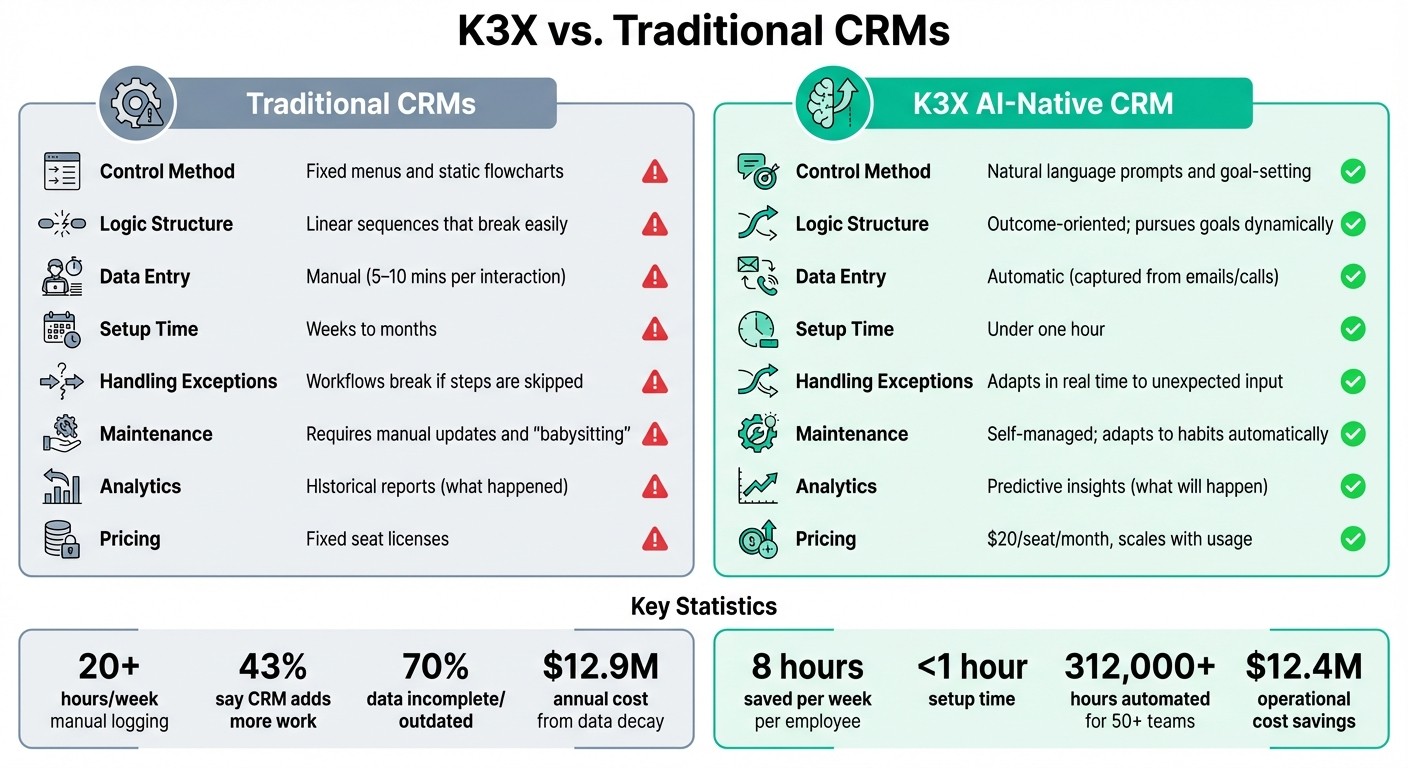
K3X AI-Native CRM vs Traditional CRMs: Feature Comparison
Limitations of Workflow-Heavy CRMs
Traditional CRMs rely on rigid, step-by-step workflows that falter when leads behave unpredictably. For example, if a lead asks an unexpected question or responds out of sequence, these systems often fail to adjust, leaving the lead in limbo. Teams then scramble to create complex flowcharts, set up manual triggers, and constantly monitor workflows to keep things running.
This setup is far from efficient. Users spend over 20 hours a week manually logging emails, calls, and contact updates. Even worse, 43% of companies say their CRM adds more work than it eliminates, while 70% of CRM data ends up incomplete or outdated due to inconsistent manual entry. This "data decay" costs businesses around $12.9 million annually.
Clearly, there's a need for a smarter, more flexible solution.
K3X's Adaptive Advantage
K3X takes a completely different approach, swapping out rigid workflows for simple, goal-based commands. Instead of building intricate sequences, users can give straightforward instructions like, "Book demo calls with every lead who hasn't responded." The AI then handles the details, adjusting in real time to achieve the desired outcome.
"We're building a CRM that works the way people expect it to, not through menus, workflows, or complexity, but through intention. You tell it the outcome. The system figures out the work."
Mykyta Samusiev, Co-Founder & CEO, K3X
This approach saves users significant time - on average, 8 hours per week per employee. K3X automatically logs calls, emails, and updates, eliminating the need for manual data entry or third-party automation tools. Teams can get started in under an hour, with no lengthy setup or learning curve, and begin seeing results right away. From lead qualification to contract routing, the AI manages it all autonomously, even adapting to unexpected situations without human intervention.
The table below highlights how K3X's intuitive design stacks up against the limitations of traditional CRMs:
Comparison Table: K3X vs. Traditional CRMs
Feature | Traditional CRMs | K3X AI-Native CRM |
|---|---|---|
Control Method | Fixed menus and static flowcharts | Natural language prompts and goal-setting |
Logic Structure | Linear sequences that break easily | Outcome-oriented; pursues goals dynamically |
Data Entry | Manual (5–10 mins per interaction) | Automatic (captured from emails/calls) |
Setup Time | Weeks to months | Under one hour |
Handling Exceptions | Workflows break if steps are skipped | Adapts in real time to unexpected input |
Maintenance | Requires manual updates and "babysitting" | Self-managed; adapts to habits automatically |
Analytics | Historical reports (what happened) | Predictive insights (what will happen) |
Pricing | Fixed seat licenses | $20/seat/month, scales with usage |
Business Benefits of Adaptive AI in Sales and Operations
Real-Time Prediction and Personalization
K3X leverages continuous learning to deliver impactful results for businesses. One of its standout features is clearing the "revenue fog" - that frustrating uncertainty about why deals stall. It does this by analyzing factors like call sentiment, objection trends, and engagement signals in real time. The result? Sales teams experience up to 5x more live conversations and see answer rates soar by 400–500%, thanks to K3X's ability to prioritize leads based on actual behavior. Additionally, with 40% of traditional CRM reporting errors caused by duplicate records, K3X’s automated logging provides a clean, reliable data foundation for accurate forecasting. Instead of wasting time hunting down outdated information, managers receive AI-generated summaries that pinpoint why prospects go quiet or suggest which objections need addressing next.
Reduced Manual Work and Improved Operations
K3X tackles one of the biggest time drains for sales teams: manual data entry. By automating tasks like call logging and follow-up scheduling, it addresses a costly issue - poor data quality, which costs businesses an average of $12.9 million annually. To make matters worse, CRM data decays at a rate of 30% per year, climbing to 35–45% in tech industries. K3X prevents this decay from the outset with automated logging and data enrichment, improving operational efficiency and laying the groundwork for sustainable growth.
Scalability and Dynamic Business Alignment
K3X’s adaptability allows businesses to scale without adding more staff. Take Rebecca Martinez, CEO of an analytics firm, as an example. Using K3X, she managed to quadruple her client base without hiring extra analysts. By automating data entry and reporting, her team could shift its focus to strategic tasks, doubling the speed of client delivery.
"The automation completely transformed our business model. Our analysts now spend their time doing actual analysis and strategy work instead of data janitor tasks."
Rebecca Martinez, CEO
K3X also offers a usage-based pricing model at $20 per seat/month, making it flexible for businesses of all sizes. This setup ensures companies aren’t stuck with high fixed costs during slower periods. Plus, the system adjusts to shifting goals instantly, eliminating the need to rework workflows when priorities change. This ability to adapt quickly to market demands keeps operations efficient and cost-effective, aligning perfectly with the fast-paced needs of modern businesses.
Conclusion
Key Points Recap
Real-time AI transformation is changing the way CRM operations are handled. K3X eliminates the need for rigid workflows and manual data entry by focusing on defined outcomes and automatically executing the next logical steps based on real-time changes during interactions. So far, the platform has automated more than 312,000 hours of work for over 50 teams, saving employees an average of 8 hours per week and cutting operational costs by an estimated $12.4 million.
Unlike traditional CRMs that rely on linear scripts prone to failure when leads act unpredictably, K3X adjusts its approach dynamically in real-time. Teams can implement the system in less than an hour - no weeks or months of setup required - allowing them to immediately benefit from AI-powered automation that gets smarter with every use.
Why Choose K3X
K3X stands out as a game-changer, offering a fresh approach to outdated systems. Instead of focusing on activity tracking, it prioritizes delivering outcomes. As Co-Founder & CEO Mykyta Samusiev explains:
"We're building a CRM that works the way people expect it to, not through menus, workflows, or complexity, but through intention. You tell it the outcome. The system figures out the work."
The impact is undeniable. Companies that adopt K3X see significant boosts in efficiency and speed, freeing up sales teams to concentrate on closing deals rather than dealing with complicated software. With usage-based pricing starting at $20 per seat/month, the platform scales with your business activity, offering advanced AI capabilities without the hefty costs of traditional enterprise CRM systems.
FAQs
How does an AI CRM know what a lead wants in real time?
An AI-powered CRM works by analyzing real-time interactions and behavioral data - things like calls, messages, or meetings - to understand a lead's needs on the spot. Platforms such as K3X continuously update lead profiles, picking up on details like engagement trends and activity history. What sets these systems apart from traditional CRMs is their ability to adjust instantly to new information. This means businesses can deliver personalized follow-ups and more strategic guidance, turning the CRM into a proactive tool that evolves and grows alongside the company.
What data does it need to personalize outreach without extra manual entry?
To make outreach more personal without requiring manual input, the system leverages data from user interactions, lead activity, conversation transcripts, and the context of calls and messages. This information is processed and updated in real time, enabling the AI to adjust seamlessly to changing user and lead behavior.
How fast can a team start using K3X and see results?
Teams can dive into K3X immediately and begin seeing outcomes without delay. This AI-powered CRM simplifies the process by removing the need for intricate setups or manual configurations. It adjusts dynamically to user behavior and lead activity in real time, letting teams concentrate on reaching their objectives without getting bogged down by technical challenges.