


AI CRMs use real-time signals to reprioritize leads, speed follow-ups, and improve conversion accuracy and sales efficiency.
Dynamic prioritization in AI-powered CRMs solves a common sales problem: missed opportunities due to slow or ineffective follow-ups. Unlike older systems that rely on static rules and manual updates, dynamic CRMs analyze real-time behavior - like email tone, website visits, or response speed - to instantly adjust lead scores and suggest next steps. This approach helps sales teams focus on high-potential leads, boosting conversion rates and efficiency.
Key Takeaways:
Responding within 1 minute increases conversions by up to 391%.
AI CRMs evaluate leads in 2–3 seconds, compared to 10–30 minutes for manual reviews.
Teams save 20+ hours weekly on data entry and report a 30% revenue increase.
Dynamic systems reduce follow-up time by 70% and improve lead qualification accuracy to 75–85%.
Quick Comparison:
Feature | Static CRMs | AI-Powered CRMs |
|---|---|---|
Lead Scoring Accuracy | ~60% | 75–85% |
Processing Speed | 10–30 minutes per lead | 2–3 seconds per lead |
Efficiency Gains | 40–60% | 70–90% |
Maintenance Effort | High | Low |
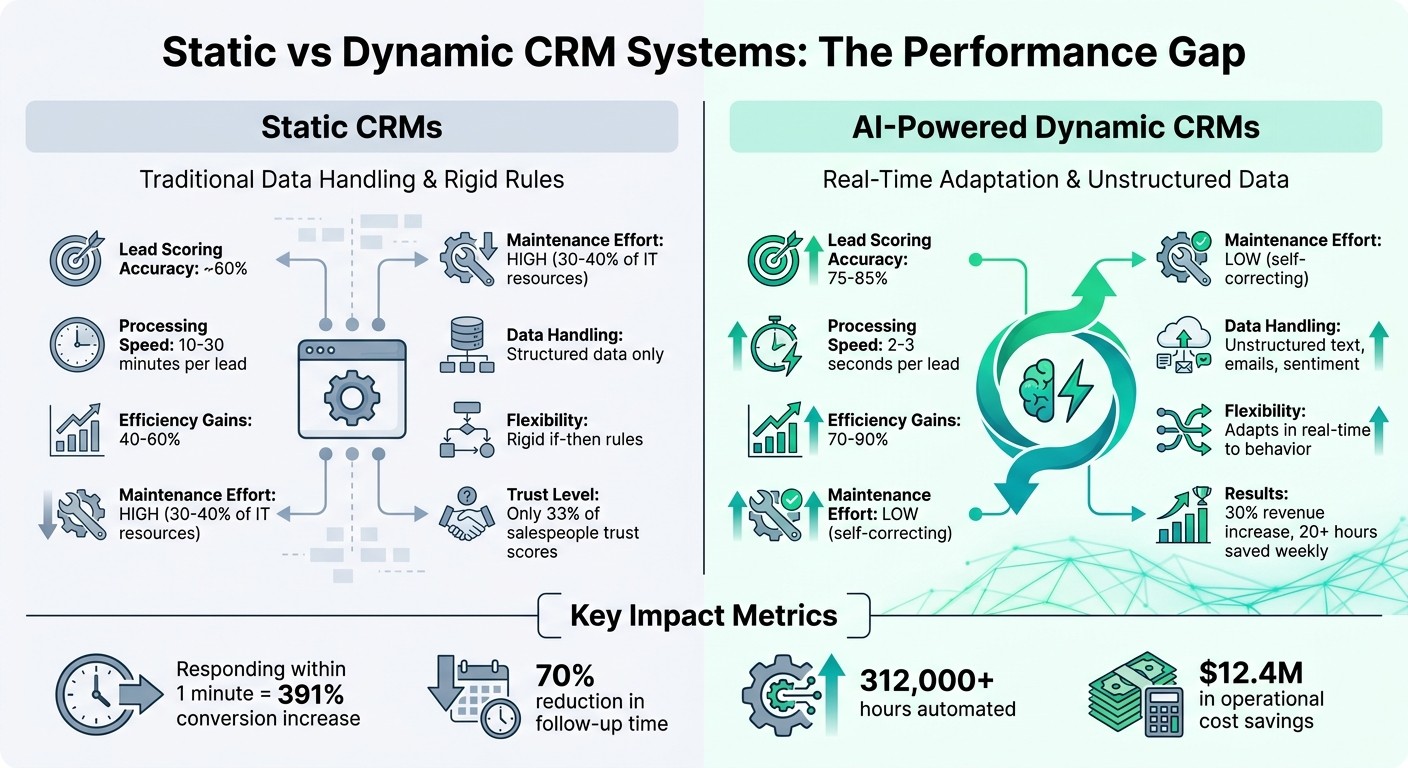
Static vs Dynamic AI CRM Systems: Performance Comparison
How to Use Predictive Intelligence in Dynamics 365 with Explainable Ai
Problems with Traditional Lead Scoring
Traditional lead scoring systems lack the flexibility and adaptability of dynamic models that update in real time. Many CRMs still rely on static, rule-based approaches where marketing teams manually assign point values to specific actions. For example, downloading a whitepaper might be worth 5 points, while visiting a pricing page earns 10. These point values are often based on guesswork rather than solid data, and once the rules are set, they’re rarely updated or revisited over time.
This outdated method leads to issues like the "student problem." Picture this: a VP visits your pricing page once, while a college student downloads multiple whitepapers. Under traditional scoring, the student might end up with a higher score - even though the VP is clearly the more valuable lead. This kind of misalignment highlights the rigidity and flaws in these systems.
Static Rules and Inflexibility
Traditional systems rely on rigid "if-then" rules that fail to reflect the complexity of real-world scenarios. For instance, they might treat a visitor from six months ago the same as one from last week - unless someone manually adds a decay rule to adjust the scores over time. As businesses grow and introduce new products, industries, or engagement channels, the number of rules required can skyrocket. In some cases, even basic setups can demand as many as 5,000 manually configured rules.
Making matters worse, any changes to a product line or pricing structure require overhauling the entire rule set. These systems also struggle to process unstructured data - like the tone of an email or insights from call transcripts - where valuable intent signals often hide. Unsurprisingly, only 44% of organizations even use lead scoring, and among those that do, just one-third of salespeople trust the scores they’re given. This rigidity directly undermines lead qualification efforts and drags down conversion rates.
Impact on Conversion Rates
The numbers speak for themselves. Traditional lead scoring models typically achieve only 60–70% accuracy, and just 27% of leads passed to sales are genuinely qualified. This inefficiency forces sales teams to waste time chasing cold prospects, while about 25% of inquiries fail to convert due to poor follow-up or prioritization.
Salespeople often lose trust in these static scores within a month, opting instead to rely on their instincts rather than CRM data. This lack of confidence contributes to poor performance: only 41% of sales reps meet their quotas, and overall conversion rates in traditional systems remain stuck between 1% and 6%. These shortcomings make it clear that static scoring systems are no longer up to the task of effectively qualifying leads.
How Dynamic Priority Algorithms Work
Dynamic priority algorithms take lead scoring to the next level by learning and adapting in real time. Instead of relying on static rules, these systems adjust lead priorities instantly based on live data, responding to shifts in buyer behavior without needing manual updates. Here's a closer look at how they achieve this level of adaptability.
Real-Time Data Integration and Processing
Modern AI-powered algorithms process leads in just 2–3 seconds by pulling in data from multiple sources. They evaluate both explicit signals - like job title, company size, or industry - and implicit signals, such as website visits, email interactions, and clicks. For instance, if a prospect repeatedly visits your pricing page within a short timeframe, the system identifies this as high-intent behavior and bumps up the lead's priority.
These systems also use natural language processing (NLP) to analyze the tone and urgency of emails or form submissions. A message like "Need this ASAP for Q2 rollout" signals immediate buying intent, prompting the system to prioritize the lead automatically.
To keep the pipeline clean, dynamic systems apply automatic score decay, reducing a lead's score by about 25% each month if there's no new activity. They also use "stop-on-engagement" logic, halting automated campaigns the moment a lead responds or books a meeting. This prevents redundant follow-ups and keeps outreach focused.
Behavioral Pattern Recognition and Adaptive Scoring
These algorithms don’t just track actions - they interpret the intent behind them. For example, visiting a competitor comparison page carries more weight than downloading a generic ebook because it suggests the prospect is actively evaluating options. By analyzing engagement frequency, content preferences, and response times, the system builds a well-rounded view of buyer intent.
Negative patterns are also flagged. For example, if a lead opens multiple emails without clicking any links, the system might pivot to sending a direct meeting invitation instead of more educational content. Similarly, behaviors like prolonged inactivity or unsubscribing from emails trigger automatic deprioritization, ensuring sales teams focus on leads that are genuinely interested. This smarter prioritization allows sales teams to spend up to 80% of their time on qualified leads, compared to just 30% with manual methods.
Outcome-Based Learning Models
What sets dynamic prioritization apart is its ability to learn from outcomes. These systems analyze why certain high-potential leads didn’t convert and adjust their scoring criteria to improve future predictions. Over time, this feedback loop can boost lead evaluation accuracy from 60% to between 75% and 85% after 6–12 months of data processing.
Instead of following rigid "if-then" rules, platforms like K3X focus on achieving defined goals. Mykyta Samusiev, CEO of K3X, puts it this way:
"Most systems are linear. They follow fixed steps - and if something unexpected happens, the flow breaks... K3X works on goals. Instead of defining steps like 'Send this email, then wait,' you define the objective".
By identifying behaviors linked to successful past deals - like specific content consumption patterns or response timings - the system prioritizes leads showing similar traits. This goal-oriented, self-optimizing approach eliminates the need for constant manual updates, adapting effortlessly to changes in market trends, buyer behavior, and product positioning.
Companies using these advanced models have reported impressive results, including a 20–40% increase in conversion rates and a 60% boost in sales team efficiency.
K3X's Outcome-Driven Dynamic Prioritization

K3X takes CRM systems to the next level by focusing on goal-driven automation, addressing the common challenges of traditional CRM setups. Unlike most CRMs that require users to build complex workflows with static triggers, K3X simplifies the process. You just define your desired outcome - like scheduling demo calls - and the AI figures out the best actions to achieve it. This approach eliminates the frustration of static automation breaking when leads behave unpredictably, such as responding out of sequence or asking unexpected questions. By prioritizing outcomes over rigid workflows, K3X tackles the maintenance headaches that legacy CRMs are notorious for.
Overcoming Common CRM Problems
Traditional CRMs often trap teams in an endless cycle of maintenance. Anytime buyer behavior shifts or a new product launches, someone has to manually update numerous workflows. This not only eats up time but also contributes to inefficiencies - 67% of salespeople report low confidence in their lead scoring data. K3X addresses these issues by replacing linear workflows with conversational prompts, significantly reducing manual input.
For instance, if a lead requests a contract during a call, K3X identifies the intent, updates the pipeline through an API, and triggers the next step - all without requiring manual action. This streamlined approach has delivered tangible results. A 125-employee funding firm, for example, reported a 70% reduction in follow-up time just two days after implementing K3X in December 2025.
The numbers don't lie. While traditional static automation boosts efficiency by 40–60%, K3X's AI-driven workflows achieve gains of 70–90%. Across its user base, K3X has automated over 312,000 hours of work, saving businesses an estimated $12.4 million in operational costs.
How K3X Adapts to Lead and User Behavior
K3X goes beyond static systems by adapting in real time to lead behaviors. It tracks every interaction - whether via email, phone, or SMS - and picks up on behavioral cues like frequent visits to a pricing page or shifts in email response patterns. For instance, if a lead opens multiple emails without engaging with links, K3X might skip further educational content and pivot to sending a direct meeting invite or initiating a phone call.
This continuous feedback loop helps the platform evolve, learning from specific sales patterns and customer behaviors. It also prevents redundant follow-ups by halting automated sequences as soon as a lead responds. Additionally, K3X can extract qualification criteria like BANT or MEDDIC from emails and calls, updating lead records automatically without any manual effort.
As Mykyta Samusiev, CEO of K3X, puts it:
"Most CRMs record activity. K3X understands outcomes. It listens, knows what changed, and makes the next moves."
– Mykyta Samusiev, CEO, K3X
For teams bogged down by manual CRM tasks, this shift to outcome-based automation translates to significant time savings - on average, 8 hours per week per employee.
Comparing Static and Dynamic Prioritization
Static CRMs operate on rigid, rule-based logic - think of an "if-this-then-that" system - while dynamic systems focus on achieving specific outcomes. With static systems, every possible scenario needs to be manually mapped out. This approach struggles when leads respond unpredictably, as the workflows can’t adapt. On the other hand, dynamic systems like K3X are outcome-oriented. Instead of scripting every step, you simply define the goal - like "schedule demo calls with unresponsive leads" - and the AI determines the best way to achieve it.
This rigidity in static systems also creates a maintenance burden. Around 30–40% of IT resources are spent keeping static workflows up to date. Any change - whether it’s a new policy, product launch, or shift in buyer behavior - requires manual updates across numerous automation processes. Dynamic systems bypass this hassle by learning from outcomes and adjusting automatically in real time.
Another key difference lies in how these systems process data. Static systems can only handle structured data and keywords, making them ineffective at capturing subtle details from sales emails or call transcripts. Dynamic systems like K3X, however, analyze unstructured text, emails, and even sentiment. For example, if a lead mentions budget concerns during a call, K3X captures that information and adjusts the next steps accordingly - no manual data entry required.
The performance gap between the two approaches is striking. Static systems improve efficiency by 40–60%, while AI-driven dynamic workflows like K3X boost it to 70–90%. Speed is another advantage: dynamic systems prioritize leads in 2–3 seconds, whereas static or manual processes take significantly longer. And timing matters - a fast response can increase conversion rates by 21x if a lead is contacted within five minutes.
Comparison Table: Static vs. Dynamic Prioritization
Feature | Static Prioritization | Dynamic Prioritization (K3X) |
|---|---|---|
Setup Complexity | High - manual rule mapping | Low - goal-based conversational prompts |
Flexibility | Rigid - fails with edge cases | High - adapts to new scenarios in real time |
Data Handling | Structured data and keywords only | Handles unstructured text, emails, and sentiment |
Decision Logic | Deterministic "if-this-then-that" | Context-aware reasoning and intent analysis |
Maintenance | High - manual updates required | Low - self-correcting and outcome-driven |
Accuracy | Approx. 60% (static rules) | 75–85% (predictive models) |
Efficiency Gains | 40–60% | 70–90% |
Processing Speed | 10–30 minutes per lead | 2–3 seconds per lead |
These differences highlight why dynamic, goal-driven systems like K3X are transforming CRM performance. By focusing on outcomes and leveraging advanced AI, they offer a more efficient and flexible approach to lead prioritization.
Future Trends in AI CRM Prioritization
Emerging Technologies in Dynamic Prioritization
AI in CRM is evolving rapidly, shifting from basic automation to relational deep learning. This approach treats CRM data as a network of interconnected nodes - think of leads, accounts, and activities linked by their relationships. Instead of viewing data in isolation, Graph Neural Networks (GNNs) analyze these connections to uncover patterns that traditional scoring methods miss. For instance, when multiple contacts from different departments of the same company engage within 14 days - a phenomenon called "multi-threaded account engagement" - conversion rates increase by 4.2x compared to single-contact interactions. Relational models can detect these patterns instantly, while traditional systems often overlook them.
Another breakthrough is the use of foundation models like KumoRFM-2. These models are designed to understand universal CRM behaviors, such as engagement velocity and activity patterns, across billions of interactions. This eliminates the lengthy 3–6 month setup typical for custom machine learning projects. Instead, they can deliver predictions from raw data in seconds. Companies leveraging these models have reported 30% higher win rates and 25% shorter sales cycles.
Agentic AI is another game-changer. Unlike traditional systems that follow preset rules, agentic AI makes autonomous decisions based on predictions. For example, it can be tasked with booking demo calls with unresponsive leads and then determine the best approach independently. Gartner forecasts that by 2028, 15% of daily work decisions will be made autonomously by such systems. Tools like K3X are already demonstrating this capability.
"Traditional workflow automation, built on state machine logic, is fundamentally incapable of handling the complexity and unpredictability of modern business operations." - Autonoly Team
While these advancements are exciting, they also come with challenges that need to be addressed.
Current Research Gaps
Despite the progress in dynamic prioritization, there are still hurdles that even advanced AI models struggle to overcome. One of the biggest challenges is scalability. Many models face difficulties when processing millions of leads across complex and interconnected datasets. While foundation models show potential, they are still in their early stages and haven't been extensively tested on an enterprise level.
Another issue is the rigidity tax - the ongoing effort required to update and maintain these systems as business conditions evolve. Even the most advanced platforms need regular fine-tuning to stay relevant.
AI also struggles with nuanced outcome-based learning. While current models are great at predicting binary outcomes, such as whether a lead will convert or not, they often falter when tasked with more complex goals. For example, identifying leads likely to become long-term customers or accounts with high lifetime value remains a challenge. Traditional manual scoring systems miss 60–70% of the signals that predict conversions, and even machine learning-based systems have room for improvement.
Lastly, data quality remains a critical issue. AI models are only as good as the data they’re trained on, and inconsistent or incomplete CRM data leads to unreliable predictions. Many companies still lack the infrastructure to maintain clean, standardized data across all touchpoints. While automated tools for data cleaning and validation are improving, human oversight is still essential to ensure accuracy.
Conclusion and Key Takeaways
Key Points Recap
Static CRMs often weigh down sales teams with tedious manual tasks and drain IT resources. On average, these systems consume 30% to 40% of IT capacity just to maintain workflows, while sales reps lose about 3.4 hours each week to data entry tasks.
Dynamic prioritization flips these inefficiencies into actionable, real-time results. For instance, a prompt like "schedule demo calls with unresponsive leads" triggers automated actions that adapt on the fly to behavioral cues. High-intent prospects are escalated automatically, and outreach stops the moment a lead responds. This approach not only improves lead qualification accuracy to an impressive 70–85% but also boosts efficiency gains to 70–90%, compared to the 40–60% range seen with static automation systems.
K3X users have seen remarkable benefits - over 312,000 hours automated and operational cost savings estimated at $12.4 million. These numbers highlight the game-changing potential of dynamic CRM solutions.
Why Businesses Should Adopt Dynamic CRM Solutions
Dynamic systems turn inefficiencies into fast, outcome-driven actions. The divide between static and dynamic platforms is growing rapidly. According to Gartner, by 2028, 15% of daily work decisions will be made autonomously by AI. Businesses sticking to outdated, workflow-heavy systems risk higher maintenance costs and falling behind competitors who can engage leads instantly - an essential advantage when response speed directly affects conversions.
Adopting dynamic CRM solutions not only improves performance but also provides cost-effective scalability. For example, K3X starts at just $20 per seat per month and includes 1,000 AI credits, unlimited contacts, and built-in calling and SMS - all without requiring long-term contracts. The platform scales with your business, ensuring you only pay for what you need. Sticking with manual workflows, on the other hand, costs both time and potential deals.
FAQs
What data does a dynamic AI CRM use to reprioritize leads?
A dynamic AI CRM leverages behavioral signals, real-time interactions, and predictive models to fine-tune lead priorities. By analyzing activity patterns and anticipating needs, it zeroes in on high-impact opportunities, enabling more efficient and timely engagement.
How can I tell if AI lead scores are accurate and trustworthy?
To check how accurate AI lead scores are, start by digging into the data and methods that power the scoring system. A dependable model will look at a variety of data points, adjust to changes in real time, and tie its predictions to measurable results, like improved conversion rates. Regularly compare the system’s predictions with actual outcomes to see how well it performs over time. Also, make sure the system is clear about how it scores leads. A reliable AI should explain why certain leads are ranked higher, giving teams the clarity they need to make confident decisions.
What does it take to implement outcome-based prioritization in K3X?
Shifting to outcome-based prioritization with K3X means moving away from rigid workflows and embracing a more flexible, goal-oriented approach. Users can set clear objectives with straightforward prompts, and K3X’s AI takes it from there - adapting in real time to guide activities and behaviors.
The platform continuously learns and adjusts, ensuring leads are prioritized, pipelines are updated, and tasks are routed automatically. This not only keeps everything aligned with your business goals but also removes the hassle of manual updates or dealing with complicated automation setups. It’s all about letting the system handle the heavy lifting while you focus on results.