

Automation outperforms manual CRM: it saves hours, improves data accuracy, speeds lead responses, cuts costs, and drives higher sales for growing teams.
CRM automation saves time, reduces errors, and boosts revenue, while manual processes often waste resources and hinder growth. Here’s what you need to know:
Manual CRM processes rely on human effort for tasks like data entry, follow-ups, and contact updates. This leads to inefficiencies, with sales reps spending only 28–34% of their time selling and data errors costing companies up to 27% of revenue.
CRM automation eliminates repetitive tasks, ensures 99% data accuracy, and cuts lead response times from 42 hours to under 1 minute. It also delivers an average ROI of $8.71 for every $1 spent and increases sales revenue by 29–41%.
Tools like K3X simplify automation with AI-driven workflows and affordable pricing at $20 per month per seat, saving 2–3 hours daily per rep and improving follow-up consistency to 99%.
Quick Comparison:
Metric | Manual Processes | CRM Automation (e.g., K3X) |
|---|---|---|
Time on Admin Tasks | 15+ hours/week per rep | Saves 2–3 hours daily |
Lead Response Time | 42 hours average | Under 1 minute |
Data Accuracy | 4–7% error rate | 99% precision |
Follow-up Consistency | 60–70% | 99% |
Monthly Cost per Seat | $4,167–$5,000 (SDR salary) | $20 |
Scalability | Requires more staff | Scales without extra costs |
Conclusion: CRM automation, especially AI-powered tools like K3X, is the clear winner for improving efficiency and driving sales growth.
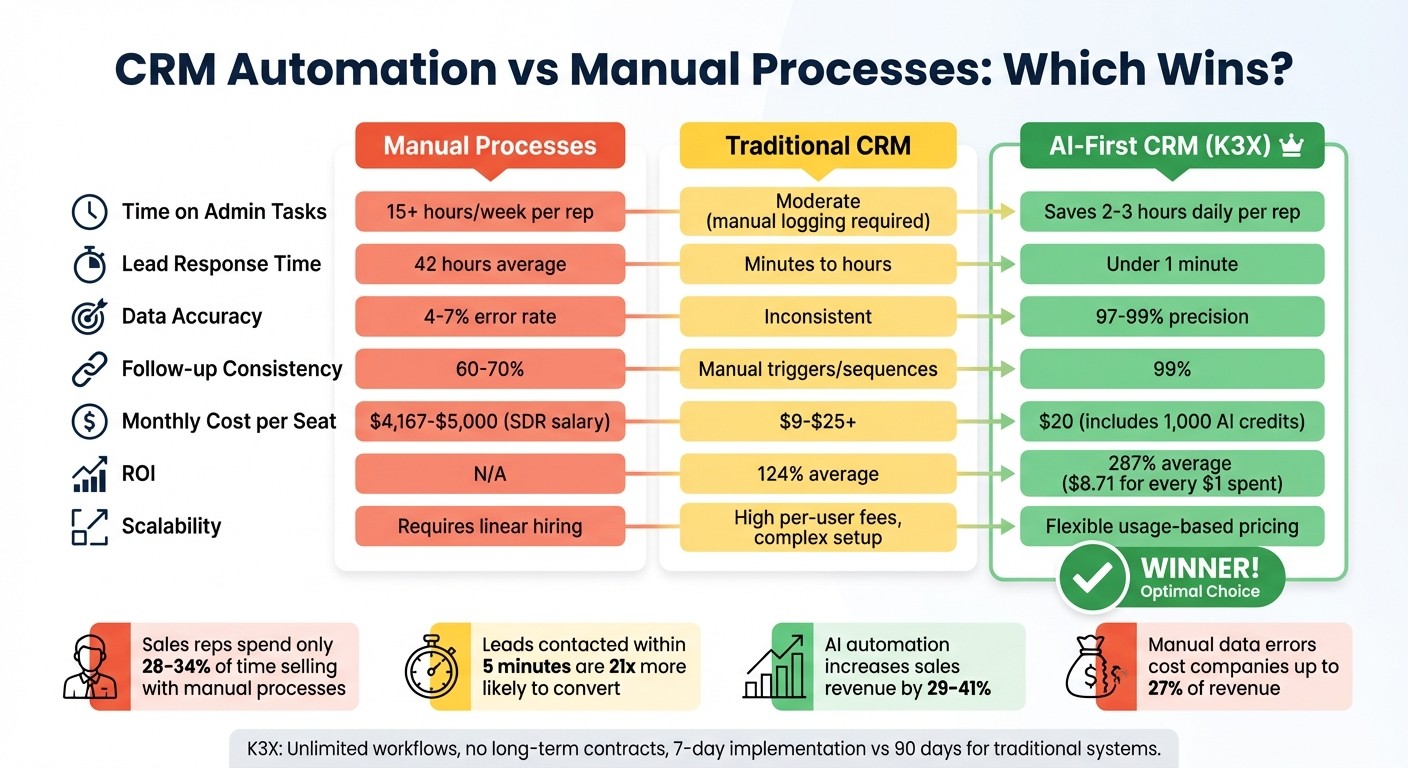
CRM Automation vs Manual Processes: Efficiency, Cost & Performance Comparison
AI CRM vs Traditional CRM: What's the Difference?
What Are Manual CRM Processes?
Manual CRM processes require sales teams to handle customer data by hand - logging call details, searching for contacts on LinkedIn, and updating deal stages in rudimentary systems. These tasks can quickly eat up time and highlight the inefficiencies of manual CRM systems.
On average, sales reps spend about 15 minutes after each call just summarizing it, another 10 minutes adding stakeholders, and even more time managing tasks, reviewing pipelines, and creating quotes or invoices.
"We force skilled sales professionals to act as data entry clerks - logging calls, creating contacts, typing notes, and updating deal stages."
– Sami AZ, Author
The numbers paint a clear picture: 32% of sales reps spend over an hour each day on administrative tasks, leaving them with just 28%–30% of their week dedicated to actual selling. This constant juggling between dynamic sales conversations and repetitive data entry disrupts their flow and creates "resumption lag", making it harder to regain focus.
These inefficiencies often lead to shortcuts that further complicate matters. When manual processes become overwhelming, some reps turn to "shadow CRMs" like personal spreadsheets or notes apps. This decentralization scatters vital customer information, leaving sales leaders with incomplete data. Even mandatory CRM fields don't solve the issue - frustrated reps may input placeholder entries like "asdf" or "TBD" just to move on quickly.
The contrast between these cumbersome processes and the efficiency of automated CRM systems, which we’ll explore next, couldn't be more stark.
What Is CRM Automation?
CRM automation leverages artificial intelligence to handle repetitive tasks that often slow down sales teams. Instead of manually logging calls, updating contact records, or scheduling follow-ups, automated systems pull key information straight from emails, calendar invites, and phone conversations. These tools can even score leads based on their likelihood to convert, assign them to the right sales representative, and trigger personalized email campaigns when prospects take actions like downloading a resource.
This level of automation isn’t just a time-saver - it’s a game-changer. AI-powered tools give sales reps back 2–3 hours every day while ensuring 99% follow-up consistency, compared to the 60–70% achieved manually. Plus, reaching out to leads within five minutes makes them 21 times more likely to convert. These efficiencies pave the way for smarter, more responsive systems.
Modern AI-native CRMs take automation to the next level. Tools like K3X allow sales teams to set up workflows using natural language commands rather than complex rules. For example, instead of creating detailed automation workflows, a rep can simply say, “Follow up with all leads who opened yesterday’s email but didn’t reply,” and the system handles it. K3X also captures data from customer interactions, provides real-time insights to flag at-risk deals, and evolves with user behavior as the business grows.
The impact of AI-driven CRM automation is already clear. Holmes Murphy, an insurance brokerage, used AI to analyze customer behavior and streamline renewals, saving about 44,000 hours and $6.9 million. Wiley, a book publisher, deployed AI-powered chatbots to manage seasonal spikes in customer inquiries, cutting annual costs by $230,000. At RBC Wealth Management, financial advisors used to spend 3–4 hours gathering data from 26 systems before client meetings. Now, AI delivers insights and automated alerts, slashing prep time significantly.
This shift from manual to automated CRM transforms static databases into active tools that directly drive sales outcomes. With K3X offering adaptive pricing starting at $20 per month per seat - including 1,000 AI credits, unlimited workflows, and built-in communication tools - even small teams can tap into enterprise-level automation without needing technical expertise. The combination of advanced functionality and affordability highlights why automation is now essential for sales success.
Manual CRM Processes vs CRM Automation: Key Differences
When comparing manual CRM processes to automation, the differences go far beyond just speed - they redefine how sales teams function. Let’s break down the numbers and see how they impact efficiency, accuracy, and overall productivity.
Sales reps using manual processes spend about 17% of their workday on data entry - essentially losing the equivalent of one full-time seller for every five reps. This inefficiency isn’t just frustrating; it’s expensive.
Response time paints an even clearer picture. With manual follow-ups, leads wait an average of 42 hours - and 55% of the time, it takes over five days to respond. Compare that to automation, where response times drop to under one minute. This matters because leads contacted within five minutes are 21 times more likely to convert. That’s a game-changer for closing deals.
Data accuracy is another major sticking point. Manual data entry comes with a 4–7% error rate, which can cost businesses up to $500,000 annually in correction efforts, customer dissatisfaction, and delays. On the other hand, AI-powered systems can achieve up to 97% precision in data matching and deduplication. Even traditional CRMs like HubSpot, which rely on manual logging, fall short compared to AI-first platforms.
Adoption rates also differ significantly. Sales reps often see older CRM systems as “reporting burdens,” leading to low usage. AI-first platforms, like K3X, flip the script by acting as a sales co-pilot, automatically capturing data from emails and calendars. This eliminates the need for constant context switching, which studies show costs 23 minutes of productivity per interruption.
"Using a unified CRM system results in much less context switching, synchronization problems, reporting issues... allowing the team to focus on selling." - Mircea Dima, Founder and CEO, AlgoCademy
Comparison Table: Efficiency, Error Rates, Scalability, and Costs
Metric | Manual Processes | Traditional CRM (HubSpot) | AI-First CRM (K3X) |
|---|---|---|---|
Time on Admin Tasks | 15+ hours/week per rep | Moderate; manual logging required | Saves 2–3 hours daily per rep |
Lead Response Time | 42 hours average | Minutes to hours | Under 1 minute |
Data Accuracy | 4–7% error rate | Inconsistent | 97% precision |
Follow-up Consistency | 60–70% | Manual triggers/sequences | 99% |
Monthly Cost per Seat | $4,167–$5,000 (SDR salary) | $9–$25+ | $20 (includes 1,000 AI credits) |
Scalability | Requires linear hiring | High per-user fees; complex setup | Flexible usage-based pricing |
User Adoption | Low (seen as a chore) | Moderate (viewed as a burden) | High (acts as sales co-pilot) |
The takeaway? Automation does more than save time - it’s 30% more cost-effective operationally. By cutting out hidden costs like manual errors and inefficiencies, CRM automation scales effortlessly without the need for proportional increases in staff or licensing expenses.
These differences highlight why automation is reshaping CRM strategies and set the stage for exploring the strengths and limitations of each approach.
Manual CRM Processes: Pros and Cons
Manual CRM processes bring a personal touch that can be crucial in certain sales environments. In complex B2B negotiations or niche markets, where trust and genuine relationships often outweigh speed, the human element becomes a key differentiator. For instance, during high-stakes enterprise deals involving multiple stakeholders, sales reps can read nonverbal cues, adapt their pitches, and negotiate custom terms - tasks that automation simply can’t replicate. Similarly, in niche markets like boutique consulting or private equity, where lead volumes are low, manual outreach enables highly tailored interactions without the need for intricate software setups.
Another advantage of manual CRM is the control it gives sales teams over every interaction. Reps can adjust their messaging, tone, and timing based on instinct or real-time feedback from prospects. This flexibility is especially valuable during objection handling, where immediate adjustments can make or break a deal. For very small businesses or startups, manual methods - like using spreadsheets and personal notes - help avoid the upfront costs and technical hurdles of CRM software.
However, manual processes come with significant downsides. Sales reps spend only 28% to 34.2% of their time selling, with manual data entry eating up 3 to 15 hours per week per rep. Even worse, 79% of opportunity-related data gathered by reps never makes it into the CRM, leading to "dirty data" that can cost companies up to 27% of their revenue. As Thomas C. Redman from Data Quality Solutions explains:
"Poor data quality creates a 'productivity tax', where organizations must allocate additional resources simply to identify and correct data errors created by manual entry processes."
Manual CRM systems also struggle to scale. While they work well for smaller lead volumes, the administrative workload grows as lead volume increases. This often forces companies to hire more staff just to maintain data accuracy. Reps may even resort to creating "shadow CRMs" to bypass the inefficiencies of the main system. With 63% of organizations reporting major inefficiencies tied to manual processes, what works for a small team can quickly become a bottleneck for growing sales operations.
Pros and Cons Table: Manual CRM Processes
Advantages | Disadvantages |
|---|---|
Flexible for custom deal negotiations and complex B2B sales | Reps spend only 28–34% of their week selling; data entry takes 3–15 hours weekly |
Full control over messaging, tone, and timing based on real-time feedback | Data quality issues cause up to 27% revenue loss and high correction costs |
Builds trust and rapport in high-touch sales environments | Follow-up consistency is only 60–70%, compared to 99% with automation |
Low initial costs and minimal technical barriers for small businesses | 79% of opportunity data never enters the CRM; reps create "shadow CRMs" |
Effective for real-time objection handling and immediate clarification | Scalability challenges arise as lead volumes grow |
Works well for niche markets with low lead volumes | 63% of companies report inefficiencies with manual processes |
K3X offers a solution by automating repetitive tasks like data entry and follow-up reminders while keeping the human touch intact where it matters most. By capturing data from emails and calendars automatically, K3X allows sales teams to focus on what they do best: building relationships and closing deals.
While manual CRM processes provide a level of personalization and control, their inefficiencies highlight the need for automation to scale effectively and reduce operational burdens.
CRM Automation: Pros and Cons
CRM automation has clear benefits, but it's not without its challenges. By automating repetitive tasks, businesses can see an average ROI of $8.71 for every $1 spent. Sales revenue often increases by 29% to 41%, and lead conversion rates can skyrocket by up to 300% after implementation.
One standout advantage is data accuracy. Automated systems achieve 99% accuracy and follow-up consistency, compared to the 60%–70% range seen with manual processes. Additionally, lead response times drop dramatically, going from an average of 42 hours to under one minute. This matters because contacting leads within five minutes makes them 21 times more likely to qualify.
However, traditional CRM systems come with hurdles. Legacy platforms have a 20% to 55% failure rate, often due to their complexity and lack of user adoption. Implementation costs can range from $10,000 to $100,000, with training budgets adding another $5,000 to $25,000. Sales reps frequently find these systems cumbersome, which can lead to the same data quality issues automation is supposed to solve.
K3X offers a solution to these challenges. Its conversational, prompt-driven interface eliminates the need for complicated setups or technical expertise. Instead of programming rigid "if-then" rules, users can create workflows through natural conversation. K3X also provides unlimited workflow automations and starts at just $20 per month per seat, making it a cost-effective choice for growing teams. By integrating tools like email, calling, and SMS, it automates data capture, transforming sales reps into "data reviewers" who approve AI-generated summaries rather than manually entering data.
Automation also shines when scaling operations. While manual processes require more staff to handle increased lead volumes, automated CRMs like K3X adapt without a proportional rise in costs. K3X’s adaptive pricing model aligns with actual usage, avoiding the fixed fees typical of traditional CRMs. For example, Holmes Murphy reported saving 44,000 hours of manual work and $6.9 million after implementing CRM automation in 2025. Similarly, RBC Wealth Management cut meeting prep time from 3–4 hours to just minutes by consolidating 26 systems into one AI-driven platform.
Pros and Cons Table: CRM Automation
Advantages | Disadvantages |
|---|---|
Delivers $8.71 ROI for every $1 spent; boosts revenue by 29–41% | Traditional systems have 20–55% failure rates due to complexity |
Saves reps 2–3 hours daily by reducing manual data entry | Implementation costs range from $10,000–$100,000 for legacy platforms |
Achieves 99% data accuracy and follow-up consistency vs. 60–70% manual | Training budgets typically require $5,000–$25,000 |
Reduces lead response time from 42 hours to under 1 minute | Legacy systems rely on rigid, technical configurations |
Increases lead conversion rates by up to 300% | Poor user adoption when systems feel like "reporting burdens" |
Scales without proportional headcount increases | Monthly licensing costs $50–$500 per user for traditional CRMs |
K3X offers unlimited workflows, prompt-driven setup, and adaptive pricing at $20/month per seat | K3X simplifies setup through conversational AI and automatic data capture |
These points provide a foundation for understanding how CRM automation impacts sales performance, setting the stage for a closer look at the numbers driving success.
Performance Comparison: The Numbers
When it comes to outcomes, the stats make a compelling case for AI-driven CRM automation. Manual CRM processes simply can't compete. For instance, AI-native CRM tools boast an average ROI of 287%, compared to just 124% for traditional systems - more than double the return. Companies using AI-driven sales automation also report a 13% to 15% boost in revenue, and automated lead scoring can improve conversion rates by 25%.
The time savings are just as impressive. Sales reps reclaim 2 to 2.15 hours daily through automation, which adds up to nearly three months of work per year. Tasks like email logging, which typically take 2 minutes, are reduced to zero. Call note entry drops from 2.5 minutes to just 30 seconds, meeting logging is eliminated entirely, and mobile deal updates shrink from 29 minutes to just 40 seconds.
K3X's pricing model is another standout feature, starting at just $20 per month per seat - a fraction of the $25–$300 range charged by traditional CRMs. Plus, its intuitive interface eliminates the hefty $10,000 to $100,000 implementation costs often associated with automation solutions. With K3X, you get unlimited workflow automations and 1,000 AI credits every month, all without locking into long-term contracts.
The real-world results speak for themselves. A health equipment manufacturer using AI-driven tools achieved an 8X ROI in just 8 months, recovering $1.2 million in churned revenue and cutting their annual churn rate from 15% to 7%. A pharmaceutical sales rep reduced their average sales cycle from 14 weeks to 8 weeks - a 43% improvement - thanks to AI-generated briefs and automated follow-ups. Meanwhile, a mid-sized software company saw a 25% drop in customer acquisition costs and slashed their sales cycle length by 40% with AI-powered automation.
"Tools with AI Native Score >80 achieved 2.8x higher ROI (average 241%) compared to non-AI tools (87%)." – Sarah Chen, RevOps Consultant
Scalability is another area where automation shines. Manual processes require more staff as lead volumes grow, but K3X leverages cloud-based infrastructure and usage-based pricing to adapt seamlessly. Implementation is also lightning-fast: AI-native platforms like K3X reduce time to value from 90 days with traditional systems to just 7 days. That means your team can start seeing results almost immediately, instead of waiting months.
These figures highlight why K3X is a game-changer for sales teams looking to maximize efficiency and drive results.
Why K3X CRM Automation Wins for Sales Teams

K3X takes the hassle out of administrative tasks, giving sales teams their time back. Manual systems often eat into valuable selling hours, but K3X flips the script by automating routine work, allowing reps to focus on what really matters - closing deals and building relationships. Thanks to its Zero-Entry philosophy, K3X automatically pulls data from emails, calendars, and meetings. This means sales reps can stop being data clerks and start being strategic decision-makers. On average, this shift saves 5 to 10 hours per week that would otherwise be spent on admin tasks.
But it’s not just about saving time. K3X's prompt-driven workflows bring a level of sophistication that traditional rule-based systems just can’t match. Its AI-powered features can tell the difference between a potential lead and a polite brush-off. For interested leads, it sends a calendar link in under five minutes - speed that matters, as reaching a lead within five minutes makes them nine times more likely to convert. Contrast this with manual processes, where leads can wait days for a response.
"The job description of a salesperson is to build relationships and close revenue. It is not to manage a database." – Sami AZ, Klu
K3X also simplifies pipeline management with real-time dashboards that flag inactive deals instantly. The platform ensures 99% follow-up consistency and uses intelligent multi-step sequences to boost response rates by 80%. And all of this comes at just $20 per month per seat, including unlimited workflow automations and 1,000 AI credits per month. Unlike other enterprise tools that can cost between $10,000 and $100,000 just to set up, K3X offers high-level automation without the hefty price tag.
When you combine these features - time savings, better lead response rates, and cost efficiency - it’s clear that K3X is a game-changer for sales teams. It’s more than just a tool; it’s a smarter way to work.
Choosing the Right CRM for Your Business
Given the measurable advantages of automation, picking the right CRM is a crucial decision. The benefits are clear: massive time savings, improved data accuracy, higher revenue potential, and a better ROI compared to manual systems. For competitive sales teams, automation isn’t optional - it’s essential.
When evaluating CRM options, look for tools that eliminate manual data entry, respond to leads quickly, and grow with your business without adding extra headcount. K3X hits all these marks with its Zero-Entry model, AI-driven workflows, and affordable, transparent pricing. Plus, there are no long-term contracts, so it scales as your business does. K3X isn’t just an AI-Native Sales & Support CRM - it’s a smarter, faster way to do sales.
FAQs
What should I automate first in my CRM?
Start by focusing on automating repetitive tasks that eat up your sales team's time - things like data entry, follow-up sequences, and lead nurturing. Automation can handle activities like logging emails, calls, and meetings, which not only saves time but also ensures more accurate data. Plus, automated follow-ups can give your close rates a healthy boost of 30–40%. Addressing these tasks early on delivers quick wins in efficiency and aligns well with modern CRM tools like K3X.
How do I keep automated follow-ups from feeling robotic?
To create automated follow-ups that feel authentic, prioritize personalization and timing. Use actions like email opens or form submissions as triggers to send messages that are relevant and well-timed. Tap into your CRM data to customize content and segment your audience, ensuring your communication feels more genuine. Keep a balance between automation and human involvement, and steer clear of sending messages that are too generic or overly frequent. This helps preserve that personal touch.
How fast can my team start seeing ROI with K3X?
Your team could start seeing a return on investment (ROI) with K3X in as little as six weeks. This platform is designed to map workflows, pinpoint areas ripe for automation, and ensure a smooth transition to live automation. Many businesses even recoup their costs in under a year.
What sets K3X apart is its user-friendly, AI-driven platform that skips the complicated setup typical of traditional systems. This means you can achieve faster deployment and start seeing measurable outcomes in just a matter of weeks.