



Balance predictive accuracy and explainability in CRM AI to improve adoption, compliance, and revenue outcomes.
AI in CRM systems often forces a tough choice: prioritize accuracy or explainability. Accuracy ensures predictions align with actual results, improving outcomes like lead scoring and revenue forecasting. Explainability, however, builds trust by clarifying why decisions are made, which is vital for adoption, compliance, and error correction.
Key Takeaways:
Accuracy: High-performing models (e.g., neural networks) boost lead conversion and shorten sales cycles but often lack transparency.
Explainability: Transparent models (e.g., decision trees) improve trust and accountability but may sacrifice predictive power.
Challenges: Sales teams hesitate to trust opaque AI, and compliance becomes harder without clear decision logic.
Balance Needed: Combining accuracy with explainability ensures AI systems perform well and remain usable at scale.
Bottom Line: CRM AI must strike a balance - accuracy drives results, but explainability ensures trust and long-term usability.
Explaining Machine Learning - Explainability vs. Accuracy Tradeoff
What Accuracy Means in CRM AI
In the context of CRM AI, accuracy measures how closely predictions align with actual results. For instance, if your system predicts a lead score of 85 or estimates $50,000 in monthly revenue, accuracy evaluates how much those predictions deviate from reality.
Two common metrics used to measure this are Mean Absolute Error (MAE) and Root Mean Square Error (RMSE). MAE calculates the average of all absolute errors, making it straightforward to interpret since it uses the same units as your data. RMSE, on the other hand, squares the errors, giving greater weight to larger deviations. Your choice between these depends on your priorities: MAE is ideal for communicating results to non-technical stakeholders, while RMSE is better for model training, especially when large errors could have serious consequences. If you notice a significant gap between MAE and RMSE, it could indicate that your model is making a few very large mistakes rather than many smaller ones. This level of precision is critical, as it directly impacts business decisions and outcomes.
Why Accuracy Matters for CRM Performance
Accurate AI can drive meaningful business results. For example, lead scoring models with around 80% accuracy can increase conversion rates by 25% and shorten sales cycles by 30%. High-performing sales teams are also 73% more likely to adopt models with an AUC accuracy between 0.85 and 0.95.
Real-world examples highlight the importance of accuracy. In 2025, HES FinTech implemented an AI-powered lead scoring model with a Gini index of 0.6 (approximately 80% accuracy), which resulted in faster deal closures and improved win rates. These results are consistent with CRM AI case studies showing how automated insights drive performance. Similarly, the Carson Group leveraged AI lead scoring to prioritize opportunities, helping secure a $68 million deal that same year. The global lead scoring market is projected to reach $1.4 billion by 2026, with AI tools accounting for over half of this growth. These examples illustrate why balancing accuracy with explainability is essential for effective CRM strategies.
Problems with Focusing Only on Accuracy
While accuracy is crucial, putting too much emphasis on it can overlook the importance of transparency and actionable insights. Sales reps are 300% more likely to engage with leads when given a clear explanation of the scoring, and 92% of sales teams report trusting AI-generated leads only when the reasoning behind them is shared.
Leadsourcing.co explains:
"A model with 75% accuracy that sales teams trust and use daily beats a 90% black box any day."
When AI models lack transparency, even technically accurate systems are often ignored. This can lead to low adoption rates, wasted resources, and what’s known as the "rigidity tax", where sales reps manually override the system. These challenges also create operational vulnerabilities, making it harder to address exceptions, justify pricing decisions, or explain inconsistencies to clients. Additionally, model accuracy can degrade by 3–5% seasonally if buyer behavior shifts and the system isn’t retrained regularly.
What Explainability Means in CRM AI
Explainability in CRM AI is all about understanding and justifying the decisions made by AI systems. It’s not enough to know what the system decided - you also need to know why it made that decision, what data influenced it, and how confident the system was in its prediction. This level of insight provides the context needed for human judgment and intervention.
Shishir Mishra, Founder and Systems Lead at KORIX, puts it this way:
"Accuracy answers 'How often is the system correct?' It does not answer why a decision was made or whether it was appropriate in context."
Even highly accurate systems can pose risks if their decisions are opaque. In regulated industries, for instance, clear decision-making logic is essential for audits and accountability. Without it, systems could lead to undefendable pricing strategies, unexplained operational exceptions, or arbitrary automated responses.
Explainability goes beyond compliance. It allows teams to question outputs, address uncertainty early, and stay in control. When users feel that AI decisions are random or lack transparency, trust erodes - even if the system's accuracy is high. Mishra highlights this issue:
"AI systems do not fail because they are inaccurate. They fail because no one can explain - or take responsibility for - what they do."
Simple Models vs. Complex Models
Choosing between simple and complex models often involves weighing transparency against performance. Simple models, like linear regression and decision trees, are easy to interpret because they provide clear rules or coefficients that show exactly how each feature affects the outcome. However, these models struggle with more complex data, such as non-linear relationships or high-dimensional datasets, which limits their accuracy in certain CRM applications.
On the other hand, complex models - such as deep neural networks and gradient-boosted trees - excel at capturing intricate patterns, making them ideal for tasks like natural language processing or image recognition. But their decision-making processes are opaque, making it hard to understand how they arrive at specific predictions without using additional tools.
For complex models, interpretation tools like SHAP (SHapley Additive exPlanations) and LIME (Local Interpretable Model-agnostic Explanations) can help. These tools analyze how changes in input data affect predictions, offering a glimpse into the "black box." However, they add computational complexity and still don’t provide the inherent clarity of simpler models.
Feature | Simple Models (Interpretable) | Complex Models (Black-Box) |
|---|---|---|
Examples | Linear regression, decision trees | Deep neural networks, gradient-boosted trees |
Transparency | High; rules or coefficients are clear | Low; decision-making is opaque |
Performance | Limited with non-linear or complex data | Excels with intricate patterns |
Best Use Case | Regulated industries (e.g., finance, healthcare) | Recommendation systems, autonomous driving |
In CRM, the choice between these models impacts both performance and user trust. For regulated industries, the decision is often straightforward. As Milvus explains:
"In regulated industries like healthcare or finance, explainability is critical for compliance and user trust, even if it means accepting slightly lower accuracy."
This balancing act between transparency and performance plays a key role in how CRM teams interact with and improve AI systems.
How Explainability Helps CRM Teams
Explainability directly impacts how teams engage with AI and build trust in its outputs. For example, when sales reps understand why a lead is scored in a particular way, the AI becomes a tool they can collaborate with, rather than something they blindly follow.
It also simplifies compliance and accountability. In December 2025, Ruby Capital Group adopted K3X's AI-driven agents and achieved a 99.8% compliance accuracy rate. This level of precision was only possible because the system made its decision logic transparent, enabling teams to audit outcomes and intervene when necessary. Without explainability, teams are left with a frustrating choice: either trust the system blindly or rely on constant manual overrides - neither of which scales effectively.
Explainability also supports continuous improvement. When errors arise, transparent systems allow teams to pinpoint the root cause and adjust the logic. In contrast, opaque systems leave teams reacting to issues after the fact, with no clear way to prevent similar problems in the future. This is especially important given that CRM data can decay at a rate of 34% annually and is often up to 80% inaccurate. The ability to question AI logic is essential for maintaining data quality.
Mishra underscores the importance of building explainability into AI systems from the start:
"Ownership requires understanding. If a human is expected to approve a decision or defend an outcome, they must be able to answer: Why did the system do this?"
The Trade-Off Between Accuracy and Explainability
Balancing accuracy and explainability is a challenge that CRM teams face every day. High-accuracy models, like deep neural networks and gradient-boosted trees, excel at identifying complex patterns but often operate as opaque "black boxes".
This creates what Shishir Mishra, Founder and Systems Lead at KORIX, describes as a difficult choice: "blind trust" versus "constant manual override" - neither of which is practical at scale. While errors in small datasets can be manually managed, large-scale operations mask these errors in averages, making it hard to understand the reasoning behind pricing, lead prioritization, or data-driven decisions. Mishra underscores the risk:
"At scale, the lack of clarity in accurate models multiplies operational risks."
The issue becomes even more critical in systems that directly impact revenue. When models produce pricing decisions or lead prioritizations that can't be explained, they undermine trust - even if they are technically accurate. This lack of transparency compounds existing challenges, like CRM data that decays at a rate of 34% annually and is often up to 80% inaccurate. The result? A growing gap between AI's potential and its practical, trustworthy application in CRM.
High Accuracy, Low Explainability
Advanced models, such as gradient-boosted machines and deep learning networks, bring undeniable performance improvements. For instance, AI-powered lead qualification can achieve 70–85% accuracy, compared to just 30–40% with manual methods. Similarly, lead conversion predictions can see a jump from 60% to 75–85% accuracy after 6–12 months of data processing. These gains translate into faster deal cycles and higher close rates, directly boosting revenue.
However, the lack of transparency in these models creates significant hurdles. Sales teams often hesitate to trust recommendations they don't understand. Support teams struggle to justify automated responses to frustrated customers. Compliance officers face challenges defending decisions during audits. The bottom line? Human operators need to understand decisions to take ownership of them. As Mishra puts it:
"Ownership requires understanding. If a human is expected to approve a decision or defend an outcome, they must be able to answer: Why did the system do this?"
This trust gap limits how CRM teams can integrate AI into their workflows. While high-accuracy models offer predictive power, their opacity introduces challenges that can’t be ignored.
High Explainability, Lower Accuracy
On the other hand, simpler models like linear regression and decision trees provide full transparency. These models make it easy to see how inputs influence outputs, which is crucial in industries like finance and healthcare, where auditability often outweighs small gains in accuracy.
But this clarity comes at a cost. Simple models struggle to capture the nuanced patterns needed for precise CRM predictions. They often miss key details like complex customer behaviors, seasonal trends, or subtle variable interactions. Additionally, businesses incur what some call a "rigidity tax" - spending 30–40% of IT resources to maintain and update rule-based systems as market conditions or policies change. While these systems are transparent, their operational inefficiencies make them harder to sustain as businesses grow.
Navigating these trade-offs helps organizations align AI's capabilities with their CRM goals, ensuring both performance and trust are considered.
How Accuracy and Explainability Affect CRM Decisions
This section delves into how the balance between model performance and clarity directly influences CRM decisions. The interplay between accuracy and explainability impacts how sales teams prioritize leads, how customer service handles complaints, and how resources are distributed across operations. Together, these factors drive targeted CRM outcomes, shaping smarter decision-making processes.
Accuracy for Better Predictions
Accurate AI models excel at making precise predictions, which can significantly boost revenue and operational efficiency. For example, when lead scoring is highly accurate, sales teams can zero in on the most promising opportunities rather than wasting time on low-potential leads. Companies leveraging AI-powered CRMs have reported a 60% increase in capacity per representative and a 30% rise in revenue per rep, largely due to improved lead prioritization. Timing also plays a critical role - responding to leads within five minutes can increase conversions by 21 times compared to waiting 30 minutes.
Take Ruby Capital Group's experience as an example. In December 2025, they implemented K3X's AI-driven agents and saw remarkable results: a 70% reduction in follow-up time, a threefold increase in ticket resolution speed within just two days, and a 99.8% compliance accuracy rate. By enabling accurate lead qualification, AI allows sales representatives to focus on high-intent opportunities, driving better outcomes.
However, even the most accurate models can face low adoption rates if they lack transparency.
Explainability for Trust and Compliance
While accuracy enhances operational performance, explainability fosters trust and ensures compliance. Transparent AI systems build confidence among users, encouraging adoption. For instance, when sales teams understand why a lead is scored a certain way - such as "visited the pricing page 3 times" or "opened 5 emails within 48 hours" - they're more likely to act on that recommendation. A striking 92% of sales teams trust AI-generated leads when the reasoning behind the scores is clear. Shishir Mishra, Founder and Systems Lead at KORIX, highlights the importance of this dynamic:
"Accuracy helps systems perform. Explainability helps organizations live with those systems over time."
In regulated industries, explainability is critical for compliance and accountability. Teams must justify their decisions - whether it's pricing, discounts, or customer prioritization - to auditors and stakeholders. Without transparency, AI decisions can become impossible to defend. Mishra underscores this challenge:
"Without explainability, ownership becomes symbolic - not real."
This need for clarity also affects everyday operations. Customer service teams must explain why certain tickets are routed to specific agents, sales managers need to justify territory assignments, and operations leaders must defend how resources are allocated. Ultimately, the trade-off is evident: a model with 75% accuracy that teams trust and use consistently is far more valuable than a 90% accurate black box that employees ignore.
Comparison: Accuracy vs. Explainability in CRM AI
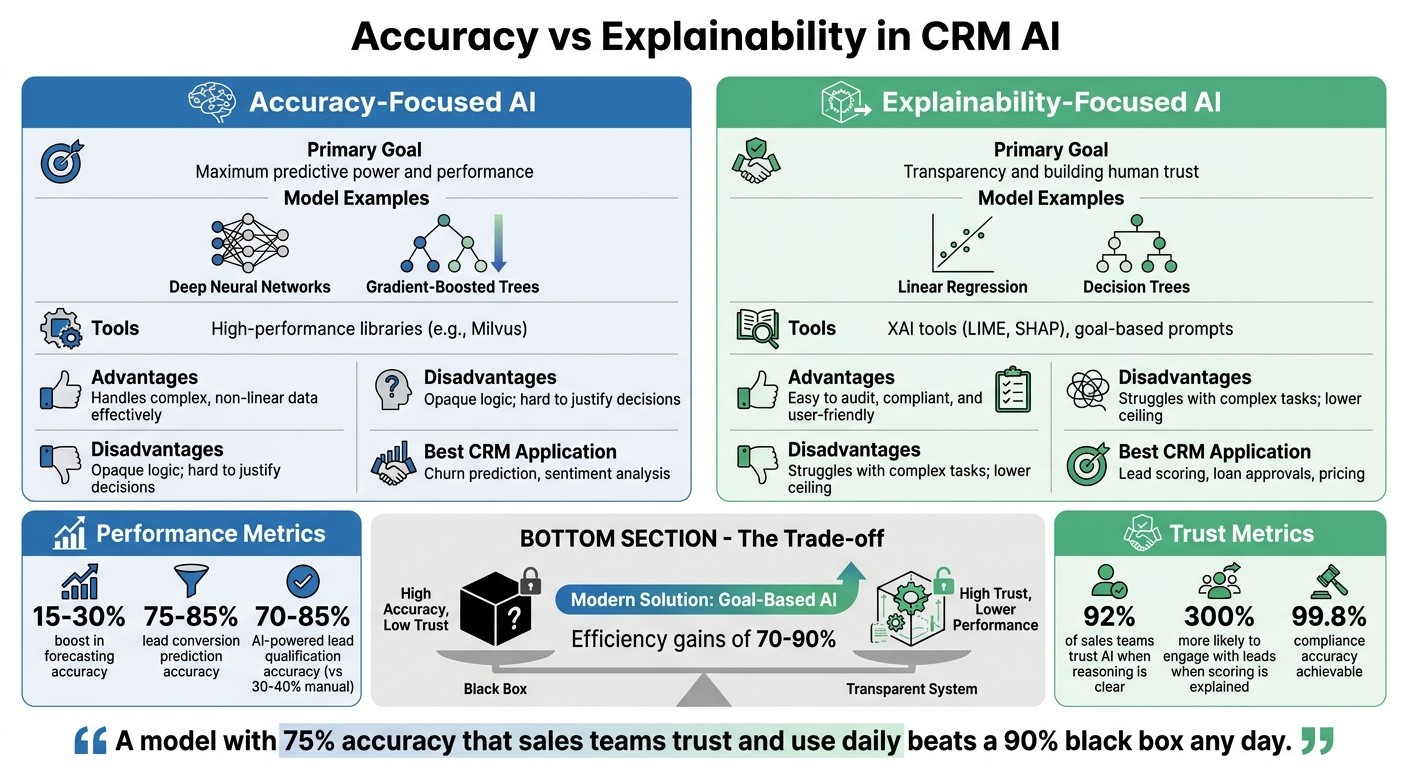
Accuracy vs Explainability in CRM AI: Key Differences and Trade-offs
When it comes to CRM AI, teams often face a tough decision: should they prioritize accuracy or explainability? Accuracy-focused models, like deep neural networks or gradient-boosted trees, are built for maximum predictive power. They excel at identifying subtle and complex patterns in large datasets. However, their inner workings are a mystery - making it hard to understand how they arrive at their conclusions. On the other hand, explainability-focused models, such as linear regression or decision trees, are designed for transparency. These models clearly show how each input influences the output, making them easier to interpret. This trade-off plays a huge role in shaping CRM performance metrics and day-to-day decision-making.
The operational impact of choosing between these models is significant. High-accuracy models can boost forecasting accuracy by 15–30% compared to traditional methods. They also improve lead conversion predictions, raising accuracy from 60% to 75–85% after processing data for 6–12 months. But there’s a catch - these opaque models can lead to unexplainable pricing decisions, unexpected errors, and communication breakdowns with customers. This lack of transparency can create challenges in risk management and accountability.
Here’s a breakdown of how these two approaches differ in terms of features and applications:
Feature | Accuracy-Focused AI | Explainability-Focused AI |
|---|---|---|
Primary Goal | Maximum predictive power and performance | Transparency and building human trust |
Model Examples | Deep Neural Networks, Gradient-Boosted Trees | Linear Regression, Decision Trees |
Tools | High-performance libraries (e.g., Milvus) | XAI tools (LIME, SHAP), goal-based prompts |
Advantages | Handles complex, non-linear data effectively | Easy to audit, compliant, and user-friendly |
Disadvantages | Opaque logic; hard to justify decisions | Struggles with complex tasks; lower ceiling |
Best CRM Application | Churn prediction, sentiment analysis | Lead scoring, loan approvals, pricing |
This is where K3X comes in, offering a solution that avoids forcing a choice between these two approaches. Instead of relying on rigid "if-then" rules, K3X uses goal-based reasoning. Teams can define the outcomes they want (e.g., "Book demo calls with unresponsive leads"), and the AI handles the logic while making its intent clear. This means transparency and performance can coexist. With this method, K3X delivers efficiency gains of 70–90%, far outpacing the 40–60% improvement seen with traditional automation.
Finding the Right Balance in Modern CRM Systems
Modern CRM systems are tackling the challenge of balancing accuracy with explainability by adopting hybrid strategies. These systems now integrate powerful predictive capabilities with transparent reasoning. The goal? To make AI assumptions clear from the outset, display confidence levels, and log decision contexts so teams can review and question outcomes when necessary. As Shishir Mishra, Founder and Systems Lead at KORIX, aptly puts it:
"At scale, accuracy without explainability creates risk, not confidence".
This approach sets the foundation for incorporating Explainable AI (XAI) tools to further improve transparency.
Using XAI Tools to Bridge the Gap
Explainable AI (XAI) tools like SHAP (SHapley Additive exPlanations) and feature importance analysis provide clarity on why an AI model made a specific prediction. For instance, if your CRM predicts a high likelihood of conversion, SHAP can highlight the driving factors - like recent email interactions, company size, and participation in previous demos. This level of transparency allows teams to validate predictions, address potential biases, and refine strategies based on actual drivers of outcomes.
XAI tools also play a crucial role in ensuring compliance, especially in regulated industries where decisions around pricing, approvals, or risk assessments need to be justified. By surfacing uncertainties early, these tools empower teams to intervene before small errors escalate into larger problems.
How K3X Combines Accuracy with Clear Explanations

K3X takes a different approach by focusing on goal-driven workflows that eliminate the need for complicated XAI dashboards. Instead of relying on rigid "if-then" programming or requiring users to interpret complex data breakdowns, K3X enables teams to define their desired outcomes - like "Book demo calls with unresponsive leads" - and the system determines the necessary steps while making its processes clear.
In February 2026, Vivian, a business financing firm, adopted K3X to improve deal flow. The results? A 3× faster lead response time and a 2× increase in deal flow visibility, all while maintaining full transparency. K3X adapts to real-time data, such as email threads and call transcripts, handling unexpected issues like out-of-order replies or missing details without disrupting workflows. Additionally, it learns from human feedback - whether approvals or corrections - to continually refine its behavior and align with your brand's tone and standards. Mykyta Samusiev, Co-Founder & CEO of K3X, explains:
"We're building a CRM that works the way people expect it to - through intention. You tell it the outcome. The system figures out the work."
The result is a system that strikes a balance between predictive accuracy and explainability. By achieving efficiency gains of 70–90% - compared to the 40–60% typical of traditional static automation - K3X empowers teams to close more deals while maintaining the transparency needed to trust and defend their decisions.
Conclusion
High-performing AI models are known for delivering better predictions, but they often fall short when it comes to transparency. This lack of clarity can erode trust, hinder defense mechanisms, and make improving the models more challenging. On a larger scale, focusing solely on accuracy creates risks, as individual errors can get lost in aggregated data. This makes it harder for teams to step in and correct small mistakes before they snowball into significant revenue issues.
The solution isn’t about picking between accuracy and explainability. Modern CRM systems need both: the predictive power to spot opportunities and the transparency to explain why those opportunities matter. Explainability allows teams to take ownership of AI-driven decisions and refine their strategies based on real insights instead of assumptions. Shishir Mishra, Founder and Systems Lead at KORIX, captures this balance perfectly:
"Accuracy helps systems perform. Explainability helps organizations live with those systems over time".
This dual focus is embodied in advanced CRM solutions like K3X. Instead of relying on rigid, step-by-step automation, K3X introduces goal-oriented workflows that adapt to real-time behaviors while maintaining clear, understandable logic. Teams don’t need to wrestle with complex configurations - they simply define outcomes, such as "Book demo calls with unresponsive leads", and K3X takes care of the rest. The results speak for themselves: K3X boosts efficiency by 70–90%, far outpacing the 40–60% gains typically seen with static automation.
FAQs
When should a CRM team prioritize explainability over accuracy?
When decisions demand accountability, trust, or a clear understanding of their outcomes, a CRM team should focus on explainability over pure accuracy. Explainability provides clarity into how decisions are made and the reasoning behind them. This becomes especially critical when operating at scale, as accuracy by itself doesn’t offer the same level of transparency or insight into the decision-making process.
How can you add explainability to a high-accuracy 'black box' model?
To improve the transparency of a high-accuracy 'black box' model, you can use tools that shed light on its decision-making processes. Methods such as LIME (Local Interpretable Model-agnostic Explanations), SHAP (SHapley Additive exPlanations), or analyzing feature importance scores can help uncover the reasoning behind predictions.
For AI-driven CRMs like K3X, blending strong performance with interpretability is key. This combination promotes transparency, builds trust, and supports better decision-making - especially when these models influence critical operations.
How do you monitor accuracy drift in CRM AI over time?
Monitoring accuracy drift in a CRM's AI system requires consistent vigilance and proactive measures. This includes regularly reviewing performance metrics to ensure the AI is functioning as expected, analyzing shifts in data distribution that could impact its effectiveness, and implementing automated alerts to flag any performance drops. These steps help the system stay aligned with changing conditions and deliver reliable results over time.