

Control CRM workflows with natural-language prompts that automate follow-ups, update pipelines, and adapt in real time—saving time and improving conversion rates.
Struggling with CRMs that slow you down? Conversational workflow control changes the game by letting you manage tasks with natural language instead of rigid processes. Simply tell the system your goal - like "follow up with inactive leads" - and AI handles the rest, adjusting in real-time to unexpected situations.
Key takeaways:
Saves time: Teams report saving 8 hours per week per employee.
Boosts efficiency: Companies see up to 42% higher lead conversion rates.
Reduces manual work: Automates data entry, follow-ups, and pipeline updates.
Quick setup: Start in under an hour by connecting tools and defining goals.
K3X, a leader in this space, eliminates complex workflows, allowing sales teams to focus on closing deals instead of managing software. With features like intent-based execution and real-time data integration, it transforms CRMs into active tools that deliver results.
How AI Transforms Sales CRM Workflows
What is Conversational Workflow Control in AI CRMs?
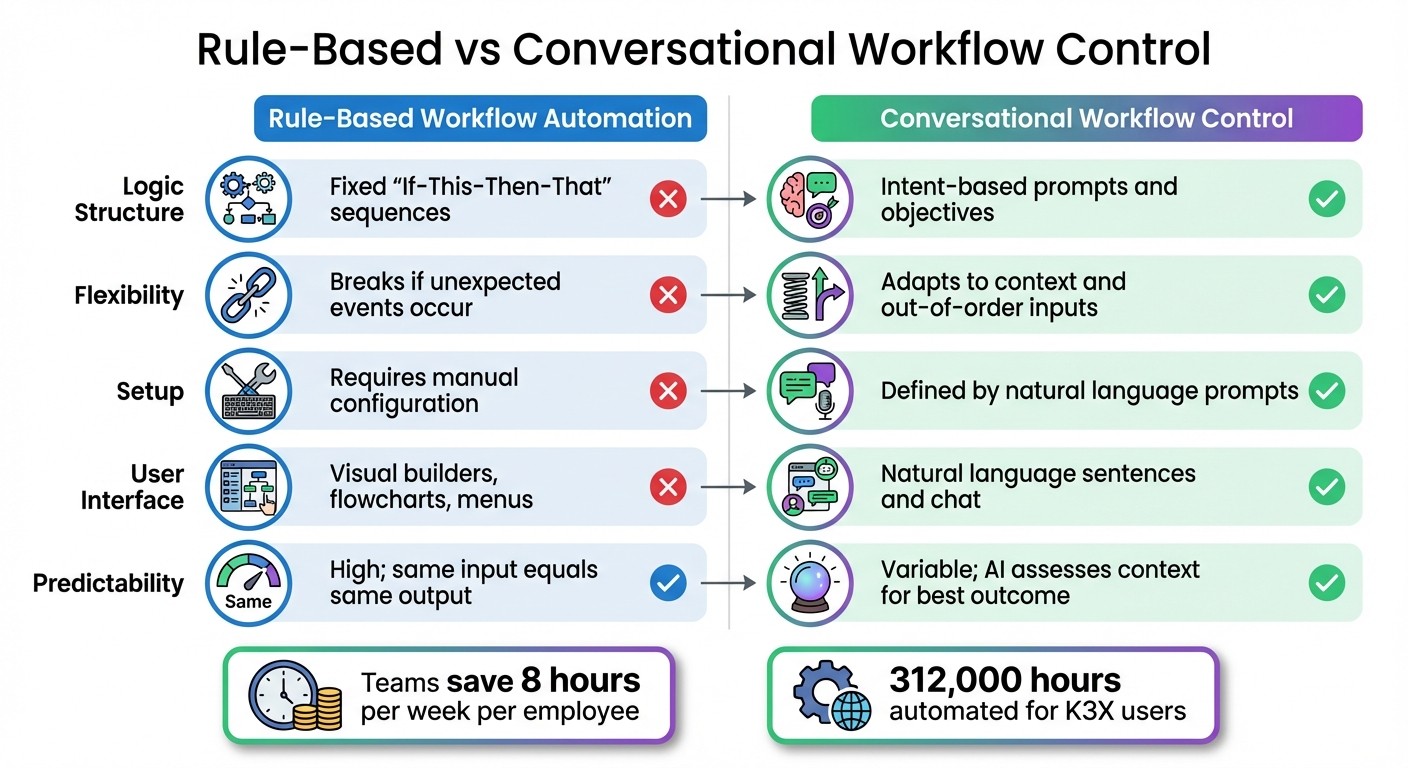
Rule-Based vs Conversational Workflow Control in AI CRMs Comparison
Conversational workflow control lets users manage CRM tasks using natural language prompts instead of navigating complex workflows. Instead of clicking through endless screens to set up automation, you simply describe what you want. For instance, you could say, "Follow up with inactive leads after 48 hours", and the AI takes care of the rest.
The standout feature here is intent-based execution. Traditional CRMs require you to outline every step in detail - like specifying, "If a lead opens an email, wait two days, send a follow-up, and stop if there's no reply." In contrast, conversational control focuses on the desired result and figures out the steps on its own. If something unexpected happens, like a lead asking an off-topic question or replying out of order, the system adjusts rather than breaking down.
This approach eliminates the need for technical expertise or tools like Zapier. Sales reps interact with the CRM conversationally, using clear instructions instead of wrestling with forms or automation diagrams. As Mykyta Samusiev, Founder & CEO of K3X, puts it:
"We're building a CRM that works the way people expect it to, not through menus, workflows, or complexity, but through intention. You tell it the outcome. The system figures out the work."
This shift away from rigid rule-based systems creates a more adaptable and user-friendly way to manage workflows.
How It Differs from Rule-Based Workflow Automation
Rule-based automation operates on fixed logic: the same input always produces the same output. For example, if you program a sequence to send three emails over six days, it will follow those steps exactly, regardless of how the lead responds. Conversational workflow control, on the other hand, evaluates each situation dynamically. The AI considers context - like whether a lead showed interest, asked about pricing, or is ready to book a meeting - and tailors its actions to maximize engagement.
Feature | Rule-Based Workflow Automation | Conversational Workflow Control |
|---|---|---|
Logic Structure | Fixed "If-This-Then-That" sequences | Intent-based prompts and objectives |
Flexibility | Breaks if unexpected events occur | Adapts to context and out-of-order inputs |
Setup | Requires manual configuration | Defined by natural language prompts |
User Interface | Visual builders, flowcharts, menus | Natural language sentences and chat |
Predictability | High; same input equals same output | Variable; AI assesses context for best outcome |
The impact is clear. Sales teams using this prompt-driven approach save an average of 8 hours per week per employee. K3X alone has automated over 312,000 hours of manual work for its users. Instead of wasting time on complex rule-building, teams can focus on what really matters: closing deals.
Core Technologies Behind Conversational Workflow Control
This adaptive, context-aware system relies on three key technologies: Natural Language Processing (NLP), LLM-based reasoning, and real-time data integration.
NLP: Translates everyday language like "Re-engage cold leads who haven't responded in two weeks" into actionable tasks, removing the need for manual setup of filters or triggers.
LLM-based reasoning: Powered by models like GPT-4, this technology analyzes conversation history, sentiment, and deal stages to decide the next best step. It can handle tasks like sending follow-ups, escalating issues, or updating pipelines. It even evaluates calls using frameworks like BANT (Budget, Authority, Need, Timeline) to make structured decisions autonomously.
Real-time data integration: Ensures the AI has access to a complete timeline of interactions - emails, meetings, follow-ups - so it understands the full context. This "relational memory" connects conversational dots instead of treating each interaction as a standalone event. As Nick Barraclough from Nylas explains:
"Revenue lives in conversations, not in fields".
Together, these technologies transform CRMs from static databases into active tools that observe, interpret, and act on their own. The system identifies risks, handles follow-ups, and updates deal stages in real time - cutting out the need for complex setups or technical know-how.
Key Benefits of Conversational Workflow Control
Conversational workflow control brings clear improvements to how sales and operations teams function. By shifting from manual processes to automation powered by prompts, teams save time and achieve performance gains that grow alongside the business. Here's how it works:
Higher Productivity and Less Manual Work
Sales teams often spend over 20 hours a week on manual data entry. K3X's automation takes over tasks like capturing emails, recording calls, and updating contact records in real time. It even gathers key details such as job titles, funding information, and LinkedIn profiles - all without requiring input from team members.
Another major time sink is follow-ups. Studies show that 80% of sales need at least 5 follow-ups, but 44% of salespeople stop after just one manual attempt. K3X addresses this issue by automating follow-ups, as seen in the Ruby Capital Group case, where no lead was left unattended.
On average, teams using AI-powered conversational CRMs save 8 hours per week per employee. Additionally, AI-driven tools have helped companies cut operational costs by $12.4M across 50+ businesses.
Real-Time Adaptation and Scalability
Traditional CRMs often falter when conversations stray from expected paths. In contrast, K3X dynamically adjusts to unexpected questions or shifts in conversation without needing manual corrections.
This flexibility is especially important for scaling businesses. With K3X managing lead interactions automatically, teams can handle a much higher volume of leads without increasing staff. For example, some companies have quadrupled their client base without hiring extra analysts.
K3X also tracks unstructured data - like emails and meeting notes - to monitor sentiment changes and buyer behavior. This eliminates "revenue fog", where deals might appear fine in CRM fields but are actually at risk. Automated follow-ups reduce time-to-first-call from 35 minutes to just 9 minutes, and contacting leads within 5 minutes makes them 21x more likely to convert compared to later outreach.
Unlike older systems that require IT support for updates, K3X lets users adjust goals and prompts instantly using natural language. This keeps workflows running smoothly without breaking.
Better Team Coordination and Sales Results
Conversational workflows streamline team collaboration by automating tasks like lead assignment, notifications, and handoffs. For instance, when a call results in a "Demo Booked", the system updates the CRM, sends a confirmation SMS, and assigns follow-up tasks - all without manual input.
These efficiencies directly impact sales outcomes. Teams report a 130% increase in efficiency when switching from manual processes to automated, context-aware pipeline management. AI-driven personalization also doubles response rates compared to generic templates.
By reducing administrative tasks, teams can focus on strategic selling. As Jennifer Wu, Director of Operations, shared:
"Our project managers were drowning in reporting work. Now they spend their time on client relationships and strategic planning instead of copying data between systems."
Automated systems cut report generation time by 92%, giving teams instant access to performance data. This allows for quicker decisions and more agile sales strategies.
K3X: Prompt-Driven Workflow Control

K3X takes CRM automation to a new level by focusing on outcomes rather than intricate workflows. Instead of crafting detailed sequences or planning every interaction, users simply define their goals, and the system handles the rest. This outcome-oriented approach allows for flexible, dynamic automation tailored to the needs of the CRM.
So far, the platform has saved over 312,000 work hours and cut operational costs by approximately $12.4 million. Teams can get started in under an hour by connecting their tools and setting goals - no IT expertise needed.
How K3X Changes CRM Automation
Traditional CRMs often require users to build workflows step by step. Think of something like: "Send email, wait two days, send a follow-up, then update the stage if the email is clicked." K3X does away with all of that. Instead, users can describe their desired outcome in plain language - like, "Schedule demo calls with leads who haven’t responded" - and the AI determines the steps to make it happen. No need for complicated third-party integrations.
This prompt-driven system replaces tools like Zapier or Make by automating tasks such as updating pipelines, assigning leads, and triggering follow-ups. If a lead responds unexpectedly or asks a question out of sequence, K3X adapts in real time without disrupting the process.
For example, in December 2025, Ruby Capital Group - a company with 125 employees - adopted K3X under CEO Michael Chkechkov. The setup took just two days, and the results were dramatic: a 70% reduction in time spent on follow-ups and a threefold increase in ticket resolution speed. The automation covered everything from lead qualification to contract routing, contributing to record-high close rates.
K3X also eliminates the need for manual data entry. It automatically logs emails, records calls, and updates contact details. In traditional systems, sales reps often spend over 15 hours a week on these tasks. With K3X, all of this is handled through insights drawn directly from interactions.
Comparison: K3X vs. Rule-Based CRM Systems
Feature | K3X (AI-Native) | |
|---|---|---|
Logic Foundation | Goal-based prompts and outcomes | Fixed "if-then" rules and sequences |
Setup Time | Ready in under an hour | Takes weeks or months for complex migrations |
Handling Exceptions | Adapts to unexpected inputs or side questions | Processes break if steps occur out of order |
Maintenance | Self-updating and adaptive | Requires manual updates as workflows change |
Data Entry | Automated using interaction insights | Relies on manual input or complex triggers |
Most AI-driven CRM setups require 30–90 days for multi-agent configurations. K3X, with its prompt-driven system, skips these lengthy setup periods. When processes evolve, users can simply update their natural language prompts, avoiding the need to rebuild workflows or reconfigure triggers.
As Samusiev puts it:
"We're building a CRM that works the way people expect it to, not through menus, workflows, or complexity, but through intention. You tell it the outcome. The system figures out the work."
K3X's Adaptive Plan starts at $20 per seat per month. This includes 1,000 AI credits, unlimited integrations, and built-in tools for email, calling, and SMS. The pricing adjusts during high-demand months and scales back during slower periods, offering flexibility to match your workload.
How to Implement Conversational Workflow Control
Getting started with conversational workflow control is straightforward: connect your tools and clearly define your desired outcomes. With K3X, most teams can begin operating in less than an hour.
Start by integrating your email, phone system, and other communication channels you already rely on. Thanks to K3X's native integrations and APIs, it easily connects with tools like power dialers, SMS platforms, and call recording software. Once set up, the system begins capturing data automatically, eliminating the need for time-consuming manual logging.
Next, define your outcomes in simple terms. Instead of creating rigid if-then workflows, describe what you want to achieve. For instance, you might say, "Schedule demo calls with leads who haven’t responded." The AI takes it from there, handling tasks like sending follow-ups, updating pipeline stages, and reassigning leads. It even adapts on the fly if a prospect responds unexpectedly.
Connecting Conversational Control with Existing Tools
K3X's plug-and-play design makes integration effortless. Using native APIs and webhooks, it establishes a real-time, two-way data flow between K3X and your existing systems. For older systems without modern APIs, Robotic Process Automation (RPA) steps in, simulating human interactions with the CRM interface to ensure synchronization.
The platform automatically extracts critical details from conversations - such as objections, commitments, or next steps - and maps them directly into the appropriate CRM fields. This seamless integration paves the way for the next step: training your AI for top-tier performance.
Training and Monitoring for Best Results
Think of training your AI like onboarding a new team member, not simply installing software. Lisa Popovici, President and Co-Founder of Siena AI, explains:
"Treat your AI agent like you're onboarding a new team member, not installing software. Before you even start training, get clear on your escalation rules and empowerment boundaries - basically teach it when NOT to help before teaching it how to help."
Start in Shadow Mode, where the AI only suggests actions. Once it proves reliable with low-risk tasks, move to Co-Pilot mode, and eventually to Autopilot when accuracy consistently exceeds 95%.
Ongoing monitoring is key to keeping the system sharp. Create feedback loops so reps can flag errors, like when the AI misses a "budget freeze" signal, allowing it to refine its logic. Conduct weekly pipeline reviews to ensure AI insights are being applied effectively. Monthly audits should include reviewing sync error logs, API tokens, and CRM field mappings to address any potential issues before they escalate.
To safeguard your operations, implement a "kill switch" that halts AI sequences if bounce rates exceed 2% or spam complaints rise above 0.1%. This protects your domain reputation while the system adjusts. Additionally, configure the AI to log its reasoning as structured notes in the CRM whenever it updates deal stages. This transparency helps your team understand the AI's decisions and ensures they align with your sales strategy.
Conclusion
Conversational workflow control is reshaping the way CRMs operate. Instead of relying on complicated flowcharts, you simply set a goal - like "schedule a demo with every unresponsive lead" - and platforms like K3X adjust dynamically to make it happen.
The benefits are hard to ignore: saving time, cutting costs, and speeding up workflows. Mykyta Samusiev, Co-Founder & CEO of K3X, captures this shift perfectly: “CRM should work through intention, not complexity”.
Traditional CRMs often treat automation as an afterthought, requiring extra tools, technical know-how, and constant upkeep. K3X takes a different approach, removing those barriers entirely. By focusing on outcomes instead of processes, it eliminates lengthy setups and IT reliance, making it a game-changer.
What’s more, the transition is quick and straightforward. Most teams can get started in under an hour by connecting their existing tools and setting goals with simple prompts. From there, the system takes over - managing follow-ups, updating pipelines, coordinating teams, and capturing data - all while adapting to user behavior seamlessly.
For businesses looking to move beyond managing software and focus on closing deals, conversational workflow control offers a smarter, more streamlined solution. It’s not about piling on more features to an overburdened system. It’s about replacing outdated, process-heavy CRMs with a platform that prioritizes outcomes over activities - and delivers results.
FAQs
How is conversational workflow control different from automation rules?
Conversational workflow control offers a more fluid and adaptable approach compared to the rigid structure of traditional automation rules. Traditional automation depends on fixed, predefined if-then logic to trigger specific actions. While effective in some scenarios, this setup can feel restrictive and lacks flexibility.
Conversational workflow control, as seen in AI-native CRMs like K3X, takes a different approach. It leverages goal-driven prompts to adjust and perform actions in real time. This not only cuts down on manual work but also allows for ongoing learning and responsiveness, making processes far more efficient and intuitive.
What tasks can K3X run from a single prompt?
K3X simplifies tasks such as updating leads, managing pipelines, sending follow-ups, capturing data, and coordinating team efforts - all through a single prompt. Instead of relying on complicated workflows, it focuses on the goals you set. This approach streamlines actions, cuts down on time, and minimizes the need for manual work.
How does K3X ensure AI actions are safe and on-brand?
K3X employs a conversational control framework to ensure AI actions remain aligned with brand standards and safety protocols. Instead of relying on rigid workflows, it uses outcome-focused prompts to guide interactions. The platform continuously evolves, learning from real-time interactions and user feedback. This approach helps it fine-tune actions, minimize mistakes, and consistently uphold the company’s branding and guidelines.