

How AI turns vague objectives into measurable outcomes, aligns teams in real time, and automates execution to improve productivity and ROI.
AI-driven goal alignment transforms how businesses set and achieve objectives. Instead of static, outdated methods, AI tools create dynamic processes that adjust based on real-time data. Here's what you need to know:
Time Savings: AI eliminates manual updates and data entry, saving employees up to 12 hours per week.
Improved Results: Companies using AI report 38% higher win rates and 36% better customer retention.
Precision: AI refines vague goals into measurable, actionable tasks tailored to roles.
Cross-Team Alignment: AI ensures all departments work toward the same objectives, reducing silos and miscommunication.
Real-Time Adjustments: AI tools like K3X adapt goals instantly based on changing market conditions or team performance.
Automation Benefits: Platforms like K3X automate workflows, reduce manual errors, and cut operational costs.
AI tools like K3X are reshaping how businesses achieve alignment, boosting productivity, and driving better outcomes through smarter automation and real-time visibility.
Setting Measurable Business Outcomes with AI
How AI Helps Define Goals
Many goals fail to deliver results because they start off too vague. Phrases like "increase revenue" or "improve customer satisfaction" might sound impressive, but they lack the clarity needed to drive action. This is where AI steps in, transforming broad intentions into specific, measurable objectives complete with timelines, success criteria, and behavioral markers.
AI evaluates your role, past performance, and key priorities to propose relevant KPIs. For example, a sales representative might focus on pipeline metrics and conversion rates, while a service team member could prioritize response times and resolution rates. These AI-generated goals are typically 85–90% ready right out of the box, requiring only minor tweaks.
As Emily Helen Arnold, People Strategy Specialist at Teamflect, notes, "AI turns vague intentions into precise, measurable objectives, giving leaders unprecedented clarity and control over performance while still preserving the human touch".
AI doesn’t stop there. It evaluates goals for clarity and measurability before they’re finalized, flagging weak spots and offering real-time improvements. Additionally, it automatically aligns individual goals with broader company OKRs, ensuring that daily tasks contribute to overarching strategic objectives.
These features set the stage for tools like K3X, which use prompt-driven design to turn goal-setting into actionable execution.
Using K3X for Outcome-Based Goal Setting

Static, manual goal-setting methods often fall short, and K3X provides a modern alternative. This platform uses a prompt-driven approach to convert big-picture objectives into actionable, role-specific tasks. Instead of building complex workflows with triggers and manual updates, you simply tell K3X what outcome you want - like "generate 50 qualified meetings this quarter" or "maintain a 3% email reply rate" - and the system handles the rest.
K3X eliminates the administrative headaches of traditional CRMs. It replaces outdated spreadsheets and endless meetings by automatically breaking down high-level goals into specific tasks. The platform updates pipelines based on real-time conversation data and adjusts follow-up actions as lead behaviors change. Unlike traditional systems that wait for quarterly reviews to identify issues, K3X continuously adapts to keep goals on track.
AI Methods for Cross-Team Goal Cascading
Aligning Goals Across Teams with AI
Many companies face a common challenge: leadership sets ambitious goals, but as these goals trickle down through departments, their clarity fades. A striking statistic shows that only 1 in 3 managers can accurately identify their company’s top three priorities. This misalignment becomes even more pronounced when high-level objectives - like "Grow Revenue" - are interpreted differently by various teams. For instance, the Product team might focus on "More Features", while Marketing zeroes in on "Lower CAC" (Customer Acquisition Cost). These disconnects come at a staggering cost, with U.S. businesses losing over $1 trillion annually due to poor alignment.
AI platforms tackle this issue head-on by automatically translating broad objectives into specific, actionable tasks tailored to each role. For example, when executives set a revenue target, AI tools can break it down into daily outreach goals for SDRs (Sales Development Representatives), renewal targets for customer success managers, and conversion benchmarks for marketing teams. This instant alignment ensures that everyone is on the same page. A real-world example is Standard Chartered Bank, which used AI to map critical skills for strategic goals into personalized learning pathways. The result? An impressive 82% platform adoption rate and a 16% uptick in personal development activity.
K3X, a prompt-driven AI system, simplifies this process further. By defining outcomes like "increase qualified pipeline by 30% this quarter", the platform dynamically assigns tasks and adjusts responsibilities. Ruby Capital Group implemented K3X in December 2025 and reported saving 70% of the time previously spent on follow-ups. They also tripled their ticket resolution speed within just two days of automation.
By bridging the gaps between departments, AI not only speeds up goal-setting but also fosters stronger collaboration, addressing the inefficiencies that often plague traditional processes.
Breaking Down Silos with AI-Driven Collaboration
Departmental silos are a major roadblock to organizational success. While 82% of C-level executives claim their teams are aligned, only 35% of sales and marketing professionals share that sentiment. This disconnect often leads teams to focus on their own metrics - like lead volume in marketing - without considering broader company goals such as lead quality or overall revenue growth.
AI helps dismantle these silos by introducing transparent "Goal Trees", which visually link individual team efforts to overarching company objectives. Instead of relying on isolated spreadsheets, teams gain access to a unified dashboard showing real-time progress. This transparency allows for immediate, coordinated action. For instance, when marketing generates leads, sales can instantly identify qualified prospects. Similarly, when a new product feature launches, customer success teams are immediately equipped to incorporate it into renewal discussions.
"The most significant revenue leaks in a modern business do not occur within the departments themselves, but in the critical handoffs between them", explains Kixie.
K3X enhances collaboration further with its "Team Flow" feature, which automates task ownership and ensures smooth handoffs between teams. The platform sends instant notifications during transitions, eliminating the confusion of "who's handling this?" moments that can consume hours each week. This addresses a critical issue: 79% of marketing leads never convert into sales. By streamlining these processes, AI ensures that no opportunity slips through the cracks, bridging gaps that often lead to inefficiencies.
Using Prompt-Driven Alignment in K3X
How Prompt-Driven Alignment Works
K3X takes a fresh approach by letting users describe their goals in plain language, cutting out the need for complicated flowcharts or rigid step-by-step workflows. Instead of setting up triggers, filters, and multiple actions, users simply state what they want to achieve. For instance, typing something like "Book demo calls with every lead who hasn't responded" prompts the system to handle all the necessary steps automatically.
This method avoids the common pitfalls of traditional systems, which often rely on fixed sequences that can fall apart if something unexpected happens - like a lead responding earlier than anticipated or asking an off-script question. K3X adapts dynamically to these situations, ensuring the process keeps moving forward smoothly.
The setup is quick and intuitive. Connecting tools and defining goals takes less than an hour, and when priorities change, users can tweak the system instantly with new prompts - no need to rebuild workflows or wait for IT to step in. This natural language approach bridges the gap between setting strategies and executing them in real-time, making it easier for teams to stay aligned.
Benefits Over Workflow-Based Systems
K3X's prompt-driven design offers a clear edge over traditional CRM systems, which often demand significant time and effort. For example, sales teams using conventional CRMs spend an average of 3.4 hours each week on manual data entry. In contrast, K3X users save about 8 hours per employee every week. So far, the platform has automated over 312,000 hours of work and helped businesses cut operational costs by around $12.4 million.
Another advantage? K3X eliminates the need for third-party middleware like Zapier or Make, which many traditional CRMs - such as Salesforce or HubSpot - rely on for connecting various functions. K3X is AI-native and works seamlessly right out of the box, reducing the complexity and costs associated with maintaining multiple tools. All it takes is describing an outcome, and the system handles the rest.
A great example of K3X in action is Ruby Capital Group, a funding company with 125 employees. In December 2025, under CEO Michael Chkechkov, they implemented K3X and completed their entire automation setup in just two days. The results were dramatic: a 70% reduction in time spent on follow-ups and a threefold increase in ticket resolution speed. As Chkechkov put it, "The automation handles everything from lead qualification to contract routing, and our close rates have never been higher."
Manual data entry errors are another issue that K3X tackles head-on. These errors cost companies an average of 15% in revenue, and 85% of salespeople admit they've lost sales because of incomplete or incorrect CRM data. K3X solves this by automatically updating records based on interactions, removing the need for manual input and reducing errors.
Feature | Traditional Workflow-Heavy CRMs | K3X Prompt-Driven CRM |
|---|---|---|
Logic Structure | Linear, script-based sequences | Goal-oriented, outcome-based |
Setup Complexity | Requires triggers, filters, and multi-step actions | Set up through natural language prompts |
Integration | Relies on third-party middleware (e.g., Zapier, Make) | Native AI execution; no third-party tools needed |
Handling Exceptions | Unexpected inputs often break the flow | AI adapts to replies and missing information |
Maintenance | Requires manual updates to workflows | Instant adjustments via prompt changes |
Setup Time | Weeks or months | Under one hour |
Real-Time Monitoring and Adjustments with AI Dashboards
Benefits of Real-Time Monitoring
Traditional CRM dashboards often lag behind, presenting data from weeks or even months ago. By the time problems surface, the chance to act may already be gone. In fact, 58% of business leaders admit they base decisions on outdated or incomplete data.
AI dashboards flip the script by providing real-time visibility into deal progress, stalled opportunities, and areas where teams need extra support. Take K3X, for example - it delivers live updates on numbers, deal statuses, and activity summaries, giving managers a clear picture of performance as it happens. This kind of instant feedback allows managers to step in with timely coaching, instead of waiting for less frequent review meetings.
The results speak for themselves: companies using AI-driven orchestration platforms have seen a 12% rise in closed-won rates, thanks to their ability to identify and fix bottlenecks as they happen, rather than relying on end-of-month reports. On top of that, AI’s anomaly detection flags unusual patterns - like sudden dips in activity or deals moving too quickly - issues that might otherwise go unnoticed during routine check-ins.
With these real-time insights, teams can make immediate adjustments, reallocating resources on the fly to stay aligned with their goals.
Making Dynamic Adjustments with AI
Using real-time data, platforms like K3X make it easy to shift priorities without disrupting workflows or waiting for IT support. For example, you could update a prompt from “Book demo calls with every unresponsive lead” to “Focus on leads in the healthcare sector,” and the system adjusts instantly, keeping operations running smoothly.
Static dashboards, which fail to reflect real-time buyer behavior, are one reason why only 7% of organizations achieve 90% or higher forecast accuracy. K3X solves this problem by automatically updating records as interactions happen, eliminating the need for manual data entry and batch updates. Its continuous pipeline monitoring ensures resources are reallocated immediately when momentum slows.
AI also adapts to changing lead behavior. If some leads respond faster while others require a different approach, the system adjusts automatically - no reprogramming needed. This flexibility helps teams stay aligned with their goals, even as markets and customer preferences evolve.
40 Minutes AI NATIVE CRM Masterclass (FULL TUTORIAL)
Traditional vs. AI-Native CRM for Goal Alignment
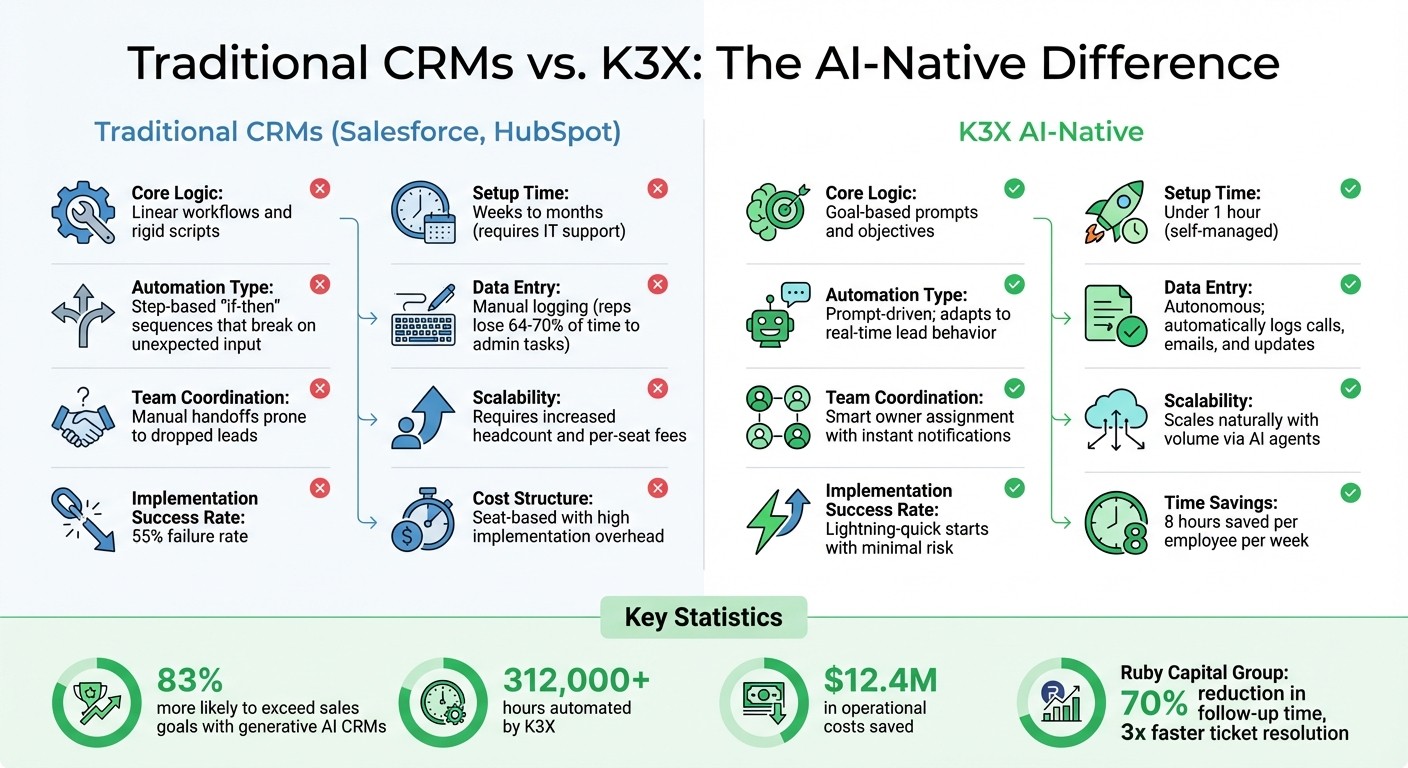
K3X vs Traditional CRM Systems: Feature Comparison
Key Differences in Execution and Automation
Traditional CRMs, like Salesforce and HubSpot, primarily serve as record-keeping tools, documenting events after they happen. In contrast, AI-native platforms such as K3X act as execution engines, focusing on business outcomes and taking proactive steps to achieve them. This fundamental difference impacts how teams operate: sales reps using traditional CRMs dedicate only 28% of their time to actual selling, with the rest consumed by manual data entry and administrative tasks. K3X changes the game by automating repetitive tasks - logging calls, updating pipelines, and managing follow-ups - without requiring human input.
Another key distinction lies in workflow design. Traditional CRMs rely on fixed, step-by-step workflows that can easily falter when unexpected scenarios arise. On the other hand, K3X employs prompt-driven execution, where users set a goal - like "Book a demo with every unresponsive lead" - and the AI dynamically determines and adjusts the necessary steps based on real-time lead behavior.
"Most CRMs record activity. K3X understands outcomes. It listens, knows what changed, and makes the next moves." - Mykyta Samusiev, Co-Founder & CEO, K3X
The implementation process further highlights the differences. Traditional CRMs often come with a 55% failure rate in deployments, requiring weeks or even months to set up, along with IT support and external consultants. In contrast, K3X can be up and running in less than an hour, with no technical expertise needed.
Cost structures also differ significantly. Traditional CRMs typically charge per seat, which can limit accessibility and create data silos. K3X uses usage-based pricing, scaling with demand. Over five years, license fees for traditional CRMs account for only 30-40% of total costs, with the remainder spent on implementation, training, and customization. K3X starts at $20 per seat per month, offering flexible scaling to match seasonal demand, so businesses aren’t stuck paying for unused capacity.
These contrasts showcase how K3X’s adaptive, outcome-focused approach streamlines operations and enhances team productivity. The table below provides a side-by-side comparison of K3X and traditional CRMs.
Comparison Table: K3X vs. Workflow-Heavy CRMs
Feature | Traditional CRMs (Salesforce, HubSpot) | K3X (AI-Native) |
|---|---|---|
Core Logic | Linear workflows and rigid scripts | Goal-based prompts and objectives |
Setup Time | Weeks to months; requires IT support and external consultants | Under an hour; self-managed |
Automation Type | Step-based "if-then" sequences that break on unexpected input | Prompt-driven; adapts to real-time lead behavior |
Data Entry | Manual logging; reps lose 64-70% of time to admin tasks | Autonomous; automatically logs calls, emails, and updates |
Team Coordination | Manual handoffs prone to dropped leads | Smart owner assignment with instant notifications |
Scalability | Requires increased headcount and per-seat fees | Scales naturally with volume via AI agents |
Implementation Success Rate | 55% failure rate | Lightning-quick starts with minimal risk |
Cost Structure | Seat-based; high implementation overhead | Usage-based; adaptive pricing |
Research shows that companies leveraging CRMs with generative AI are 83% more likely to exceed their sales goals. However, this advantage only materializes when the platform is designed around achieving outcomes rather than retrofitting AI onto older systems. K3X users report saving an average of 8 hours per week per employee, freeing up time to focus on closing deals and nurturing client relationships. These distinctions directly influence how organizations align their teams with business goals and sustain long-term success.
Measuring ROI and Continuous Improvement in K3X
Tracking ROI with AI Tools
K3X takes a fresh approach to ROI tracking by focusing on outcomes rather than simply tallying tasks. While traditional CRMs often emphasize activities like calls or emails, they fall short of showing whether those efforts hit revenue goals. K3X flips the script, spotlighting results: which deals advanced, which leads converted, and how much time was saved in the process.
The platform includes an ROI calculator that digs deeper, measuring direct labor costs, hours saved, and operational expenses reduced through automation. It highlights an often-overlooked reality: manual work can cost 20–30% more than direct labor alone when you factor in errors and lost productivity.
K3X also offers a real-time dashboard packed with live data on deal progress, activity summaries, and transparent performance metrics. With its Performance Insights feature, managers can pinpoint exactly where deals are stalling, making it easier to adjust strategies on the fly. Users have reported impressive results: a 92% improvement in report-generation efficiency and 99.8% compliance accuracy thanks to K3X's automation tools.
These measurable ROI metrics not only showcase K3X's effectiveness but also demonstrate its ability to evolve and refine processes for even greater efficiency over time.
Continuous Process Improvement
K3X isn't just about executing tasks; it’s designed to learn and adapt alongside your team. By observing user habits, workflows, and patterns, the platform fine-tunes its processes automatically - no need for manual updates. A simple prompt, like adjusting a goal or changing assignment logic, triggers instant adaptation without disrupting ongoing workflows.
"K3X adapts to your habits, workflows, and patterns in real time." – Sophie Bergman, Head of Client Solutions, K3X
To maintain momentum, daily use of the Performance Insights feature is key. This tool helps identify pipeline bottlenecks where deals often stall. For example, setting specific prompts like “Book demo calls with every lead who hasn’t responded” enables the AI to optimize actions toward achieving those goals. By keeping an eye on the live dashboard, teams can make real-time adjustments to assignments and workflows as market conditions shift.
The payoff for consistent tracking is clear. Companies that closely monitor automation outcomes are 1.7x more likely to report meaningful financial gains. Additionally, when automation is fine-tuned at the interaction level, operational costs can drop by 20–30%. Moving beyond vanity metrics like email counts and focusing on lagging indicators - such as win rate improvements, shorter sales cycles, and revenue directly attributed to AI - offers a sharper view of what truly drives business growth.
Conclusion
AI-driven goal alignment isn't just about setting objectives - it’s about creating a system where strategy connects directly to daily actions. Traditional CRMs often treat goals as static checkboxes, reviewed every few months. In contrast, AI-native platforms like K3X turn these goals into dynamic, real-time signals that guide actions continuously.
With prompt-driven execution at its core, K3X ensures real-time adjustments that elevate team performance. Unlike workflow-heavy systems, it focuses on achieving specific outcomes and adapts automatically. The efficiency gains seen in earlier examples highlight the power of this approach.
Real-time monitoring changes the game. When only 26% of employees understand how their work aligns with company goals, having instant visibility becomes a game-changer. Real-time insights allow for immediate course corrections, identifying bottlenecks and misalignments as they happen - not weeks later in a report. Companies using continuous feedback systems report 40% higher employee engagement and a 26% boost in performance, far surpassing the results of traditional annual reviews.
The results are undeniable. For instance, Ruby Capital Group cut follow-up times by 70% within two days of adopting K3X’s AI-driven agents in December 2025. Similarly, PTC generated $18 million in new pipeline over just four months by combining intent signals with automated execution. These successes emphasize what truly matters: revenue growth, faster sales cycles, and higher win rates - not superficial metrics like email counts.
"We're building a CRM that works the way people expect it to, not through menus, workflows, or complexity, but through intention. You tell it the outcome. The system figures out the work." – Mykyta Samusiev, Founder & CEO, K3X
This shift from static processes to dynamic systems not only simplifies operations but also ensures continuous alignment across teams. By adopting AI-native tools like K3X, organizations can achieve a fully aligned, results-driven operation with ease.
FAQs
How do I start AI-driven goal alignment without disrupting current workflows?
To begin, set clear and measurable objectives that directly tie into your team’s and business’s broader goals. Tools like K3X can simplify this process by replacing inflexible workflows with intuitive, prompt-based interactions. This approach reduces disruptions by automating repetitive tasks such as follow-ups, updates, and team coordination. Make it a habit to regularly evaluate and tweak these objectives to ensure they remain aligned with your business’s changing needs.
What data does K3X need to turn vague goals into measurable outcomes?
K3X thrives on clear, specific, and measurable goals. Pair these with relevant KPIs and historical performance data, and the platform can turn abstract objectives into actionable outcomes. This approach ensures everything stays aligned with your business priorities, making your goals both achievable and strategic.
How do we measure ROI from AI goal alignment in the first 30 days?
To gauge ROI from AI goal alignment within the first 30 days, it's crucial to monitor both leading and lagging indicators. Keep an eye on metrics such as AI adoption rates, improvements in key performance indicators (like response times and lead conversions), and the percentage of tasks automated. Tools like K3X can help track outcome-focused KPIs, including follow-up efficiency and overall team productivity. Pair these data points with user feedback to assess early progress and build a case for further investment.