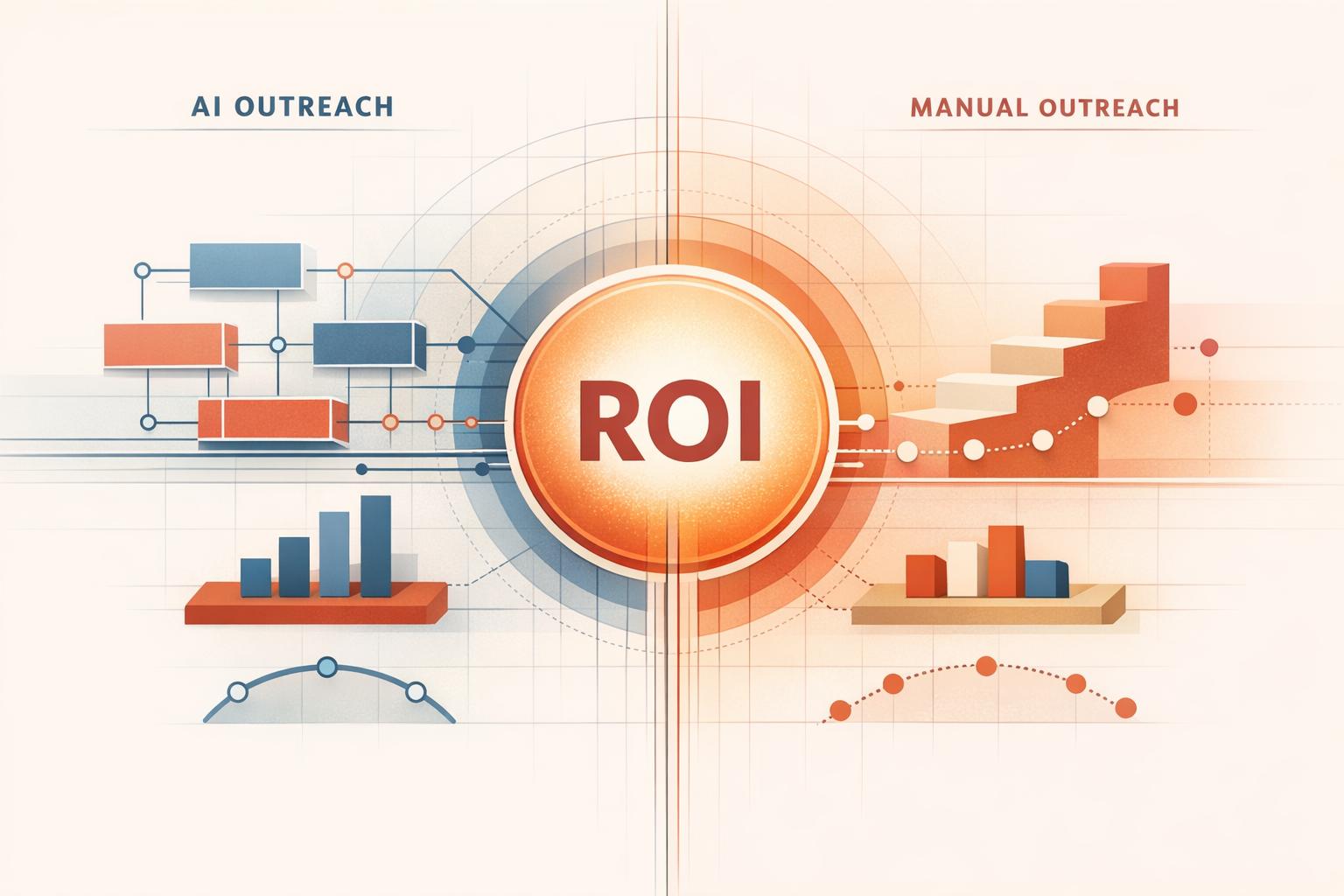

Compare costs, reply rates, and sales-cycle impact of AI vs manual LinkedIn outreach to determine the best ROI mix.
AI-powered LinkedIn outreach is cheaper, faster, and more efficient than manual methods, but manual outreach excels in personalization for high-value deals. Here's what you need to know:
AI Outreach Costs Less: AI reduces the cost per qualified lead to $14, compared to $1,500 for manual outreach.
Efficiency: AI handles 500–1,000+ prospects weekly, while manual methods are limited to 150–250 prospects.
Response Rates: Manual outreach can achieve 15–25% reply rates with personalization, while advanced AI reaches 8–12%.
Speed: AI shortens sales cycles to 20–30 days, compared to 35–45 days for manual outreach.
Scalability: AI manages large volumes effortlessly, while manual methods are constrained by time and team size.
Quick Comparison:
Factor | Manual Outreach | AI-Driven Outreach |
|---|---|---|
Cost per Lead | $1,500 | $14 |
Prospect Volume | 150–250/week | 500–1,000+/week |
Reply Rate | 15–25% | 8–12% |
Sales Cycle | 35–45 days | 20–30 days |
Key takeaway: Use AI for efficiency and cost savings, but reserve manual outreach for high-value, relationship-driven deals. Combining both methods can maximize results.
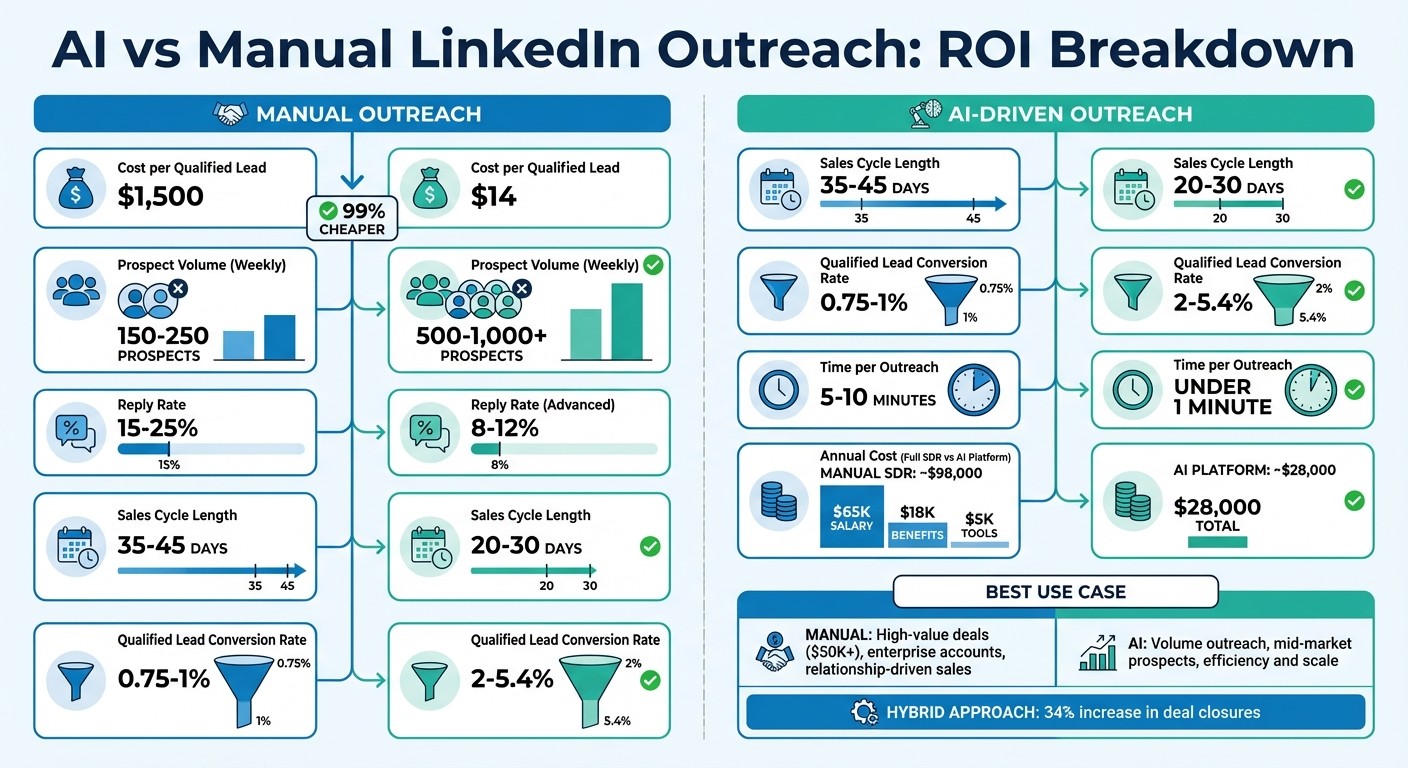
AI vs Manual LinkedIn Outreach ROI Comparison
Manual LinkedIn Outreach: What You Need to Know
Manual LinkedIn outreach involves sending personalized messages to individual prospects, carefully crafted to resonate with them. When done well, this approach stands out in a sea of generic digital communication, as prospects appreciate the effort and personal touch.
However, many teams rely on templates with only minor adjustments. While crafting each message can take 15–20 minutes, relying too heavily on templates can dilute authenticity. This raises a critical question: can your team sustain the time and effort needed for meaningful personalization?
Advantages of Manual Outreach
Manual outreach shines when it comes to building trust and fostering deeper connections. This approach often works best for high-value prospects, as personalized messages tend to elicit better responses than automated sequences. It’s particularly effective for enterprise deals exceeding $50,000 or industries like consulting, where relationships are key.
Another major strength of manual outreach is its flexibility. Salespeople can adapt their messaging in real time based on a prospect's tone or response, helping to nurture the relationship. For high-stakes deals - say, a $500,000 contract - spending extra time on research and highly personalized communication can pay off significantly.
There’s also the benefit of compliance. Manual outreach aligns with LinkedIn's terms of service, eliminating the risk of account suspension. Automated tools, on the other hand, can face filtering rates as high as 15–40%. When done right, manual outreach boasts response rates of 4–7%. And by leveraging personalization techniques - like referencing a prospect’s recent job change or company funding news - response rates can soar to 15–25%.
Despite these advantages, scaling manual outreach remains a tough hurdle.
Drawbacks of Manual Methods
The biggest challenge with manual outreach is scalability. A salesperson can only manage 30–50 prospects daily, which translates to 12–15 hours a week for just 50 prospects. As workloads grow, repetitive tasks can lead to burnout and reduced quality.
The time investment is steep. Each prospect requires 15–20 minutes of research, drafting, and sending. On top of that, salespeople lose 4–6 hours weekly to these repetitive tasks. This adds up financially, with manual outreach costing around $1,500 per qualified lead, compared to roughly $14 per lead using AI-driven methods.
Follow-up consistency is another issue. Research shows that 44% of salespeople stop after one follow-up, even though 80% of sales require at least five attempts. Manual processes also increase the risk of CRM errors, which can cost companies thousands of dollars each month. CRM data managed manually can degrade by 34% annually, with inaccuracies reaching up to 80%. These inefficiencies often stretch the sales cycle to 35–45 days, compared to 20–30 days with automated tools.
AI-Driven LinkedIn Outreach: How It Works
AI-powered outreach has redefined how businesses connect with prospects. Instead of spending countless hours researching and drafting messages, AI platforms now handle tasks like connection requests, follow-ups, and personalized communication at a scale no human team could achieve. These platforms analyze 75+ data points per prospect - including job titles, company size, recent news, and mutual connections - to craft messages that feel personal and relevant.
What makes these tools stand out is their reliance on goal-driven prompts. Instead of building complicated "if-then" workflows, platforms like K3X let you set a clear objective - such as "Book demo calls with all non-responsive leads" - and the AI takes care of the rest, determining the best approach on its own.
How AI Automates Outreach
AI outreach platforms blend automation with adaptive decision-making. Unlike static tools that follow rigid scripts, these systems adjust strategies in real time. For instance, if a prospect opens several emails without responding, the AI may switch tactics by offering a direct meeting link instead of sending more educational content.
These platforms manage everything from sending initial connection requests to executing complex follow-up sequences. Take K3X as an example - it automatically logs emails, updates contact records, and organizes pipeline stages without needing additional integrations. This eliminates the time-consuming tasks of manual data entry and copy-pasting, which typically eat up about 8 hours per week for sales teams. With those hours freed up, teams can focus on activities that directly drive revenue.
AI platforms also operate around the clock, delivering near-instant responses. This is a game-changer because leads contacted within five minutes are 21 times more likely to convert. Unlike manual outreach, which is limited by working hours and competing demands, AI ensures consistent and timely engagement, giving businesses a real edge in speed and efficiency.
Advantages of AI Outreach
AI outreach offers clear advantages in terms of scale and efficiency. While manual outreach is limited by time and resources, AI can manage hundreds - or even thousands - of contacts at once. This capability boosts efficiency by 70–90%, compared to the 40–60% typically achieved with traditional automation.
The benefits don’t stop there. Sales teams using AI close deals 23% faster than those relying on manual processes. Research time per prospect plummets from 20 minutes to just 2 minutes. Platforms like K3X also help companies save an average of 8 hours per employee each week.
AI outreach is also much more cost-effective. Manual outreach can cost around $1,500 per qualified lead in labor, while AI automation can reduce that figure to just $14 per lead. Businesses report an average ROI of 171%, with some seeing returns as high as 410%.
Another major advantage is improved response rates. AI-driven personalization leads to response rates of 8–12%, compared to just 2–3% with generic automation. Using authority-led tactics - where the AI engages prospects on social platforms before messaging - response rates can climb even higher, reaching 15–22%.
"Most CRMs record activity. K3X understands outcomes. It listens, knows what changed, and makes the next moves." - Mykyta Samusiev, Co-Founder & CEO, K3X
Drawbacks of AI Outreach
Despite its many benefits, AI outreach isn’t without challenges. One common hurdle is the learning curve. Even with user-friendly platforms like K3X, there’s an initial setup period where the system must adapt to your business practices and messaging style. This requires some upfront effort to ensure the AI aligns with your brand voice and targets the right audience.
Another concern is message quality. While AI-generated messages are based on extensive data, they can sometimes miss the mark in tone or accuracy. To avoid these pitfalls, it’s essential to implement a thorough QA process before scaling any outreach campaign. Ensuring proper tone consistency and configuring deliverability protocols (like SPF, DKIM, and DMARC) can help maintain credibility.
Finally, account safety is a key consideration. High-quality AI tools that respect LinkedIn’s rate limits - typically 10–20 messages per day - maintain filtering rates of just 5–10%, comparable to manual outreach. However, poorly configured automation can lead to account suspensions. To avoid this, choose platforms that use authenticated APIs and replicate human-like pacing rather than sending out large volumes of messages at once.
ROI Comparison: Manual vs AI-Driven Outreach
Looking at the numbers, it's clear that the choice between manual and AI-driven outreach boils down to balancing efficiency and cost savings for your business.
Efficiency and Scale
Manual outreach has its limits. A single sales rep can realistically handle 30–50 prospects daily, dedicating 5–10 minutes to researching and personalizing each message. That adds up to about 150–250 prospects per week at full capacity. On the other hand, AI-driven platforms can process 500–1,000+ prospects weekly, completing each outreach in seconds rather than minutes. The difference in scale is striking - manual methods are restricted by team size, while AI can scale almost infinitely.
Factor | Manual Outreach | AI-Driven Outreach |
|---|---|---|
Prospect Volume | 30–50 daily / 150–250 weekly | 500–1,000+ weekly |
Time per Outreach | 5–10 minutes | Under 1 minute |
Scalability | Limited by headcount | Virtually unlimited |
Cost Breakdown
The cost comparison is equally revealing. A fully loaded sales development representative (SDR) comes with an annual price tag of about $98,000. Meanwhile, AI platforms like K3X cost between $480 and $3,120 annually (based on $20 per seat/month for 2–13 users). Even high-end enterprise AI solutions range from $12,000 to $28,000 per year, which is still far less than the expense of human labor.
Line Item | Human SDR (Manual) | AI SDR Platform |
|---|---|---|
Base Salary / Fee | $65,000 | $12,000–$24,000 |
Benefits & Taxes | $18,000 | $0 |
Tools & Tech Stack | $5,000 | Included |
Total Annual Cost | ~$98,000 | ~$28,000 |
Response Rates and Conversions
Response rates tell an interesting story. Manual outreach, when paired with signal-based personalization (like targeting prospects after job changes or funding news), achieves 15–25% reply rates. Standard AI campaigns typically see 5–10% response rates, but advanced AI with variable-based personalization can push that to 8–12%. AI that incorporates authority-driven tactics - such as engaging with a prospect's content before messaging - can even match manual reply rates at 15–22%.
Where AI truly shines is in converting leads and speeding up the sales process. AI-driven campaigns boast a 2–5.4% qualified lead conversion rate, compared to manual outreach's 0.75–1%. Additionally, AI shortens the sales cycle from 35–45 days to 20–30 days, reducing time-to-close by 18% - a direct boost to revenue.
Metric | Manual Outreach | AI-Driven Outreach |
|---|---|---|
Reply Rate | 15–25% | 8–12% (advanced AI) |
Qualified Lead Rate | 0.75–1% | 2–5.4% |
Sales Cycle Length | 35–45 days | 20–30 days |
These figures explain why many businesses are adopting a hybrid strategy, combining the strengths of AI-driven tools with the personal touch of manual outreach to maximize their ROI.
Combining AI and Manual Outreach for Better ROI
Merging AI with manual outreach creates a powerful strategy that amplifies the strengths of each method. Sales teams using this hybrid approach see impressive results, with a 34% increase in deal closures compared to teams relying solely on manual efforts. The key? Leveraging AI for efficiency while reserving manual outreach for meaningful, high-value interactions.
Using K3X for Top-of-Funnel Automation

K3X simplifies the early stages of outreach, saving your team hours of repetitive work. Instead of setting up intricate "if-then" workflows, you just specify the outcomes you want - like “Schedule demo calls with unresponsive leads” - and K3X handles the rest.
Take Ruby Capital Group as an example. By using K3X, they streamlined lead qualification and follow-ups, achieving record-breaking close rates. The platform automates lead qualification, contract routing, and pipeline updates, freeing up your team to focus on strategic initiatives. This outcome-driven automation eliminates the need to map every scenario, ensuring no lead is overlooked.
K3X also delivers measurable time and cost savings. On average, it saves 8 hours per employee each week. At just $20 per user per month, it boasts an average ROI of 171%, with some implementations reaching as high as 410%. Beyond saving time, K3X ensures smoother team collaboration by automating handoffs and keeping pipelines up to date, creating space for meaningful human engagement.
Balancing Volume and Personalization
This approach strikes the perfect balance between scaling outreach and maintaining a personal touch. AI can handle outreach to 50–100 new prospects weekly through automated sequences. Once a prospect shows interest or when targeting high-value accounts, manual outreach takes over. This method drastically reduces the time spent on research, allowing sales teams to focus on more impactful interactions. AI drafts messages using over 75 data points, while human reps fine-tune and send them, increasing engagement rates by 35%.
For enterprise-level accounts and C-suite interactions, manual outreach is essential for building trust and navigating complex negotiations. On the other hand, AI excels with mid-market prospects, crafting messages that feel as genuine as hand-written ones. This hybrid approach scales outreach without sacrificing authenticity.
The benefits don’t stop there. By combining AI-driven sequences with manual touches, companies shorten sales cycles by 18%, reducing the timeline from 35–45 days to just 20–30 days. This frees up reps to focus on high-value activities like nurturing warm referrals, deepening relationships, and managing complex deals, while AI efficiently handles routine tasks like follow-ups and administrative work.
Conclusion: Picking the Right Outreach Method
When it comes to choosing the best outreach method, the decision ultimately hinges on your specific sales goals and operational needs. Whether you opt for AI-driven automation or manual LinkedIn outreach depends on factors like deal size, team bandwidth, and the volume of leads. For enterprise accounts valued at $50,000 or more, manual outreach remains crucial for establishing the trust required to close high-stakes deals. In other cases, AI-powered tools often provide a better return on investment.
The cost benefits of AI automation are hard to ignore. Platforms like K3X, priced at just $20 per seat per month, can save an average of 8 hours per employee every week. To date, K3X has automated more than 312,000 hours of work and cut $12.4 million in operational costs for its users.
K3X stands out because of its focus on outcomes rather than rigid workflows. Instead of relying on complicated "if-then" logic that can falter when leads behave unpredictably, you simply instruct K3X on your desired results - like "Schedule demo calls with non-responders" - and it takes care of the rest. This approach delivers efficiency gains of 70–90%, far exceeding the 40–60% typically achieved by static automation systems.
"Most CRMs record activity. K3X understands outcomes. It listens, knows what changed, and makes the next moves."
Mykyta Samusiev, Co-Founder & CEO, K3X
For teams managing a high volume of leads with limited staff, K3X offers a quick and scalable solution. The platform can be set up in under an hour and includes unlimited automation, integrated email and calling features, and a built-in power dialer. It eliminates the headaches of traditional CRMs, allowing teams to focus more on strategy and less on repetitive tasks. By aligning your outreach strategy with these tools, you can boost your sales efficiency and achieve better results.
FAQs
When should I use manual outreach instead of AI on LinkedIn?
Manual outreach works best for high-value prospects who need a personal touch. Why? It delivers higher response rates (15–25%) and acceptance rates (40–60%), builds trust, and excels in handling complex or sensitive discussions. On the other hand, AI shines when it comes to scaling efforts and tackling initial prospecting, though its response rates are lower (5–10%).
The smart move? Combine both approaches. Use AI to handle the volume and identify potential leads, then focus manual efforts on nurturing key prospects. This way, you can strike the right balance between efficiency and meaningful engagement, ensuring a better return on investment.
How can I keep AI outreach compliant and protect my LinkedIn account?
To keep your LinkedIn account safe and compliant, stick to automation tools that align with platform policies and imitate natural human activity. Prioritize personalized outreach, keep your activity levels moderate, and steer clear of anything that might come across as spam. It's also a good idea to keep an eye on your engagement metrics and tweak your approach as necessary. Tools like K3X can be helpful by adjusting to user behavior in smart ways, minimizing risks, and ensuring compliance while improving your outreach strategy.
What’s the best hybrid workflow to combine AI volume with human personalization?
The most effective hybrid workflow combines AI for high-volume prospecting and outreach with human expertise for more nuanced, high-value interactions. AI excels at scaling outreach efforts, even adding personalized touches at scale. Meanwhile, human agents step in for tasks like complex negotiations and building genuine relationships. Tools such as K3X make this approach seamless by automating repetitive tasks, allowing teams to dedicate their energy to closing deals and creating meaningful connections.