
AI timing delivers significant ROI when you measure baselines, account for hidden costs, and monitor performance in real time.
AI timing boosts engagement and revenue by delivering messages at the right moment. Companies using AI-driven systems see higher conversions, faster lead responses, and reduced costs compared to manual processes. For example, automating email send times increased order rates by 10% for Shady Rays in early 2026. To measure ROI effectively, follow these steps:
Set Baseline Metrics: Track engagement (open rates, CTR), conversions, timing (response time, interaction time), and financial benchmarks (revenue per notification).
Calculate Costs: Include software fees, data preparation, integration, and training expenses.
Measure Improvements: Compare pre- and post-AI metrics like response time, conversion rates, and time-to-conversion.
Calculate ROI: Use the formula: ROI = ((Net Benefits – Costs) / Costs) × 100.
Monitor and Refine: Use real-time dashboards to track performance and adjust strategies regularly.
For example, a company saving 8 hours per week per employee and increasing conversions by 5% could achieve an ROI of over 11,000% in under 60 days. Platforms like K3X simplify this process by automating workflows and providing real-time insights.
Key takeaway: AI timing improves efficiency, reduces costs, and drives revenue - but only if you measure, monitor, and optimize consistently.
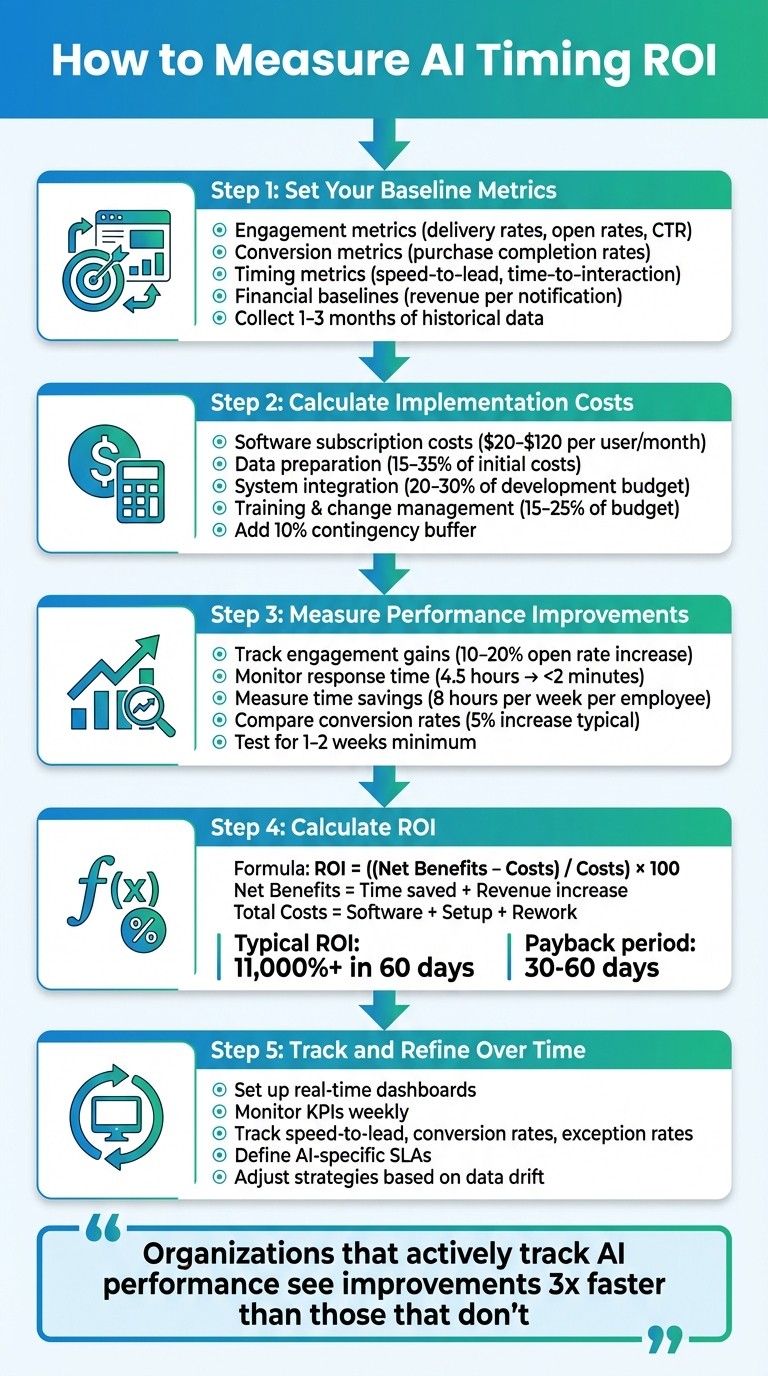
5-Step Process to Measure AI Timing ROI
Ep 725: Measuring AI ROI: Why you’re doing it wrong and the 7 Steps to fix it (Start Here Series ...
Step 1: Set Your Baseline Metrics
Precise timing can directly impact revenue, so the first step is to establish clear baseline metrics. By documenting your current performance, you’ll have a solid foundation to measure how AI improves timing and delivers measurable results. Without these benchmarks, it’s nearly impossible to prove the value AI brings to the table.
Choose the Right Metrics
Focus on metrics that tie directly to revenue. Here are some key areas to track:
Engagement metrics: These include delivery rates, open rates, and click-through rates (CTR). They help you understand how many notifications actually reach users and drive actions. For example, Android users average a 5.4% CTR, while iOS users average 4.9%.
Conversion metrics: Measure the percentage of users who complete a desired action - like making a purchase or booking a demo - after receiving a notification.
Timing metrics: Record your current "speed-to-lead" (how quickly you respond to inbound interest) and "time-to-interaction" (how long it takes users to engage). AI systems aim for response times under 2 minutes, a big improvement over the traditional average of 4.5 hours.
Financial baselines: Track revenue per notification and the labor hours your team spends on manual scheduling and follow-ups.
Once you’ve identified these metrics, the next step is to back them up with real data.
Collect Historical Data
To set accurate benchmarks, gather 1–3 months of CRM data to track conversion rates, errors, and lead performance. Additionally, monitor your current performance in real-time for 2–4 weeks before introducing AI. This combination of historical data and recent observations provides a complete picture of both long-term trends and current performance.
Make sure your tracking systems are up to date and accurately capturing all touchpoints. If internal data is limited, you can reference reliable industry research for initial estimates. However, prioritize your own data whenever possible, as it’s the most relevant to your business.
Step 2: Calculate Implementation Costs
Once you've established your baseline metrics, it's time to figure out the costs of integrating AI into your operations. A surprising 83% of businesses miscalculate ROI because they fail to account for hidden expenses like integration time and data preparation. To avoid falling into this trap, you need to consider both the obvious subscription fees and the less apparent costs that can quickly pile up.
Software Subscription Costs
Start by evaluating your software subscription fees before diving into the hidden expenses. These fees are often the most straightforward part of the budget. For example, K3X's Adaptive plan costs $20 per month per seat and includes AI credits, offering a budget-friendly option. By contrast, traditional sales engagement platforms average $71 per user per month, while enterprise-level CRM systems typically range from $100 to $120 per user per month and often require a minimum number of users.
But subscription fees are only part of the story. If you're using credit-based AI models, monitor your weekly usage closely to avoid surprise charges. There's also the "API and cloud tax" to consider - these variable costs can fluctuate unpredictably, unlike the fixed fees of traditional CRM systems. With global AI spending expected to surpass $300 billion by 2026, these hidden costs are becoming more relevant than ever.
Setup and Integration Costs
The real budget-busters often lie in setup and integration. Data preparation alone can eat up 15–35% of your initial development costs. Breaking it down further, cleaning your data typically accounts for 15–20% of total costs, while updating legacy systems can take up 25–35%.
System integration adds another layer of complexity. For example, connecting AI-powered timing solutions to existing CRMs often consumes 20–30% of your development budget. On top of that, don't overlook the costs of change management and employee training, which can take up an additional 15–25% of your total implementation budget.
These overlooked expenses can lead to significant budget overruns:
"The gap between what finance approved and what operations actually spent... is consistently 5 to 40 times wider than the initial estimate".
Yugank Aman, Enterprise AI Specialist
To stay on the safe side, include a 10% contingency in your budget to cover unexpected scope creep or technical issues. A tool that starts at $99 per month can quickly balloon to $847 per month once internal setup costs are factored in.
Step 3: Measure Performance Improvements
Once you've calculated your implementation costs, the next step is to determine whether AI-driven timing is delivering results. The best way to do this is by comparing your baseline metrics with the actual performance data after AI is in place. Without proper testing, understanding your ROI will be nearly impossible.
Track Performance Gains
Start by documenting changes in key engagement metrics. For instance, AI-driven timing has been shown to boost open rates by 10–20% and double reply rates from 1–5% to 5–10%. A great example comes from Shady Rays, a premium sunglasses brand. In January 2026, they used Klaviyo's AI-powered personalized send time for over 30 email campaigns. The result? A 10% increase in placed order rates and significant time saved by eliminating the need for manual scheduling.
Beyond tracking opens and clicks, it's also important to monitor response quality. This includes metrics like interest levels and opt-outs, which provide insights into how well your timing strategy is resonating. AI timing can even shorten your sales cycle, reducing the time it takes to move from initial contact to a qualified opportunity. Instead of the traditional 15–30 days, AI can cut this down to just 5–12 days. This acceleration not only improves efficiency but also increases revenue velocity. Once you've tracked these gains, the next step is to measure the time saved.
Measure Time Savings
The efficiency improvements from AI can be quantified in terms of time saved. To do this, subtract the time AI takes to handle a task from the time it would take manually, then multiply the saved hours by your team's hourly rate. For example, in late 2025, a Katy HVAC contractor automated their lead response process. This reduced their average response time from 4.5 hours to under 2 minutes and boosted their conversion rate by 8%, resulting in an additional $28,800 in annual revenue.
AI can also save professionals a significant amount of time - often reclaiming an entire workday (around 8 hours) each week. This frees up about 20% of your team's time, which can then be redirected toward higher-value tasks like closing deals or nurturing leads.
Before and After Comparison
A simple comparison table can help you visualize the improvements AI brings. Here's an example of the kind of gains you might see when shifting from manual processes to AI-optimized timing:
Metric | Manual | AI-Driven | Improvement % |
|---|---|---|---|
Lead Response Time | 4.5 hours | < 2 minutes | ~99% |
Cold Reply Rate | 1–5% | 5–10% | 50–100% |
Email Click Rate | Standard rate | +35% over control | 35% |
Time-to-Conversion | 15–30 days | 5–12 days | 50–60% |
Cost Per Lead (B2B) | $50–$150 | $15–$45 | 70% reduction |
Run your tests for 1–2 weeks or until you reach statistical significance. Generally, you'll need about 3,800–4,000 sends per variant to detect a 20% lift with 95% confidence. Avoid testing during periods like holiday weeks or the end of a quarter, as these times can introduce inconsistencies that skew results.
This kind of clear comparison underscores how AI-driven timing, offered by platforms like K3X, can outperform traditional scheduling methods.
Step 4: Calculate ROI Using the Standard Formula
Once you've measured your performance gains, it's time to calculate your ROI. Use the formula: ROI = ((Net Benefits – Costs) / Costs) × 100. The trick lies in knowing what to include under "Net Benefits" and "Costs."
For Net Benefits, factor in time saved (calculated as hours reclaimed multiplied by the hourly rate), avoided error costs, and additional revenue from faster lead response times. For Total Costs, include your software subscription fees, setup and integration expenses, and any time spent by your team on reviewing or correcting AI outputs - often referred to as "rework costs".
K3X ROI Example

K3X simplifies processes with a prompt-driven approach, eliminating the need for complex workflows. Users simply state their desired outcomes, and K3X handles the rest. This efficiency directly impacts ROI by reducing implementation costs and ongoing workflow management. Unlike traditional, schedule-driven CRMs, K3X's method accelerates ROI significantly.
Take the case of Ruby Capital Group, a funding company with 125 employees that adopted K3X's AI-driven agents in December 2025. Within just two days of setup, they achieved a 70% reduction in time spent on follow-ups and tripled their ticket resolution speed. CEO Michael Chkechkov highlighted how the system managed tasks like lead qualification and contract routing, freeing the sales team to focus on closing deals. On average, K3X users save 8 hours per week per employee, and companies using the platform have collectively eliminated $12.4 million in operational costs.
Sample ROI Calculation
Let’s look at a B2B firm with 10 sales reps using K3X. The platform costs $20 per seat monthly, totaling $2,400 annually, with an additional $2,000 setup fee. That brings the first-year costs to $4,400.
Each sales rep saves 8 hours per week on tasks like manual follow-ups, data entry, and pipeline updates. With a fully loaded hourly rate of $50 (including benefits and overhead), this translates to $400 per week per rep, or $208,000 annually for the team. By cutting lead response time from 4 hours to under 2 minutes, the firm also sees a 5 percentage point increase in conversion rates. With 60 leads per month and an average deal value of $8,000, this improvement generates an additional $288,000 in annual revenue.
Calculation:
Net Benefits = $208,000 (time savings) + $288,000 (revenue increase) = $496,000.
ROI = (($496,000 - $4,400) / $4,400) × 100 = 11,172%.
The payback period is under 4 days, and most small businesses achieve full ROI from AI automation within 30–60 days. This rapid return reflects the growing shift toward AI automation for delivering immediate results.
"The ROI was immediate. Our project managers were drowning in reporting work. Now they spend their time on client relationships."
Jennifer Wu, Director of Operations
Step 5: Track and Refine Over Time
Calculating ROI once won’t cut it. Building on the insights from Step 4, you’ll need to monitor performance continuously to keep everything running smoothly. AI timing strategies thrive on real-time monitoring to maintain efficiency and prevent small issues from snowballing into major setbacks. Unlike older systems that rely on periodic checks, AI demands constant oversight of inputs, outputs, and system behavior. This proactive approach helps catch problems like model drift early, saving significant time - issues resolved without proper monitoring can take three to five times longer to fix.
Monitor Performance Metrics
Set up real-time dashboards to track essential KPIs and address performance drifts before they become costly. These dashboards should focus on metrics like speed-to-lead, conversion rates, response quality scores, and exception rates (how often AI needs human intervention). High exception rates often point to weak logic or poor data, signaling it’s time for adjustments to avoid revenue loss. Instead of just tracking notifications, concentrate on actual outcomes - like meetings booked and deals closed. Reviewing KPIs weekly ensures you can tweak your timing strategies before they negatively impact results.
Define AI-specific SLAs to set acceptable standards for latency, accuracy, and reliability. Keep an eye on cost efficiency by monitoring token usage and compute expenses per successful output, so API costs don’t spiral out of control. Advanced systems should also track data drift (changes in input data) and concept drift (shifts in the relationship between inputs and outputs) to determine when retraining the AI is necessary.
K3X vs. Legacy CRM Monitoring
Traditional systems often lag behind when it comes to real-time adjustments, but K3X offers a smarter, prompt-driven alternative. Older CRMs rely on manually constructed reports and delayed data, which slows decision-making. K3X flips the script with live visibility dashboards that provide real-time insights into team activity, deal progress, and productivity. It even eliminates manual data entry by automatically logging emails, calls, and outcomes across over 100 integrated tools.
Feature | Legacy CRM | K3X Advantage |
|---|---|---|
Performance Visibility | Static, delayed reports; requires manual data export and analysis | Business Snapshot: Real-time visibility into team activity, call metrics, and productivity |
Data Logging | Manual note-taking and status updates often lead to gaps and errors | Automated CRM Sync: Automatically logs calls, texts, outcomes, and recordings |
System Adjustments | Requires complex migrations or IT support to update logic | Prompt-Driven Refinement: Adjust goals and logic instantly with simple prompts |
Monitoring Focus | Tracks activity (emails sent, calls made) | Outcome Tracking: Focuses on what changed in the pipeline and suggests next steps |
K3X’s continuous improvement engine learns and adapts to user activity, habits, and behavior patterns in real time. If you need to tweak AI logic, adjust goals, or reassign tasks, you can do it effortlessly using prompts - no need for complex migrations or disrupting workflows. This adaptability keeps your system aligned with your evolving business needs, ensuring ROI growth without the headaches of traditional platforms.
"Most CRMs record activity. K3X understands outcomes. It listens, knows what changed, and makes the next moves."
Mykyta Samusiev, Co-Founder & CEO, K3X
Conclusion
To calculate ROI effectively, follow these straightforward steps: establish baseline performance, account for all costs, and measure improvements in efficiency, quality, and revenue. Use the standard ROI formula to determine your returns, and make it a priority to monitor performance consistently. This helps identify issues early and refine strategies as needed.
The key to success often lies in disciplined measurement. Research shows that organizations that actively track AI performance see improvements three times faster than those that don't. Yet, 56% of CEOs report no measurable ROI from their AI investments due to the absence of proper tracking frameworks.
This is where K3X steps in, simplifying the process by eliminating the manual data entry that traditional CRMs rely on. While older systems only achieve 65% accuracy, K3X automates data capture from emails, calls, and texts with 94% accuracy. Instead of waiting 36 weeks to see measurable ROI with conventional CRMs, AI-powered platforms like K3X deliver results in just 12 weeks. Its real-time dashboards replace outdated static reports, offering instant insights into key metrics like meetings booked, deals closed, and pipeline progress.
"AI ROI measurement must extend beyond simple cost savings to encompass the full spectrum of value creation, including product innovation, market positioning, and sustainable competitive advantage."
Keerok AI Implementation Framework
FAQs
How do I attribute revenue lift to better timing versus other changes?
To connect revenue increases to improved timing, leverage attribution methods like AI-driven models or predictive analytics. These tools dig into customer journeys and delayed effects, helping pinpoint how timing specifically influences outcomes while separating it from other variables.
Using frameworks like the ROI Timing Framework™ can be a game-changer. This approach factors in revenue delays and ongoing contributions, ensuring your results are measured accurately. Pairing these frameworks with baseline tracking allows you to confidently attribute revenue growth to better timing, not unrelated factors.
What’s the minimum data or volume needed to reliably measure timing ROI?
To gauge the return on investment (ROI) of timing improvements effectively, start by collecting baseline data. Focus on metrics like process time, volume, and error rates before introducing AI or automation. After implementation, monitor these same metrics for at least two weeks. This comparison period is crucial for drawing meaningful insights. Consistent tracking ensures you can accurately evaluate how AI impacts timing and identify actionable results.
Which hidden AI costs most often reduce real ROI in practice?
The biggest hidden costs eating into AI's ROI often stem from implementation and adoption-related expenses. While licensing fees are the most obvious upfront cost, expenses like consulting, system integration, employee training, and managing organizational changes can quickly balloon. In fact, these costs can sometimes climb into the hundreds of thousands of dollars within the first year alone.
On top of that, slow or incomplete adoption by staff can further delay the full benefits of AI systems. And let’s not forget the indirect costs - like continuous optimization efforts or the missed opportunities when AI isn’t fully utilized - which quietly chip away at the overall return on investment.