

How AI-driven CRMs cut manual work, improve lead scoring, shorten sales cycles, and reduce operational costs by up to 40%.
AI-powered CRMs can save businesses time and money by automating repetitive tasks, improving lead targeting, and speeding up processes. Here's how they help:
Automation: Tasks like data entry, lead scoring, and follow-ups are handled automatically, saving up to 85% of the time spent on manual work.
Cost Savings: Companies report a 20–40% reduction in expenses, with ROI reaching 245% compared to 145% for older systems.
Faster Setup: While older CRMs take 12 weeks or more to implement, AI-driven platforms like K3X can be ready in as little as 4 weeks.
Better Results: AI tools improve lead scoring accuracy (up to 89%), reduce sales cycle times by 30%, and cut error rates by 40–75%.
Flexible Pricing: Platforms like K3X offer adaptive pricing starting at $20/month, eliminating hidden fees and costly integrations.
Switching to an AI-powered CRM isn't just about saving money - it's about freeing your team to focus on closing deals instead of managing data. With features like predictive analytics and prompt-based controls, these systems streamline workflows and deliver measurable results.
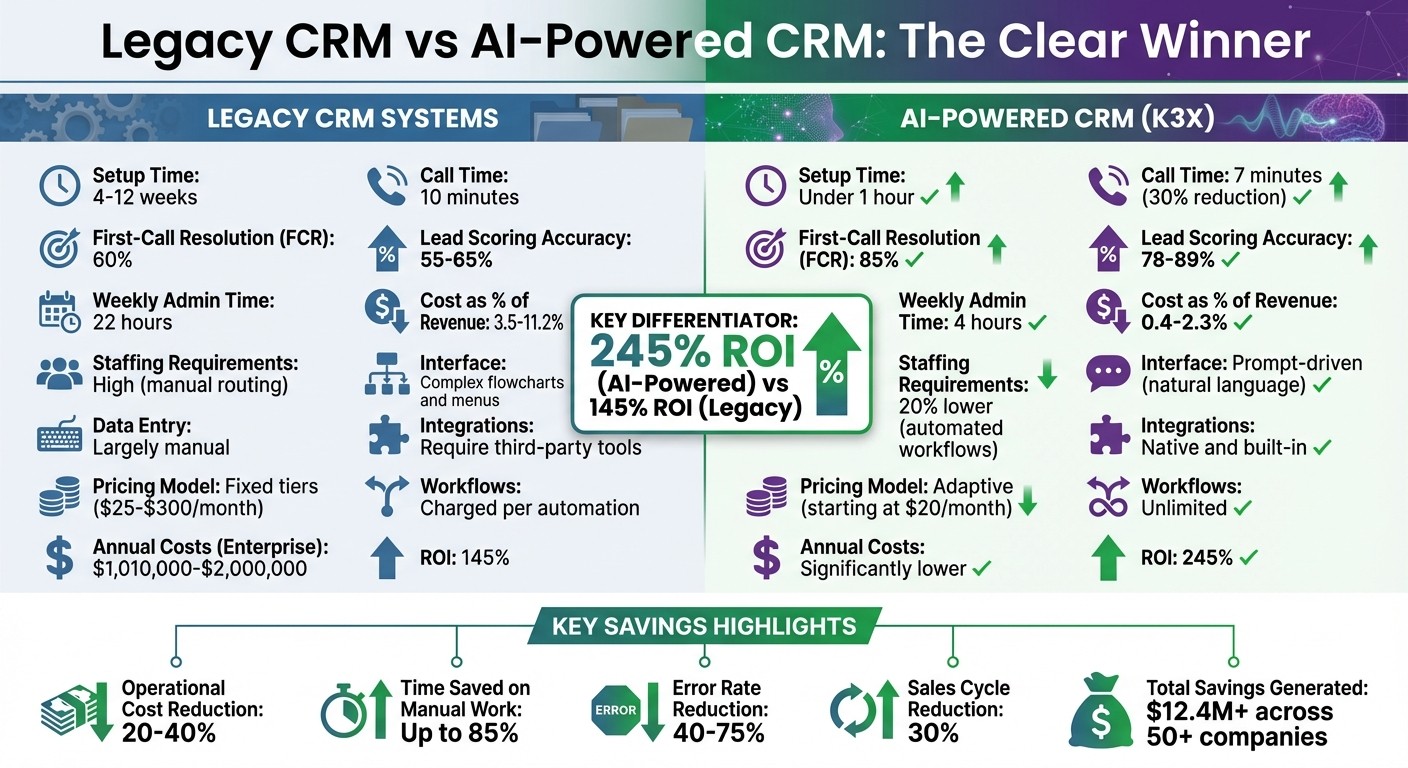
Legacy CRM vs AI-Powered CRM Cost and Performance Comparison
How Greenleaf Built a Custom CRM, Saving Thousands of Dollars
The High Costs of Legacy CRM Systems
Older CRM systems come with hefty price tags, from ongoing maintenance to the time spent on manual tasks. Sales teams often lose between 3 to 6 hours each week on manual data entry - hours that could be better spent closing deals. For a 10-person team, this adds up to about 2,800 hours annually, translating to a staggering $140,000 in lost productivity if you factor in a $50/hour loaded cost. These inefficiencies not only eat into productivity but also drive up operational expenses - problems that AI-powered CRMs aim to solve.
Manual Data Entry Wastes Time
Sales reps spend just 30% of their week actually selling, with the rest swallowed up by administrative work. A whopping 71% of reps say they spend too much time on data entry, and 32% admit to dedicating over an hour daily to these tasks. This constant cycle of routine administrative work not only disrupts their focus but also leads to "dirty data" that can skew revenue forecasts and complicate marketing efforts. To make matters worse, B2B contact data deteriorates at a rate of 30% annually, prompting many reps to resort to unofficial tools like spreadsheets or personal notes. These inefficiencies aren’t just frustrating - they also inflate costs, making the case for AI-driven solutions even stronger.
Setup and Maintenance Expenses
Implementing a traditional CRM system can take up to 12 weeks - or even 6 to 9 months for enterprise versions - compared to just 4 weeks for AI-powered platforms. Annual maintenance and IT support alone can exceed $200,000.
And that’s just the start. Customization often adds 20% to 30% to the overall software cost, while integrations with tools like email, e-commerce, or ERP systems can tack on one-time fees ranging from $5,000 to $60,000. Hiring a full-time CRM administrator? That’s another $80,000 per year. Training costs can also pile up, ranging anywhere from $2,000 to $50,000 depending on the organization’s size. These hidden and recurring expenses highlight why many businesses are turning to AI-driven CRMs as a smarter, more efficient alternative.
How AI-Powered CRMs Automate Work and Cut Costs
AI-powered CRMs are transforming how sales teams operate by automating tedious tasks and cutting down on inefficiencies. Unlike older systems that demand hours of manual input, these advanced platforms handle tasks like logging calls, updating records, and following up with contacts automatically. The impact? Businesses can see operational costs drop by 20–30% on average, with some cases reaching reductions of up to 40%. Using machine learning and robotic process automation, these systems pull data from emails, forms, and other sources to auto-fill CRM records, reducing the time spent on data management by as much as 85%.
The financial benefits are impressive. For instance, a tech startup that teamed up with SuperAGI in June 2025 to implement AI-driven sales solutions saw a 35% cut in operational costs, a 20% reduction in staffing needs, and a 30% shorter sales cycle - all while growing its lead pipeline by 40%. Ruby Capital Group, a funding company with 125 employees, used K3X AI tools to automate follow-ups within two days, saving 70% of the time previously spent on these tasks and tripling the speed of ticket resolutions.
These results stem from two key features: automation for repetitive tasks and intuitive, conversational controls.
Automating Repetitive Work
Sales reps often spend 64% of their time on tasks that don’t directly generate revenue. AI steps in to handle this workload, automating data entry, lead qualification, and follow-up emails. Machine learning algorithms analyze engagement patterns and behavior to score leads, then route the most promising ones to the right representative based on factors like territory and expertise. AI chatbots tackle routine questions, while personalized email and WhatsApp campaigns are triggered automatically based on user actions.
One logistics company introduced a conversational AI agent to handle outbound cold calls around the clock. The result? Four times as many conversations and double the number of booked demos - all without adding staff.
Automation also significantly reduces errors. When manual tasks are replaced with AI processes, error rates drop by 40–75%. These time savings add up across the organization. For example, a Fortune 500 financial services company used conversational AI agents in Slack to cut 2.3 hours of daily administrative work per account executive, boosting deal velocity by 41% in just one quarter.
But automation is only part of the story. AI-powered CRMs also simplify user interactions with intuitive, prompt-based controls.
Simple Prompt-Based Controls
Traditional CRMs can be clunky, requiring users to navigate endless menus and rigid workflows. AI-powered platforms like K3X change the game by letting users manage tasks with simple, conversational prompts. Want to schedule a demo, update your pipeline, or adjust stage rules? Just type what you need in plain English, and the system - using Natural Language Processing - handles the rest.
"Most CRMs record activity. K3X understands outcomes. It listens, knows what changed, and makes the next moves." - Mykyta Samusiev, Co-Founder & CEO, K3X
This approach drastically reduces setup and learning time. While traditional CRMs often require up to 12 weeks to implement, AI-powered platforms like K3X can be up and running in as little as 4 weeks - or even just minutes for native AI features. Sales teams can focus less on navigating software and more on closing deals, reclaiming up to 12 hours per week per rep.
Predictive Analytics and Better Resource Use
AI-powered CRMs are changing the way businesses manage their resources by analyzing past and real-time data to fine-tune lead targeting and resource allocation. These systems assess historical sales trends and current behaviors to identify high-potential leads and the most effective strategies for closing deals. The payoff? Companies report 20–30% higher conversion rates and up to a 25% drop in sales costs.
When it comes to lead scoring, AI tools shine with 70–85% accuracy by analyzing over 50 data points, including firmographics, behavioral cues (like website visits or content downloads), and intent signals (such as visits to pricing pages). This level of precision slashes the cost per qualified lead from $150–$200 to just $40–$60.
AI also ramps up sales productivity - by as much as 30% - by assigning top-tier leads to the most suitable sales reps. Real-time pattern recognition flags key behaviors, like multiple visits to a pricing page within 48 hours, prompting immediate follow-ups. This targeted approach ensures sales teams focus their efforts where it matters most.
Focusing on High-Value Leads
AI's ability to prioritize leads takes resource allocation to the next level. Predictive lead scoring uses machine learning to analyze 12–24 months of closed deals, identifying the factors that best predict conversions [31, 32]. Variables such as company size, industry, and behavioral patterns (e.g., website visits or downloads) are evaluated to give each lead a score.
This automated scoring process boosts conversion rates by 15% and trims sales cycles by 10%. Leads scoring between 80 and 100 are flagged for immediate contact, while those scoring under 40 are routed into nurture campaigns. This reduces false positives by 60–70%, enabling sales reps to zero in on prospects with genuine interest.
Kyle Dorman, Department Manager – Operations at Ray White, highlighted the impact of automation:
"There's probably about a 70% increase in efficiency in regards to the admin tasks that were removed and automated, which is a huge win for us".
Beyond scoring, AI tools fill in crucial gaps in lead profiles by automatically adding details like company revenue, tech stacks, and recent funding rounds. This saves sales teams from tedious manual research and ensures they have all the context they need [31, 5].
Faster Sales Cycles
AI doesn’t just help sales teams work smarter - it helps them work faster. By offering real-time insights and adaptive automation, AI compresses sales cycles. AI-powered forecasting achieves 95% accuracy, a significant leap from the 70–80% accuracy of traditional methods. This allows teams to focus their energy on deals most likely to close, cutting down operational costs. HubSpot reports a 48% reduction in the average time it takes to close deals for teams using AI tools.
Real-time guidance further speeds things up. AI systems provide next-best-action recommendations, such as the best time to reach out or tailored product suggestions, based on individual customer data [6, 36]. This approach has helped sales teams achieve 88% forecast accuracy, compared to the 64% typically seen with spreadsheet-based methods.
Predictive analytics also plays a key role in reducing churn. By spotting early warning signs - like declining login activity or negative feedback in support tickets - AI triggers proactive retention strategies. These workflows can cut churn by as much as 30% [33, 34]. Instead of being passive data hubs, AI-powered CRMs become proactive tools that anticipate and address customer needs.
"AI-powered CRMs can help businesses predict revenue growth, identify new sales opportunities, and reduce customer churn." – SuperAGI
Examples of AI-Driven Cost Savings
Concrete examples show how AI-powered CRMs can slash costs while improving efficiency through automation and smarter processes.
Case Study: Manufacturing Firm Cuts Service Costs
A manufacturing company transformed its customer service operations by implementing AI-driven chatbots and predictive analytics. The results? A 40% drop in service costs, a 30% reduction in call time (from 10 minutes to 7 minutes), and an increase in first-contact resolution (FCR) rates from 60% to 85%.
TechForge Industrial, a precision parts manufacturer with just 15 employees, made a bold move: they switched from Salesforce to an AI-native CRM between January and July 2024. This decision slashed their annual CRM expenses from $95,000 to $29,000 (a 69% savings). On top of that, lead scoring accuracy jumped from 60% to 78%, and their sales cycle was cut nearly in half - from 52 days to just 28. Within five months, the company generated $1.7 million in annual recurring revenue.
"We were paying Salesforce prices for a system that felt like it was built for selling SaaS subscriptions, not managing 18-month engineering approval cycles... Our sales ops team spent more time troubleshooting Salesforce errors than actually analyzing our pipeline." – Sarah Martinez, VP of Sales, TechForge Industrial
This example highlights how AI-powered CRMs can deliver both cost savings and operational improvements.
Denby Pottery, a UK-based manufacturer, faced overwhelming customer service demands. By deploying an AI chatbot and live chat solution, they reduced customer emails by 23% and phone calls by 45%, allowing their team to focus on more complex issues.
Comparing Legacy CRMs vs. AI-Powered Systems
When you compare legacy CRMs to AI-powered systems, the differences in performance metrics are striking:
Metric | Legacy CRM Systems | AI-Powered CRM (e.g., K3X) |
|---|---|---|
Call Time | 10 minutes | 7 minutes (30% reduction) |
First-Call Resolution (FCR) | 60% | 85% |
Lead Scoring Accuracy | 55–65% | 78–89% |
Weekly Admin Time | 22 hours | 4 hours |
Cost as % of Revenue | 3.5–11.2% | 0.4–2.3% |
Staffing Requirements | High (manual routing) | 20% lower (automated workflows) |
These metrics clearly show how AI-powered CRMs outperform their legacy counterparts across key areas.
CloudMetrics, a B2B SaaS startup with 12 employees, reaped significant rewards after transitioning from Salesforce to an AI-native CRM. Between March and October 2025, the company cut its monthly CRM costs from $2,340 to $749 - a 68% savings. Sales reps saved 18 hours of admin work per week, enabling them to increase demos by 50%. Lead scoring accuracy rose from 62% to 89%, and the company’s revenue grew by 156% in just six months.
"I went from spending 22 hours a week on Salesforce busywork to maybe 4 hours. Now I have 18 extra hours to prospect, run demos, and close deals." – Maria Chen, Senior Account Executive, CloudMetrics
These examples illustrate why AI-powered CRMs, like K3X, are becoming the go-to choice for companies seeking cost savings and improved efficiency.
Why K3X Leads in AI-Powered CRM

K3X has redefined CRM automation by cutting setup time to less than an hour and automating 245,000 work hours, which has saved over $12.4 million in operational costs for more than 50 companies.
K3X Features and Benefits
K3X is the first CRM to function entirely through intuitive prompts, allowing users to set goals in plain English instead of creating intricate workflows. For instance, instead of programming steps like "send email A, wait 3 days, send email B", you can simply instruct, "Book demo calls with every lead who hasn't responded", and the AI figures out the necessary steps. Data entry is fully automated, with calls, emails, and SMS logged instantly and records updated in real time. This eliminates the need for third-party integration tools and reduces the time teams spend on manual tasks by an average of 80%.
The platform offers adaptive pricing starting at $20 per seat per month, with no long-term contracts. This includes 1,000 AI credits monthly, unlimited workflows, automations, contacts, and leads, as well as built-in email, calling, and SMS features. Unlike traditional CRMs that charge extra for automations or integrations, K3X adjusts pricing based on actual usage. During slower periods, pricing automatically reverts to the base $20 rate, ensuring transparency and avoiding hidden costs often associated with legacy systems.
"Most CRMs record activity. K3X understands outcomes. It listens, knows what changed, and makes the next moves."
– Mykyta Samusiev, Co-Founder & CEO, K3X
In December 2025, Ruby Capital Group, a company with 125 employees, implemented K3X's AI-driven agents and completed setup in just two days. This transition led to a 70% reduction in time spent on follow-ups and tripled ticket resolution speed, allowing the sales team to dedicate their time to closing deals.
These results highlight how K3X is setting a new benchmark for AI-powered CRM technology.
How K3X Compares to Competitors
K3X stands out from traditional CRMs with its modern, adaptive features. Here's how it compares to older platforms like Zendesk and Freshdesk:
Feature | K3X AI-Native CRM | Traditional CRMs (Zendesk, Freshdesk, Salesforce) |
|---|---|---|
Setup Time | Under 1 hour | 4–12 weeks |
Interface | Prompt-driven (natural language) | Complex flowcharts and menus |
Data Entry | 100% automated | Largely manual |
Integrations | Native and built-in | Often require third-party tools |
Pricing Model | Adaptive - starting at $20/month | Fixed tiers; typically $25–$300/month |
Workflows | Unlimited | Often charged per automation |
Traditional CRMs rely on rigid, script-based logic that can falter when leads respond unpredictably or ask unexpected questions. K3X, on the other hand, focuses on outcomes, adapting to real-time changes in conversations without requiring manual adjustments or workarounds.
Additionally, enterprise businesses using traditional CRMs often face annual costs ranging from $1,010,000 to $2,000,000 when factoring in staffing, training, and maintenance. K3X eliminates these expenses with its self-managed, AI-driven platform, removing the need for extensive IT support and consultant fees.
Conclusion: Cutting Costs with AI-Powered CRMs
Switching from traditional CRMs to AI-powered systems is about more than just upgrading technology - it's about cutting unnecessary expenses and channeling resources into activities that drive revenue. Legacy platforms often trap businesses in cycles of manual data entry, complicated setups, and hefty maintenance costs that can exceed $180,000 annually for small businesses alone. AI-driven CRMs like K3X break free from these constraints by automating tedious tasks, simplifying implementation, and eliminating the need for costly third-party tools.
The financial benefits of AI-powered CRMs are both tangible and immediate. For example, K3X has reportedly saved its users $12.4 million in operational costs by automating 245,000 hours of manual work. Even more impressive, the average ROI for AI-powered CRMs is 245%, significantly outpacing the 145% ROI seen with traditional systems.
What makes K3X stand out is its focus on outcomes. Unlike rigid systems that struggle when leads behave unpredictably, K3X is designed to achieve specific goals - like scheduling demo calls or re-engaging cold leads - and adjusts its actions dynamically. This outcome-oriented design not only reduces the need for costly manual intervention but also allows teams to focus on closing deals rather than managing data.
For businesses weighing their CRM options, the cost savings are clear. At just $20 per seat per month with flexible, usage-based pricing, K3X offers enterprise-grade automation without the hefty price tag. Plus, there are no long-term contracts or hidden integration fees to worry about.
The numbers don't lie - AI-powered CRMs are a smart way to save money and boost efficiency. How soon can your business start reaping these benefits? By adopting K3X, you can transform your CRM from a costly overhead into a tool that drives revenue growth and operational success.
FAQs
What data does an AI CRM need to work well?
An AI-powered CRM thrives on reliable, complete, and precise data to deliver optimal results. This includes essential information like customer contact details, purchase history, interaction logs, and demographic insights. Ensuring clean and standardized data entry, along with conducting regular audits, helps avoid common problems like duplicate entries or missing profiles. When inaccuracies are corrected and gaps are filled, enriched data allows the AI to better analyze customer behavior, forecast trends, and streamline task automation.
How do you calculate ROI for an AI-powered CRM?
When figuring out the ROI of an AI-powered CRM, you need to look at two main areas: cost savings and revenue gains. Cost savings might come from automation that reduces expenses in marketing, sales, or customer service. On the other hand, revenue gains could be driven by higher sales numbers or better customer retention.
Some key metrics to focus on include:
Staff time savings: How much time is freed up by automating repetitive tasks?
Shorter sales cycles: Does the AI help close deals faster?
Increased customer lifetime value: Are customers spending more or staying loyal longer?
To make this process easier, ROI calculators can be a handy tool. They help pull together all the data - like savings and revenue boosts - and give you a clear picture of how quickly the CRM could pay for itself.
What security and compliance controls should an AI CRM have?
An AI CRM must prioritize robust security and compliance measures to safeguard customer data and adhere to legal standards. Core protections include data encryption (both at rest and in transit), anomaly detection to identify unusual activity, role-based access controls (RBAC) to limit access based on user roles, and continuous monitoring to quickly address potential threats.
Staying compliant with regulations like GDPR and CCPA is non-negotiable. Additionally, governance policies should be in place to prevent data breaches and ensure auditability. These measures not only help businesses meet legal obligations but also build trust with their customers.