


Automate tasks and share real-time data with AI to cut manual work, speed lead response, and improve sales and operations coordination.
Misalignment between sales and operations costs U.S. companies over $1 trillion annually. While 82% of executives believe their teams are aligned, 65% of employees disagree. This disconnect leads to wasted time, outdated data, and lost revenue opportunities. AI offers a solution by automating workflows, reducing errors, and creating real-time data-sharing systems. The result? Companies adopting AI report faster revenue growth, higher profitability, and improved team collaboration.
Key Benefits of AI for Sales and Operations:
Automated Task Coordination: AI assigns tasks, updates CRMs, and reduces manual data entry errors.
Real-Time Data Sharing: Teams access up-to-date information instantly, eliminating delays.
Predictive Insights: AI identifies risks, prioritizes leads, and suggests actions to close deals.
Efficiency Gains: Sales reps save 5-6 hours per week, and lead response times drop to under 90 seconds.
Revenue Impact: Companies see a 12% increase in close-won rates and a 3.3x ROI.
AI bridges the gap between sales and operations by eliminating silos, streamlining workflows, and enabling smarter decision-making. Start by identifying workflow gaps, selecting the right platform, and setting shared goals to see measurable results in as little as 30 days.
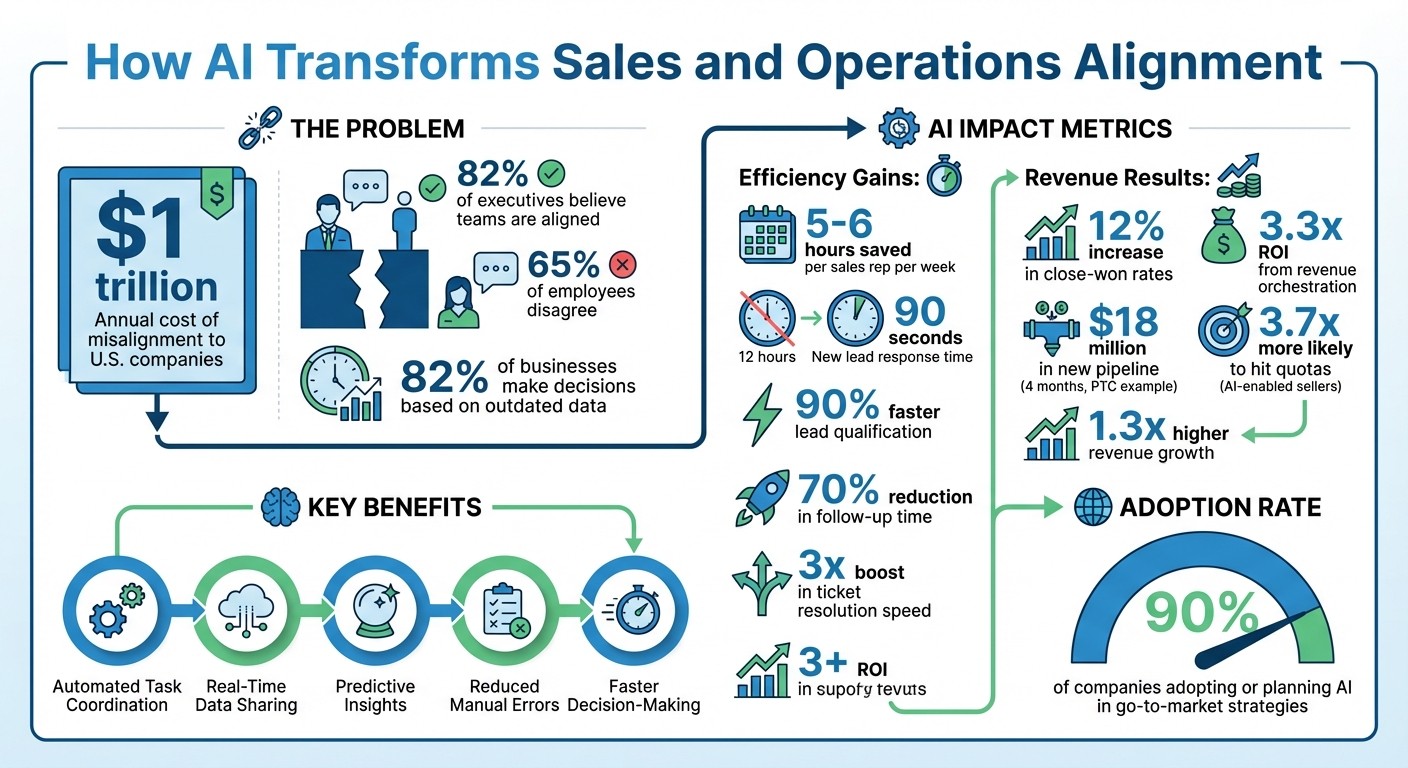
AI Impact on Sales and Operations Alignment: Key Statistics and ROI
Momentum Demo - AI-Native Revenue Operations and Deal Execution
What AI Task Coordination Means for Sales and Operations
AI task coordination brings together data, communication, and workflows, ensuring that sales and operations teams interact seamlessly and at the right moment. Instead of juggling multiple tools and relying on manual processes, AI creates a connected system where buyer actions automatically trigger the next steps for both teams.
This eliminates what experts call "human middleware" - the time wasted on manual data corrections and task delegation. For instance, when a deal is closed or a buyer shows interest, AI updates the CRM instantly, notifies operations, and assigns tasks based on team capacity and territory rules. The result? Faster execution and fewer bottlenecks.
Companies that adopt revenue orchestration have reported a 12% increase in close-won rates and a 3.3x ROI. Take Ruby Capital Group as an example. In December 2025, they implemented K3X's AI-driven agents for follow-ups and contract routing. The setup took just two days and led to a 70% reduction in follow-up time and a 3x boost in ticket resolution speed.
How AI Task Coordination Works
AI task coordination relies on three main mechanisms: automated task assignment, real-time updates, and predictive insights. When a lead interacts - whether through a call, email, or website visit - the AI captures critical details like budget, timeline, and pain points, and automatically updates CRM fields. This eliminates the need for manual data entry, ensuring that both sales and operations are working with accurate, up-to-date information.
Using predictive signals such as engagement levels, deal risks, and intent data, the system dynamically routes leads and assigns tasks to the right team members. For example, if a high-value prospect mentions pricing during a call, AI can immediately activate a retention strategy, adjust the forecast, and alert the operations team. These systems can reduce lead response times from 12 hours to under 90 seconds and speed up lead qualification by as much as 90%.
Unlike traditional automation systems that follow rigid, step-by-step scripts, AI platforms like K3X are designed to achieve specific outcomes. As Mykyta Samusiev, Co-Founder & CEO of K3X, puts it:
"Most CRMs record activity. K3X understands outcomes. It listens, knows what changed, and makes the next moves."
This focus on outcomes allows the system to adapt when buyers skip steps or behave unpredictably - something conventional workflows struggle to manage. This adaptability lays the groundwork for advanced AI capabilities that strengthen alignment between sales and operations.
Why Manual Workflows Create Problems
Manual workflows add to the misalignment challenges by creating repetitive, low-value tasks. Sales teams often spend a significant part of their day on administrative duties like data entry, which not only consumes time but also introduces errors. In fact, 82% of businesses admit to making key decisions based on outdated information due to inaccuracies in manual data entry.
Traditional CRM systems make things worse by requiring users to set up complex sequences, triggers, and rules that can break if a single step is missed. This forces operations teams to act as "data janitors", fixing errors and chasing compliance issues. Meanwhile, delays in email notifications disrupt lead handoffs, slowing down deals.
Feature | Manual Workflow | AI Task Coordination |
|---|---|---|
Data Entry | Manual, prone to errors | Automated, updates directly from interactions |
Lead Routing | Static rules or manual assignments | Dynamic, based on intent signals |
Handoffs | Slow, reliant on email notifications | Instant, triggered CRM updates |
Forecasting | Based on outdated or "gut" data | Driven by real-time engagement signals |
Task Management | Linear, repetitive processes | Adaptive, focused on outcomes |
AI platforms like K3X tackle these problems by replacing rigid workflows with conversational control. Instead of defining every step in a process, users simply state the goal - like "book a demo" or "route this lead to operations" - and the system intelligently handles the rest. This reduces manual effort and speeds up execution, helping teams focus on what matters most.
AI Features That Improve Sales and Operations Alignment
AI systems bring sales and operations teams together by automating data handling and streamlining tasks. Instead of relying on manual processes and disjointed tools, these platforms create a shared space where both teams can access up-to-the-minute information. This foundation of accurate data allows for better task prioritization and seamless communication, bridging the gap between departments.
Automated CRM Updates and Shared Dashboards
One of the standout features of AI is its ability to automatically log customer interactions into CRM systems, removing the need for manual updates. On average, sales reps spend 3.4 hours a week on CRM data entry - a process that not only wastes time but also costs companies around 15% of their revenue due to errors. By automating this task, AI ensures both accuracy and efficiency.
Take K3X, for example. It uses conversation intelligence to update CRM fields after calls and meetings. This creates a single, reliable source of information that everyone can access.
Shared dashboards take this a step further by providing real-time insights into deal progress, activity summaries, and performance metrics. This level of transparency eliminates what’s often called the "revenue fog", a problem affecting 82% of companies that rely on outdated data for decision-making. With accurate and timely information, teams can make smarter decisions and work more effectively.
Smart Task Prioritization
AI doesn’t just share data - it also helps teams work smarter by prioritizing tasks. It evaluates factors like deal urgency, revenue potential, and team availability to assign and prioritize tasks. For instance, if a prospect shows strong buying signals - like repeatedly engaging with key product information - AI can escalate the lead, assign it to the most experienced rep, and initiate follow-up actions. On the flip side, if a deal starts to stall, the system alerts both sales and operations teams, offering suggestions to re-engage the prospect.
"Speed-to-lead" is critical, and AI ensures it’s maintained. Fischer Homes, for example, tripled their outbound call volume using Kixie’s multi-line AI PowerDialer, which integrates with their CRM to automate dialing and logging. By analyzing engagement data, the system ensures reps focus on the most promising leads first.
AI also prevents operational bottlenecks. When multiple deals close at once, it can distribute tasks among team members based on workload and expertise, ensuring no one is overwhelmed and responsibilities are balanced.
Real-Time Data Sharing Between Teams
Instant data sharing is another game-changer. Misalignment often happens when one team has to wait on information from another. AI platforms solve this by instantly sharing updates through webhooks, automated notifications, and integrated communication tools.
For example, when a deal is marked as "Closed Won", operations gets all the necessary details immediately, removing the need for back-and-forth emails. Similarly, if a support call uncovers a potential churn risk, sales is notified right away to step in and address the issue before it escalates.
A great example is PTC, which generated $18 million in new pipeline within just four months by using 6sense for intent signals and Kixie for automated follow-ups. This level of integration ensures both sales and operations are on the same page and can respond to opportunities or issues without delay.
Data Sharing Method | Manual Process | AI-Powered Process |
|---|---|---|
Lead Handoff | Email notifications (often delayed) | Instant CRM updates + Slack alerts |
Deal Updates | Weekly status meetings | Real-time dashboard sync |
Customer Issues | Manually forwarded support tickets | Automatic routing to account owner |
Performance Metrics | Monthly reports | Live dashboards accessible to all teams |
K3X enhances communication further by integrating email, calling, and SMS into its platform. Every interaction automatically updates the shared record, giving operations a complete view of customer conversations without needing to ask sales for updates.
The outcome? Teams save countless hours previously spent searching for information - employees can waste up to 12 hours a week on this alone. With AI, teams can focus on what matters most: serving customers. These platforms don’t just improve systems; they create a shared understanding of customer activity, keeping everyone on the same page in real time.
How to Set Up AI Task Coordination in Your Company
Getting AI task coordination running smoothly doesn't have to be overwhelming. The key is to start by identifying where your current processes are falling short, choose a platform that directly addresses those issues, and ensure that your teams are aligned with shared goals.
Find Gaps in Your Current Workflows
Before introducing AI tools, take a close look at where your workflows are breaking down. Start by surveying leadership and front-line staff separately - this helps uncover perception gaps. For instance, executives may think everything is aligned, while employees experience a completely different reality.
Another major issue to look for is platform fatigue. If your sales team is juggling 8 to 15 tools every day, productivity can take a serious hit - by as much as 40%. Track how much time is being wasted on repetitive tasks like manual data entry, CRM updates, and lead routing.
Pay special attention to how information flows between sales and operations. Are customers being asked the same questions repeatedly? Are deals stalling because no one knows the next step? These are signs of poor coordination. For example, if 79% or more of your marketing leads aren’t converting, it’s likely because sales and marketing have different definitions of a "qualified lead".
Finally, audit your CRM data. Incomplete or inconsistent records make reporting unreliable and can cost your company big money. To put it in perspective, misalignment between sales and marketing costs U.S. businesses over $1 trillion annually.
Select the Right AI Platform
Once you’ve identified the weak spots, it’s time to pick a platform that addresses them effectively. The number of features a tool has isn’t as important as its ability to integrate with your existing systems and reduce the need for switching between multiple apps.
Focus on platforms that act as an execution layer. For instance, K3X doesn’t just provide recommendations - it takes action. When a deal closes, it updates the CRM, notifies operations, and triggers the next steps automatically. This "Revenue Action Orchestration" model allows your team to focus on customers instead of managing software.
Look for tools with bi-directional syncing capabilities, so data flows seamlessly between the platform and your CRM in real-time. It should also support webhooks and APIs to connect with tools like Slack, Zendesk, and your marketing software. Reducing tool fragmentation should be a priority, especially since 56% of leaders cite it as their biggest operational challenge.
Training is equally important. A staggering 72% of employees rate their company’s AI training as inadequate, which often leads to poor adoption. Provide role-specific training sessions and start small by solving one major bottleneck - like slow lead response times - before rolling out additional features.
Once the right platform is in place, aligning efforts across teams requires shared performance metrics.
Create Shared Metrics and KPIs
Stop working in silos by adopting unified revenue goals for both sales and operations.
The first step is agreeing on shared definitions. Both teams need to be on the same page about what counts as a "qualified lead" to avoid miscommunication and wasted effort. Establish baseline metrics before implementing AI, such as forecast error rates, time spent on manual tasks, and deal cycle length. These benchmarks will help you measure ROI later.
Your KPIs should include both leading indicators (like hours saved on manual tasks or improved data accuracy) and lagging indicators (such as pipeline velocity and forecast accuracy). For example, track how much time AI saves on CRM updates weekly while also monitoring whether deals move faster through the pipeline.
Another critical metric is "speed-to-connect", or how quickly your team reaches out after a buyer shows interest. Reducing this time from 35 minutes to under 10 minutes can significantly boost conversion rates. AI platforms like K3X can automate lead routing, trigger follow-ups, and ensure no opportunities are missed.
Lastly, ensure both teams have access to the same dashboards. When everyone works off the same real-time data, it eliminates confusion and fosters alignment. This transparency enables continuous improvement, making it easier to maintain coordination between sales and operations over time.
Tracking Results and Improving Over Time
After implementing AI for task coordination, the next step is to monitor performance, expand its use, and address any issues that arise. Tracking progress not only helps measure ROI but also fine-tunes the collaboration between sales and operations.
Metrics to Track
Metrics can be divided into two categories: leading indicators (short-term process improvements like reducing CRM errors or speeding up lead responses) and lagging indicators (long-term results such as improved forecast accuracy and higher pipeline conversion rates).
Even small improvements can significantly enhance sales efficiency. For instance, automating CRM updates and data entry can save each sales rep 5 to 6 hours per week. Another key metric to monitor is "speed-to-connect." AI can shrink lead response times from 12 hours to under 90 seconds. Reaching out to a lead within one hour can increase conversion chances by 7x.
When assessing alignment, look at areas where teams often clash. Are disputes over commissions between sales and finance decreasing? Are pipeline review meetings becoming shorter and more productive? Companies leveraging AI for revenue orchestration have seen a 50% reduction in time spent on manual pipeline reviews.
Ultimately, revenue outcomes are the most critical measure of success. Track metrics like win rates, forecast accuracy, and pipeline velocity. For example, in 2025, PTC generated $18 million in new pipeline in just four months by combining intent signals with automated execution. Similarly, Fischer Homes tripled their outbound call volume and contact rates by using dialer automation, allowing a small team to operate as efficiently as one three times its size.
"Most businesses only need to track 2–4 well-chosen KPIs aligned with strategic goals." - Spinify
Focus on the metrics that directly tie to your business objectives. Once these are established, you can confidently expand AI applications across the organization.
Expanding AI Use Across Your Organization
After achieving early wins, scale AI usage gradually. Start by piloting it in one department, measure results over 30 to 60 days, and then standardize successful workflows before rolling them out company-wide.
Ensure seamless integration with tools like Salesforce, HubSpot, and Slack to avoid data silos and enhance productivity. Training is also essential - don’t rely on employees to figure it out on their own. Instead, schedule dedicated, role-specific training sessions. Currently, 72% of employees rate their company’s AI training as mediocre or worse.
Companies using revenue orchestration models - where AI connects data, insights, and execution in real time - have reported a 3.3x ROI and a 12% increase in close-won rates. These results highlight the value of an AI-native CRM like K3X, with its focus on outcome-based performance tracking.
Solving Common Implementation Problems
One of the biggest hurdles to AI adoption isn’t the technology - it’s trust. 78% of enterprises say AI adoption stalls because they don’t trust their revenue data. To address this, ensure your data is clean by deduplicating and completing records. This can improve AI accuracy by up to 5% and cut training time by 30%. Avoid "pilot purgatory" by assigning clear roles for integration and change management from the outset.
It’s also important to strike the right balance between automation and human oversight. AI can handle tasks like routing leads and triggering follow-ups, but human teams should still review deal forecasts and manage escalations.
"AI is far more likely to change sales ops roles than replace them. It automates repetitive tasks... so teams can focus on strategy, analysis, planning, and decision-making." - CaptivateIQ
Lastly, set up automated alerts to catch potential problems early. For example, notify a rep if a hot lead hasn’t been contacted within 60 minutes. These safeguards help ensure no opportunities are missed as your team adjusts to new workflows.
Conclusion
Aligning sales and operations is key to eliminating costly inefficiencies within teams. Fragmented tools and manual processes often double the chances of missing revenue goals. AI platforms like K3X address this issue by turning the CRM from a static database into a dynamic system that actively manages tasks, updates pipelines, and handles follow-ups in real time.
Switching from outdated workflows to AI-powered orchestration delivers tangible results: a 3.3× ROI, a 12% increase in close-won rates, 5 to 6 hours saved per week per rep, and lead response times reduced to under 90 seconds. These results reinforce earlier discussions about the importance of streamlined task management and shared metrics, highlighting AI's central role in bridging the gap between sales and operations.
Unlike traditional CRMs that depend on manual triggers and complex sequences, K3X leverages prompt-driven automation to handle multi-step processes effortlessly. By setting clear goals, the platform takes over responsibilities like routing, CRM maintenance, team coordination, and performance tracking. This eliminates the disconnect between strategy and execution, ensuring sales plans don’t remain stuck in spreadsheets but instead drive meaningful revenue growth .
The numbers speak for themselves: sellers who integrate AI into their workflows are 3.7× more likely to hit their quotas, and AI-powered teams report revenue growth 1.3 times higher than their counterparts. With 90% of companies already adopting or planning to implement AI in their go-to-market strategies, the real question is no longer if AI should be adopted, but how soon you can start.
To get started, focus on your biggest challenge - whether it’s inaccurate forecasting, delayed lead responses, or messy data. Choose one high-impact workflow to optimize, track the results over the next 30 to 60 days, and expand your efforts from there. Address your top bottleneck and see firsthand how AI can revolutionize your operations.
FAQs
What processes should we automate first to align sales and ops?
To bring sales and operations together, start by tackling repetitive tasks that often bog down teamwork - things like lead routing, follow-ups, and data entry. Using AI-powered tools to automate these processes can make a big difference, as they work in real time to streamline workflows and cut down on silos. For example, automating lead management ensures both teams have access to accurate, up-to-date information, which leads to smoother communication and quicker decision-making.
What data should be cleaned before using AI for coordination?
Before integrating AI into coordination efforts, it's crucial to clean and update your sales data. This means tackling issues like incomplete records, ghost leads, outdated email addresses, disconnected phone numbers, and duplicate or incorrect entries. Having accurate and up-to-date data not only boosts AI performance but also ensures smoother collaboration between teams.
How do we measure ROI from AI sales and operations alignment?
To gauge ROI from aligning sales and operations through AI, focus on tracking key metrics. These include revenue growth, sales productivity, pipeline velocity, and deal closure times. Tools like K3X can play a big role here by automating follow-ups and simplifying workflows, which helps improve efficiency and cut costs.
Beyond these, look at strategic indicators like lead conversion rates, customer satisfaction, and sales forecast accuracy. These metrics provide a broader view of how AI impacts overall business performance.