
Adaptive AI follow-up reminders cut costs, speed responses under a minute, and boost rep revenue with goal-driven automation.
Missed follow-ups cost businesses up to $127,000 annually. AI tools can fix this by automating reminders, saving time, and increasing sales. Here's a quick breakdown:
Manual methods: Costly ($8–$15 per email), inconsistent (~60% follow-through), and time-consuming (2+ hours/day per rep). Scaling requires more staff, which inflates costs.
AI tools (e.g., Outreach): Reduce costs ($0.50–$2 per email) and response times (under 5 minutes). However, they rely on rigid workflows, which aren't flexible when leads behave unpredictably.
K3X AI: Combines low costs ($20/user/month), fast setup (<1 hour), and real-time goal-based adjustments. Boosts lead response rates, shortens sales cycles, and increases revenue per rep by 30%.
Quick Comparison
Factor | Manual Follow-Up | AI Tools | K3X AI Follow-Ups |
|---|---|---|---|
Cost per Touch | $8–$15 | $0.50–$2.00 | $0.50–$2.00 |
Response Time | 27–31 hours | Under 5 minutes | Under 1 minute |
Setup Time | None | Weeks to months | Less than 1 hour |
Consistency Rate | ~60–70% | 99% | 99% |
Scalability | Proportional hiring | High volume, rigid | High volume, flexible |
Key Takeaway: Manual methods are outdated and resource-intensive. AI tools improve efficiency, but K3X stands out by offering dynamic, outcome-focused solutions that save time, lower costs, and maximize sales results.
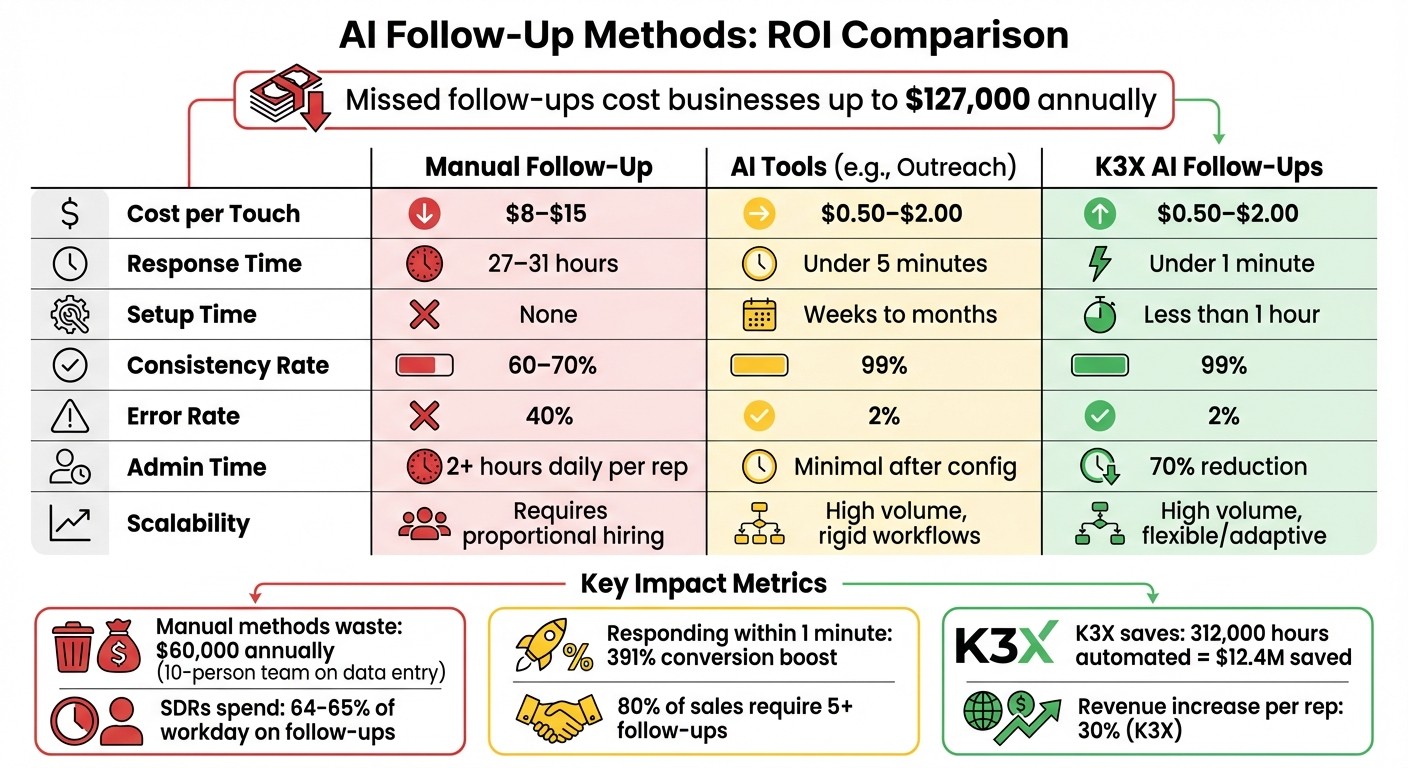
AI Follow-Up Methods Comparison: Manual vs AI Tools vs K3X ROI Analysis
How to Automate Lead Follow-Up Using AI (Email, SMS & Ads)
1. Manual Follow-Up Methods
Manual follow-ups depend on human effort - think sticky notes, spreadsheets, and memory - to keep track of when sales reps should reconnect with prospects. While this approach allows for personalized outreach, it’s far from efficient and comes with hidden costs that can take a toll on your bottom line.
Cost Efficiency
Manual follow-ups are expensive. Each personalized email costs between $2 and $4 in SDR labor, based on an average hourly rate of $26.45. But that’s just the tip of the iceberg. When you add in research, data entry, and CRM logging, each touchpoint balloons to $8 to $15. For a 10-person sales team, spending just 30 minutes a day on manual data entry adds up to an eye-watering $60,000 annually in wasted labor.
"Your top account executive, the $150,000 seller you hired to close deals, spends less than 30% of their time actually selling. The other 70% of their time? They're a data-entry clerk." - Justin Herrick, Reevo
And it’s not just about the money. These outdated processes eat into valuable selling time, making it harder for your team to focus on what really matters - closing deals.
Time Savings
Time savings? Not with manual methods. In fact, they’re a massive time sink. SDRs spend over two hours every day on follow-up tasks, which eats up 64% to 65% of their workday. That’s time they could be using to build relationships and convert leads into customers.
Conversion Rate Improvement
Manual follow-ups also struggle with consistency, which impacts conversion rates. While automated systems hit a 99% consistency rate, manual methods hover between 60% and 70%. Take Precision Insurance Group, for example. Before automation, only 12% of their leads received three or more follow-ups. Many sales reps simply stop following up to avoid coming across as pushy. This inconsistency means missed opportunities and fewer closed deals.
Scalability
Scaling manual follow-ups is a logistical nightmare. Want to double your output? You’ll need to double your team, payroll, and operational complexity. An SDR can send about 36 emails per day. Managing 10,000 leads each month would require 33 SDRs, costing around $206,000 in payroll alone. This linear growth model caps your revenue potential, as your ability to scale depends entirely on hiring and training more reps. These limitations highlight why businesses are increasingly turning to AI-powered follow-up solutions.
2. AI-Powered Tools (e.g., Outreach, Fireflies.ai)
Manual follow-ups can be tedious and costly, but AI-powered tools like Outreach and Fireflies.ai are changing the game. These platforms automate tasks like tracking, drafting, and logging follow-ups, saving time and cutting expenses. The result? Your team can focus more on selling and less on repetitive admin work.
Cost Efficiency
One of the biggest advantages of these tools is the reduction in costs. With AI, the cost per follow-up drops to just $0.50 to $2.00. To put that into perspective, a single operator using automation can manage over 10,000 leads each month - a workload that would otherwise require 33 sales development representatives (SDRs) and cost around $200,000 in monthly payroll.
"Manual follow-ups cap throughput at what one human can type and cost roughly $2 to $4 per email when you factor in SDR labor. Automation drops per-email cost to near zero." - Hans Dekker, Instantly
Beyond just labor costs, AI tools also save time on data entry. Each sales rep can reclaim 47 minutes daily by automating these tasks [3,9].
Time Savings
Speed is another area where AI tools shine. Tasks like post-call summaries, which used to take 10 minutes to write manually, now take just 10 seconds to review and send. AI systems can respond to leads in under 5 minutes - sometimes as fast as 60 seconds. This speed matters because responding within 5 minutes makes you 21 times more likely to qualify a lead.
Take Precision Insurance Group, for example. Their 6-person sales team reduced response times from 27 hours to 4 minutes, which boosted closed deals by 43% and added $18,400 in monthly revenue. Similarly, a B2B software company cut first-contact time from 31 hours to 90 seconds, leading to a 67% increase in discovery calls and a 31% rise in closed deals over just two months.
Conversion Rate Improvement
AI tools also excel at consistency, which is key to improving conversion rates. While 80% of sales require at least five follow-ups, 44% of human reps stop after just one attempt [3,9]. AI ensures every lead gets the necessary attention, achieving a follow-up execution rate of over 95%, compared to the 40%-60% typically achieved manually.
For example, a Phoenix-based pest control company used an AI sales agent to handle seasonal volume spikes. Their lead response rates soared from 40% to 100%, and appointment bookings nearly doubled from 22% to 48%. This translated into an additional $34,000 in revenue per rep annually.
Scalability
AI-powered tools are built to handle volume far better than manual methods. Platforms like Outreach and Fireflies.ai streamline workflows, but they do require setting up sequences, triggers, and rules for each campaign. Adjusting to new campaigns or changing lead behavior can take hours or even days, often requiring technical expertise or dedicated operations staff.
Despite these challenges, traditional AI platforms are still highly efficient. However, newer approaches, like K3X's goal-based, prompt-driven systems, aim to simplify scalability further by eliminating the need for complex workflows. This makes adapting to changes faster and easier without sacrificing performance.
3. K3X AI Follow-Ups

K3X reimagines follow-up systems by addressing the inefficiencies of traditional approaches. With its prompt-driven functionality, it dynamically determines the best way to achieve outcomes in real time, offering a smarter, more efficient solution.
Cost Efficiency
K3X delivers substantial savings right from the start. At just $20 per seat per month, it’s a fraction of the cost of traditional CRM systems, which typically range between $90 and $150 per user. For a 10-person team, this translates to $2,400 annually compared to $10,800–$18,000 for standard CRMs.
What’s more, K3X’s setup is lightning-fast, taking less than an hour - far quicker than the usual 12-week implementation process of conventional systems. This rapid deployment eliminates hefty consultant fees, IT expenses, and the need for third-party integration tools. The result? Faster revenue generation and lower upfront costs. Across its user base, K3X has automated over 312,000 hours of work, saving businesses an estimated $12.4 million in operational costs. On average, each employee reclaims 8 hours per week by cutting out manual data entry and follow-up tasks.
Time Savings
K3X slashes follow-up time by an impressive 70%. It handles meeting transcriptions, logs details, and updates pipeline stages automatically - instead of the typical 15 to 45 minutes spent on post-call tasks. For example, Ruby Capital Group implemented K3X’s AI-driven agents in just two days and saw their follow-up time drop by 70%, while response times tripled.
"Our sales team was spending half their day on admin work. Now they're talking to customers and closing deals."
Michael Chkechkov, CEO, Ruby Capital Group
Sales reps, who usually spend only 28% to 33% of their time selling, can now reclaim the 67% to 72% lost to administrative tasks.
Conversion Rate Improvement
K3X significantly boosts conversion rates with its lead qualification accuracy of 70% to 85%, far outpacing the 30% to 40% accuracy common with manual methods. Automated data capture enhances forecast accuracy by 22% and shortens sales cycles by 17%. Features like "stop on engagement" logic ensure follow-up sequences pause immediately when a lead responds. Businesses using K3X report a 60% increase in workload capacity per representative and a 30% rise in revenue per rep.
Scalability
Scaling with K3X is seamless and avoids the usual complications of traditional AI tools, which can require hours or even days to tweak campaigns. Instead of rigid workflows, K3X’s goal-based prompts adapt in real time to shifting lead behaviors.
As Mykyta Samusiev, CEO of K3X, puts it:
"Most systems are linear. They follow fixed steps - and if something unexpected happens, the flow breaks... K3X works on goals. Instead of defining steps like 'Send this email, then wait,' you define the objective."
Additionally, K3X’s adaptive pricing model adjusts with your business needs. During busier months, costs scale up, but they return to the $20 base rate during slower periods. This flexibility ensures you only pay for what you use, making it a cost-effective choice for growing businesses. Its dynamic capabilities make it a standout alternative to legacy systems, offering a better return on investment.
Advantages and Drawbacks
Choosing the right follow-up method involves weighing the pros and cons, as each approach affects ROI differently. Manual methods offer flexibility but come with higher costs, traditional AI tools provide consistency but lack adaptability, and K3X strikes a balance between automation and responsiveness.
Here’s a detailed comparison of key metrics across the three methods:
Factor | Manual Follow-Up | Traditional AI Tools | K3X AI Follow-Ups |
|---|---|---|---|
Cost per Touch | $8–$15 (labor costs) | $0.50–$2.00 after setup | $0.50–$2.00 (pay-as-you-go) |
Response Time | 27–31 hours average | Under 5 minutes | Under 1 minute |
Setup Time | None required | Weeks to months | Less than 1 hour |
Consistency Rate | 60–70% | 99% | 99% |
Error Rate | 40% (fatigue/volume) | 2% | 2% |
Workflow Type | Human-dependent | Fixed workflows | Goal-based/adaptive |
Scalability | Requires proportional hiring | Handles high volume but inflexible | Handles high volume with real-time adaptation |
Admin Time | 2+ hours daily per rep | Minimal after configuration | 70% reduction |
These numbers highlight how adaptive systems like K3X can overcome the constraints of traditional methods.
Manual follow-ups shine in situations where deals require a personal touch or complex negotiations. However, scaling manually means increasing headcount proportionally, which can quickly become unsustainable. Tools like Outreach or HubSpot streamline repetitive tasks and deliver near-perfect consistency, but their rigid workflows struggle when leads behave unpredictably. K3X, on the other hand, eliminates these bottlenecks by focusing on outcomes rather than predefined steps. It adapts in real time to lead behavior while maintaining the cost benefits of automation.
Ultimately, the best approach depends on your business's growth stage. Manual methods work well for small teams handling intricate sales, but they lack scalability. Traditional AI tools suit companies with established workflows and technical resources. K3X is ideal for teams needing instant setup, dynamic scalability, and the ability to adapt to unpredictable scenarios.
This comparison underscores how K3X’s adaptive, outcome-driven approach can deliver better ROI for scaling sales operations.
Conclusion
The numbers don't lie - manual follow-ups are a major drain on resources. On average, teams lose $14,200 every month due to inefficiencies tied to manual processes. Considering that responding to leads within one minute can boost conversions by an incredible 391%, and that 80% of sales require at least five follow-ups to close, it's clear that relying solely on manual efforts isn't sustainable. Businesses need smarter, real-time solutions to stay competitive.
This is where K3X steps in. Its outcome-focused model integrates smoothly with modern sales operations, outperforming both manual processes and traditional AI tools. What sets K3X apart? It adapts dynamically to lead behavior, ensuring continuous engagement, all while keeping costs low - just $0.50 to $2.00 per touch. Unlike older AI systems that rely on rigid workflows, K3X evolves in real time, delivering enterprise-level automation without the high costs or lengthy setup times of traditional CRMs.
"Most CRMs record activity. K3X understands outcomes. It listens, knows what changed, and makes the next moves." - Mykyta Samusiev, Co-Founder & CEO, K3X
For businesses reviewing their follow-up strategies, the choice often comes down to their growth stage and available resources. With sales reps spending up to 70% of their time on administrative tasks instead of selling, implementing an adaptive AI system like K3X isn't just a "nice-to-have" - it could be the game-changer that prevents revenue loss and fuels sustainable growth. By automating follow-ups, K3X turns wasted time into qualified meetings and closed deals.
FAQs
How do I calculate ROI for AI follow-up reminders?
Determining the ROI for AI-powered follow-up reminders involves weighing the financial benefits against the associated costs. Here’s how you can break it down:
Measure Time Savings: Start by calculating how many hours your team saves thanks to automation. Multiply those saved hours by your team’s average hourly rate to estimate the monetary value of this efficiency.
Evaluate Revenue Impact: Consider the potential revenue boost from faster follow-ups and reduced errors. These improvements can lead to higher customer satisfaction and, ultimately, better conversion rates.
Factor in Costs: Deduct the cost of the AI tool from the total benefits. Then, apply this formula to calculate ROI:
ROI = (Total Benefits / Costs) × 100
This approach gives you a clear picture of whether the investment in AI follow-up reminders is delivering value for your business.
What does “goal-based” follow-up mean in K3X?
K3X uses AI to transform broad objectives into clear, actionable tasks. By defining your goals, the system automatically aligns teams and handles task execution in real time. This removes the need for manual workflows or complicated setups, ensuring effortless coordination and delivering measurable results.
How fast can K3X be set up and start improving responses?
K3X is designed for quick setup, allowing you to see improvements in responses in just minutes - often in less than an hour. All you need to do is connect your existing tools, set your objectives using prompts, and let the system handle the rest. This streamlined process saves significant time compared to older methods, which often require weeks to get up and running.