
The Evolution of AI Agents
AI can help me identify which prospects deserve sales outreach first, but it cannot confirm that they are ready to buy. I use its rankings to guide qualification - not to replace direct checks of budget, authority, need, and timing.
Prospectory.ai reports an 8.7% first-touch-to-closed-won conversion rate for real-time-signal targeting versus 2.1% for historical-fit targeting across 3,847 opportunities tested from June 2024 through November 2025. I treat that vendor-reported result as support for prioritization, not a purchase guarantee.
Before acting, I check who generated the activity, how recent it is, and whether the account fits. My rule is simple: <u>let AI rank the queue; let verified buying details determine the next step.</u>
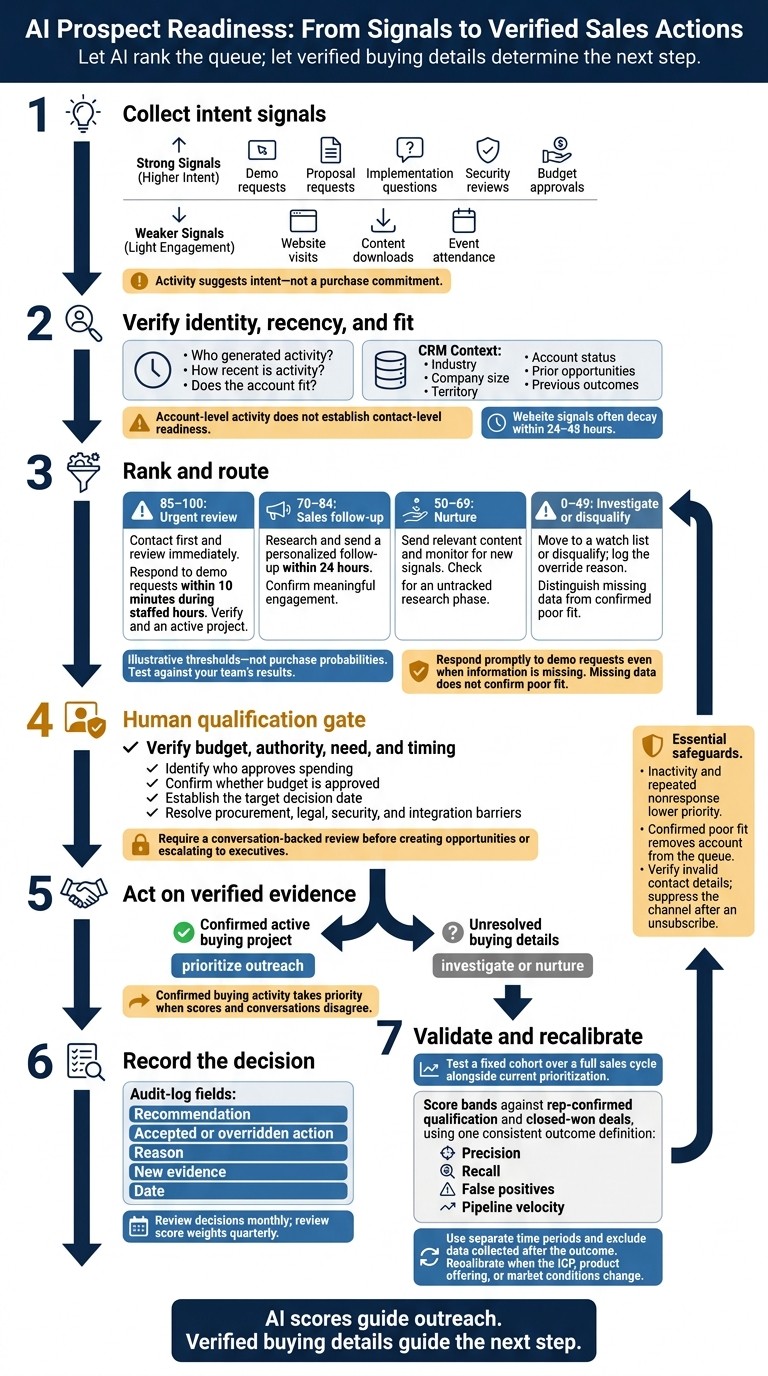
AI Prospect Readiness: From Signals to Verified Sales Actions
The AI Lead-Scoring Model That Beats Your CRM's
Signals That Suggest Purchase Intent
AI ranks prospects using evidence of likely purchase intent. Give demo requests, proposal requests, implementation questions, security reviews, and budget approvals more weight than light engagement. Reduce the weight of older activity and apply fit filters, then check how often those signals lead to purchases.
Negative signals should change the ranking, too. Inactivity and repeated nonresponse should lower priority, while poor fit should remove an account from the queue. Verify invalid contact details, and suppress the affected channel after an unsubscribe rather than simply subtracting points.
How Reliable Are Buying Signals?
Buying signals help rank prospects, but they don't prove someone will buy. The activity may come from researchers, competitors, or employees.
Prospectory.ai reports that, across 3,847 opportunities tested from June 2024 through November 2025, real-time-signal targeting produced an 8.7% first-touch-to-closed-won conversion rate, compared with 2.1% for historical-fit targeting.[2] The result supports prioritization, not certainty.
Signal | What it suggests | Why it can mislead | Human check needed |
|---|---|---|---|
Pricing-page visits | Cost comparison | Competitor or researcher checking prices | Verify identity, company fit, and purpose |
Demo requests | Willingness to evaluate | Curiosity without authority or budget | Confirm the problem and buying role |
Repeated engagement | Sustained evaluation | Education or recruiter research | Check who is engaging and why |
Discovery calls | Active consideration | Early research or polite interest | Confirm timeline, budget process, and next steps |
CRM history adds context by showing whether the activity comes from a current account, a closed-lost deal, or a new prospect.
How CRM Data Improves Prioritization
CRM data helps determine whether an account belongs in the queue and which rep should own it. Industry, company size, territory, account status, prior opportunities, and previous outcomes turn a score into a usable routing rule. K3X can surface this context without admin-heavy workflow rules, helping AI CRM tools prioritize sales workflows automatically.
Identity matching matters as much as scoring. Account-level activity doesn't establish which contact is ready to buy, and several identified stakeholders can tell you more than repeated visits from one person. Before outreach, even high-scoring prospects need contact-level verification, another recent signal, and a fit check.
What AI Cannot Confirm Without Human Qualification
AI can rank likely buyers, but it cannot confirm budget approval, buying authority, need, or timing. It may suggest budget capacity without proving that spending has been approved. Reps still need to identify the decision group, confirm the problem, and ask what must happen before a purchase.[1][2] The score is a routing tool, not a qualification record, and differs significantly from AI deal scoring vs. traditional methods used for forecasting.
CRM signal dates and context help reps prepare for qualification. Live conversations must confirm procurement, legal, security, and integration barriers before reps treat a deal as real or act on its score.[1][2]
Interest in replacing a system does not establish that switching is practical.[1][2]
Missing CRM data, stale patterns, small datasets, biased historical labels, uneven follow-up, and data leakage can all distort readiness scores.[2][3]
What Reps Need to See Beyond the Score
Reps need to see the source signals, timestamps, missing fields, and contradictory CRM notes behind each score.[1]
In K3X, require a review backed by a conversation before creating opportunities or escalating to executives. Record who approves spending, whether the budget is approved, the target decision date, and unresolved barriers.[1] After these checks, use the score to decide who gets contacted first.
Turning Readiness Scores Into Sales Actions
Turn readiness scores into routing rules by combining recent activity with CRM context. Weight scores by fit and recency: website signals often decay within 24–48 hours.[2][5]
Score bands guide actions; they do not represent purchase probabilities. Test these illustrative thresholds against your team’s results. Respond promptly to demo requests even when information is missing - missing data does not confirm poor fit.[4]
Score band | Action | Human check | Metric |
|---|---|---|---|
85–100: Urgent review | Contact first and review immediately. Respond to demo requests within 10 minutes during staffed hours.[4] | Verify fit and an active project. | Time from signal to first outreach |
70–84: Sales follow-up | Research and send a personalized follow-up within 24 hours.[4] | Confirm meaningful engagement. | Opportunity conversion rate |
50–69: Nurture | Send relevant content and monitor for new signals. | Check for an untracked research phase. | Engagement lift |
0–49: Investigate or disqualify | Move to a watch list or disqualify; log the override reason. | Distinguish missing data from confirmed poor fit. | False positive rate |
How you apply these rules depends on the platform’s setup and automation model.
Platform | Setup complexity | Automation style | Admin overhead | Illustrative entry pricing for 10 users/month* |
|---|---|---|---|---|
K3X | Prompt-led; validate data and actions | AI-native, prompt-to-action | Less rule-building; human review still needed | $399/month - Adaptive; unlimited seats and 400,000 monthly credits |
Higher for customized routing | Flow and configurable rules | Often needs a dedicated administrator | $250 - Starter Suite | |
Low for basic use; higher for advanced workflows | Visual workflows; capabilities depend on tier | Moderate as workflows expand | $150 - Sales Hub Starter | |
Low for basic pipelines | Trigger-based automations on eligible plans | Low to moderate | $140 - Lite | |
Moderate | Workflow rules and Blueprint on eligible editions | Moderate | $140 - Standard | |
Low to moderate | Board-based automation recipes | Requires board and recipe maintenance | $120 - monday CRM Basic | |
Low for calling and email workflows | Outreach sequences and workflows on eligible plans | Low to moderate | $350 - Essentials | |
Moderate for custom data models | Flexible workflows and AI actions | Requires data-model and workflow ownership | $290 - Plus |
Illustrative USD subscription totals use annual-billing rates except for K3X’s monthly subscription and exclude taxes, add-ons, and implementation. These compare entry plans - not equivalent readiness-automation packages or verified September 30, 2026 quotes. Confirm current pricing and required tiers before budgeting.
Salesforce supports extensive customization, while HubSpot connects marketing and sales. Pipedrive and Close focus on rep execution; Zoho offers broad configuration, monday.com flexible boards, and Attio flexible data models. K3X uses prompts to drive actions rather than requiring teams to assemble every routing rule manually.
Make each decision auditable. In K3X, reps can review the score explanation, correct weak inputs, and log the decision.[1] Record the recommendation, the accepted or overridden action, the reason, new evidence, and the date. Review decisions monthly and score weights quarterly.[1][3]
Examples of Prospect Prioritization
When scores and conversations disagree, confirmed buying activity takes priority. Log the new evidence and the reason for overriding the score.
A low-scoring prospect moves ahead of a content-engaged prospect when a conversation confirms an active buying project. Record the project and the source of the new information, then log the override before prioritizing outreach.[2][4]
These examples describe routing rules, not outcome claims.
K3X vs. Other CRMs for Readiness Workflows
The right CRM turns readiness scores into action without adding unnecessary admin work. Compare K3X with Salesforce, HubSpot, Pipedrive, Zoho CRM, monday.com, Close, and Attio on setup time, automation depth, and maintenance needs.
Platform Strengths and Trade-Offs
K3X uses prompt-to-action agents for prospecting, qualification, outreach, meeting booking, and CRM updates. Visual configuration, logs, dashboards, and webhooks help teams track execution, while native MCP access connects CRM actions to Claude or ChatGPT.
These tools automate execution, not validation. Readiness still depends on clean signal ingestion and human qualification.
Platform | Strength and readiness-workflow approach | Setup and maintenance trade-off | Pricing status in this comparison |
|---|---|---|---|
K3X | Prompt-to-action agents turn instructions into prospecting, outreach, booking, and CRM updates | Visual configuration reduces manual rule-building; inputs, permissions, and actions still need review | Pricing below |
Salesforce | Deep customization, a large ecosystem, and Einstein AI support complex sales processes | Often requires specialist admins and regular maintenance | Quote required |
HubSpot | Connected marketing and sales data support inbound scoring and follow-up | Advanced workflows depend on tier and require regular configuration | Quote required |
Pipedrive | Visual pipelines and trigger-based automation support straightforward sales workflows | Simple workflows are easy to set up and maintain | Quote required |
Zoho CRM | Broad suite coverage, workflow rules, and Zia AI support configurable sales processes | Deeper cross-app workflows require more configuration and maintenance | Quote required |
monday.com | Flexible boards and automation recipes support custom readiness workflows | Teams must build and maintain their sales logic | Quote required |
Close | Built-in telephony and automated sequences support high-volume outbound outreach | Readiness signals must be mapped into outreach workflows | Quote required |
Attio | Flexible data models and workflows support custom objects and relationship mapping | Requires comfort with data structure and workflow design | Quote required |
Pricing varies by edition, billing cadence, add-ons, and seat minimums. Confirm current U.S. quotes directly with each provider.
Comparing Pricing for a 10-User Team
For a 10-user team, K3X’s Adaptive plan costs $399/month, with unlimited seats and 400,000 monthly credits. The other platforms require quotes for this comparison.
Platform | 10-user pricing note |
|---|---|
K3X | $399/month; unlimited seats and 400,000 monthly credits |
Salesforce | Quote required |
HubSpot | Quote required |
Pipedrive | Quote required |
Zoho CRM | Quote required |
monday.com | Quote required |
Close | Quote required |
Attio | Quote required |
K3X credits cover AI actions, contact reveals, calls, and texts. Optional top-ups start at $99 for 100,000 credits. Purchased top-up credits roll over while the subscription remains active; included monthly credits do not.
When credits run out, credit-based actions pause until more credits are added, while the CRM remains available. See K3X pricing for plan details.
Budget for usage charges and implementation fees alongside subscription costs to cover the workflow capacity your team needs.
Testing Scores Against Buying Outcomes
After routing, validate whether scores predict buying outcomes. Use the same score bands as your routing rules, and test readiness scores against rep-confirmed qualification and closed-won deals over a full sales cycle. [1]
Run the model in parallel with current prioritization. Score a fixed cohort of accounts while reps keep their existing approach, then compare later outcomes. This avoids changing rep behavior or biasing results toward high-scoring accounts. Test buying outcomes, not just engagement. [1]
Metrics to Track
Track qualification, meetings booked, opportunity creation, and closed-won conversion across score bands as part of your sales pipeline management. Use one outcome definition throughout the test, such as rep-qualified or closed-won. [2]
Precision measures how often high-scoring accounts convert; recall measures how many actual buyers the model identifies early. Also monitor false positives and pipeline velocity. These metrics assess the model’s predictions - they don’t confirm an individual prospect’s readiness. [2]
When to Adjust Scores and Thresholds
Adjust signal weights and thresholds when score bands no longer separate buying outcomes. Compare bands within the same ICP using samples from separate time periods, and exclude data collected after the outcome. [1][3]
Recalibrate when your ICP, product offering, or market conditions change. [1][3]
FAQs
How much data do I need to trust AI readiness scores?
You don’t need years of historical data to get started. Several hundred closed-won and closed-lost records are ideal for finding reliable patterns, while third-party intent data can provide early signals. Logging outcomes helps improve accuracy over time.
Signal quality and recency matter most. Monthly audits that compare predictions with actual pipeline outcomes can help you reach useful accuracy within two to three quarters. Validate scores against your closed-deal data before relying on them.
How should I handle anonymous buying signals?
Use enrichment tools, such as reverse IP lookup, to identify companies behind anonymous website visits. LinkedIn Sales Navigator or enrichment APIs can help identify likely individuals, but they do not confirm who visited.
A pricing-page visit alone does not prove purchase readiness. Combine it with other signals to build a composite score, and prioritize high-intent anonymous accounts for research rather than individual outreach.
Use consent-based first-party data and verify GDPR and CCPA compliance.
How can I avoid overlooking low-scoring buyers?
Separate profile fit from current buying intent. A prospect with a low score may still have an urgent need. Lower scores as engagement ages, track activity across an account’s stakeholders, and give repeated high-intent actions - such as pricing-page visits - more weight than casual blog reading.
Use signal-driven outreach for active buyers and a separate nurture track for passive prospects. Regularly compare scores against closed-won and closed-lost outcomes, then adjust signal weights when the model misses buyers.