
The Evolution of AI Agents
AI-native CRMs are redefining how businesses manage customer relationships by integrating artificial intelligence at their core. Unlike older systems that rely heavily on manual data entry and static workflows, these platforms automate repetitive tasks, predict customer behaviors, and provide actionable recommendations in real time. This means sales teams can focus more on selling and less on administrative work.
Key benefits of AI-native CRMs:
Automation: Eliminates manual data entry by automatically logging emails, calls, and updates.
Predictive Insights: Uses AI to predict sales outcomes like lead scores, forecasts, and churn risks.
Personalization: Analyzes customer interactions to tailor responses and improve engagement.
Efficiency: Saves up to 8 hours per week per employee by reducing admin tasks.
Ease of Use: Features prompt-driven interfaces that simplify setup and daily use.
For example, platforms like K3X allow users to issue simple commands (e.g., “schedule follow-ups with inactive leads”), and the system handles the rest. With pricing at $50 per month flat, these systems are accessible and scalable for businesses of all sizes.
AI-native CRMs are not just tools for record-keeping - they actively help businesses make smarter decisions and deliver better customer experiences.
AI Native CRM - Explained By a Google Vids Cartoon Avatar
What Is AI-Native CRM?
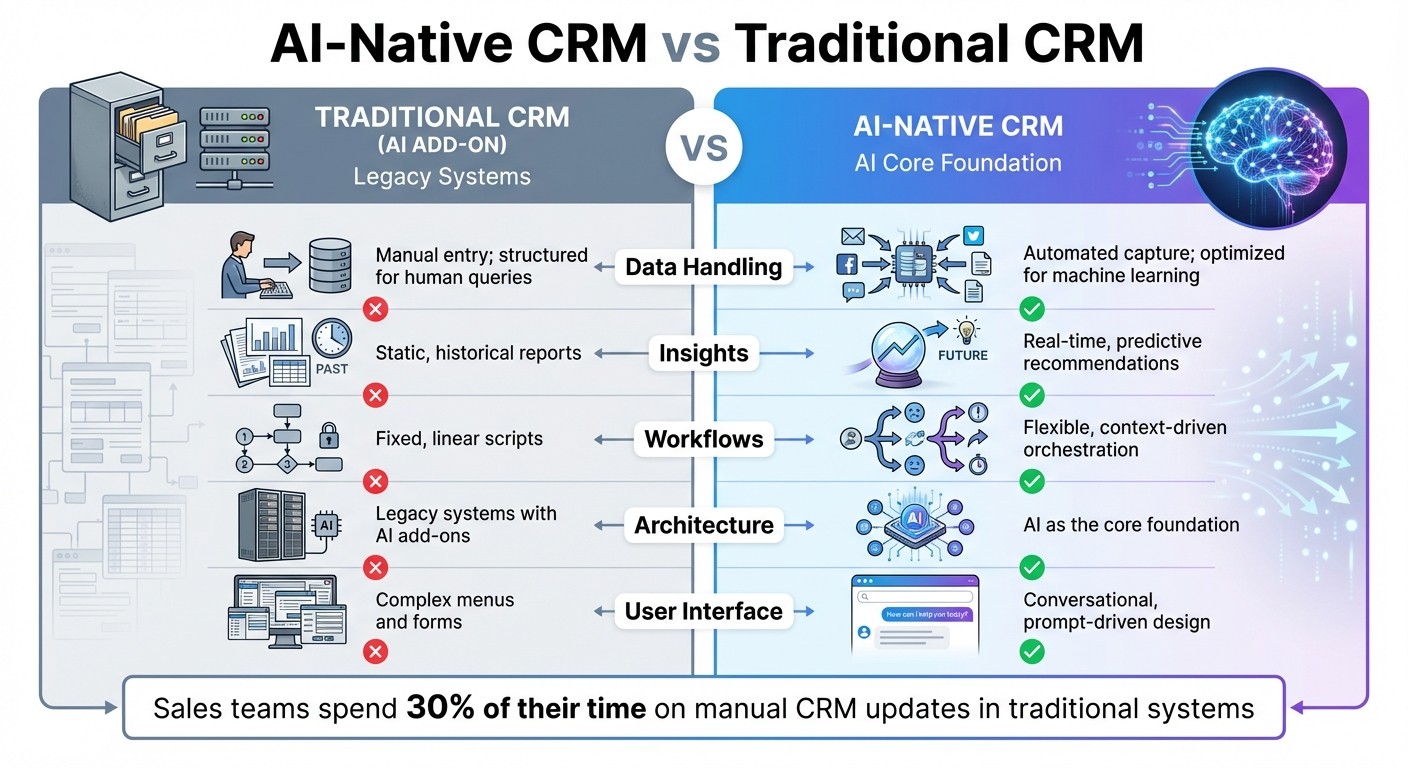
AI-Native CRM vs Traditional CRM: Key Differences Comparison
An AI-native CRM is a customer relationship management system built with artificial intelligence as its foundation, rather than incorporating AI as an afterthought. While traditional CRMs often bolt AI features onto existing frameworks, AI-native platforms are designed from the ground up to integrate tools like machine learning (ML), natural language processing (NLP), and predictive analytics throughout their entire architecture [2][9]. This difference in design means these systems are fundamentally more advanced in how they handle data and decision-making.
The key distinction lies in automation and intelligence. Traditional CRMs often require manual data entry, but AI-native systems automatically capture interactions and provide real-time, actionable recommendations [4][8]. For instance, about 65% of companies using AI-powered CRMs report saving an average of 8 hours per week [9][5]. These platforms also employ self-learning mechanisms, improving their insights with every interaction, and feature prompt-driven interfaces. For example, users can type plain-language commands like "schedule follow-ups with unresponsive leads", and the CRM will execute the task [10][9][5]. These capabilities highlight what sets AI-native CRMs apart.
Key Characteristics of AI-Native CRM
AI-native CRMs bring a transformative approach to customer management, starting with how they structure and process data. Unlike traditional systems, which often organize data for manual queries, these platforms are designed to feed machine learning models. This setup allows them to identify patterns and make automated decisions [6]. Additionally, they eliminate data silos - a common issue in older systems where critical context is trapped in isolated tools like email threads or call logs [7].
These platforms automatically collect 100% of first-party data, ensuring every customer interaction is captured without requiring manual input [7]. Beyond merely logging calls or emails, the integrated AI can analyze conversations for sentiment, intent, and potential risks using natural language processing. This level of interpretation transforms the CRM from a passive data repository into an active system that guides users with actionable insights.
Another defining feature is context-aware automation. Instead of relying on rigid, pre-set workflows, AI-native CRMs adapt dynamically based on the situation. According to Everest Group, these systems are distinguished by their ability to shape data storage, learn from behavioral patterns, orchestrate workflows, and guide user actions through AI-driven insights [8]. As a result, the platform continuously evolves, refining its recommendations to better align with your business needs.
AI-Native CRM vs Traditional CRM
The gap between AI-native and traditional CRMs goes far beyond surface-level differences. Traditional systems often depend on manual data entry, with sales teams spending nearly 30% of their time updating CRM fields instead of focusing on sales [6]. In contrast, AI-native platforms automate this process, seamlessly capturing and enriching data from emails, calls, and social media in real time [11][12].
Feature | Traditional CRM (AI Add-on) | AI-Native CRM |
|---|---|---|
Data Handling | ||
Insights | ||
Workflows | ||
Architecture | ||
User Interface | Complex menus and forms [5] |
Perhaps the biggest difference is how these systems approach customer data. Traditional CRMs are reactive, focusing on recording past events. AI-native platforms, on the other hand, are predictive, using advanced algorithms to forecast behaviors like churn risk or purchase intent and suggesting proactive steps [11][13]. This evolution shifts CRMs from being passive tools to becoming active, strategic partners in managing customer relationships.
Core Features of AI-Native CRM
AI-native CRMs bring three standout capabilities that reshape how sales and operations teams function: predictive analytics that anticipate issues before they arise, automated workflows that cut down on repetitive tasks, and personalized interactions tailored to each customer’s situation. These features work seamlessly within the system’s architecture.
Predictive Analytics for Better Decisions
Predictive analytics turns your CRM into more than just a tool for tracking past activities - it becomes a proactive advisor. Instead of manually sifting through reports, the system automatically scores leads by analyzing engagement signals like email opens, website activity, and how far prospects scroll through key pages like pricing [17][18]. This helps sales teams prioritize the leads that are most likely to convert.
It also identifies churn risks early. By spotting patterns such as reduced login activity or negative sentiment in support tickets, AI-native CRMs flag accounts that need immediate attention [16][18]. For forecasting, these platforms use historical data, deal momentum, and engagement trends to deliver precise revenue predictions while highlighting deals that might be in jeopardy [18].
But it doesn’t stop at predictions. These systems recommend next-best actions based on strategies that have worked in similar situations. Instead of vague to-do lists, sales reps get actionable advice, like making a follow-up call or offering a targeted discount [16].
"AI won't replace sellers. It will free them to sell" [3]
As Jason Eubanks, CEO of Aurasell, explains, the goal is to shift sales teams away from guesswork and onto data-backed strategies that produce results. This approach lays the groundwork for highly automated and effective workflows.
Automated Workflows and Data Entry
Building on predictive insights, automated workflows save sales reps up to 30% of their time by eliminating tedious data entry [6]. AI-native CRMs handle tasks like logging emails, recording calls, and syncing calendar invites automatically [5][14]. They also keep your database up-to-date by running self-updating routines that refresh contact details, job titles, and company information in real time [14][17].
These workflows are dynamic, adjusting to customer behavior as it happens. For example, if a prospect visits your pricing page, the CRM can immediately trigger a tailored outreach sequence or route the lead to the right team member - cutting response times from hours to minutes [14][19][5]. Deal stages also update automatically based on interactions, eliminating the need for manual input [5][14].
A real-world example: In December 2025, Ruby Capital Group, a 125-person funding company, adopted K3X’s AI-driven tools under CEO Michael Chkechkov. The automation managed tasks like lead qualification and contract routing, slashing follow-up times by 70% and tripling ticket resolution speed [5].
"Our sales team was spending half their day on admin work. Now they're talking to customers and closing deals. The automation handles everything from lead qualification to contract routing" [5]
Personalized Customer Interactions
AI-native CRMs go beyond automation and predictions by personalizing every customer interaction. Using natural language processing (NLP), these platforms analyze tone, urgency, and intent to craft prioritized, effective responses [18]. This allows businesses to deliver tailored experiences at scale without the need for manual customization.
The system also maintains universal context across all touchpoints - whether it’s a call, email, or meeting note. This creates a cohesive narrative rather than isolated snippets of information [15][8]. When a customer contacts your team, the CRM instantly displays the entire relationship history, along with AI-generated insights about that account’s priorities. This level of context makes chatbots and automated responses feel genuinely helpful rather than robotic, boosting customer satisfaction while lightening the workload for your teams. It’s all about creating meaningful, outcome-focused interactions that drive success.
Benefits of AI-Native CRM for Sales and Operations
By combining predictive analytics with automated workflows, AI-native CRM systems provide deeper customer insights, improve sales performance, and streamline operations for scalability.
Better Customer Understanding
AI-native CRMs break down data silos between marketing, sales, and service teams, creating a unified view of each customer [12][4]. Instead of scattered data, these platforms consolidate interactions - like emails, calls, website visits, and support tickets - into a single system that connects the dots automatically. With natural language processing, they can even detect customer sentiment and intent, alerting teams to shifts in mood or behavior [22].
This level of insight directly impacts revenue. Companies using AI-powered customer intelligence have reported revenue growth of 10% to 20% through highly personalized campaigns [22]. For instance, Bank of America's AI assistant, Erica, has handled over 2 billion customer interactions since 2018, delivering answers to 98% of users in under 44 seconds [22]. Similarly, T-Mobile leveraged Salesforce Einstein to analyze behavioral patterns, boosting lead conversion rates by 30% and improving overall sales productivity by 15% [22].
The demand for personalization is clear - 76% of consumers express frustration when their experiences lack customization [22]. AI-native systems address this by analyzing browsing habits, purchase histories, and support interactions to uncover patterns that would be nearly impossible to identify manually [21][22].
Higher Sales Performance
AI-native CRMs help sales teams focus on the 25% to 27% of leads that are most likely to convert [22]. These platforms use real-time scoring based on engagement signals like email opens, pricing page visits, and demo requests, eliminating guesswork and speeding up sales cycles.
Across industries, companies are seeing tangible results. Scott Sutter, Head of Sales at Helium SEO, highlighted the impact:
"Not only is AI booking meetings, but it's also filtering out the noise, letting our team focus on real opportunities" [21].
These improvements in sales performance naturally enhance operational efficiency as well.
Efficiency and Scalability
AI-native CRMs reduce the administrative burden that often consumes up to 60% of a team’s time [22]. By automating tasks like data entry, lead assignments, and pipeline updates, these platforms save an average of 8 hours per employee each week [5]. For example, FairPrice Group, a retailer in Singapore with over 570 touchpoints, achieved an 80% case deflection rate and reduced the cost per support ticket by 10% after integrating AI into their service operations [23].
The unified design of AI-native systems also supports seamless scaling. Unlike traditional CRMs, which require complex integrations and custom workflows as businesses grow, AI-native platforms update effortlessly across all modules [12][8]. Early adopters have cut operational costs by as much as $12.4 million and reduced support expenses by 20% to 30% through features like intelligent routing and automated case resolution [5][20].
"AI-native CRM is not defined by whether a platform has AI features, but by whether AI is shaping how the system stores data, learns from patterns, orchestrates workflows, and guides human action." - Everest Group [8]
K3X: A Leading AI-Native CRM
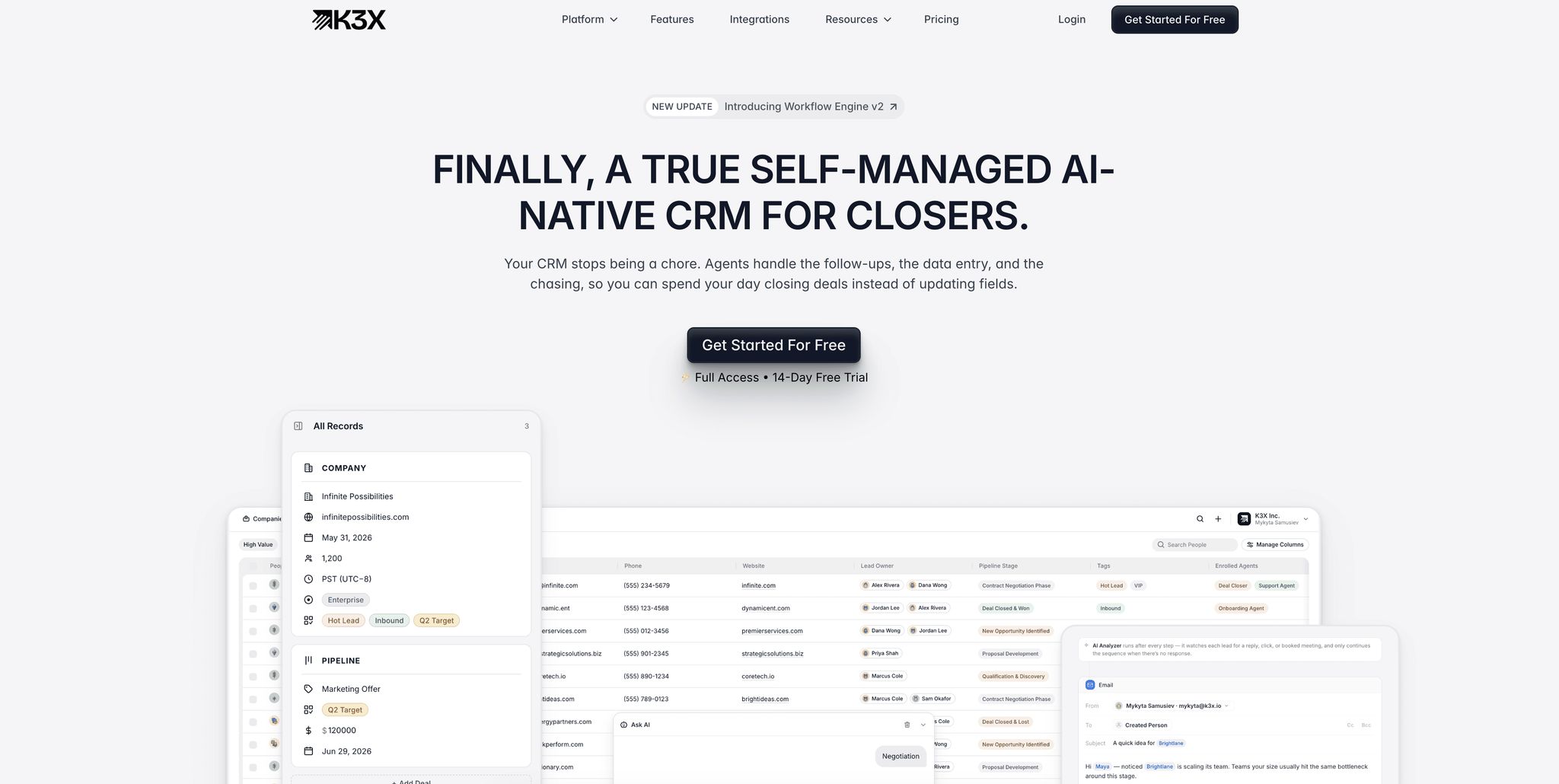
K3X takes the concept of AI-native CRMs to the next level with its intuitive, prompt-driven design. Instead of relying on outdated menus or tedious manual updates, users simply describe their goals - like "Book demo calls with every lead who hasn't responded" - and the system handles the rest. It determines the necessary steps, adjusts to unexpected replies, and keeps working toward the desired outcome [5].
This approach isn't just convenient; it's a game-changer. By automating over 312,000 hours of work, K3X has cut operational costs by an estimated $12.4 million. On a more personal level, it saves employees about 8 hours every week by handling tasks like data entry, email and call logging, and real-time pipeline updates automatically [5].
K3X's Prompt-Driven Interface and Features
K3X eliminates the need for complicated automation tools or third-party services like Zapier. It seamlessly manages follow-ups, lead assignments, and pipeline updates. Even if a lead responds in an unexpected way or asks an out-of-scope question, the platform adapts on the fly, keeping workflows intact [5].
Take the example of Ruby Capital Group, a funding company with 125 employees. In December 2025, under the leadership of CEO Michael Chkechkov, the company adopted K3X to streamline its sales operations. Automating everything from lead qualification to contract handling, they reduced the time spent on follow-ups by 70% and tripled their ticket resolution speed - all within just two days of setting up the automation. This case highlights how AI-powered systems can deliver real-world efficiency boosts [5].
"Our sales team was spending half their day on admin work. Now they're talking to customers and closing deals. The automation handles everything from lead qualification to contract routing."
Michael Chkechkov, CEO, Ruby Capital Group [5]
K3X also comes packed with tools like integrated email, SMS, and calling capabilities, a one-click dialer, unlimited call recordings, and real-time dashboards. Setup is quick - most teams are up and running in under an hour by connecting their existing tools and defining their goals through prompts [5].
This streamlined design sets K3X apart from traditional CRM systems.
K3X vs Legacy CRM Systems
Legacy CRMs often rely on manual updates and rigid workflows that can easily break when leads behave unpredictably. K3X flips the script by focusing on outcomes rather than steps, dynamically adapting to changes as they happen.
Feature | K3X (AI-Native) | Legacy CRM Systems |
|---|---|---|
Interface | Prompt-driven (natural language) | Menu and form-driven |
Logic | Goal-oriented (pursues outcomes) | Linear (follows fixed scripts) |
Data Entry | Fully automated (logs calls/emails) | Manual (requires constant updates) |
Setup Time | Under 1 hour | Weeks or months |
Adaptability | Handles unexpected replies/changes | Flows break if steps are skipped |
Pricing | Adaptive/Usage-based ($50/month flat) | Often rigid with long-term contracts |
As K3X Co-Founder and CEO Mykyta Samusiev puts it:
"Most CRMs record activity. K3X understands outcomes. It listens, knows what changed, and makes the next moves." [5]
Pricing and Scalability
K3X’s pricing model is as flexible as its design. Starting at $50 per month flat, the plan includes 2,000 AI • Twilio Credits, unlimited system integrations, unlimited contacts and leads, plus built-in tools for email, calling, and SMS - all without locking users into long-term contracts.
The platform’s usage-based pricing adjusts automatically based on workload. During busy months, additional AI • Twilio Credits are utilized, and costs increase accordingly. During slower periods, pricing reverts to the $50 base rate. This ensures businesses only pay for what they need, avoiding expensive tier upgrades or renegotiations as lead volumes fluctuate [5].
How to Adopt AI-Native CRM for Outcome-Based Operations
AI-native CRMs bring predictive analytics and automated workflows to the forefront, transforming how businesses operate. Transitioning to one of these systems requires careful planning and a focus on the right features. With a solid platform, most businesses can be up and running in less than an hour.
Choosing the Right AI-Native CRM
When evaluating options, consider whether the AI is built into the system or simply added on as an afterthought. Legacy systems with retrofitted AI often lack the scalability and autonomy modern teams need [3]. Look for platforms designed as "decision engines" that actively work with your data instead of just storing it.
Prioritize outcome-based logic. Unlike traditional CRMs that require detailed step-by-step workflows - like "Send email, wait three days, send follow-up" - AI-native systems such as K3X let you define a goal (e.g., "Book demo calls with unresponsive leads") and handle the execution automatically [5].
Prompt-driven interfaces are another key feature. These eliminate the need for complex setup processes, allowing your team to use plain language to set rules. This approach significantly reduces onboarding time and makes the system accessible to everyone [5].
Review the platform's time-to-action metrics. The best AI-native CRMs minimize delays between a trigger - like a leadership change at a prospect company - and your team’s response. For instance, Analytic Partners reduced account research time from 3 hours to just 15 minutes, leading to a 40% year-over-year increase in their qualified pipeline [24].
Ensure the CRM offers seamless integrations with your existing tools. The platform should connect easily to your email, phone, and other software for smooth data flow. K3X, for example, supports unlimited integrations and automatically logs calls and emails, saving time on manual data entry [5].
Lastly, opt for usage-based pricing models to avoid long-term financial commitments. Platforms like K3X charge $50 per month flat with 2,000 AI • Twilio Credits, while others, such as Clarify, offer free CRM access and only charge for successful AI-assisted tasks [3].
Once you've chosen your platform, it’s time to prepare for a smooth transition from your legacy system.
Migrating from Traditional CRM to AI-Native CRM
Switching to an AI-native CRM is best done in phases to minimize disruption. Many companies follow a 90-day migration plan: Days 1–30 for setup and AI training, Days 31–60 for advanced automation, and Days 61–90 for scaling predictive analytics [25].
Start by focusing on data integrity. Use automated connectors to clean, deduplicate, and enrich your legacy data, turning it into structured, machine-learning-ready information [1]. If your organization has extensive historical data, consider a hybrid approach: maintain your old CRM for record-keeping while using the AI-native system for engagement and intelligence [6].
Integrate your existing tools - like email and phone systems - into the new platform. Most AI-native CRMs, including K3X, complete this step in minutes without requiring heavy IT involvement, enabling teams to start operating quickly [5].
Set clear goals using natural language prompts instead of rebuilding rigid workflows. For example, you can instruct the system to automatically move deals to the next stage when a contract is signed, and it will handle the details [5].
Invest in AI fluency training for your team. Successful adoption depends on reps learning to collaborate with AI beyond basic data entry. Companies that prioritize upskilling see higher adoption rates, with AI-native platforms reporting over 90% daily active usage compared to 65% for traditional CRMs [25].
Begin with high-impact pilot projects to build confidence and demonstrate ROI. For example, test predictive lead scoring or automated follow-ups before scaling the system company-wide. Aim for measurable results within 90 days, such as improved conversion rates or reduced research time per account [24].
Transitioning to an AI-native CRM shifts your team from manual processes to intelligent automation. With the right platform and a structured migration plan, your team can spend more time selling and less time on data entry - exactly what these systems are designed to achieve.
Conclusion: The Future of AI-Native CRM
AI-native CRM is changing the game for how businesses approach customer relationship management. AI-native CRMs are replacing traditional systems that predict, automate, and guide sales teams to make smarter decisions. that predict, automate, and guide sales teams to make smarter decisions. This shift allows sales professionals to focus more on strategy and closing deals, rather than getting bogged down in manual tasks.
The numbers speak for themselves. Companies using AI-driven platforms save an average of 8 hours per week per employee while significantly reducing operational costs. For example, K3X has already automated over 312,000 hours for its first 50+ customers[5]. Sephora’s AI-powered CRM strategy led to explosive growth in e-commerce sales, jumping from $580 million in 2016 to $3 billion by 2022 - a fourfold increase in just six years[22]. These examples highlight the growing momentum behind intelligent automation and the shift toward outcome-focused sales processes.
"Most CRMs record activity. K3X understands outcomes. It listens, knows what changed, and makes the next moves."
Mykyta Samusiev, Co-Founder & CEO, K3X[5]
The future of CRM lies in systems that eliminate repetitive tasks, adapt instantly to customer behavior, and deliver personalized experiences at scale. With 76% of consumers expressing frustration over the lack of personalization[22], businesses that adopt AI-native CRMs gain a clear edge. Faster response times, richer customer insights, and improved conversion rates are just the beginning.
K3X is leading this transformation with its intuitive, prompt-based approach. Unlike traditional CRMs bogged down with complex workflows, K3X focuses on understanding your goals and determining the steps to achieve them. At just $50 per month flat - including 2,000 AI • Twilio Credits - it offers advanced AI capabilities without requiring long-term commitments. This evolution makes AI-native CRMs more accessible, turning customer management from a burdensome task into a strategic advantage.
As AI continues to advance, the gap between businesses clinging to outdated systems and those embracing AI-native platforms will only grow. Choosing a solution like K3X today could position your company for stronger growth and a lasting competitive edge in the years to come.
FAQs
How is an AI-native CRM different from “AI add-ons” in older CRMs?
AI-native CRMs are designed with artificial intelligence at their core, unlike older CRMs that depend on third-party AI add-ons. These add-ons can lead to disjointed workflows and incomplete integration. On the other hand, AI-native CRMs incorporate AI directly into their framework, allowing them to automate tasks, gather data effortlessly, and deliver real-time insights without any hiccups. This built-in approach reduces manual work and ensures operations run far more smoothly compared to traditional systems that rely on patched-on AI features.
What data does an AI-native CRM need to make accurate predictions?
An AI-driven CRM thrives on a mix of diverse, real-time data to deliver accurate predictions. This data spans several areas, including interaction details like emails, calls, and meetings, as well as customer profiles, purchase histories, and the content of communications. By digging into patterns within both structured and unstructured data, AI algorithms can predict customer needs, pinpoint potential leads, and recommend the next best actions to take. To ensure these insights are precise and actionable, the data must be high-quality and continuously updated, aligning closely with customer behavior.
What’s the easiest way to migrate from a traditional CRM to K3X?
Migrating to K3X is straightforward thanks to its AI-native architecture, which minimizes manual data entry and streamlines the setup process. With K3X, tasks like updating leads, pipelines, and follow-ups are handled automatically, removing the hassle of complicated migration steps. To get started, you can request an invitation or demo. This offers a personalized onboarding experience tailored to your current systems, ensuring the transition is as seamless as possible.